Industrial Communication Protocols: Comparison, Selection & Troubleshooting
Industrial automation protocols move control states, measurements, diagnostics and production information between sensors, instruments, drives, remote I/O, PLCs, HMIs and supervisory systems. This guide separates those roles, compares the major protocol families and turns selection into an evidence-based engineering decision.
Reviewed and updated August 30, 2026
An industrial automation protocol is a defined set of message, timing, addressing and data rules that lets automation devices exchange information. There is no single best protocol for an entire plant. A machine can use IO-Link for sensors, PROFINET or EtherNet/IP for cyclic I/O, a motion-focused network for synchronized drives, and OPC UA or MQTT Sparkplug for supervisory information at the same time.
The practical selection question is therefore not “Which protocol is fastest?” It is: which communication role must be proven, which exact devices implement it, what failure behavior is acceptable, and what evidence will demonstrate that it works? Start with those requirements, then choose a protocol, products and topology that can satisfy them.
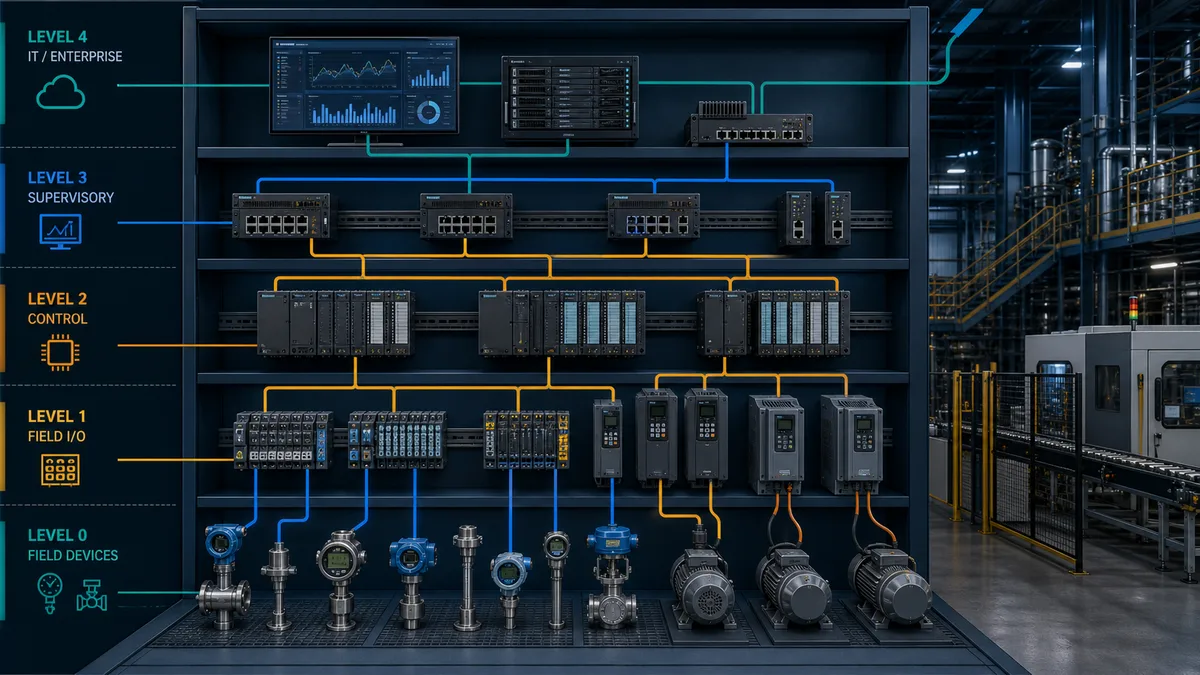
Industrial automation protocols at a glance
Use this short answer as the orientation map:
| Communication need | Common protocol families | The evidence that matters |
|---|---|---|
| Simple multi-vendor registers or coils | Modbus RTU, Modbus TCP | register contract, byte order, unit identifier, exception and timeout behavior |
| Cyclic controller-to-I/O, drive or robot data | PROFINET, EtherNet/IP, EtherCAT, CC-Link IE | device support, update interval, jitter, connection capacity, diagnostics and recovery |
| Smart sensor or actuator connection | IO-Link, AS-Interface | exact master port class, IODD/device description, process-data map, status and replacement behavior |
| Process instrument data and diagnostics | HART, FOUNDATION Fieldbus, PROFIBUS PA | power and physical-layer design, host/device support, device description, scheduling and hazardous-area requirements |
| PLC, SCADA, MES or enterprise information | OPC UA | endpoint and certificate policy, namespace, NodeIds, data types, quality, timestamps and subscription behavior |
| Edge-to-broker publish/subscribe information | MQTT with Sparkplug where applicable | topic namespace, payload contract, session state, birth/death behavior, broker availability and access control |
| Legacy machine or plant support | PROFIBUS, DeviceNet, ControlNet, CANopen and proprietary networks | installed-base inventory, spares, captures, configuration archives and a staged migration plan |
These rows describe roles, not automatic product compatibility. A controller that lists “Ethernet” may not implement the required industrial application protocol. A device that implements a named protocol may still require a particular profile, option module, firmware, device-description file or engineering-tool version. Verify the exact catalog number and revision at both endpoints.
Direct answers to the most common protocol questions
| Question | Short engineering answer |
|---|---|
| What is the best industrial communication protocol? | There is no universal best. Choose the smallest proven stack that meets the exact device, timing, failure, diagnostic, safety, security and lifecycle requirements. |
| Which protocol is easiest for simple register exchange? | Modbus RTU or TCP is often a practical candidate when both endpoints publish an exact register contract and polling plus failure behavior meet the requirement. |
| Which protocols are used for cyclic PLC I/O? | PROFINET, EtherNet/IP, EtherCAT and CC-Link IE are common families, but the correct choice depends on controller ecosystem, profiles, timing, topology and supported devices. |
| Which protocol should connect a smart sensor? | IO-Link is a point-to-point device technology through a master; AS-Interface can aggregate field-level sensors and actuators; neither is automatically a replacement for every controller network. |
| Which protocol should connect PLC data to SCADA or MES? | OPC UA is a strong candidate for structured information with types, quality and timestamps. MQTT with Sparkplug can suit brokered state distribution. Neither should automatically replace the cyclic control path. |
| Does Ethernet mean two products will communicate? | No. Ethernet describes lower communication layers. Both products must implement compatible application protocols, roles, profiles, data layouts and security settings. |
| Is the fastest protocol always best? | No. Measured application timing, recovery, diagnostics, maintainability and device fit matter more than a headline link speed. |
| Can one plant use several protocols? | Yes. Layered plants routinely use different technologies for instruments, sensors, cyclic control, motion and supervisory information. The boundaries must be documented and tested. |
First separate the communication layers
“Industrial Ethernet,” “fieldbus,” “OPC UA” and “RS-485” are often compared as though they were equivalent. They are not. Separate at least four boundaries before making a shortlist.
| Boundary | What it defines | Examples | Common category error |
|---|---|---|---|
| Physical medium | electrical or optical signaling and installation | copper Ethernet, fiber, RS-485, two-wire instrument bus | treating RS-485 as a complete application protocol |
| Link and network behavior | framing, access, forwarding, addressing and topology | Ethernet, IP, switched topology, scheduled fieldbus access | assuming an Ethernet link proves application compatibility |
| Application protocol | commands, objects, services or process-data exchange | Modbus, CIP, PROFINET application relations, EtherCAT process data, OPC UA services | assuming two application protocols interoperate because both use Ethernet |
| Information contract | names, types, units, quality, timestamps and ownership | register map, I/O assembly, module slot map, OPC UA information model, Sparkplug metrics | moving bytes successfully while interpreting the wrong engineering value |
The distinction explains many commissioning failures. Link LEDs can be green while the PLC uses the wrong assembly instance. A Modbus TCP request can receive a valid response while the engineer applies the wrong zero-based offset or word order. An OPC UA client can trust a server certificate and browse nodes while the application subscribes to the wrong namespace. Diagnose the highest proven boundary, not the most visible symptom.
Control traffic and information traffic have different jobs
Cyclic control traffic exists to refresh commands, status and I/O predictably. Information traffic exists to expose context, history, events or state to supervisory consumers. Some technologies can participate in more than one role, but that does not erase the engineering difference.
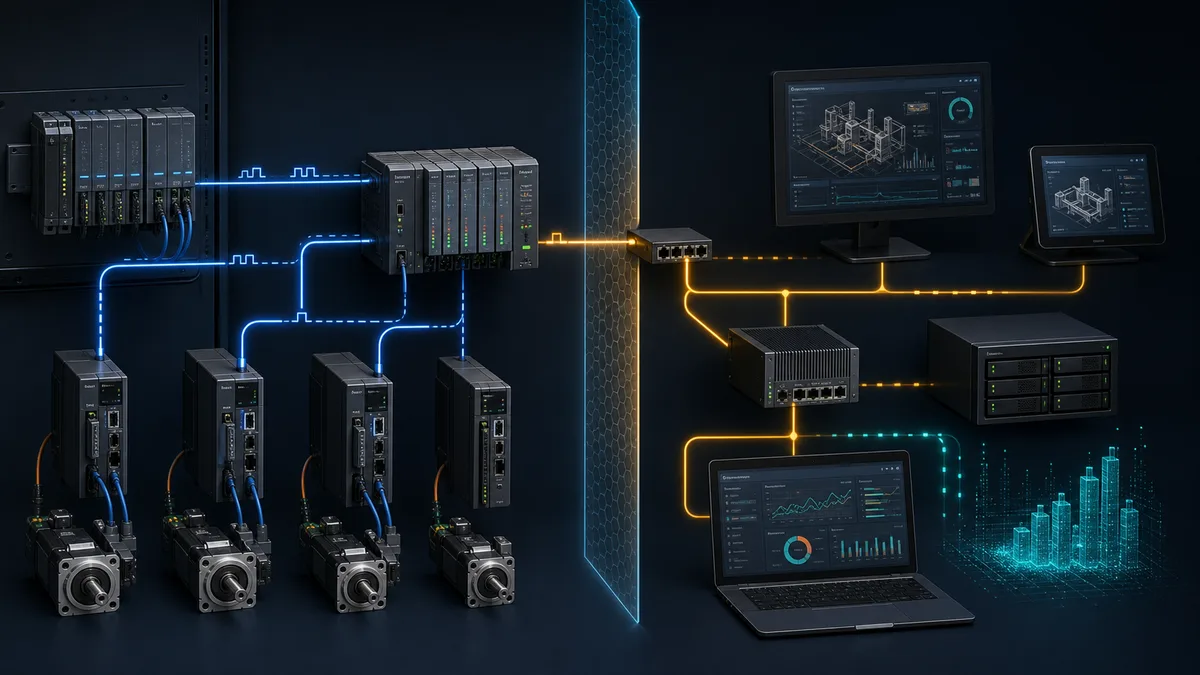
For a motor-drive link, ask how frequently commands and feedback update, what happens when the connection is lost, and how the drive enters a defined state. For a historian feed, ask whether values carry source timestamps and quality, how subscriptions recover, and whether missed samples are detectable. “Low latency” alone answers neither case.
Wire speed is also not control-loop performance. A 100 Mbit/s label does not state the requested packet interval, device processing time, task scheduling, switch behavior, network load, jitter or recovery time. Define the application-level acceptance metric and measure it on the representative topology.
How the major industrial protocol families differ
| Family | Typical role | Communication model | Engineering proof that distinguishes it |
|---|---|---|---|
| Modbus RTU/TCP | simple device and controller data exchange | client request and server response around coils and registers | exact register contract, transport settings, polling capacity and exception behavior |
| PROFINET | controller, remote I/O, drive and machine-device exchange | configured controller/device relationships with cyclic and acyclic services | GSDML/profile support, update behavior, diagnostics, topology and recovery |
| EtherNet/IP | controller, I/O, drive, robot and peer exchange | CIP objects, explicit services and connected I/O data | assemblies, originator/target ownership, RPI, connection limits and timeout state |
| EtherCAT | synchronized machine I/O and motion-oriented exchange | MainDevice frame processed through ordered SubDevices | topology, process-data mapping, cycle, Distributed Clocks use and state recovery |
| IO-Link | smart sensor and actuator point connection | master port to one device with cyclic data and on-request information | port class/mode, IODD, process-data layout, value status and replacement policy |
| HART / FOUNDATION Fieldbus | process instruments, diagnostics and field control roles | instrument command/response or scheduled digital fieldbus services | physical-layer design, host/device roles, descriptions, schedule and hazardous-area method |
| OPC UA | structured supervisory and system information | client-server services or PubSub with information models | endpoint trust, namespace, NodeIds, type/unit/quality/timestamp and reconnect behavior |
| MQTT Sparkplug | brokered IIoT and supervisory state distribution | publish/subscribe with industrial namespace, payload and session conventions | topic ownership, birth/death, broker/access design, buffering and consumer recovery |
Modbus RTU and Modbus TCP
Modbus defines an application data model and function-based request/response behavior. The same conceptual coils and registers can be carried over serial lines or TCP/IP, but the transport wrapper and diagnostics differ. Its strength is broad implementation and a small conceptual surface. Its weakness is that the engineering contract—register meaning, scaling, word order and write authority—often lives outside the protocol.
The Modbus Organization specifications are the primary reference. The organization distinguishes the application specification, serial implementation guide, TCP messaging guide and Modbus Security specification. Do not infer that every installed Modbus TCP product supports the TLS-based Modbus Security variant; verify the exact product and deployment.
Use Modbus when both endpoints expose a documented map and the required update and failure behavior can be proven. Do not choose it merely because a gateway advertises “universal” support. The Modbus protocol guide and Modbus RTU tutorial cover frame and mapping details.
PROFINET
PROFINET combines industrial Ethernet communication with device descriptions, controller/device relationships, diagnostics and application profiles. It supports ordinary TCP/IP communication alongside real-time traffic, while RT and IRT capabilities address different timing needs. The official PROFINET system description is the correct starting point for roles, conformance classes, GSDML, diagnostics, synchronization and redundancy concepts.
Selection must be profile- and product-specific. “Supports PROFINET” does not alone prove a required drive telegram, PROFIsafe implementation, redundancy mode, shared-device behavior or IRT capability. Validate the controller, device, switch, engineering tool and device-description versions as one system. Use the PROFINET PLC guide for a commissioning path.
EtherNet/IP
EtherNet/IP uses standard Ethernet and Internet Protocol technologies with the Common Industrial Protocol. CIP provides objects and services used for explicit communication and I/O connections, with additional technologies such as CIP Sync, CIP Motion, CIP Safety and CIP Security available where products support them. ODVA’s EtherNet/IP technology overview is the authoritative scope reference.
For a real connection, document originator and target roles, transport type, assembly instances, sizes, requested packet intervals, multicast or unicast choice, timeout behavior and ownership. Device Level Ring is a topology/recovery option, not a substitute for an application recovery requirement. CIP Security is likewise a product and deployment capability, not proof that every EtherNet/IP exchange is authenticated or encrypted. The EtherNet/IP PLC guide covers these boundaries.
EtherCAT
EtherCAT is optimized for high-performance machine communication. The MainDevice sends a frame through SubDevices, which read and insert addressed process data as the frame moves through the network. Distributed Clocks support precise synchronization, and line, tree and star arrangements can be built from compatible ports. The EtherCAT Technology Group functional description explains the processing principle, topology, Distributed Clocks, diagnostics, profiles and conformance.
Do not convert those architectural strengths into an unqualified promise for a machine. Performance depends on the exact MainDevice, SubDevices, cycle configuration, topology, clock use, task behavior and application. Validate the selected device profiles and error-recovery behavior on the representative machine. The EtherCAT PLC guide gives a focused proof plan.
IO-Link, HART and FOUNDATION Fieldbus
These technologies solve different field-device problems. IO-Link is a standardized point-to-point technology under IEC 61131-9 for sensors and actuators; the IO-Link organization explicitly notes that it is not a fieldbus. A PLC usually reaches devices through an IO-Link master, so the master’s port configuration, IODD, process-data map and device status are central evidence.
HART provides request/reply and optional burst communication for smart field instruments, commonly alongside a primary process signal. Validate host roles, device commands, multidrop implications, loop design and device descriptions. Do not assume the presence of a 4–20 mA value means its digital diagnostics are being collected.
FOUNDATION Fieldbus is a digital process-automation network with scheduled communication, function-block concepts and control-in-the-field capabilities. Its physical-layer power, segment design, termination, hazardous-area method, host support and schedule are system concerns. It should not be reduced to “another serial protocol.”
PROFIBUS, CANopen, DeviceNet, ControlNet and AS-Interface
These families remain relevant because installed equipment, device ecosystems and machine lifecycles outlast marketing cycles. A protocol is not obsolete merely because it is not Ethernet-based; it becomes a business risk when product support, spares, skills, diagnostics or capacity can no longer meet the asset requirement.
PROFIBUS DP is widely encountered on factory devices and remote I/O, while PROFIBUS PA addresses process instruments with a different physical-layer context. Treat DP and PA segment design, device descriptions, addresses, bus timing, termination and diagnostic repeaters as concrete engineering subjects. Do not describe an entire installed PROFIBUS system by baud rate alone. The controller interface, couplers or links, segment loading, spur rules and device GSD versions form part of the accepted system.
CANopen builds standardized application and communication behavior above CAN. The official CANopen reference from CAN in Automation identifies the object dictionary plus SDO, PDO, NMT, special-function and error-control protocols. For commissioning, record the node ID, bitrate, EDS or device description, required device profile, PDO mapping and transmission type, heartbeat or node-guarding method, SYNC use and NMT start behavior. A CAN link with valid frames is not proof that a mapped object has the required units, size or ownership.
DeviceNet and ControlNet use CIP within older ODVA network families. DeviceNet is commonly found at device level over CAN-related media; ControlNet was designed for scheduled and unscheduled control communication on its own physical network. Existing systems require the same discipline as newer Ethernet networks: preserve the scanner configuration, electronic keying and data map, document taps and termination, retain compatible tools and spares, and capture a healthy diagnostic baseline before intervention. Do not assume an EtherNet/IP replacement is a wiring-only conversion merely because all three use CIP concepts.
AS-Interface (AS-i) is a field-level system for sensors and actuators, not a general-purpose replacement for every fieldbus. The AS-International technology reference describes its two-conductor data-and-energy approach and flexible line, star or tree topology. Selection evidence includes the master and gateway role, AS-i generation, addressing, power budget, segment arrangement, certified device compatibility, input/output map, diagnostics and the exact rules for any safety components. Its installation convenience does not remove the need to validate power, piercing connections, duplicate addresses and application behavior.
| Legacy or field-level family | Preserve before making changes | Typical first diagnostic split |
|---|---|---|
| PROFIBUS DP/PA | GSD files, master configuration, addresses, segment drawing, coupler settings, baud rate and healthy diagnostics | physical segment and termination versus missing or wrong device configuration |
| CANopen | EDS, object dictionary references, node IDs, bitrate, PDO mapping, heartbeat/NMT behavior and device profile | CAN error state versus network management versus wrong object mapping |
| DeviceNet | scanner list, EDS, node addresses, bitrate, power and trunk/drop record, produced/consumed sizes | network power/media versus scanner connection versus data size or keying |
| ControlNet | schedule, keeper and node records, taps, terminators, media path and tool versions | physical/media status versus scheduled connection or configuration |
| AS-Interface | master/gateway archive, addresses, AS-i version, power budget, segment map and device certificates | power/physical connection versus duplicate/missing address versus I/O map |
CC-Link IE, TSN and converged industrial Ethernet
CC-Link includes fieldbus and industrial Ethernet generations with different capabilities. The CC-Link Partner Association network overview separates classic CC-Link, CC-Link IE Controller, Field, Field Basic and CC-Link IE TSN. Verify the exact family at each endpoint; “CC-Link compatible” is too broad to prove a connection.
Time-Sensitive Networking, or TSN, is a group of IEEE 802.1 mechanisms for functions such as time synchronization and scheduled traffic. It is not by itself a complete automation application protocol or a guarantee of end-to-end control performance. For example, the official CC-Link IE TSN overview describes how its industrial protocol uses TSN mechanisms within a defined architecture. A real design still needs compatible products, profiles, switches and configuration plus measured application timing under load.
OPC UA PubSub is similarly a communication model, not shorthand for one fixed transport or performance class. The OPC UA architecture reference distinguishes brokered and broker-less middleware forms. If PubSub participates in a field or converged architecture, record the transport mapping, publisher and subscriber configuration, dataset metadata, security keys or trust mechanism, time synchronization, network quality-of-service configuration, failover and measured delivery behavior. Avoid treating “OPC UA over TSN” as a product-independent promise.
Safety protocols are validated overlays, not ordinary status bits
PROFIsafe, CIP Safety, FSoE, CC-Link Safety and AS-Interface Safety at Work carry safety-related communication within defined ecosystems. Their existence does not turn arbitrary standard PLC code, standard I/O or network diagnostics into a safety function. A safety communication design requires compatible certified components, the prescribed engineering tools and parameters, unique identities and signatures where applicable, verified timeout and fault reactions, and validation of the complete safety function through sensors, logic, communications and final elements.
Keep standard control status separate from the safety claim. It is useful for a standard PLC or HMI to display safety-device status, but that display is not the safety decision. A gateway or protocol converter must not be assumed to preserve a safety integrity claim unless the complete architecture and intended use are explicitly supported and validated. The AS-Interface Safety at Work overview is one example of a defined safe communication system; use the applicable protocol specification, product safety manuals and machinery risk-reduction process for the actual project.
OPC UA and MQTT Sparkplug
OPC UA is a platform-independent architecture for exposing and accessing structured information. Its services include discovery, browsing, read/write, subscriptions, events and methods; its information model can attach relationships and meaning to values. The OPC Foundation overview describes its service-oriented architecture, information modeling and configurable security mechanisms.
An OPC UA acceptance test should verify endpoint identity, certificate trust, security policy, user authorization, namespace stability, NodeIds, data types, engineering units, quality, timestamps, sampling, publishing and reconnect behavior. Security capabilities must be configured and governed; their existence in the standard does not secure an installation automatically.
MQTT is a publish/subscribe messaging protocol. Eclipse Sparkplug defines an industrial topic namespace, payload and session-state conventions on top of MQTT. Sparkplug is useful when consumers need state-aware industrial data through a broker, but it does not replace a deterministic field-control network. Verify broker redundancy, TLS and identity, access-control lists, store-and-forward behavior, topic ownership, metric definitions and birth/death handling.
Protocol comparison by real project scenario
A useful comparison starts with a bounded job, not a list of protocol names. These examples are shortlisting patterns, not universal prescriptions.
| Project scenario | Credible shortlist | Questions that decide the choice | Acceptance evidence |
|---|---|---|---|
| Add a temperature transmitter to a process unit | 4–20 mA/HART, FOUNDATION Fieldbus, PROFIBUS PA, remote I/O with an appropriate instrument interface | hazardous-area method, existing host, loop or segment power, diagnostics, maintenance tools and installed skill | loop or segment calculation, device description, known-value test, status/diagnostics and replacement test |
| Add a photoelectric sensor with remote parameterization | IO-Link through a compatible master | port class, cable and power, IODD, process-data length, parameter ownership and replacement policy | identity, process value, value status, parameter read/write controls and swap procedure |
| Add mixed discrete devices across a conveyor | AS-Interface, remote I/O on the controller network | point density, distributed power, topology, safety scope, diagnostic granularity and installed gateways | segment power, address plan, I/O map, broken-device indication and recovery |
| Connect a PLC to remote I/O and drives | controller-native PROFINET, EtherNet/IP, EtherCAT or CC-Link IE family | exact CPU/device support, profiles, update and synchronization, connection limits, topology and support | conformance or product evidence, loaded timing trace, mapping, loss response and restart |
| Integrate a third-party meter with documented registers | Modbus RTU or TCP | register map quality, write needs, polling load, serial or Ethernet infrastructure and exception behavior | known-value and boundary tests, byte order, timeout, stale flag and reconnect |
| Coordinate tightly synchronized axes | motion-capable profile and products on EtherCAT, PROFINET IRT, CIP Motion or another approved platform | controller and drive ecosystem, supported motion profile, clocks, task scheduling and safety architecture | representative axes under load, synchronization error, fault stop and controlled recovery |
| Publish PLC context to SCADA or MES | OPC UA client-server, sometimes through a gateway | namespace ownership, types, units, quality, timestamps, certificates, subscriptions and server capacity | trust and authorization, browse/read/subscription, bad-quality case, restart and namespace stability |
| Send state-aware edge data through a broker | MQTT with Sparkplug where the ecosystem supports it | topic and metric governance, birth/death, buffering, broker resilience, TLS identity and consumer behavior | loss/reconnect, stale state, duplicate or out-of-order handling, access denial and store-forward test |
| Extend a brownfield network | retain, segment, bridge or staged migration | lifecycle risk, spares, downtime, hidden consumers, semantic conversion and rollback | healthy baseline, one-to-one data contract, gateway failure case, pilot and signed cutover record |
A four-gate protocol decision
- Compatibility gate: both endpoint catalog numbers, firmware revisions, roles and required profiles are explicitly supported. A logo or generic family name is not enough.
- Application gate: the stack can meet the written update, jitter, synchronization, data-quality, timeout, recovery and scale requirements on a representative topology.
- Operations gate: the plant can diagnose, back up, restore, replace, secure and patch the system with available tools, licences, spares and skills.
- Assurance gate: safety, hazardous-area, cybersecurity, regulatory and contractual claims are supported by the correct product evidence and independent validation process.
Only candidates that pass all mandatory gates should receive a weighted cost or preference score. This prevents a low purchase price or attractive headline speed from compensating for a missing device profile, untestable recovery path or unsupported safety function.
A protocol-selection scorecard that survives review
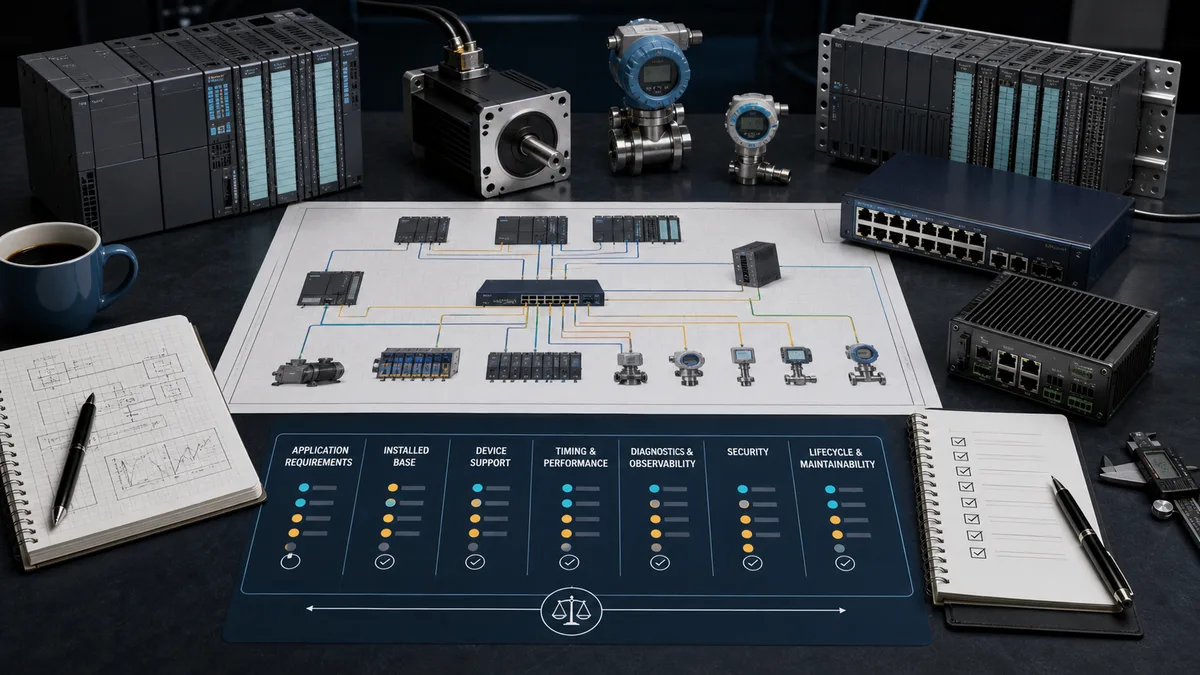
Apply mandatory gates before weighted scores
Build a weighted scorecard before asking vendors for a design. A useful version has these rows:
| Requirement | Question to answer | Evidence before purchase |
|---|---|---|
| Exact device support | Do both catalog numbers and revisions implement the required role and profile? | manuals, conformance listings where applicable, device-description files and a bench connection |
| Timing | What update, jitter, synchronization and timeout behavior does the application require? | measured trace tied to PLC tasks and device timestamps |
| Scale | How many connections, devices, bytes, subscriptions or messages are required with reserve? | product limits and a loaded representative test |
| Topology and media | What distances, connectors, redundancy and environmental ratings apply? | network drawing, media bill, installation rules and recovery test |
| Diagnostics | Can maintenance isolate cable, port, device, connection and data-contract faults? | alarm list, switch counters, device diagnostics and packet or protocol trace |
| Security | Which identities, trust, authorization, segmentation, logging and update processes are supported? | security manuals, asset-owner policy and an access/recovery test |
| Engineering lifecycle | Can the team archive, restore, replace and migrate the system? | licensed tools, version matrix, backups, spare-device replacement and restore drill |
| Local support | Are trained staff, spares and escalation paths available where the machine operates? | named responsibilities, response terms and stocked critical parts |
Use gates for non-negotiable requirements. A candidate that cannot meet a safety profile, environmental rating, hazardous-area method, recovery time or lifecycle obligation should not win by scoring well on price elsewhere.
Compare installed cost and operational support
Compare total installed cost after the gates: hardware, licenses, engineering, managed infrastructure, test tools, training, downtime exposure, spares and migration—not only interface price. Score the support model that will exist at the machine location, including who can diagnose the network on night shift, who owns certificates and switch configuration, how quickly a configured spare can arrive, and whether the engineering toolchain can still be licensed and restored through the planned equipment life. Record assumptions beside every score so reviewers can challenge evidence instead of debating unexplained numbers.
Commissioning: prove one data contract end to end
Build a representative end-to-end path
Before connecting a full line, create one representative path from source to consumer. Record the exact devices, firmware, configuration files and expected values. The following acceptance sequence works across protocol families:
- Prove physical installation. Inspect media, connectors, shielding, separation, grounding, power and termination against the applicable installation instructions.
- Prove identities and roles. Confirm addresses, names, certificates and controller/device, client/server, publisher/subscriber or master/device roles.
- Prove configuration agreement. Match description files, modules, assemblies, register maps, data types, lengths and update settings.
- Prove the information contract. Inject known minimum, normal, maximum and invalid values. Verify units, scaling, signedness, byte/word order, quality and timestamps at the consumer.
- Prove timing under load. Measure application update, jitter, loss and task interaction with representative traffic—not an empty-network ping.
- Prove failure and recovery. Disconnect media, remove device power, deny trust, stop a publisher or create a controlled mismatch. Verify timeout, alarm, safe application response and automatic or procedural recovery.
- Prove restoration. Replace a representative device or restore from the controlled archive using the procedure maintenance will actually receive.
The result should be a signed record, not “communication OK.” Capture versions, topology, test stimulus, timestamps, expected result, observed result, deviations and final configuration hashes or archive identifiers.
| Acceptance case | Controlled stimulus | Minimum recorded pass evidence |
|---|---|---|
| known-value mapping | inject minimum, normal, maximum, negative where valid and invalid/bad-quality cases | source and consumer values, types, units, byte order, quality and timestamp agree |
| cyclic timing under load | run representative devices, HMI, diagnostics and normal engineering traffic | measured update/jitter/loss against the written limit with PLC task context |
| connection loss | remove the approved test link or stop one endpoint | detected timeout, alarm, defined command/output behavior and recovery time |
| identity or configuration mismatch | introduce a safe duplicate, wrong name, wrong module or untrusted certificate in the test bench | unambiguous diagnostic at the responsible layer and no silent use of wrong data |
| restart and power return | restart endpoints and infrastructure in documented sequences | deterministic reconnect, data validity transition, command ownership and alarm clearing |
| device replacement | replace with the approved spare and restore through the maintenance procedure | identity, firmware, configuration, mapping, diagnostics and application test all pass |
Retain a reproducible acceptance record
Keep the test record with the released PLC, HMI, drive, gateway, server and managed-network archives. Include who ran each case, calibrated test equipment where relevant, exact timestamps, screenshots or traces, deviations, corrective action and the final approval. A later maintainer should be able to reconstruct the accepted path and compare a fault-state capture with the baseline without relying on the original commissioning engineer's memory.
Troubleshoot by the last proven boundary
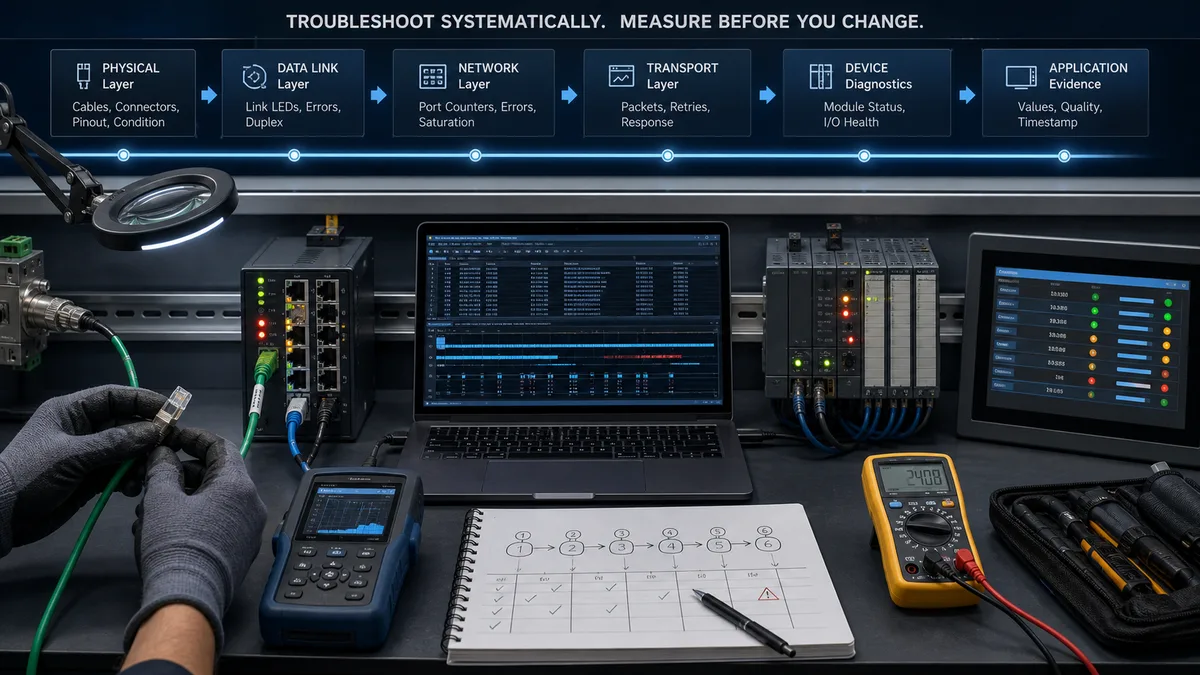
| Evidence layer | Ask this first | Examples of evidence |
|---|---|---|
| Scope and change | What failed, when, and what changed just before it? | operator timeline, maintenance log, switch configuration change, firmware or recipe event |
| Power and physical | Are both endpoints powered and is the installed medium healthy? | voltage under load, connector inspection, cable test, optical power, termination or segment diagnostics |
| Link and port | Is the link stable and are counters changing abnormally? | link transitions, CRC/FCS errors, discards, duplex/speed, topology and ring state |
| Address and identity | Is the expected device present without conflict? | device name, IP/MAC, node address, certificate, duplicate-address alarms |
| Protocol session | Did the intended connection or session establish? | controller connection status, exception codes, application relations, EtherCAT state, OPC UA session/subscription |
| Data contract | Are the right bytes interpreted with the right meaning? | assembly size, register offset, slot map, namespace/NodeId, type, unit, quality and timestamp |
| Application behavior | Does PLC and equipment logic respond safely to good, bad and stale data? | watchdog, stale-data flag, permissive, fallback, operator alarm and recovery sequence |
Do not start by power-cycling every component or downloading a “known good” project. Those actions can erase transient evidence and introduce a second fault. Snapshot diagnostics and counters first, compare the two ends of the same exchange, then make one reversible change. The PLC communication troubleshooting guide expands this evidence ladder.
Brownfield migration without a big-bang cutover
Legacy does not automatically mean defective. A stable PROFIBUS, DeviceNet, serial Modbus or proprietary network may continue to meet its requirement. Migration becomes defensible when lifecycle, capacity, diagnostics, security, expansion or downtime risk exceeds the risk and cost of change.
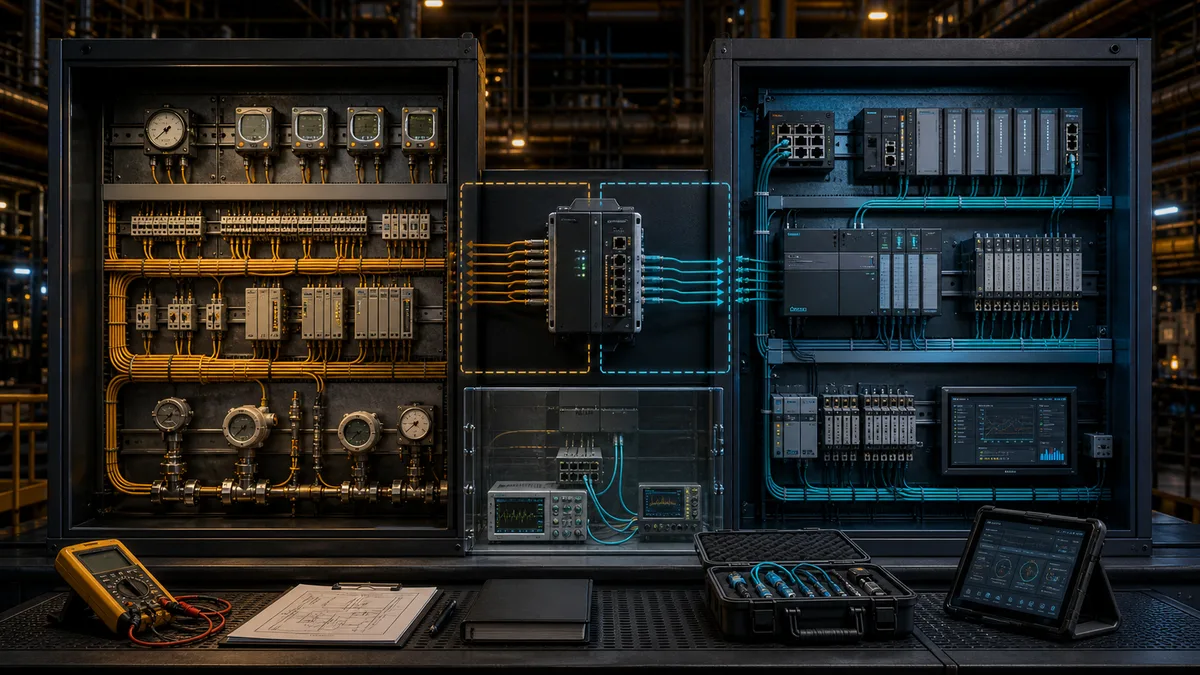
Start with an inventory of nodes, firmware, addresses, profiles, media, termination, drawings, configuration archives, spare parts and undocumented consumers. Capture normal traffic and fault behavior while the system is healthy. Define the replacement data contract signal by signal, including status and diagnostic semantics—not only numerical values.
A gateway can reduce immediate rewiring, but it creates two protocol contracts and a failure boundary. Specify ownership, mapping, buffering, stale-data behavior, diagnostics, time synchronization, cybersecurity, spares and bypass or recovery. Bench-test the bridge with representative devices, then pilot a bounded cell. Keep a tested rollback condition and a cutover decision authority. Retire the old network only after acceptance records, training, backups and spares are in place.
Cybersecurity is an architecture, not a protocol checkbox
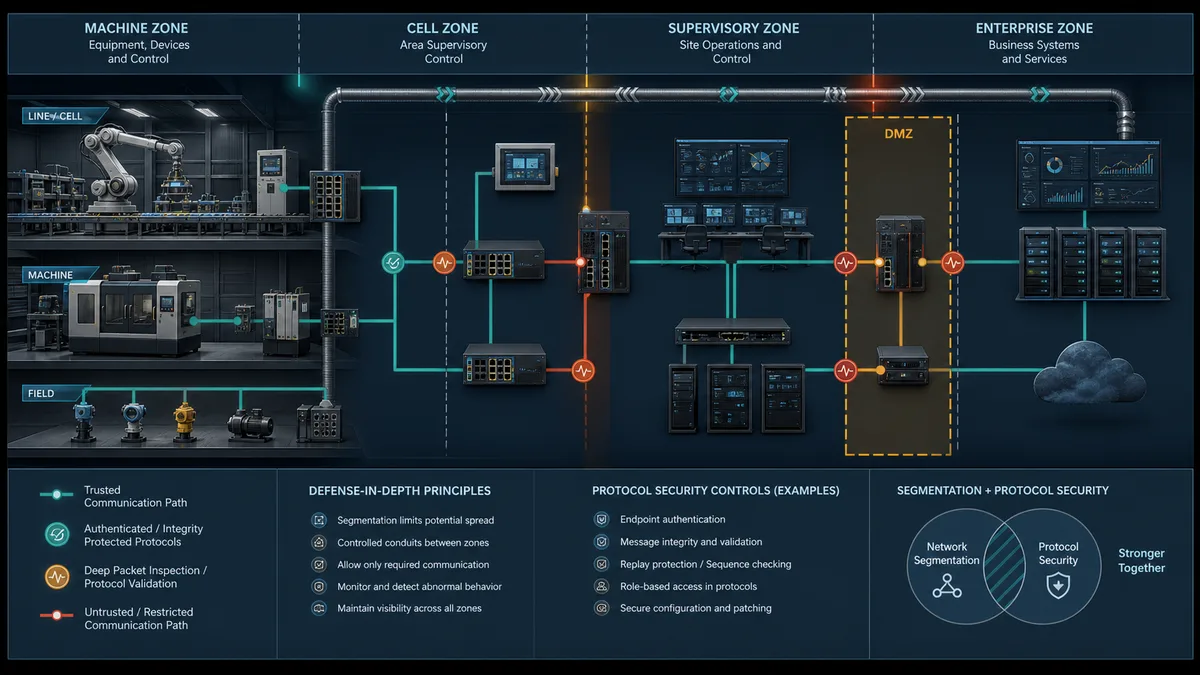
Treat every network path as an allowed communication relationship with an owner and business purpose. Segment control assets from unrelated enterprise and Internet traffic. Permit only required flows through managed boundaries. Control engineering access, remote support, certificates, accounts and removable media. Maintain inventories, backups, time sources, logs, update processes and incident recovery.
Native security can add identity, integrity, confidentiality or authorization when products and operations implement it correctly. It cannot compensate for shared administrator credentials, unmanaged switches, uncontrolled remote access, untested backups or flat routing. The NIST SP 800-82 Rev. 3 guide provides current operational-technology security guidance; IEC 62443 is the relevant standards family for industrial automation and control-system security programs, systems and components.
Answer map for engineers, search and AI assistants
Use these bounded answers when a broader question needs a precise starting point:
- Industrial communication protocol definition: rules for messages, addressing, timing, services or data interpretation between industrial devices and systems. A cable or Ethernet link alone is not the full protocol.
- Industrial automation protocol list: common families include Modbus, PROFIBUS, PROFINET, EtherNet/IP, DeviceNet, ControlNet, EtherCAT, CANopen, CC-Link, AS-Interface, IO-Link, HART, FOUNDATION Fieldbus, OPC UA and MQTT/Sparkplug. They serve different layers and roles.
- Fieldbus versus industrial Ethernet: fieldbus commonly uses purpose-built field-network media and access methods; industrial Ethernet builds on Ethernet-related layers. Neither category automatically proves timing, interoperability or diagnostics.
- PROFINET versus EtherNet/IP versus EtherCAT: compare exact controller and device support, profiles, update and synchronization needs, topology, diagnostics, lifecycle and measured recovery. Do not choose from a generic speed table.
- OPC UA versus MQTT: OPC UA provides services and information modeling, including client-server and PubSub; MQTT is a publish/subscribe transport, while Sparkplug adds industrial namespace, payload and state conventions. They can complement rather than replace each other.
- Protocol troubleshooting order: preserve evidence, then prove power/physical, link, identity/address, session, data contract and application response. A ping or green LED proves only a narrow boundary.
- Gateway risk: a gateway creates two contracts plus mapping, timing, stale-data, diagnostic, security and recovery responsibilities. It is an engineered boundary, not transparent magic.
- Protocol security: use native controls where supported, but also inventory, segment, restrict conduits and remote access, manage identity and updates, log events, and test backups and recovery.
These answers intentionally avoid universal distance, node-count, cycle-time or safety claims. Those values belong to the exact specification, product manuals, topology, configuration and validation record.
Focused implementation and comparison guides
After selecting the network role, move to the exact implementation owner: Allen-Bradley IO-Link integration, ET 200 PROFINET, EtherCAT versus standard Ethernet, OpenPLC EtherCAT, MQTT Sparkplug for PLC data, Allen-Bradley EtherNet/IP, Omron PROFINET, or the role-correct Rockwell-to-PROFINET gateway and module guide. Use the PROFIBUS DP implementation guide for the serial fieldbus itself and Modbus versus PROFIBUS when the task is a requirements-led comparison. These pages own platform, packet, mapping and diagnostic detail that a broad selector should not duplicate.
Official sources and claim boundaries
Use a protocol association or standards body to establish the technology definition, then use exact vendor manuals and conformance records for the purchased products. These sources are suitable starting points:
- Modbus specifications and implementation guides
- PROFINET technology and application system description
- ODVA EtherNet/IP technology overview
- EtherCAT functional principle and technology reference
- OPC UA architecture overview
- IO-Link official technology overview
- FieldComm Group HART technology explanation
- FieldComm Group FOUNDATION Fieldbus explanation
- Eclipse Sparkplug specification
- CAN in Automation CANopen reference
- CC-Link Partner Association network-family overview
- CC-Link IE TSN technology overview
- AS-International AS-Interface technology overview
- OPC UA PubSub architecture reference
- NIST Guide to Operational Technology Security
This guide compares architectures and engineering evidence. It does not certify interoperability, timing, cybersecurity, functional safety, hazardous-area suitability or installation compliance for a specific product combination. Those claims require the current specifications, manufacturer instructions, applicable regulations, competent engineering review and representative testing.
Practise protocol fault reasoning before the plant window
Use the industrial communication protocols training path to rehearse topology, connection, data-contract and stale-data diagnosis in a browser scenario. Ownership disclosure: PLC Programming operates PLC Simulation Software. The training model does not emulate every vendor stack or prove installed timing, interoperability, electrical integrity, cybersecurity, safety or regulatory compliance. Transfer the method to approved tools and representative hardware before a production change.
Continue Learning
Protocol Selection and Troubleshooting
Protocols Directory and Wizard
Browse protocol-specific references and compare candidate technologies.
PLC Communication Protocols
PLC-specific implementation, mapping and troubleshooting guidance.
PLC Communication Troubleshooting
A physical-to-application evidence ladder for communication faults.
Managed vs Unmanaged Switch
Choose switch capabilities from diagnostics, topology and operational requirements.
Industrial Ethernet Deep Dives
PROFINET PLC Guide
Roles, GSDML, RT/IRT boundaries, commissioning and diagnostics.
EtherNet/IP PLC Guide
CIP objects, assemblies, connections, timing and evidence.
EtherCAT PLC Guide
MainDevice, SubDevice, process data, Distributed Clocks and recovery.
PROFINET vs EtherNet/IP
A requirements-based comparison of two controller-centric ecosystems.
Device and Information Protocols
Modbus Protocol Guide
Data model, addressing, serial and TCP wrappers, exceptions and tests.
OPC UA Tutorial
Endpoints, certificates, namespaces, subscriptions and information models.
IO-Link Tutorial
Masters, ports, IODDs, process data and smart-device diagnostics.
HART Tutorial
Host roles, commands, loop integration and instrument evidence.
Frequently Asked Questions
What are industrial automation protocols?
Industrial automation protocols are agreed rules for exchanging control states, measurements, commands, diagnostics or production information between industrial devices and systems. A protocol may define framing, addressing, services, timing, objects or data semantics. Physical media such as Ethernet cabling and RS-485 are parts of a communication stack, not automatically complete application protocols.
Which industrial communication protocol is most common?
There is no defensible single answer across every layer, industry and region. Modbus has very broad device implementation; PROFINET and EtherNet/IP are common controller and device networks in their respective ecosystems; EtherCAT is prominent in performance-focused machinery; OPC UA is widely used for structured supervisory information. Select from the installed base and exact application rather than a universal popularity claim.
What protocol should a new PLC project use?
Start with the exact PLC, drive, remote I/O, instrument, robot, safety, motion and supervisory requirements. Shortlist only protocols and profiles implemented by every required endpoint. Compare measured timing, topology, diagnostics, recovery, security, engineering lifecycle, local support and total installed cost on representative hardware before committing.
Is industrial Ethernet the same as EtherNet/IP?
No. Industrial Ethernet is a broad category for Ethernet-based industrial networking. EtherNet/IP is a specific industrial application protocol that uses standard Ethernet and Internet Protocol technologies with CIP. PROFINET, EtherCAT and Modbus TCP also use Ethernet-related infrastructure but are not interchangeable with EtherNet/IP.
Is RS-485 an industrial protocol?
RS-485 specifies electrical signaling characteristics for a balanced multipoint serial link; it does not by itself define application messages, register meanings or device behavior. Modbus RTU and other application protocols can use an RS-485 physical layer. Troubleshooting must therefore separate wiring and termination from serial settings, frames and the data contract.
Is OPC UA a real-time control protocol?
OPC UA is a broad architecture with client-server and PubSub capabilities, information models and configurable transports and security. Do not classify every OPC UA implementation with one timing label. Define the required use case and profile, then verify the exact products, network, scheduling and measured behavior. Conventional supervisory subscriptions should not be assumed to replace a proven cyclic field-control link.
What is the difference between fieldbus and industrial Ethernet?
Fieldbus commonly refers to digital industrial networks developed for field devices, often with bus access and physical layers distinct from switched Ethernet. Industrial Ethernet technologies use Ethernet-related physical and link technologies while adding automation-specific services and timing behavior. The category names alone do not determine determinism, diagnostics, security or compatibility.
How do I troubleshoot an industrial network fault?
Preserve evidence first. Define the scope and timeline, then prove power and physical installation, link and port health, address and identity, protocol connection, data mapping and application response in that order. Compare both ends of the same exchange and change one reversible variable at a time. Do not treat a green link LED or successful ping as proof of a valid control data contract.
Can a gateway convert any industrial protocol safely?
A gateway can translate supported messages and data, but it creates two protocol contracts and another failure boundary. Verify mapping, data types, byte order, ownership, buffering, stale-data behavior, timing, diagnostics, security, time synchronization, capacity, spares and restart behavior. Safety and deterministic-control claims require specific approved architectures and validation.
Do secure protocol features make an industrial network secure?
No. Authentication, integrity and encryption can strengthen a design when supported and configured, but security also requires asset inventory, segmentation, controlled conduits, least privilege, managed remote access, logging, certificate and account lifecycle, secure updates, backups and tested recovery. Apply the asset owner security program and product security manuals to the complete system.
Is CANopen the same as CAN?
No. CAN defines lower communication behavior, while CANopen adds a standardized application and communication profile with an object dictionary and protocols such as SDO, PDO and NMT. Two CAN-capable products do not automatically form a CANopen application; verify bitrate, profile, EDS, object mapping, node management and error-control behavior.
Is TSN an industrial communication protocol?
TSN is a group of IEEE 802.1 networking mechanisms such as time synchronization and scheduled traffic, not a complete industrial application protocol by itself. A deployable system needs an application protocol, compatible endpoint and switch support, configuration, clock architecture, traffic engineering and measured end-to-end behavior.
Can MQTT replace PROFINET, EtherNet/IP or EtherCAT?
Not as a general rule. MQTT is useful for decoupled brokered information exchange, and Sparkplug adds industrial state and payload conventions. Cyclic controller, I/O, drive and motion networks have different timing, connection and failure requirements. Keep control and information roles separate unless the exact architecture is supported and validated for the use case.
Can standard PLC network data be used as a safety signal?
Ordinary protocol data or a standard PLC status bit is not automatically safety-related. Safety communication requires a defined safety protocol, compatible certified devices, prescribed configuration and parameters, verified fault reactions, and validation of the complete safety function including sensors, logic, communications and final elements.