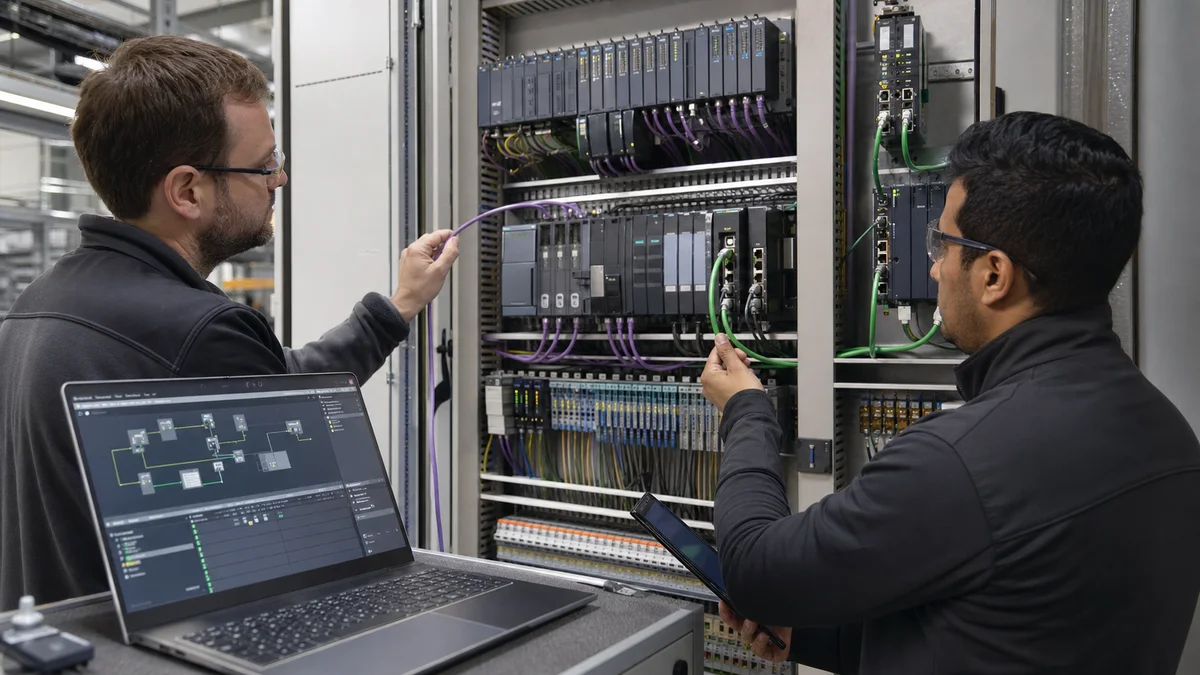
DeviceNet vs PROFINET 2026 | Complete Protocol Comparison Guide
Expert comparison of DeviceNet vs PROFINET protocols covering speed, architecture, installation, costs, migration strategies, and when to choose each industrial communication protocol.
Introduction: Choosing Between Fieldbus and Industrial Ethernet Communication
The decision between DeviceNet and PROFINET represents more than selecting a communication protocol—it reflects a fundamental choice between traditional fieldbus architecture and modern industrial Ethernet technology. Understanding the DeviceNet vs PROFINET comparison helps automation engineers make informed decisions that optimize system performance, minimize total cost of ownership, and ensure long-term infrastructure compatibility with evolving industrial automation requirements.
DeviceNet emerged in the mid-1990s as a robust CAN-based fieldbus protocol specifically designed for connecting industrial devices in factory automation applications. Built on the proven Controller Area Network (CAN) physical layer, DeviceNet delivers reliable, deterministic communication for sensors, actuators, motor starters, drives, and discrete I/O devices. Its widespread adoption in Rockwell Automation systems and support from major device manufacturers established DeviceNet as a dominant fieldbus protocol for two decades.
PROFINET represents Siemens' industrial Ethernet communication protocol, leveraging standard IT infrastructure while delivering the real-time performance demanded by modern automation applications. Unlike traditional fieldbus protocols limited by serial communication constraints, PROFINET utilizes 100 Mbps Ethernet technology supporting high-speed I/O, motion control, process automation, and seamless integration with enterprise networks. As the strategic protocol for Siemens and numerous industrial device manufacturers, PROFINET enables Industry 4.0 initiatives, advanced diagnostics, and convergence between operational technology and information technology systems.
This comprehensive DeviceNet vs PROFINET comparison analyzes both protocols across technical architecture, performance characteristics, installation requirements, cost factors, application suitability, and migration strategies. Whether you're designing new automation systems, upgrading existing installations, or evaluating protocol options for specific applications, this guide provides the technical depth and practical insights needed to select the optimal communication protocol for your industrial automation requirements in 2026.
Quick Comparison Overview
| Feature | DeviceNet | PROFINET |
|---|---|---|
| Technology Type | CAN-based Fieldbus | Industrial Ethernet |
| Physical Layer | CAN (ISO 11898) | Ethernet IEEE 802.3 |
| Maximum Speed | 500 Kbps | 100 Mbps (1 Gbps capable) |
| Typical Cycle Time | 2-20 ms | 250 μs - 10 ms |
| Topology | Trunk-line/Drop-line | Star, Line, Ring |
| Maximum Distance | 500m @ 125 Kbps | 100m per segment (unlimited with switches) |
| Maximum Nodes | 64 devices | 512 devices per subnet |
| Installation | Specialized DeviceNet cables/connectors | Standard RJ45 Ethernet cables |
| Power on Cable | Yes (24V DC embedded) | Separate power required |
| Diagnostics | Basic node status | Extensive device-level diagnostics |
| Vendor Support | Declining (legacy) | Growing (strategic protocol) |
| Best Applications | Simple discrete I/O, legacy Rockwell systems | Motion control, high-speed I/O, modern systems |
| Future Development | Maintenance only | Active development and enhancement |
| Cost per Node | Moderate | Higher initial, lower long-term |
Chapter 1: What is DeviceNet?
DeviceNet Fundamentals and Architecture
DeviceNet represents an open industrial network protocol built on the Controller Area Network (CAN) physical layer, specifically designed for connecting low-level industrial devices including sensors, actuators, motor starters, process valves, drives, and discrete I/O modules. Originally developed by Allen-Bradley (now Rockwell Automation) in the mid-1990s, DeviceNet became an open standard managed by the Open DeviceNet Vendors Association (ODVA), ensuring multi-vendor interoperability and preventing proprietary control over protocol evolution.
CAN-Based Architecture:
DeviceNet leverages the proven CAN protocol developed for automotive applications, inheriting its robust error detection, multi-master capability, and deterministic message prioritization. The CAN physical layer provides excellent noise immunity, making DeviceNet particularly suitable for harsh industrial environments with electrical interference, temperature extremes, and vibration.
The protocol uses a broadcast communication model where all devices see all messages on the network. Each message includes an identifier that establishes priority—lower identifier numbers receive higher priority during arbitration when multiple devices attempt simultaneous transmission. This priority-based approach ensures critical messages receive preferential network access without requiring complex scheduling algorithms.
Message Types and Communication Model:
DeviceNet defines several message types optimized for different communication requirements:
- I/O Messages: High-priority cyclic data exchange for time-critical process data including sensor readings, actuator commands, and device status information
- Explicit Messages: Lower-priority request/response communication for device configuration, parameter management, diagnostic queries, and non-time-critical operations
- Poll Messages: Master-initiated requests for data from specific slave devices
- Cyclic Messages: Periodic data transmission at configured intervals
- Change-of-State (COS) Messages: Event-triggered communication sent only when data values change, reducing unnecessary network traffic
Producer-Consumer Communication Model:
Unlike traditional master-slave protocols where a central master polls each device individually, DeviceNet implements a producer-consumer model that improves efficiency. Devices producing data broadcast messages onto the network, and any device configured as a consumer of that data can receive and process it. This multicast approach enables one device to efficiently send data to multiple consumers without repeated transmissions, optimizing bandwidth utilization and reducing cycle times.
DeviceNet History and Evolution
Origins (1994-1996):
Allen-Bradley (Rockwell Automation) developed DeviceNet to address the growing need for open, vendor-neutral communication between industrial controllers and field devices. Prior to DeviceNet, most device-level communication used proprietary protocols requiring expensive gateways and limiting device interoperability. By building on the proven CAN standard, DeviceNet delivered robust communication while maintaining competitive implementation costs.
ODVA Formation (1995):
The Open DeviceNet Vendors Association was established to manage specification development, certification testing, and protocol promotion. This transition from proprietary control to open industry organization accelerated vendor adoption, ensuring DeviceNet remained accessible to all manufacturers without licensing restrictions or preferential treatment.
Peak Adoption (2000-2010):
DeviceNet experienced widespread adoption across discrete manufacturing industries including automotive assembly, material handling, packaging machinery, and semiconductor manufacturing. The protocol's seamless integration with Rockwell Automation ControlLogix and CompactLogix PLCs, combined with extensive device availability from major manufacturers, established DeviceNet as a dominant device-level fieldbus protocol in North America.
Standardization:
DeviceNet achieved international recognition through IEC 62026 standardization, validating its technical design and ensuring long-term protocol stability. This formal standardization provided confidence for long-term infrastructure investments while maintaining backward compatibility across specification revisions.
Current Status (2026):
While DeviceNet remains installed in millions of devices worldwide, new installations have declined significantly as industrial Ethernet protocols offer superior performance, bandwidth, and IT integration capabilities. Rockwell Automation positions DeviceNet as a mature technology in maintenance mode while promoting EtherNet/IP as their strategic industrial Ethernet protocol. Device manufacturers continue supporting existing DeviceNet products but focus new development on Ethernet-based alternatives.
DeviceNet Technical Specifications
Communication Speed and Distance:
DeviceNet supports three communication speeds with inversely proportional maximum distances:
- 125 Kbps: Maximum 500 meters total network length
- 250 Kbps: Maximum 250 meters total network length
- 500 Kbps: Maximum 100 meters total network length
The speed-distance relationship stems from CAN physical layer signal propagation constraints. Higher baud rates require shorter propagation delays to maintain proper bit synchronization across all network nodes. Most installations use 250 Kbps or 500 Kbps for improved performance while accepting reduced distance capabilities.
Network Topology and Cabling:
DeviceNet uses a trunk-line/drop-line topology where a main trunk cable runs through the installation area with individual drop cables connecting devices to the trunk. This architecture simplifies installation compared to point-to-point wiring while providing flexibility for adding or relocating devices.
Cable Types:
- Thick Cable: Main trunk lines supporting longer distances and higher current capacity for powering multiple devices
- Thin Cable: Drop connections and shorter trunk segments for cost-effective installation
- Flat Cable: Specialized cable for applications requiring flexible installation paths
Power Distribution:
A key DeviceNet advantage is integrated 24V DC power distribution through the same cable carrying communication signals. This dual-purpose cable simplifies installation by eliminating separate power wiring for many devices. Cable current capacity ranges from 3 to 8 amps depending on cable type and gauge, sufficient for powering sensors, discrete I/O modules, and other low-power devices directly from the network.
Connector Standards:
DeviceNet specifies sealed M12 circular connectors (5-pin) and open-style connectors for industrial environments. The standardized connector design ensures mechanical compatibility across devices from different manufacturers while providing the durability required for factory floor installations.
Chapter 2: What is PROFINET?
PROFINET Fundamentals and Architecture
PROFINET (Process Field Network) represents Siemens' industrial Ethernet communication protocol designed to meet demanding factory and process automation requirements while leveraging standard Ethernet technology and IT infrastructure. Unlike traditional fieldbus protocols using proprietary physical layers, PROFINET utilizes standard IEEE 802.3 Ethernet with TCP/IP for configuration and specialized real-time channels for cyclic process data exchange.
Three Communication Channels:
PROFINET implements a sophisticated multi-channel architecture that simultaneously supports different communication types with appropriate performance characteristics:
-
TCP/IP Channel: Handles non-real-time communication including device configuration, parameter management, diagnostic data, and engineering access. This standard IT protocol enables seamless integration with enterprise networks, web servers, and cloud platforms.
-
Real-Time (RT) Channel: Provides deterministic cyclic data exchange for standard automation applications with cycle times from 10 milliseconds down to 1 millisecond. RT communication uses optimized Ethernet frames processed by software stacks in the device operating system.
-
Isochronous Real-Time (IRT) Channel: Delivers ultra-deterministic performance for motion control and high-precision applications with jitter below 1 microsecond and cycle times down to 250 microseconds. IRT uses hardware-based frame processing and time-synchronized switching for guaranteed performance.
Device Classes and Conformance:
PROFINET defines three device conformance classes that specify performance capabilities and target applications:
- PROFINET CC-A: Basic I/O devices with RT communication suitable for standard automation applications not requiring sub-millisecond performance
- PROFINET CC-B: Advanced I/O devices with RT communication and enhanced diagnostics for sophisticated automation applications
- PROFINET CC-C: Motion control devices with IRT communication for multi-axis positioning, robotics, and synchronized applications requiring microsecond-level determinism
PROFINET History and Evolution
Origins (1999-2002):
PROFIBUS International (now PI - PROFIBUS & PROFINET International) initiated PROFINET development to create a next-generation industrial communication protocol that combined proven PROFIBUS data models with Ethernet technology. The goal was maintaining compatibility with existing PROFIBUS concepts while enabling future scalability and IT integration.
Initial Release (2003):
PROFINET V1.0 specification introduced basic RT communication capabilities, component-based engineering, and integration with existing PROFIBUS installations through proxy technology. Early adoption focused on discrete manufacturing applications requiring Ethernet connectivity and basic real-time performance.
IRT Introduction (2005-2007):
PROFINET V2.0 added Isochronous Real-Time (IRT) capabilities, enabling demanding motion control applications previously requiring specialized motion networks. Hardware-based IRT switches and synchronized device interfaces delivered microsecond-level performance required for multi-axis servo applications, competing with established motion protocols like SERCOS and EtherCAT.
Modern Capabilities (2010-Present):
Recent PROFINET versions add advanced features including:
- Energy management and power consumption monitoring
- Shared device functionality for multi-master applications
- Time-sensitive networking (TSN) integration
- Enhanced cybersecurity with OPC UA integration
- Wireless PROFINET for mobile equipment
- Advanced diagnostics with condition monitoring integration
Market Adoption and Standardization:
PROFINET achieved international standardization through IEC 61158 and IEC 61784, ensuring protocol stability and multi-vendor interoperability. By 2026, over 60 million PROFINET devices have been installed worldwide, with 8+ million new nodes added annually. Over 2,000 vendors offer PROFINET-certified products spanning every automation device category.
PROFINET Technical Specifications
Communication Speed and Performance:
PROFINET operates on standard 100BASE-TX Ethernet infrastructure (100 Mbps) with support for Gigabit Ethernet (1000BASE-T) in advanced applications. This bandwidth exceeds DeviceNet by a factor of 200x, enabling simultaneous communication with hundreds of devices while maintaining fast update rates.
Real-Time Performance:
- PROFINET RT: Cycle times 1-10 ms typical, jitter <1 ms, suitable for distributed I/O and standard drives
- PROFINET IRT: Cycle times 250 μs - 4 ms, jitter <1 μs, suitable for multi-axis motion control and synchronized applications
- Bandwidth efficiency: Up to 90% network capacity available for process data
Network Topology:
PROFINET supports flexible topologies including:
- Line (Daisy-chain): Devices connected in series using integrated switches
- Star: Devices connected to central switch(es)
- Ring: Redundant topology for fault tolerance
- Hybrid: Combination of topologies optimized for specific installation requirements
Distance and Scalability:
- Segment length: 100 meters maximum per copper cable segment between devices or switches
- Total network extent: Unlimited when using switches to extend network
- Fiber optic: Multi-kilometer distances for distributed installations
- Nodes per subnet: 512 devices per PROFINET subnet
- Total network capacity: Multiple subnets enable thousands of devices
Cabling and Connectors:
PROFINET uses standard industrial Ethernet components:
- Cable: Cat5e or Cat6 Ethernet cable minimum
- Connectors: RJ45 connectors or M12 X-coded industrial connectors
- Power: Separate power distribution required (no power-over-network in standard PROFINET)
Chapter 3: Technical Architecture Comparison
Physical Layer and Communication Technology
DeviceNet Physical Layer:
DeviceNet's CAN-based physical layer uses differential signaling on twisted-pair cable to achieve excellent noise immunity. The CAN_H and CAN_L signal lines carry complementary signals that communicate through voltage differential rather than absolute voltage levels. This differential approach provides robust communication in electrically noisy industrial environments where single-ended signals would suffer from interference.
The broadcast bus architecture means all devices connect to common trunk cable, creating a shared medium where all devices see all messages. While this simplifies physical wiring, it creates bandwidth limitations since only one device can transmit at any given time. Network utilization above 70-80% typically causes performance degradation as message collisions and arbitration delays increase.
PROFINET Physical Layer:
PROFINET leverages standard Ethernet physical layer technology, using either copper twisted-pair cables (100BASE-TX) or fiber optic links for longer distances. The Ethernet star or line topology with integrated switches in devices eliminates the shared medium limitations of bus-based networks.
Full-duplex Ethernet communication enables simultaneous bidirectional communication, effectively doubling bandwidth compared to half-duplex operation. Switches provide dedicated bandwidth between ports, preventing network congestion even at high utilization levels. This switched architecture enables PROFINET networks to maintain consistent performance with hundreds of devices operating simultaneously.
Protocol Stack and Message Processing
DeviceNet Protocol Stack:
The DeviceNet protocol stack builds on the CAN data link layer with additional layers providing:
- CAN Physical Layer: Differential signaling, bit stuffing, error detection
- CAN Data Link Layer: Frame formatting, arbitration, acknowledgment
- DeviceNet Transport Layer: Message fragmentation for data exceeding 8 bytes
- DeviceNet Application Layer: Object model, device profiles, explicit messaging
DeviceNet's reliance on CAN's 8-byte maximum data payload requires fragmentation for larger messages. While efficient for small I/O data, this fragmentation adds overhead and complexity for diagnostic messages or configuration data requiring multiple frames.
PROFINET Protocol Stack:
PROFINET implements a layered architecture supporting multiple communication types:
- Ethernet Physical Layer: IEEE 802.3 100BASE-TX or 1000BASE-T
- Data Link Layer: Standard Ethernet MAC with VLAN priority tagging
- Real-Time Layer: Optimized frame processing bypassing IP/UDP stack
- TCP/IP Layer: Standard networking for configuration and diagnostics
- Application Layer: PROFINET I/O, alarms, diagnostics, device management
The ability to use full Ethernet frame sizes (up to 1500 bytes) enables efficient bulk data transfer for diagnostics, parameterization, and file transfers without fragmentation overhead.
Determinism and Real-Time Performance
DeviceNet Determinism:
DeviceNet achieves determinism through CAN's priority-based arbitration mechanism. Each message identifier establishes transmission priority—lower identifiers win arbitration when multiple devices attempt simultaneous transmission. This predictable arbitration ensures critical messages receive preferential network access.
However, calculating worst-case response times requires analyzing all higher-priority messages that could delay lower-priority transmissions. Network performance degrades non-linearly as utilization increases, making capacity planning critical for maintaining deterministic behavior.
Typical DeviceNet Performance:
- Network scan time: 2-20 ms depending on device count and data volume
- Determinism: Priority-based with calculable worst-case timing
- Network load recommendation: Keep below 70% utilization for reliable performance
PROFINET Determinism:
PROFINET RT achieves determinism through prioritized frame scheduling and optimized frame processing. Real-time frames receive higher priority than standard TCP/IP traffic, ensuring process data updates receive preferential treatment. Software-based RT processing achieves cycle times of 1-10 milliseconds suitable for most I/O and drive applications.
PROFINET IRT delivers guaranteed determinism through hardware-based frame scheduling and time synchronization. The network cycle divides into reserved time slots for IRT communication and open slots for RT and TCP/IP traffic. This time-division multiplexing provides absolute guarantees for IRT communication regardless of other network activity.
Typical PROFINET Performance:
- RT cycle time: 1-10 ms for standard I/O applications
- IRT cycle time: 250 μs - 4 ms for motion control
- Jitter: <1 μs for IRT, <1 ms for RT
- Network capacity: Hundreds of devices with millisecond updates
Bandwidth and Data Throughput
DeviceNet Bandwidth Limitations:
DeviceNet's maximum 500 Kbps bandwidth severely limits data throughput compared to modern industrial Ethernet protocols. Actual throughput is further reduced by protocol overhead, arbitration delays, and the requirement to keep network utilization below 70-80% for reliable performance.
Practical DeviceNet Capacity:
- Maximum devices: 64 nodes per network
- Effective throughput: ~30-35 KB/s at 500 Kbps with moderate loading
- Typical I/O capacity: 200-500 I/O points per network
- Complex devices: 10-30 drives or smart devices per network
PROFINET Bandwidth Advantages:
PROFINET's 100 Mbps Ethernet bandwidth provides 200x more capacity than DeviceNet, enabling dramatically higher device counts, faster update rates, and support for bandwidth-intensive devices. The switched architecture prevents bandwidth competition between devices.
Practical PROFINET Capacity:
- Maximum devices: 512 nodes per subnet (multiple subnets possible)
- Effective throughput: 8-10 MB/s for process data with RT
- Typical I/O capacity: Thousands of I/O points per network
- Complex devices: 100+ drives or smart devices with excellent performance
Chapter 4: Head-to-Head Feature Comparison
Speed and Performance Analysis
Communication Speed:
The raw bandwidth difference between DeviceNet (500 Kbps) and PROFINET (100 Mbps) represents a 200:1 advantage for PROFINET. This massive bandwidth differential translates directly into faster cycle times, higher device counts, and support for data-intensive applications like advanced diagnostics and condition monitoring.
Update Rates:
DeviceNet typical scan cycles of 5-20 milliseconds suit traditional discrete I/O and basic drive applications but limit responsiveness for high-speed applications. PROFINET RT delivers 1-10 millisecond cycles for standard applications, while PROFINET IRT achieves sub-millisecond performance for demanding motion control requirements.
Performance Comparison:
| Metric | DeviceNet | PROFINET RT | PROFINET IRT |
|---|---|---|---|
| Bandwidth | 500 Kbps | 100 Mbps | 100 Mbps |
| Typical Cycle | 5-20 ms | 1-10 ms | 0.25-4 ms |
| Minimum Cycle | 2-5 ms | 1 ms | 0.25 ms |
| Jitter | 0.5-2 ms | <1 ms | <1 μs |
| Max I/O Points | 200-500 | 10,000+ | 5,000+ |
| Max Drives | 10-30 | 100+ | 50+ |
Network Topology and Flexibility
DeviceNet Topology:
DeviceNet's trunk-line/drop-line topology provides reasonable installation flexibility but imposes restrictions compared to Ethernet-based protocols. The main trunk cable runs through the installation with drop cables connecting individual devices. While this approach works well for linear machine layouts, it becomes cumbersome for distributed or non-linear installations.
Topology Limitations:
- Fixed trunk-line architecture limits flexibility
- Adding devices requires trunk cable access
- Cable length calculations must account for all trunk and drop segments
- Trunk cable failure typically disables entire network segment
PROFINET Topology:
PROFINET supports virtually any topology through its Ethernet-based architecture. Star topologies with central switches, line topologies using integrated device switches, ring topologies for redundancy, and hybrid combinations all work seamlessly. This flexibility enables topology optimization for specific installation requirements.
Topology Advantages:
- Star topology centralizes connections at switch locations
- Line topology eliminates external switches for linear installations
- Ring topology provides redundancy and fault tolerance
- Hybrid topologies combine approaches for optimal installations
- Hot-swap capability enables device replacement without network disruption
Cable and Installation Requirements
DeviceNet Cabling:
DeviceNet requires specialized cables combining power and communication conductors in a single assembly. While this integrated approach simplifies wiring for devices powered from the network, it mandates specific DeviceNet cable types rather than generic industrial cable.
Cable Specifications:
- Thick cable: 2x15 AWG (power) + 2x18 AWG (signal), 3-8A capacity
- Thin cable: 2x18 AWG (power) + 2x22 AWG (signal), 3A capacity
- Flat cable: Specialized flexible cable for specific applications
- Connectors: M12 5-pin or open-style DeviceNet-specific connectors
Installation Advantages:
- Combined power and communication reduces wiring
- Standardized connectors ensure compatibility
- Well-established installation practices and documentation
Installation Limitations:
- Specialized cable more expensive than generic alternatives
- Limited cable availability compared to standard Ethernet
- Trunk cable sizing requires power capacity calculations
- Drop cable length restrictions (6 meters typical)
PROFINET Cabling:
PROFINET uses standard industrial Ethernet components widely available from multiple suppliers. Cat5e or Cat6 cable with RJ45 connectors provides the most cost-effective solution, while M12 X-coded connectors offer ruggedized alternatives for harsh environments.
Cable Specifications:
- Standard: Cat5e or Cat6 twisted-pair cable
- Industrial: Increased jacket durability, oil resistance, wider temperature range
- Fiber optic: Multi-mode or single-mode for long distances
- Connectors: RJ45 (cost-effective) or M12 X-coded (industrial sealed)
Installation Advantages:
- Widely available standard components
- Competitive pricing from multiple suppliers
- Existing IT infrastructure knowledge applicable
- Longer segment distances (100m per segment)
Installation Limitations:
- Separate power distribution required
- Proper Ethernet installation practices essential
- Fiber optic expertise needed for long-distance links
Distance Limitations
DeviceNet Distance Constraints:
DeviceNet's distance capabilities decrease significantly as communication speed increases, following CAN physical layer constraints. The inverse relationship between speed and distance requires choosing a compromise suitable for the specific application.
Maximum Distances:
- 125 Kbps: 500 meters total network length (trunk + drops)
- 250 Kbps: 250 meters total network length
- 500 Kbps: 100 meters total network length
- Drop cables: 6 meters typical maximum per drop
PROFINET Distance Capabilities:
PROFINET supports 100 meters per copper cable segment, with unlimited total network extent when using switches or fiber optic links to extend the network. This flexibility enables distributed installations spanning large facilities.
Maximum Distances:
- Copper (Cat5e/6): 100 meters per segment between devices/switches
- Multi-mode fiber: 2 kilometers typical
- Single-mode fiber: 20+ kilometers for extreme distances
- Total network: Unlimited with proper switch/fiber infrastructure
Device Support and Ecosystem
DeviceNet Device Availability:
DeviceNet benefits from over 25 years of device development, with extensive legacy support from major manufacturers. However, new device development has slowed dramatically as manufacturers prioritize industrial Ethernet protocols.
Device Categories:
- Discrete I/O modules (extensive availability)
- Motor starters and overload relays (wide support)
- Pneumatic valve manifolds (good availability)
- Variable frequency drives (mature product lines)
- Sensors and actuators (declining new development)
- Specialty devices (limited new products)
Vendor Support Status:
- Mature products in maintenance mode
- Replacement parts available but declining
- New product development minimal
- Long-term availability concerns for new projects
PROFINET Device Availability:
PROFINET enjoys strong device support from over 2,000 vendors with active new product development. As a strategic protocol for Siemens and many industrial device manufacturers, PROFINET device selection continues expanding across all automation categories.
Device Categories:
- Distributed I/O (extensive selection)
- Servo drives and motion control (growing rapidly)
- Process instrumentation (strong support)
- Safety devices (comprehensive offerings)
- Vision systems and sensors (increasing availability)
- Specialty devices (active development)
Vendor Support Status:
- Active new product development
- Growing device selection
- Long-term protocol commitment
- Strong future availability confidence
Cost Analysis
DeviceNet Cost Factors:
Initial Infrastructure Costs:
- Specialized DeviceNet cable and connectors more expensive than generic Ethernet
- Scanner/interface cards for PLC integration
- Lower cost for simple networks due to integrated power
Device Costs:
- Mature products often competitively priced
- Limited low-cost options for new devices
- Declining production volumes may increase costs
Installation Costs:
- Combined power/communication reduces labor for powered devices
- Trunk-line topology requires careful cable routing
- Specialized connectors require DeviceNet-trained technicians
Lifecycle Costs:
- Limited expansion capacity may require network segmentation
- Decreasing vendor support increases long-term risk
- Replacement part availability concerns
PROFINET Cost Factors:
Initial Infrastructure Costs:
- Standard Ethernet components from multiple low-cost suppliers
- Higher-cost industrial switches for demanding applications
- Separate power distribution infrastructure
Device Costs:
- Growing competition drives competitive pricing
- Wide vendor selection enables cost optimization
- Advanced features may command premium pricing
Installation Costs:
- Standard Ethernet skills widely available
- Flexible topology reduces installation complexity
- Separate power wiring increases labor
Lifecycle Costs:
- Excellent expansion capacity defers infrastructure costs
- Strong vendor commitment reduces obsolescence risk
- Advanced diagnostics reduce troubleshooting time
- Energy efficiency features reduce operating costs
Total Cost Comparison:
| Cost Category | DeviceNet | PROFINET | Advantage |
|---|---|---|---|
| Initial Hardware | Lower (simple systems) | Higher (requires switches) | DeviceNet |
| Cabling | Higher (specialized) | Lower (standard) | PROFINET |
| Installation | Lower (combined power) | Higher (separate power) | DeviceNet |
| Expansion | Higher (limited capacity) | Lower (scalable) | PROFINET |
| Maintenance | Moderate | Lower (diagnostics) | PROFINET |
| Lifecycle | Higher (obsolescence risk) | Lower (long-term support) | PROFINET |
Real-Time Capabilities
DeviceNet Real-Time Performance:
DeviceNet provides deterministic communication through CAN's priority-based arbitration, suitable for traditional discrete I/O and basic motion applications. The predictable arbitration mechanism ensures critical messages receive preferential network access.
Suitable Applications:
- Discrete I/O with 5-20 ms update requirements
- Basic drive applications with moderate dynamic response
- Sensor networks with non-critical timing
- Sequential machine control
Limited Applications:
- High-speed motion control (insufficient bandwidth)
- Synchronized multi-axis applications (inadequate determinism)
- Applications requiring sub-millisecond response times
PROFINET Real-Time Performance:
PROFINET delivers tiered real-time performance matching application requirements. Standard RT suits typical I/O and drive applications, while IRT enables demanding motion control and synchronized applications previously requiring specialized motion networks.
PROFINET RT Applications:
- Standard distributed I/O (1-10 ms updates)
- Variable frequency drives (standard performance)
- Process automation and control
- Building automation systems
PROFINET IRT Applications:
- Multi-axis motion control systems
- Robotics and handling systems
- Packaging and printing machinery
- Semiconductor manufacturing equipment
- Coordinated press and forming operations
- High-speed assembly automation
Chapter 5: DeviceNet Advantages and Use Cases
Key DeviceNet Strengths
Integrated Power Distribution:
DeviceNet's most significant advantage remains integrated 24V DC power distribution through the communication cable. This feature dramatically simplifies installation for devices consuming moderate power, eliminating separate power wiring for sensors, I/O modules, and other low-power devices. The installation labor savings particularly benefit machines with numerous sensors and discrete devices distributed across the system.
Mature and Proven Technology:
Over 25 years of field deployment provides confidence in DeviceNet's reliability and performance for traditional automation applications. Extensive installation experience, comprehensive troubleshooting documentation, and proven design patterns reduce implementation risk for applications where DeviceNet capabilities match requirements.
Simple Implementation for Basic Applications:
DeviceNet's straightforward architecture and well-established configuration procedures enable rapid implementation for discrete I/O and basic device networks. The mature tooling, extensive training materials, and widespread technician familiarity reduce engineering time and commissioning complexity for suitable applications.
Rockwell Automation Integration:
Seamless integration with Rockwell Automation ControlLogix, CompactLogix, and legacy PLC platforms provides native DeviceNet support without additional gateways or protocol conversion. This tight integration simplifies system architecture and reduces component count for Rockwell-based installations.
Ideal DeviceNet Applications
Discrete Manufacturing Automation:
DeviceNet excels at connecting discrete I/O, motor starters, pneumatic valve manifolds, and basic sensors in sequential machine control applications where millisecond-level performance suffices. Assembly machines, material handling systems, and packaging lines with moderate I/O counts represent ideal DeviceNet applications.
Example Application - Assembly Machine:
- 50-100 discrete I/O points
- 5-10 pneumatic valve manifolds
- Motor starters for conveyor drives
- Photoelectric sensors and proximity switches
- 10-20 ms cycle time requirement
- Installation benefits from integrated power
Legacy System Maintenance:
Maintaining existing DeviceNet installations with established infrastructure and trained personnel often makes continued DeviceNet use the most practical choice. Adding new devices to existing DeviceNet networks avoids technology mixing and leverages existing engineering expertise.
Rockwell-Centric Facilities:
Facilities standardized on Rockwell Automation control platforms with significant DeviceNet expertise may continue DeviceNet deployment for applications within its capabilities, leveraging existing knowledge and maintaining consistency across installations.
Simple Sensor Networks:
Connecting multiple sensors with moderate data requirements to a central controller represents an ideal DeviceNet application, especially when integrated power distribution significantly reduces installation costs.
Chapter 6: PROFINET Advantages and Use Cases
Key PROFINET Strengths
Superior Performance and Bandwidth:
PROFINET's 100 Mbps Ethernet bandwidth provides dramatically higher capacity than fieldbus alternatives, enabling fast cycle times with hundreds of devices. This performance headroom supports bandwidth-intensive applications including advanced diagnostics, condition monitoring, and large data transfers while maintaining excellent process data update rates.
Scalability and Future-Proofing:
PROFINET's architecture scales from simple sensor connections to complex systems with hundreds of devices without performance degradation. The protocol's active development roadmap, industry backing, and alignment with Industry 4.0 initiatives ensure long-term viability and continuous capability enhancement.
Advanced Diagnostics and Monitoring:
Comprehensive device-level diagnostics, topology discovery, asset management data, and integration with condition monitoring systems enable proactive maintenance and rapid troubleshooting. The rich diagnostic information accessible through standard IT tools reduces downtime and simplifies problem identification.
IT/OT Convergence:
Native Ethernet architecture enables seamless integration with enterprise networks, cloud platforms, analytics systems, and IT infrastructure. This convergence supports Industry 4.0 initiatives, remote monitoring, predictive maintenance, and data-driven optimization impossible with isolated fieldbus networks.
Flexible Topology Options:
Support for star, line, ring, and hybrid topologies enables installation optimization for specific requirements. Ring topology provides network redundancy for critical applications, while line topology with integrated device switches eliminates external switching infrastructure costs.
International Standardization:
IEC 61158 and IEC 61784 standardization with over 2,000 member companies ensures multi-vendor interoperability, competitive device pricing, and freedom from proprietary protocol control. The extensive vendor ecosystem prevents lock-in and provides competitive device selection.
Ideal PROFINET Applications
Motion Control Systems:
PROFINET IRT delivers the determinism and synchronization required for demanding multi-axis motion applications. Packaging machinery, robotic systems, printing equipment, and coordinated press operations benefit from sub-microsecond jitter performance and guaranteed cycle times.
Example Application - Packaging Line:
- 8-12 servo drives for coordinated motion
- 200+ discrete I/O points
- 20+ remote I/O stations
- HMI and SCADA integration
- 2 ms cycle time with IRT
- Advanced diagnostics for predictive maintenance
High-Speed Discrete I/O:
Applications requiring fast discrete I/O updates benefit from PROFINET RT performance. High-speed assembly, test and measurement, and semiconductor handling equipment requiring 1-5 millisecond I/O response leverage PROFINET's superior bandwidth and determinism.
Process Automation:
Process control applications benefit from PROFINET's support for process instrumentation, extensive diagnostic capabilities, and integration with process control systems. The protocol handles both discrete I/O and analog process variables efficiently within unified network infrastructure.
Siemens-Based Installations:
Facilities standardized on Siemens control platforms achieve optimal integration and performance with PROFINET. Native TIA Portal support, integrated engineering, and comprehensive device libraries simplify implementation and reduce engineering time.
Modern Greenfield Projects:
New automation projects benefit from PROFINET's performance, scalability, and long-term support commitment. The protocol's alignment with industry trends and continuous development ensure infrastructure relevance throughout extended facility lifecycles.
Industry 4.0 and IIoT Initiatives:
Applications requiring edge computing, cloud connectivity, advanced analytics, and enterprise integration leverage PROFINET's native Ethernet architecture and IT/OT convergence capabilities. The protocol supports modern manufacturing technologies impossible with isolated fieldbus networks.
Chapter 7: When to Choose DeviceNet
Technical Selection Criteria
Choose DeviceNet when:
Existing DeviceNet Infrastructure: Facilities with established DeviceNet networks, trained personnel, spare parts inventory, and engineering expertise should continue DeviceNet deployment for applications within protocol capabilities. Leveraging existing infrastructure and knowledge provides faster implementation and lower risk than introducing new technology.
Integrated Power Distribution Critical: Applications where combined power and communication cabling provides significant installation savings justify DeviceNet selection. Machines with numerous sensors and discrete devices distributed across the system benefit most from integrated power, especially when individual devices consume moderate current within DeviceNet's power distribution capacity.
Simple Discrete I/O Requirements: Basic discrete I/O applications with moderate device counts (under 50 devices) and non-demanding performance requirements (10-20 ms cycle times acceptable) can use DeviceNet effectively. The protocol's simplicity and mature tooling enable rapid implementation for straightforward applications.
Rockwell Automation Standardization: Facilities standardized exclusively on Rockwell Automation control platforms may prefer DeviceNet for applications within its capabilities, maintaining consistency across installations and leveraging native PLC integration.
Budget Constraints for Simple Systems: Small systems with minimal expansion requirements may achieve lower initial costs with DeviceNet's combined power distribution compared to PROFINET requiring separate power infrastructure and Ethernet switches.
Application-Specific Recommendations
Suitable DeviceNet Applications:
- Assembly machines with moderate I/O counts
- Conveyor systems with distributed motor starters
- Pneumatic control systems with valve manifolds
- Sensor networks with non-critical timing
- Legacy equipment integration
- Replacement systems for existing DeviceNet installations
DeviceNet Limitations to Consider:
- Limited expansion capacity may require future network segmentation
- Declining vendor support increases long-term spare parts risk
- Inadequate performance for high-speed or motion applications
- Poor scalability for growing automation requirements
- Limited diagnostic capabilities compared to modern protocols
Chapter 8: When to Choose PROFINET
Technical Selection Criteria
Choose PROFINET when:
High Performance Requirements: Applications requiring fast cycle times (sub-10 millisecond), high device counts (100+ devices), or significant bandwidth for diagnostics and monitoring data mandate PROFINET selection. The protocol's superior performance ensures system responsiveness and scalability impossible with fieldbus alternatives.
Motion Control Applications: Multi-axis motion control, robotics, coordinated machine control, and applications requiring deterministic synchronization benefit from PROFINET IRT capabilities. The sub-microsecond jitter and guaranteed cycle times enable precision motion previously requiring specialized motion networks.
Long-Term Infrastructure Investment: New facilities and major upgrades benefit from PROFINET's active development, strong vendor commitment, and alignment with industry trends. The protocol's long-term viability and continuous enhancement ensure infrastructure relevance throughout 20+ year facility lifecycles.
IT/OT Integration Requirements: Applications requiring enterprise connectivity, cloud integration, advanced analytics, remote monitoring, or Industry 4.0 capabilities leverage PROFINET's native Ethernet architecture. The protocol enables seamless data flow from field devices to enterprise systems impossible with isolated fieldbus networks.
Siemens Control Platforms: Facilities using Siemens PLCs achieve optimal integration, performance, and engineering efficiency with PROFINET. Native TIA Portal support, integrated configuration, and comprehensive device libraries reduce engineering time and simplify implementation.
Scalability and Future Expansion: Applications with anticipated growth, uncertain future requirements, or need for significant expansion capacity benefit from PROFINET's scalable architecture. The protocol maintains excellent performance with hundreds of devices, providing headroom for future additions.
Application-Specific Recommendations
Ideal PROFINET Applications:
- Motion control and robotics systems
- High-speed assembly and manufacturing
- Process automation with extensive I/O
- Packaging and printing machinery
- Semiconductor manufacturing equipment
- Automotive assembly systems
- Food and beverage production lines
- Building automation and infrastructure
- Water/wastewater treatment facilities
- Any new automation project requiring long-term viability
PROFINET Advantages to Leverage:
- Advanced diagnostics reduce troubleshooting time
- IT integration enables data-driven optimization
- Scalable architecture accommodates growth
- Strong vendor ecosystem ensures device availability
- Industry standardization prevents proprietary lock-in
- Active development provides continuous improvement
Chapter 9: Migration from DeviceNet to PROFINET
Migration Planning Considerations
Business Case for Migration:
When to Migrate:
- DeviceNet network capacity exhausted with expansion requirements
- System performance inadequate for production requirements
- Major system upgrades provide migration opportunity
- Device obsolescence forces equipment replacement
- IT integration and Industry 4.0 initiatives require Ethernet connectivity
- Long-term vendor support concerns for DeviceNet components
When to Maintain DeviceNet:
- Existing system meets performance requirements
- No significant expansion plans
- Budget unavailable for comprehensive upgrade
- DeviceNet-specific devices unavailable in PROFINET
- Short remaining service life before complete replacement
Migration Strategies
Phased Migration Approach:
Phase 1 - New Additions: Implement new automation systems and major expansions using PROFINET while maintaining existing DeviceNet networks. This approach minimizes disruption while transitioning new infrastructure to strategic protocol.
Phase 2 - Opportunistic Conversion: Convert DeviceNet segments to PROFINET during scheduled maintenance, equipment upgrades, or system modifications. Replace DeviceNet devices with PROFINET equivalents as equipment reaches end-of-life.
Phase 3 - Complete Transition: Retire remaining DeviceNet infrastructure once coverage and performance justify elimination of parallel protocol support.
Parallel Protocol Operation:
Gateway Solutions: Protocol gateways enable DeviceNet devices to communicate with PROFINET controllers during transition periods. While adding cost and complexity, gateways provide migration flexibility and enable incremental conversion without complete system replacement.
Dual-Protocol Controllers: Some PLCs support both DeviceNet and PROFINET communication simultaneously, enabling gradual network conversion while maintaining operational continuity. This approach works well for facilities with mixed automation systems.
Technical Migration Considerations
Device Replacement Mapping:
Create comprehensive inventory of existing DeviceNet devices with replacement identification:
- Map each DeviceNet device to PROFINET equivalent
- Identify devices requiring alternative solutions
- Document configuration and parameterization requirements
- Plan power distribution for separated power and communication
Network Architecture Redesign:
PROFINET's different topology options enable installation optimization:
- Evaluate star vs. line vs. ring topology for each area
- Plan switch locations and types (industrial vs. managed)
- Design power distribution infrastructure
- Consider fiber optic links for long distances
Engineering and Documentation:
- Convert DeviceNet configurations to PROFINET equivalents
- Update control programs for different I/O addressing
- Revise electrical documentation for separate power/communication
- Update troubleshooting procedures and training materials
Testing and Validation:
- Implement test setup validating PROFINET performance
- Verify device functionality and configuration
- Test diagnostic and monitoring capabilities
- Validate cycle times and determinism for critical applications
- Confirm IT integration and remote access functionality
Migration Costs and Timeline
Cost Factors:
Equipment Costs:
- PROFINET devices to replace DeviceNet counterparts
- Industrial Ethernet switches and infrastructure
- Fiber optic components for long-distance segments
- Power distribution components previously embedded in DeviceNet
- Engineering tools and software licenses
Labor Costs:
- System design and engineering
- Device configuration and parameterization
- Installation and wiring
- Testing and commissioning
- Training for maintenance personnel
- Documentation updates
Downtime Costs:
- Production lost during migration cutover
- Testing and validation time
- Contingency for unexpected issues
Timeline Considerations:
Simple discrete I/O migration may complete in days, while complex motion control systems require weeks of engineering, testing, and validation. Phased migration spreading conversion across multiple shutdown periods minimizes individual downtime events while extending overall transition timeline.
Chapter 10: Frequently Asked Questions
What is the main difference between DeviceNet and PROFINET?
DeviceNet is a CAN-based fieldbus protocol with 500 Kbps maximum speed designed for device-level communication in factory automation, while PROFINET is an industrial Ethernet protocol operating at 100 Mbps with advanced real-time capabilities. The fundamental difference lies in the underlying technology: DeviceNet uses serial CAN communication with integrated power distribution, whereas PROFINET leverages standard Ethernet infrastructure with superior performance, scalability, and IT integration. PROFINET provides 200x more bandwidth, supports 8x more devices, achieves faster cycle times, and offers extensive diagnostics compared to DeviceNet's more limited capabilities.
Can DeviceNet and PROFINET work together on the same network?
DeviceNet and PROFINET cannot directly communicate on the same physical network due to completely different physical layers and communication protocols. However, they can coexist in the same automation system using protocol gateways or PLCs with dual-protocol support. Protocol gateways translate data between DeviceNet and PROFINET networks, enabling integration during migration periods or mixed-vendor installations. Controllers like Siemens S7-300/400 with appropriate communication modules can support both protocols simultaneously, acting as a bridge between networks. This approach adds cost and complexity but provides flexibility for phased migrations or maintaining legacy DeviceNet segments alongside new PROFINET infrastructure.
Is DeviceNet being phased out?
DeviceNet is in maintenance-only status with minimal new device development as industrial Ethernet protocols like EtherNet/IP, PROFINET, and EtherCAT dominate new installations. Rockwell Automation, the primary DeviceNet promoter, positions EtherNet/IP as their strategic industrial Ethernet protocol while continuing DeviceNet support for existing installations. Device manufacturers maintain current DeviceNet products but focus new development on Ethernet-based alternatives. While DeviceNet remains functional in millions of existing installations and continues receiving vendor support for replacement parts, new automation projects typically select industrial Ethernet protocols offering superior performance, scalability, and long-term viability.
Which is faster, DeviceNet or PROFINET?
PROFINET is dramatically faster than DeviceNet across all performance metrics. DeviceNet operates at maximum 500 Kbps with typical cycle times of 5-20 milliseconds, while PROFINET delivers 100 Mbps bandwidth with RT cycle times of 1-10 milliseconds and IRT performance achieving 250 microsecond cycles with sub-microsecond jitter. The 200:1 bandwidth advantage enables PROFINET to support hundreds of devices with fast update rates, whereas DeviceNet typically handles 20-50 devices with slower refresh cycles. For motion control applications, PROFINET IRT provides deterministic performance impossible with DeviceNet's limited bandwidth and longer cycle times.
What are the maximum cable distances for DeviceNet vs PROFINET?
DeviceNet maximum distance depends on communication speed: 500 meters at 125 Kbps, 250 meters at 250 Kbps, or 100 meters at 500 Kbps, with these limits applying to total network length including trunk and drop cables. PROFINET supports 100 meters per copper segment between devices or switches with unlimited total network extent when using switches to extend the network. For longer distances, PROFINET can use fiber optic links spanning 2 kilometers (multi-mode fiber) or 20+ kilometers (single-mode fiber), making it suitable for distributed installations across large facilities where DeviceNet distance limitations would require multiple network segments or alternative technology.
Does PROFINET support power over cable like DeviceNet?
Standard PROFINET does not include integrated power distribution like DeviceNet's combined power and communication cabling. PROFINET requires separate 24V DC power distribution wiring to field devices, increasing installation labor compared to DeviceNet's integrated approach. However, PROFINET with Power over Ethernet (PoE) per IEEE 802.3af/at standards enables power delivery for appropriate devices, though industrial automation devices typically require higher power than PoE provides. Some vendors offer proprietary power-over-PROFINET solutions for specific applications, but these lack the universal support of DeviceNet's standardized integrated power. The separate power distribution requirement represents a PROFINET installation disadvantage partially offset by standard low-cost Ethernet cabling versus DeviceNet's specialized cables.
How many devices can connect to DeviceNet vs PROFINET networks?
DeviceNet supports maximum 64 nodes per network segment (addresses 0-63), though practical installations typically connect 20-50 devices due to bandwidth limitations at higher utilization levels. PROFINET supports 512 devices per subnet with multiple subnets possible for larger installations, enabling thousands of devices in comprehensive facility automation systems. The switched Ethernet architecture prevents the bandwidth competition inherent in DeviceNet's shared bus design, allowing PROFINET to maintain excellent performance with hundreds of active devices. For applications requiring extensive I/O coverage, multiple distributed drives, or numerous smart devices, PROFINET's superior scalability provides significant advantages over DeviceNet's limited node capacity.
Which protocol is more cost-effective, DeviceNet or PROFINET?
Cost comparison depends on application requirements and lifecycle perspective. DeviceNet may provide lower initial costs for simple systems with integrated power distribution reducing installation labor, while PROFINET uses more expensive industrial switches but lower-cost standard Ethernet cables. For small systems (under 30 devices) with minimal expansion plans, DeviceNet total installation costs may be competitive. However, PROFINET lifecycle costs are typically lower due to superior diagnostics reducing troubleshooting time, excellent scalability deferring infrastructure upgrades, strong vendor commitment minimizing obsolescence risk, and alignment with industry trends protecting long-term investment. New installations should evaluate 10-15 year total cost including expansion, maintenance, and obsolescence risk rather than just initial hardware costs.
Can I use DeviceNet for motion control applications?
DeviceNet provides inadequate performance for demanding motion control applications requiring fast response times, precise synchronization, and deterministic behavior. While DeviceNet can connect basic variable frequency drives for simple motion applications tolerating 10-20 millisecond response times, it lacks the bandwidth and determinism for coordinated multi-axis systems, precision positioning, or high-dynamic motion control. PROFINET IRT, EtherCAT, and SERCOS III represent appropriate protocols for serious motion control delivering sub-millisecond cycle times, microsecond-level synchronization, and guaranteed deterministic performance. Applications involving robotics, packaging machinery, CNC systems, or synchronized multi-axis motion require industrial Ethernet motion protocols rather than DeviceNet.
What diagnostic capabilities do DeviceNet and PROFINET provide?
DeviceNet offers basic diagnostics including device presence, communication status, and simple error reporting through device status indicators and network scanner diagnostics. Troubleshooting typically requires specialized DeviceNet diagnostic tools to analyze network traffic and identify communication issues. PROFINET provides comprehensive device-level diagnostics including detailed error messages, topology discovery showing network configuration, asset management data for inventory tracking, historical alarm logging, and integration with condition monitoring systems. Advanced PROFINET diagnostics enable predictive maintenance through vibration monitoring, temperature tracking, and performance trending impossible with DeviceNet's limited diagnostic infrastructure. The extensive diagnostic capabilities significantly reduce troubleshooting time and enable proactive maintenance strategies.
Which manufacturers support DeviceNet and PROFINET?
DeviceNet receives support primarily from Rockwell Automation (Allen-Bradley) and ODVA member companies, with over 300 vendors offering DeviceNet-certified products. However, new DeviceNet product development has declined significantly as vendors focus on Ethernet-based protocols. PROFINET benefits from over 2,000 member companies in PROFIBUS & PROFINET International (PI) with active new product development across all device categories. Major automation vendors including Siemens, Phoenix Contact, Pepperl+Fuchs, Turck, Balluff, Festo, SMC, Bosch Rexroth, and virtually all drive manufacturers offer extensive PROFINET device portfolios. The broader vendor ecosystem and active development commitment provide superior long-term product availability for PROFINET compared to DeviceNet's mature but declining support base.
Is PROFINET compatible with Rockwell Automation PLCs?
PROFINET is not natively supported by Rockwell Automation PLCs, which focus on EtherNet/IP as their strategic industrial Ethernet protocol. However, integration is possible through protocol gateways translating between PROFINET and EtherNet/IP or ControlNet/DeviceNet networks. These gateways enable Rockwell PLCs to communicate with PROFINET devices or Siemens PLCs to integrate with Rockwell networks, though adding cost, complexity, and potential performance limitations. For facilities standardized on Rockwell control platforms, EtherNet/IP represents the native industrial Ethernet protocol providing optimal integration, while Siemens-based installations achieve best results with PROFINET. Multi-vendor installations may require gateway solutions or controller selection based on dominant automation platform.
Conclusion: Making the Right Protocol Choice for Your Application
The DeviceNet vs PROFINET decision fundamentally represents choosing between mature fieldbus technology entering legacy status and modern industrial Ethernet positioned for long-term growth. While DeviceNet continues serving existing installations and specific applications benefiting from integrated power distribution, PROFINET's superior performance, scalability, and industry momentum make it the strategic choice for new automation investments requiring competitive advantage and long-term infrastructure viability.
DeviceNet's strengths—integrated power distribution, simple implementation for basic applications, and extensive Rockwell Automation integration—remain relevant for specific use cases including maintenance of existing systems, simple discrete I/O networks with power distribution benefits, and applications within the protocol's performance envelope. Facilities with significant DeviceNet expertise and infrastructure may continue deployment for suitable applications while recognizing the protocol's declining vendor support and limited expansion capacity.
PROFINET delivers compelling advantages for demanding applications including motion control, high-speed automation, extensive I/O systems, and modern manufacturing requiring IT/OT convergence. The protocol's 200x bandwidth advantage, support for 8x more devices, sub-millisecond real-time performance, advanced diagnostics, and active development roadmap position PROFINET as the optimal selection for greenfield projects, major upgrades, and applications requiring performance headroom and future scalability.
For automation professionals planning new installations, the technical evidence strongly favors PROFINET selection for virtually all applications beyond simple discrete I/O where DeviceNet's integrated power provides significant installation savings. The protocol's alignment with Industry 4.0 trends, strong vendor ecosystem, international standardization, and continuous capability enhancement ensure infrastructure relevance throughout extended facility lifecycles while enabling data-driven optimization, predictive maintenance, and enterprise integration impossible with isolated fieldbus networks.
The industrial automation industry's clear direction toward industrial Ethernet protocols makes PROFINET the future-proof choice for organizations seeking competitive manufacturing capabilities, operational excellence, and infrastructure investments that maintain value and performance relevance for decades. While DeviceNet remains functional for specific legacy applications, strategic automation investments in 2026 and beyond belong to industrial Ethernet protocols delivering the performance, scalability, and integration capabilities required for modern competitive manufacturing operations.