Modbus vs PROFIBUS: Architecture, Data, Timing and Selection
Compare Modbus RTU/TCP with PROFIBUS DP/PA by roles, data model, engineering files, physical layer, timing, diagnostics, lifecycle and proof requirements.
Modbus vs PROFIBUS in one answer
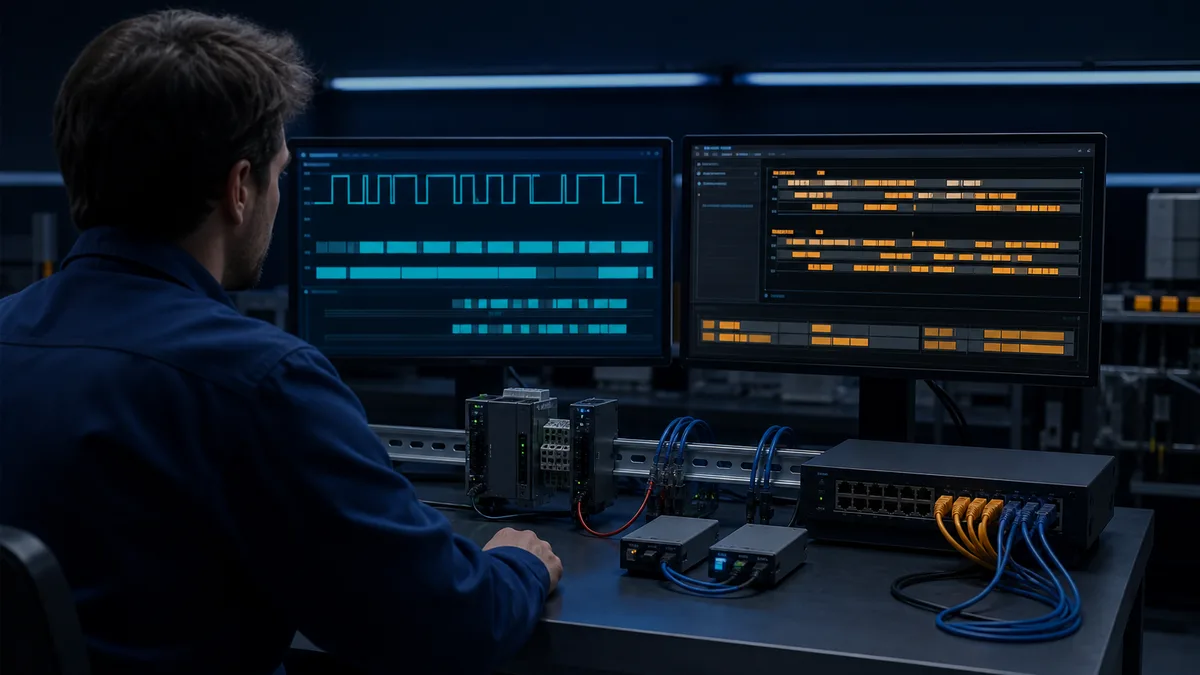
Choose only after naming the exact variants and the application contract. “Modbus vs PROFIBUS” is not one clean standards comparison: Modbus is an application protocol whose PDU can travel in RTU, ASCII or TCP wrappers, while PROFIBUS is an industrial fieldbus family whose DP protocol is combined with transmission technologies and application profiles. A useful project comparison is usually Modbus RTU over a documented serial interface versus PROFIBUS DP over a documented RS-485/fiber segment, or Modbus TCP versus a proposed PROFIBUS/PROFINET lifecycle path.
Modbus is often a strong fit when both endpoints expose an exact register map, the client can schedule polling within measured freshness limits, and a simple multi-vendor request/response interface is valuable. PROFIBUS DP is often a strong fit when an established plant uses compatible DP controllers/devices, GSD-based configuration, cyclic I/O, standardized profiles or richer station/module/channel diagnostics. Neither label proves device compatibility, update time, cable design, security, safe failure or maintainability.
Selection rule: preserve a healthy supported installed network unless measured constraints or lifecycle risk justify change. For a new design, compare supported products, engineering workflow, physical environment, load, diagnostics, security, skills, spares and migration/rollback evidence—not age or headline baud rate alone.
Download the Modbus-vs-PROFIBUS decision matrix (CSV) and replace every generic row with evidence from the exact controller, interface, device and site.
Canonical boundaries
| Reader task | Specialist owner | Boundary |
|---|---|---|
| full Modbus family reference | Modbus protocol guide | data tables, functions, RTU/TCP frames, addressing, values and diagnostics |
| Modbus RTU construction | Modbus RTU over RS-485 | serial settings, CRC, physical trunk, poll capacity and commissioning |
| full PROFIBUS implementation | PROFIBUS DP protocol guide | roles, bus cycles, GSD, mapping, DP/PA, commissioning and faults |
| detailed copper construction | PROFIBUS cable guide | cable, connectors, termination, shielding and qualified measurements |
| TCP/RTU conversion | Modbus TCP converter | direction, Unit-ID routing, queues, serial capacity and gateway security |
| PROFIBUS migration | PROFINET vs PROFIBUS | installed-base retention versus staged Ethernet migration |
First normalize the comparison
The four combinations below answer different questions. Do not merge them into one “speed” row.
| Candidate | Protocol/application model | Typical transport context | Core configuration artifact | Typical use under comparison |
|---|---|---|---|---|
| Modbus RTU | client request, server response, tables/functions, RTU address/timing/CRC | asynchronous serial, commonly two-wire EIA/TIA-485 | controlled register map plus serial schedule | meters, drives, instruments and PLC links |
| Modbus TCP | client/server PDU after MBAP header | TCP/IP, commonly industrial Ethernet | register map plus endpoint/connection/Unit-ID contract | PLC, HMI, SCADA, gateway and device integration |
| PROFIBUS DP | active-station access plus cyclic DP controller/device exchange; supported acyclic/diagnostic services | commonly DP RS-485 or supported fiber | GSD, Ident identity, station address, module order and process-data contract | distributed I/O, drives and intelligent devices |
| PROFIBUS PA | DP protocol with PA profiles and a process-automation physical/segment-power context | MBP trunk/spur systems through suitable links/couplers | device/profile plus powered-segment design | process instruments, including applicable hazardous-area designs |
The comparison on this page focuses on Modbus RTU and PROFIBUS DP because both frequently appear as serial field networks. Modbus TCP and PROFIBUS PA are included where their different transport or process context changes the decision.
Compare architecture and communication ownership
Modbus owns a request contract
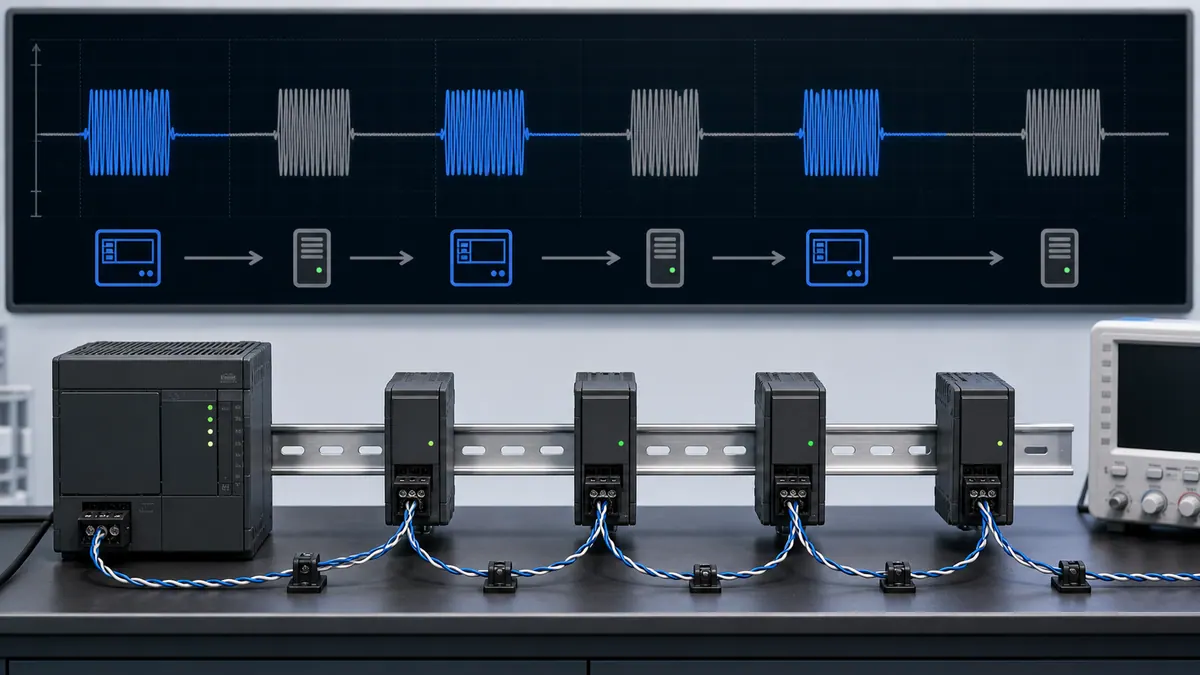
A Modbus client selects the server/Unit ID as applicable, function, zero-based protocol offset, quantity and value interpretation. A server returns a normal response, confirms a supported write, returns an exception or stays silent. The core protocol does not define what device register 100 means or how two registers form a float; the device's controlled map owns type, scale, units, access and word order.
One serial RTU client normally schedules requests on a bus. That polling can be deliberately modeled, measured and bounded for the application's credible load. It is inaccurate to label all Modbus polling “non-deterministic” while ignoring the actual schedule, response distribution, retry/timeout policy and value-age objective.
PROFIBUS DP owns an engineered cyclic data shape
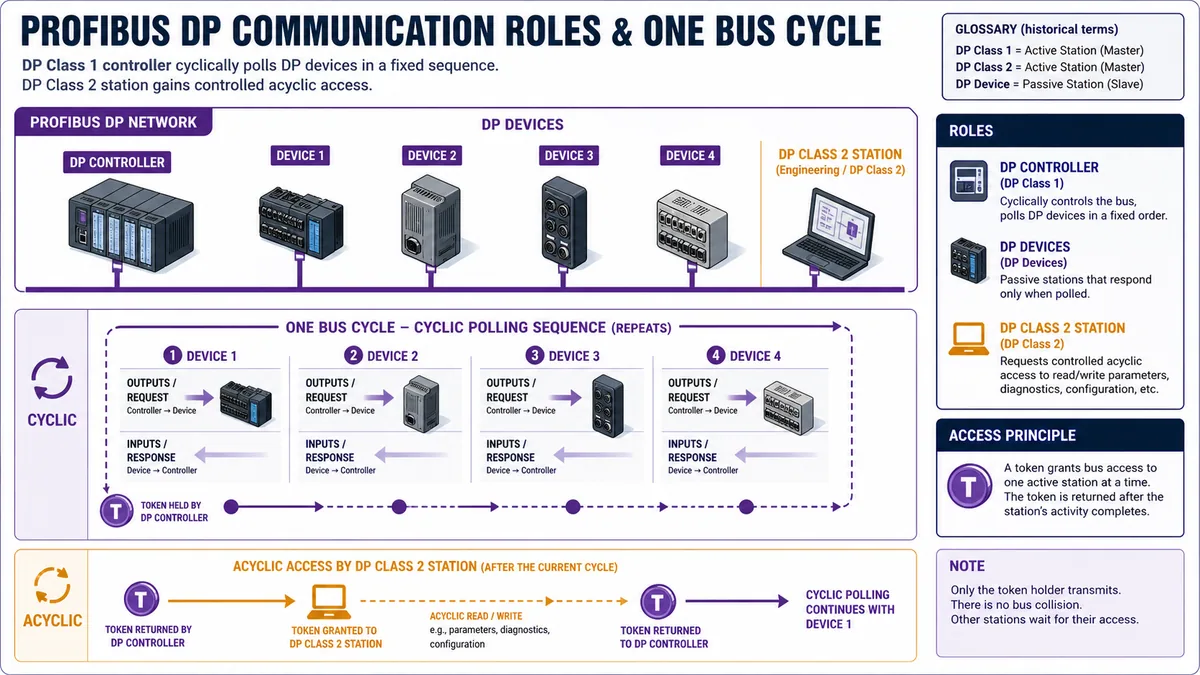
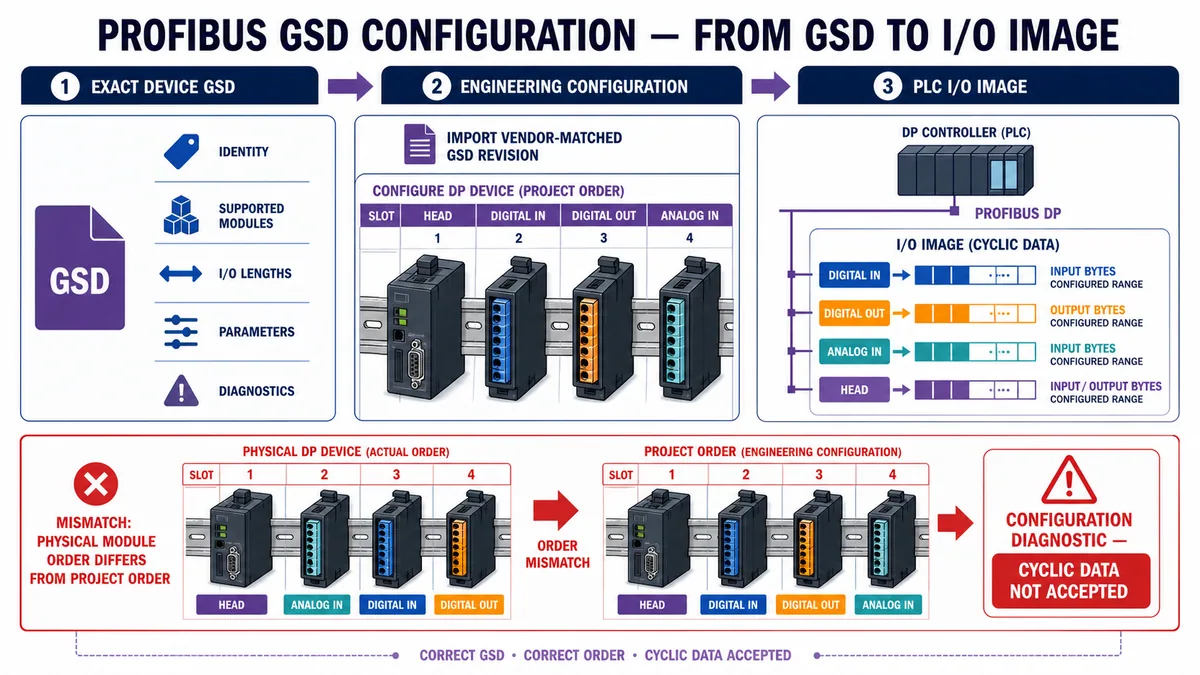
A DP controller normally exchanges configured output and input data cyclically with DP devices. Device identity, GSD, station address, parameter data, selected modules, module order and input/output lengths must agree before useful data exchange. Supported DP-V1 services add acyclic records and alarms alongside cyclic data.
PROFIBUS engineering does not eliminate application meaning. A GSD is a standardized device communication description; it is not an XML-like universal process model and does not prove scale, units, safe state or mechanical behavior. The device/profile manual and tested PLC tag contract still own those meanings.
| Architecture question | Modbus evidence | PROFIBUS DP evidence |
|---|---|---|
| Who initiates? | named RTU/TCP client and transaction owner | DP controller/active station roles and token/access design |
| What identifies the endpoint? | serial server address or TCP endpoint plus Unit ID | station address, Ident/device identity and GSD configuration |
| What defines data? | function, offset, quantity and device register map | selected module/data layout plus device/profile meaning |
| What repeats? | application poll list and schedule | configured cyclic device exchanges |
| What is on-demand? | any client request; constrained by role/transport | supported acyclic records/alarms and Class 2 access |
| How is failure represented? | exception, timeout, framing/CRC/connection evidence and application quality | controller, station, configuration, module/channel and telegram diagnostics |
Compare data engineering and maintenance
Register contract versus GSD plus process-data contract
| Data-engineering task | Modbus | PROFIBUS DP | Acceptance evidence |
|---|---|---|---|
| choose object | coil/discrete/input/holding table and function | supported GSD module/profile selection | current controlled source matches device |
| locate value | transmitted zero-based offset and quantity | slot/module plus input/output byte/word location | raw capture and PLC address agree |
| define type | device-controlled signedness, width and multi-register order | device/profile-controlled field structure and byte/word meaning | asymmetric known vector decodes exactly |
| define scale/units | device map and configuration | device/profile manual and parameters | low/mid/high independent reference |
| quality | transaction validation, last-good age, device status registers | DP communication and device/module/channel diagnostics | forced approved fault invalidates consumer data |
| replacement | address/settings/map/firmware compatibility | Ident/GSD/firmware/module compatibility and parameterization | spare restores only after repeated functional proof |
The GSD workflow can reduce manual communication-configuration ambiguity for supported devices, but it adds version and compatibility governance. The register-map workflow is simple when the vendor publishes a stable, precise table, but fragile when reference notation, firmware variants or multi-register encodings are unclear. Score the actual documentation, not the theoretical model.
Compare physical networks without transferring rules
Both Modbus RTU and PROFIBUS DP can be implemented over balanced serial physical layers, but their approved cable, connector, topology, termination, bias/polarization, reference, shield, baud-distance and device-loading rules are not interchangeable.
| Physical decision | Modbus RTU implementation | PROFIBUS DP implementation |
|---|---|---|
| interface | exact device may use RS-485, RS-232 or another supported serial interface | exact DP device/controller may use RS-485 or supported fiber |
| cable/connector | product and project design; terminal names vary | PI/device installation system; common DP connectors do not make every layout identical |
| idle state | transceiver-integrated or engineered bias/fail-safe strategy | PROFIBUS physical design/termination and exact interface guidance |
| termination | electrical ends where required by the line design | powered termination behavior and segment ends per applicable guidance |
| topology | controlled trunk/drop design with measured limits | controlled segment/repeater/fiber topology |
| shield/bonding/reference | site/device/EMC/common-mode design | PI/device/site equipotential and shielding design |
| PA transfer | not applicable by label | DP RS-485 rules must not be copied to PA MBP trunk/spur design |
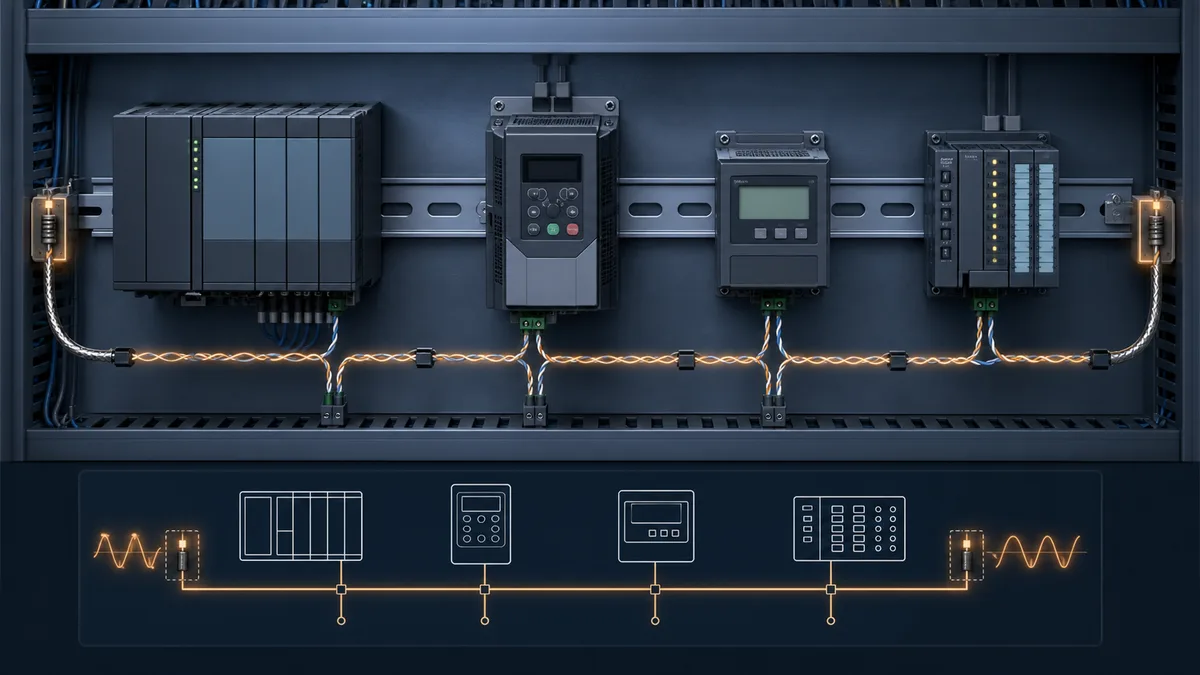
Do not select from a universal distance/node table. Address space is not electrical capacity; the practical device count also depends on transceiver load, topology, telegram/poll load, response time, retry policy and freshness goals.
Compare timing from the consumer backwards
Modbus RTU worked scheduling model
For each request, estimate:
Transaction time = request wire time
                 + required separation / turnaround
                 + measured server processing
                 + response wire time
                 + justified engineering margin
Then sum the scheduled transactions, retries and timeouts that can occur before the value's next valid update. A ten-device link can meet a two-second freshness goal or fail it depending on frame sizes, baud, server response, poll classes and degraded behavior. The protocol name alone cannot answer.
PROFIBUS DP worked age model
Model device exchange, telegram sizes, response/turnaround, active-station/token behavior, acyclic/diagnostic load, retries, controller-interface update, PLC task phase and consumer cycle. Bus cycle is not automatically HMI or interlock data age.
| Timing metric | Why measure it | Compare under |
|---|---|---|
| normal cycle distribution | establishes typical and variation evidence | representative device/poll load |
| worst credible response | sizes timeout and freshness margin | slowest supported device state |
| retry/error behavior | shows degraded capacity and precursor faults | controlled error/fault cases |
| PLC consumer age | proves application requirement | task phase plus network update |
| restoration time | proves alarm/fallback and recovery | device/network restart cases |
Compare diagnostics by evidence depth
Modbus exceptions are protocol-level responses: illegal function, illegal data address and other defined codes show that a server received enough of a request to reject it. A timeout can arise from no request, wrong address/settings, physical failure, CRC discard, busy/slow device or missing response. Device health often requires mapped diagnostic registers and endpoint counters.
PROFIBUS DP can provide controller/interface, live-list, parameter/configuration and device/module/channel diagnostic layers when supported and configured. Richer available diagnostics do not help if the PLC/HMI collapses them into one red bit or the team lacks the correct GSD/manual/tool evidence.
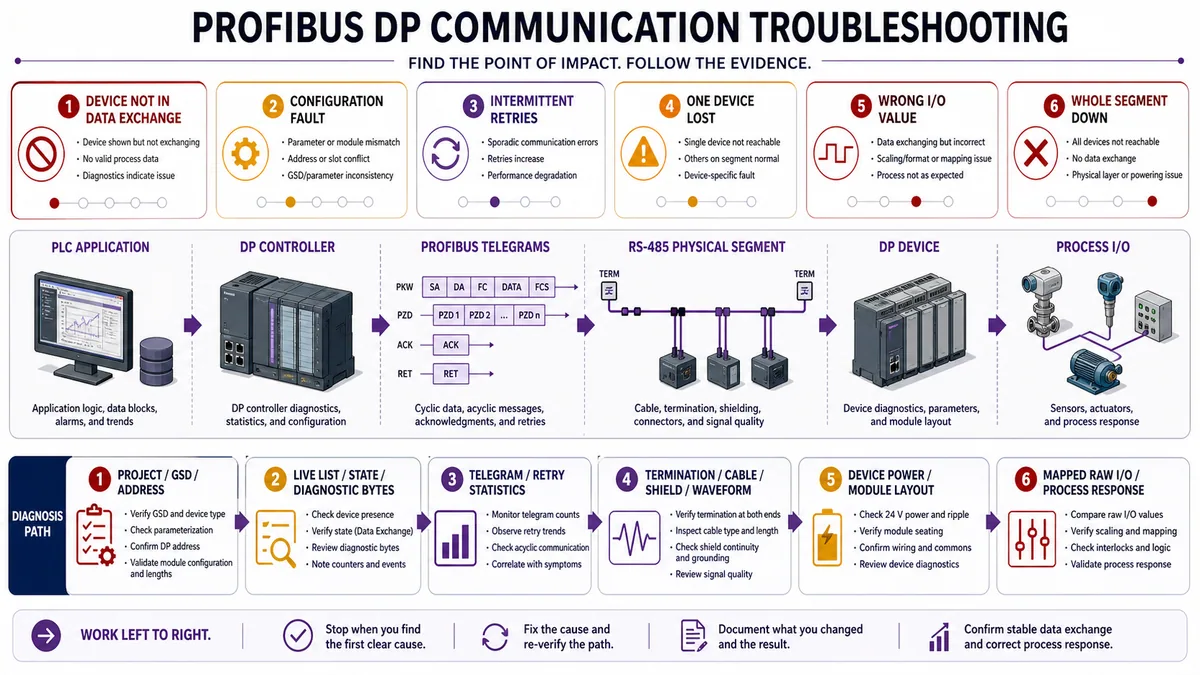
| Symptom | Modbus first evidence | PROFIBUS DP first evidence | Shared anti-pattern |
|---|---|---|---|
| one device absent | request bytes, server address/settings, physical activity and power | live list, station address, power and segment path | changing application mapping first |
| device visible but no useful data | response/exception plus function/offset/type | parameter/config diagnostic plus module order/length | treating visibility as accepted configuration |
| stable wrong value | raw registers, word order, scale and freshness | raw cyclic bytes, field definition, scale and quality | rewiring a semantic fault |
| intermittent loss | counters/capture, timing, connector/power/waveform correlation | retry/telegram trend, diagnostic timeline and physical evidence | resetting before capture |
| whole segment down | client/interface, trunk, termination/reference and broad change | controller/interface, trunk, termination power and broad change | replacing every device |
| recovers after restart | configuration/counter/timeline comparison | accepted configuration, recurrence and diagnostic comparison | declaring root cause fixed |
Download the cross-protocol fault-capture sheet (CSV) to keep the symptom, scope, raw transport evidence and process timeline together.
Selection scorecard
Use mandatory gates before weighted preferences. A candidate fails if no supported controller/device combination, approved physical design, required timing, diagnostic evidence, security architecture, safety boundary, lifecycle path or competent support exists.
| Decision area | Evidence to collect | Modbus may lead when | PROFIBUS may lead when |
|---|---|---|---|
| installed base | healthy topology, tools, spares and skills | stable documented register devices dominate | stable supported DP devices/infrastructure dominate |
| device availability | exact current product interfaces | Modbus is the strongest common interface | DP/profile support is current and verified |
| engineering clarity | maps/GSDs/manual quality | maps are precise, stable and testable | GSD/profile/device packages are well governed |
| timing | measured model under load/fault | polling meets every freshness deadline | cyclic DP plan meets tighter structured I/O need |
| diagnostics | observable controller/device evidence | mapped device diagnostics and counters suffice | station/module/channel evidence materially improves recovery |
| physical environment | segment design and qualified evidence | existing serial design is fit | existing DP/fiber/PA architecture is fit |
| cybersecurity | reachable paths and administration | constrained isolated service is supportable | engineering/gateway paths are equally controlled |
| lifecycle | vendor support, spares, migration/rollback | broad device availability reduces dependency | installed standard and profiles reduce operational change |
| total cost | hardware, engineering, test, support and downtime | simpler interface lowers whole-life effort | consistent ecosystem lowers commissioning/recovery effort |
Worked decision: brownfield packaging line
Assume an existing line has a healthy, documented PROFIBUS DP remote-I/O network and two new energy meters that support Modbus RTU only. Replacing the DP network to achieve one protocol would expand commissioning and outage risk without solving a measured constraint. A defensible architecture can retain DP for distributed I/O and add one isolated, capacity-tested Modbus segment for the meters, with separate quality/age contracts and a managed data boundary. “One protocol everywhere” is not automatically simpler after migration risk is counted.
Worked decision: new small utility skid
Assume one PLC must read four meters and one analyzer, every device exposes a current Modbus map, a five-second freshness goal is acceptable, the panel has an approved isolated serial interface, and maintainers support the tools. A modeled and tested Modbus RTU link may be lower-risk than introducing PROFIBUS solely for theoretical speed. If the same skid instead requires a supported DP drive profile, large distributed I/O set and plant-standard diagnostic workflow, PROFIBUS DP may score differently.
Commission the selected candidate with the same proof standard
| Test | Modbus evidence | PROFIBUS DP evidence |
|---|---|---|
| identity | endpoint/port, address/Unit ID, map and firmware | controller/device, station, Ident, GSD and firmware |
| configuration | serial/TCP settings, function, offset, quantity, type | parameters, module order, I/O length and profile |
| normal data | captured request/response and known physical value | cyclic bytes/tag plus known physical value |
| boundary data | first/last valid address and conversion extremes | first/last channel/module field and conversion extremes |
| diagnostic | exception/timeout/device-status event | station/module/channel event and raw diagnostic |
| loss | stale deadline, bounded retry and safe consumer response | device/segment loss, invalid data and safe consumer response |
| recovery | full response revalidation; no command replay | accepted startup/data state; no unintended restart |
| load | poll/connection distribution and value age | bus cycle/retry/consumer age distribution |
| restoration | backup, endpoint settings and map version | project, GSD set, parameters and replacement behavior |
Download the protocol selection acceptance matrix (CSV) and use project-approved criteria rather than the examples on this page.
Migration and coexistence
Modbus and PROFIBUS can coexist through separate controller interfaces or suitable gateways, but coexistence creates more than cabling. Define which system owns each value and command, how quality and age cross the boundary, how addresses map, which side retries, what happens when one side is unavailable, how writes are authorized and how the configuration is backed up.
Do not assume every Ethernet successor preserves behavior unchanged. Modbus TCP retains the common Modbus PDU but changes endpoint, connection and transport evidence. PROFINET is not PROFIBUS inside Ethernet; its frames, engineering descriptions, timing classes, topology and commissioning workflow differ. Migration needs a matched functional and degraded-state test, rollback and operator/maintenance readiness.
Frequently asked questions
What is the main difference between Modbus and PROFIBUS?
Modbus defines client/server operations over four logical data tables and relies on device-controlled register meaning. PROFIBUS DP provides an engineered fieldbus system with controller/device roles, cyclic data exchange, GSD configuration and supported diagnostic/profile services. Compare exact transports and products, not names alone.
Is PROFIBUS always faster than Modbus?
PROFIBUS DP supports high data rates and planned cyclic exchange, but “faster” must be the measured end-to-end value age for the configured system. A small Modbus poll list can meet its requirement; a loaded or faulting network of either type can miss an unsupported assumption.
Is Modbus non-deterministic?
Modbus does not provide PROFIBUS DP's engineered cyclic schedule, but a single controlled RTU client can use a fixed poll plan whose normal and degraded timing is modeled and measured. Whether that is sufficiently bounded depends on response, retries, timeouts and the application deadline.
Is PROFIBUS proprietary to Siemens?
No. PROFIBUS is standardized and supported through PROFIBUS & PROFINET International, with products from many manufacturers. Siemens has a major installed base and tool ecosystem, but selection must use the exact certified/supported controller and device set.
Is a PROFIBUS GSD file like a Modbus register map?
They overlap only partly. A GSD describes device communication/configuration capabilities such as modules, lengths, parameters and diagnostics. A Modbus map describes application addresses and meanings. A GSD still does not replace all device/profile/process meaning.
Can Modbus and PROFIBUS use the same RS-485 cable?
Do not assume so. Both may use balanced serial signaling in particular implementations, but the applicable cable, connector, topology, termination, bias/polarization, reference and installation rules differ. Use the exact protocol and product guidance.
Which protocol supports more devices?
Address-space maxima do not answer usable capacity. Count exact electrical loads/segments and calculate telegram or poll load, retries, update objectives and controller/device limits. A design can reach a timing limit before an address limit.
Does PROFIBUS provide better diagnostics?
PROFIBUS DP can expose structured controller, station, configuration, module and channel diagnostics when supported. Modbus uses responses/exceptions plus device registers and endpoint counters. The better system is the one that preserves actionable evidence in the PLC/HMI and maintenance workflow.
Is Modbus cheaper than PROFIBUS?
Hardware can be inexpensive, but total cost includes documentation quality, engineering, interfaces, physical installation, testing, downtime, diagnostics, tools, training, spares and recovery. Score the installed lifecycle rather than a transceiver or connector price.
Should a new project avoid both protocols?
No universal rule applies. Ethernet options may fit many new systems, while supported serial devices, process instruments, physical environments or installed standards can justify Modbus RTU or PROFIBUS. Choose from current product and project evidence.
Can PROFIBUS carry safety communication?
PROFIsafe can support safety communication over an approved black-channel architecture when the complete certified/supported host, device, parameters, safety program, response time and lifecycle are validated. Ordinary PROFIBUS data is not automatically safety-rated.
Can Modbus be used for safety control?
Ordinary Modbus RTU/TCP does not become a safety protocol because a command is repeated or checked. Safety functions require suitable architecture and lifecycle validation independent of this comparison.
How do I migrate from PROFIBUS to Modbus or vice versa?
Inventory exact data, commands, quality, diagnostics, timing and failure behavior; build a typed mapping; select supported interfaces; test matched normal/fault cases; control cutover and rollback; and update drawings, backups, training and spares. A gateway is not automatic semantic equivalence.
Where can I practise protocol troubleshooting?
Use the industrial communication simulator to rehearse first-failed-boundary diagnosis. The two sites share an operator. The browser lab does not reproduce exact RTU/DP hardware, waveform, GSD, timing, device, process or safety behavior.
Primary and official sources
- Modbus Organization specifications and implementation guides
- Modbus Application Protocol Specification V1.1b3
- Modbus over Serial Line Specification and Implementation Guide V1.02
- Modbus Messaging on TCP/IP Implementation Guide V1.0b
- Modbus Organization introduction
- Modbus Organization FAQ
- PI PROFIBUS technology overview
- PI PROFIBUS System Description
- PI PROFIBUS installation guidance index
- PI PROFIBUS Commissioning Guideline V1.23
- PI PROFIBUS GSD library
- PI Ident Numbers
- PI PROFIsafe technology
- Siemens ET 200SP IM 155-6 DP HF manual
- ABB FPBA-01 PROFIBUS DP adapter manual
- NIST SP 800-82 Rev. 3
- OSHA 29 CFR 1910.147 hazardous-energy control
- IEC 61158-1:2023 overview
Limitations: this comparison is a vendor-neutral decision and verification framework, not a cable design, GSD approval, register map, timing guarantee, cybersecurity architecture, safety lifecycle or permission to test a production network. Use current exact product documents, controlled project records, competent personnel and approved physical/process/safety procedures.


