PLC Brands Compared: 10 Vendor Ecosystems and a Selection Test (2026)
Compare ten PLC ecosystems by installed-base fit, dated software evidence, motion, safety, protocols, lifecycle, support and a matched engineering pilot.
PLC brands comparison: the short answer
There is no universally best PLC brand. For a brownfield plant, the strongest default is usually the supported installed standard. For a new machine, the best shortlist is the set of platforms that satisfy every mandatory requirement and can be serviced in the delivery region. The winner should then come from a matched pilot, exact bill of materials, software/firmware compatibility check, lifecycle evidence and stakeholder-approved weighting—not from global reputation alone.
This 2026 comparison covers ten important vendor ecosystems without assigning unsupported global-market-share percentages. Use it to build a shortlist, then verify exact catalog numbers, firmware, software entitlements and lifecycle status with the manufacturers.
What this comparison can and cannot prove
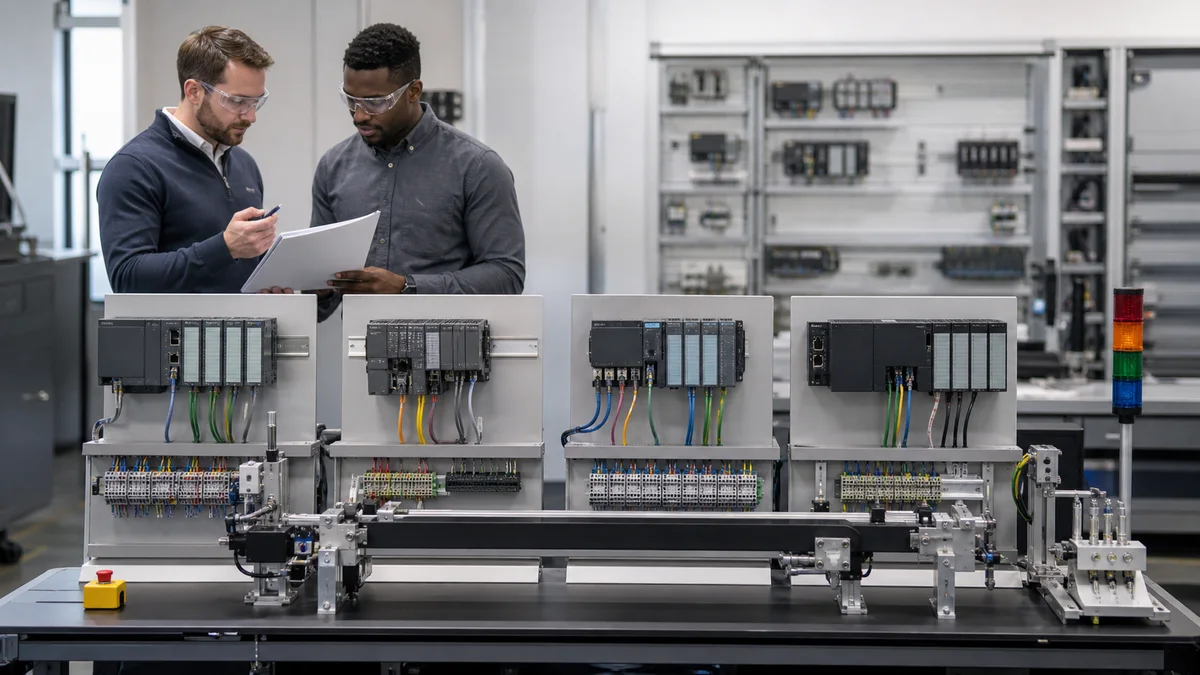
This guide compares ecosystems, not every CPU inside each catalog. A compact controller and a high-availability process controller from the same manufacturer can have different programming tools, networks, safety options, task models, lifecycle dates and support channels. The word “supports” is also too vague for procurement: support may be built into one CPU, require an option module on another, depend on firmware, or cover only a subset of a protocol profile.
The comparison therefore separates five evidence layers:
| Evidence layer | Question it answers | Acceptable evidence | Not enough by itself |
|---|---|---|---|
| Installed standard | Can the site own this platform? | Approved-vendor list, installed inventory, recoverable projects, spares and named support staff | “The plant uses this brand somewhere” |
| Exact product fit | Can the configured CPU, modules and firmware meet the requirement? | Current product manual, selection tool output, catalog numbers and written vendor confirmation | Family brochure or distributor category page |
| Engineering workflow | Can the team build, test, diagnose and restore the application? | Frozen tool versions, matched pilot, observed timings, screenshots and exported reports | A promotional demo or a programmer's preference |
| Lifecycle and security | Can the system be maintained through the required service life? | Lifecycle status, update channel, vulnerability advisories, backup/restore proof and spare strategy | “The vendor is large” or “PLCs last 20 years” |
| Commercial and regional delivery | Can it be bought and supported where the machine will operate? | Dated authorized quote, lead time, license terms, training plan and response agreement | An undated web price in another country |
Claims on this page are bounded to sources reviewed on August 29, 2026. Product pages can change. Before purchase, save the exact manuals, release notes, entitlement terms and selection records used for the decision.
Why this is not a top-ten ranking
The ten ecosystems are listed to create a practical consideration set, not positions one through ten. A rank would require a declared application, mandatory requirements, region, weights and comparable evidence. Without those inputs, “number one” is marketing vocabulary. A small machine builder optimizing for freely downloadable software and local stock can rationally select a different platform from a validated process plant protecting an installed high-availability standard.
Quick comparison
| Vendor ecosystem | Engineering environment | Typical reason to shortlist | Verify before selection |
|---|---|---|---|
| Siemens SIMATIC | TIA Portal / STEP 7 | Existing SIMATIC standard; integrated automation portfolio | TIA version, CPU generation, licenses and PROFINET device support |
| Rockwell Automation Logix | Studio 5000 Logix Designer | Existing Allen-Bradley standard and EtherNet/IP ecosystem | Controller/firmware compatibility, activation and support contract |
| Mitsubishi Electric MELSEC | GX Works3 or legacy tool by CPU | iQ-F/iQ-R projects and existing MELSEC machinery | Exact CPU-to-software mapping, CC-Link options and regional support |
| Schneider Electric Modicon | EcoStruxure Control Expert or machine software by family | Existing Modicon infrastructure and process/machine portfolio | M580/M340/Machine Expert boundary, protocols and lifecycle |
| Beckhoff | TwinCAT 3 | PC-based control and EtherCAT-centric motion | Runtime licenses, IPC sizing, real-time configuration and local skills |
| Omron Sysmac | Sysmac Studio | Integrated machine control, motion, vision and safety | Controller edition, option units, licenses and supported device profiles |
| ABB / B&R | Automation Builder or Automation Studio | Existing ABB/B&R machine or process ecosystem | Which product organization owns the project and toolchain |
| Emerson PACSystems | PAC Machine Edition | Existing PACSystems/GE installed base and infrastructure projects | Current 200/300/400-Series naming, legacy migration and lifecycle |
| Delta Electronics | ISPSoft/DIAStudio or WPLSoft by family | Compact machinery with an existing Delta standard | Exact family/tool mapping, support, approvals and protocol modules |
| AutomationDirect | Productivity, Do-more or CLICK software by family | North American small-machine and training projects | Family-specific software, I/O limits, approvals and support scope |
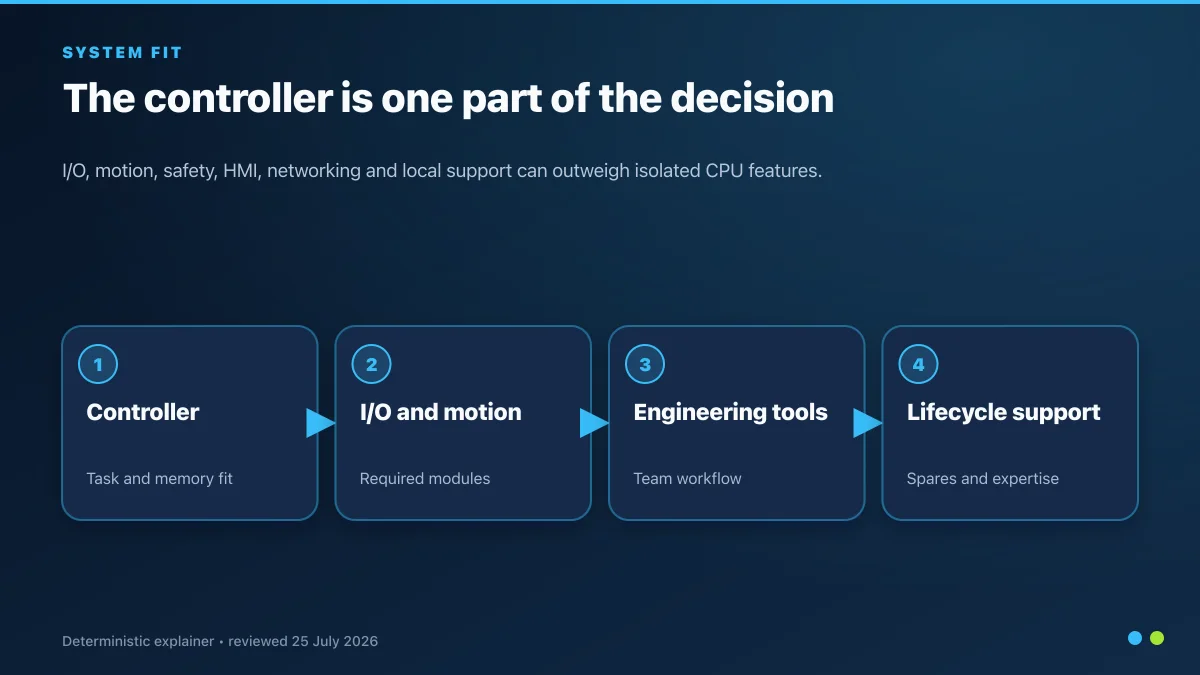
Shortlist by constraint, not by reputation
| Project constraint | First evidence to collect |
|---|---|
| Existing plant standard | Installed CPU/module inventory, spare stock, approved libraries and available engineers |
| High-axis-count motion | Required kinematics, update rate, drive integration and a hardware pilot |
| Safety functions | Risk assessment, required performance and certified component/application manuals |
| Brownfield migration | Source project access, supported conversion path, I/O cutover and rollback plan |
| Regulated production | Change control, audit trail, software lifecycle and long-term support evidence |
| Training laboratory | Learning objective, replaceable hardware, safe I/O and software access terms |
Dated software and compatibility checkpoint
The table below is a research checkpoint, not permission to standardize the named release. A project may need an older engineering version because its installed controller firmware, safety signature, option package, operating system, or validated baseline requires it.
| Ecosystem | Official evidence checked on August 29, 2026 | Version boundary to freeze for a real project |
|---|---|---|
| Siemens SIMATIC | Siemens support and product material identify TIA Portal V21 and STEP 7 within TIA Portal | TIA release, update/hotfix, STEP 7 edition, CPU catalog number and firmware, hardware support package, PLCSIM option and safety package |
| Rockwell Logix | Rockwell PCDC lists Studio 5000 Logix Designer 38.x releases; the controller manual says Logix Designer and controller firmware use the same major revision | Controller family/catalog, firmware major and minor, Logix Designer release/edition, FactoryTalk services, Add-on Profiles and activation entitlement |
| Mitsubishi MELSEC | The current GX Works3 operating manual contains module-specific minimum software support entries instead of one safe universal pairing | CPU and module model, CPU firmware, GX Works3 build, module profiles, motion tool and CC-Link engineering files |
| Schneider Modicon | Schneider identifies EcoStruxure Control Expert as the common environment for M340, M580, M580 Safety and selected legacy ranges | Controller family, firmware, Control Expert release/license, device DTM/EDS/GSD files, safety toolchain and legacy-conversion path |
| Beckhoff TwinCAT | Beckhoff's download finder presents TwinCAT 3.1 Build 4026 package-based XAE/XAR downloads | XAE build/packages, target XAR build, IPC/OS image, runtime licenses, EtherCAT device descriptions and real-time configuration |
| Omron Sysmac | Omron's product and platform pages identify Sysmac Studio for NJ/NX machine automation and maintain a separate software revision history | Sysmac Studio build/license, NJ/NX/NY controller model and version, EtherCAT/EtherNet/IP device revisions, safety and simulation options |
| ABB AC500 / B&R | ABB publishes Automation Builder 2.9.0 material dated 2026; B&R lists Automation Studio V6 packages including 6.5.1.7 | Treat them as separate projects: exact AC500 or B&R CPU, engineering release, runtime/firmware, libraries, safety package and licenses |
| Emerson PACSystems | Emerson documents PAC Machine Edition 10 and a PAC Productivity Suite package line; controller manuals state minimum PME/firmware combinations | PACSystems catalog, CPU firmware, PME build/edition, target pack, device profiles, change-management compatibility and legacy GE project path |
| Delta | Delta maps DIADesigner and ISPSoft to different PLC families and notes that language support varies by series | PLC family/model, firmware, DIADesigner or ISPSoft build, communication/motion options and local distributor support |
| AutomationDirect | AutomationDirect publishes separate CLICK, Do-more Designer and Productivity Suite support/download surfaces | Choose one family first; freeze CPU/firmware, its matching software build, project format, module revisions and export/restore method |
Two practical consequences follow. First, a comparison spreadsheet should never contain only “TIA Portal,” “Studio 5000,” or “TwinCAT.” It needs the tested release and entitlement. Second, opening and saving an old project in a newer tool can be a migration event. Preserve an untouched source backup, record the conversion messages, and prove a rollback before relying on the converted project.
Define mandatory requirements before comparing vendors
Separate pass/fail requirements from weighted preferences. A candidate that cannot meet a required safety function, environmental rating, redundancy architecture, protocol role, regulatory approval, or delivery date should not recover through a high score for interface familiarity.
| Requirement group | Write this before contacting vendors | Evidence required to pass |
|---|---|---|
| Control workload | I/O count and types, task periods, sequence complexity, data retention, recipe and timestamp needs | Sizing calculation plus exact CPU/module manual references and a measured pilot margin |
| Motion | Axis count, coordination/kinematics, update period, encoder/drive interfaces, homing and safe-motion functions | Supported architecture, drive/controller compatibility and representative multi-axis test |
| Functional safety | Risk-reduction functions and required performance from the machine/process safety lifecycle | Risk assessment, certified products/libraries, safety manual, validation plan and competent review |
| Communications | Protocol, controller/device/client/server role, profile, connection count, update time, diagnostics and cybersecurity boundary | Exact firmware/module support, conformance/device files and a test with the real peer |
| Environment and approvals | Temperature, vibration, contamination, hazardous location, marine/rail or regional conformity needs | Catalog-specific certificates and installation limits for every selected component |
| Availability and recovery | Redundancy, bumpless behavior, repair time, spare horizon, backup frequency and restoration objective | Vendor architecture, fault tests, spare plan and timed bare-device restore exercise |
| Engineering operations | Supported OS/VM, version control, compare, audit, multiuser, simulation, online-change and access-control needs | Tool demonstration using the project workflow and written license/entitlement terms |
| Delivery region | Site countries, commissioning language, local stock, support hours and integrator competence | Authorized quote, named support path, training availability and response commitment |
How the ten vendors compare
Siemens SIMATIC
Shortlist Siemens when the customer standard is SIMATIC, the project depends on the Siemens drive/HMI/safety ecosystem, or local integrators primarily support TIA Portal. Verify the exact controller and TIA Portal release; “Siemens PLC” is not a sufficient compatibility specification.
- Official source: SIMATIC controllers
- Internal guide: Siemens vs Allen-Bradley
Rockwell Automation / Allen-Bradley Logix
Shortlist Logix where the plant standard, spare stock and engineering team already use ControlLogix or CompactLogix and EtherNet/IP. Confirm firmware/software compatibility and required Studio 5000 editions before quoting.
- Official source: Programmable controllers
- Internal guide: Studio 5000 software
Mitsubishi Electric MELSEC
Shortlist MELSEC for an existing Mitsubishi machine base or where iQ-F/iQ-R, Mitsubishi drives and CC-Link fit the approved architecture. CPU generation determines whether GX Works3, GX Works2 or a legacy tool is required.
- Official source: MELSEC programmable controllers
- Internal guide: Mitsubishi PLC programming
Schneider Electric Modicon
Shortlist Modicon where EcoStruxure/Modicon is already standardized, especially in infrastructure and process-related applications. Confirm whether the project belongs in Control Expert or the machine-control toolchain and which protocol functions are built in versus optional.
- Official source: Modicon PLCs and PACs
- Internal guide: Schneider vs Siemens
Beckhoff
Shortlist Beckhoff when PC-based control, EtherCAT and tightly integrated motion are project requirements and the team can support the TwinCAT runtime/IPC lifecycle. Validate task timing on the specified hardware rather than treating a benchmark as a project guarantee.
- Official source: TwinCAT automation software
- Internal guide: TwinCAT vs CODESYS
Omron Sysmac
Shortlist Omron where the approved machine architecture benefits from a shared controller, motion, safety and vision toolchain. Verify the exact controller, option units, supported devices and Sysmac Studio license.
- Official source: Machine automation controllers
- Internal guide: Omron vs Siemens
ABB and B&R
ABB's AC500 and B&R's machine-automation portfolio use different engineering environments and support organizations. Shortlist the specific ecosystem already approved for the project; do not collapse both into one generic “ABB PLC” specification.
- Official sources: ABB AC500, B&R control systems
- Internal guide: ABB PLC programming
Emerson PACSystems
Shortlist PACSystems for an existing GE/Emerson installed base or where the current PACSystems architecture and PAC Machine Edition meet the project requirements. Emerson now presents current controllers as 200-, 300- and 400-Series; record the legacy and current names during migration.
- Official sources: PACSystems PLCs, PAC Machine Edition 10
- Internal guide: GE/Emerson PACSystems tutorial
Delta Electronics
Shortlist Delta where a customer already supports the family or the complete machine BOM, local approvals and distributor support make it suitable. Confirm whether the CPU uses ISPSoft, DIAStudio, WPLSoft or another family-specific environment.
- Official source: Delta PLCs
- Internal guide: Delta PLC tutorial
AutomationDirect
Shortlist AutomationDirect for supported North American small-machine, laboratory and retrofit contexts where the chosen family meets the approvals and I/O/network requirements. CLICK, Do-more and Productivity are distinct platforms; evaluate the exact family.
- Official source: PLC hardware and software
- Internal guide: Free PLC software comparison
Live mini-lab
Try it: press START, then STOP
A stop-dominant seal-in rung: START latches the motor output through its own contact, and STOP breaks the circuit.
Watch the output lamp: it stays on after START until you press STOP.
Free · no signup to try · runs in your browserOpens plcsimulationsoftware.com — same team
Which PLC brand fits which project context
This table identifies starting points for evidence collection, not winners. Any row can change after mandatory requirements, region, installed standards and the configured-product pilot are applied.
| Project context | Sensible first shortlist | Why it enters the consideration set | Disqualifying question to ask early |
|---|---|---|---|
| Existing Siemens plant | Siemens SIMATIC plus any approved migration alternative | Installed projects, spares, PROFINET devices, training and TIA workflow may dominate ownership cost | Is the source project recoverable in the required TIA release, and is the installed CPU still supported? |
| Existing Allen-Bradley plant | Rockwell Logix plus any plant-approved alternative | Logix skills, EtherNet/IP assets, libraries, firmware standards and stocked modules may reduce change risk | Can the organization maintain all required Studio 5000/firmware majors and activation entitlements? |
| High-performance machine with EtherCAT | Beckhoff, Omron Sysmac, B&R and other candidates proven against the motion scope | Integrated motion and EtherCAT engineering are central to these machine-control consideration sets | Can the exact hardware meet axis, cycle, recovery and support requirements under the real workload? |
| Process/infrastructure modernization | Schneider Modicon, Siemens, Rockwell, Emerson PACSystems, ABB and approved regional alternatives | These ecosystems include architectures commonly considered for broader plant and infrastructure control | Is the proposed controller/toolchain the right family, and is the legacy conversion and cutover evidence credible? |
| Cost-constrained supported small machine | AutomationDirect, Delta, compact lines from larger vendors and locally supported alternatives | Controller, I/O, engineering software and local distribution can be evaluated as a complete smaller system | Does the exact family meet approvals, support, protocol, diagnostics, cybersecurity and long-term spare requirements? |
| Training lab | Platform used by target employers plus a vendor-neutral fundamentals environment | Employment relevance and transferable reasoning matter more than collecting many incompatible starter kits | Are software access, safe training I/O, replacement cost and learning outcomes documented? |
| Customer-specified OEM machine | Customer standard first; deviation only through formal approval | A technically elegant exception can become an unsupported asset at every customer site | Who will own updates, spares, licenses, remote support and technician training after acceptance? |
“Most popular” is not a substitute for these questions. A global installed-base claim does not tell a machine builder whether a distributor stocks a specific safety I/O module in South Africa, whether a customer accepts a runtime license, or whether a plant can restore the exact project after a laptop replacement.
Compare lifecycle and total ownership cost
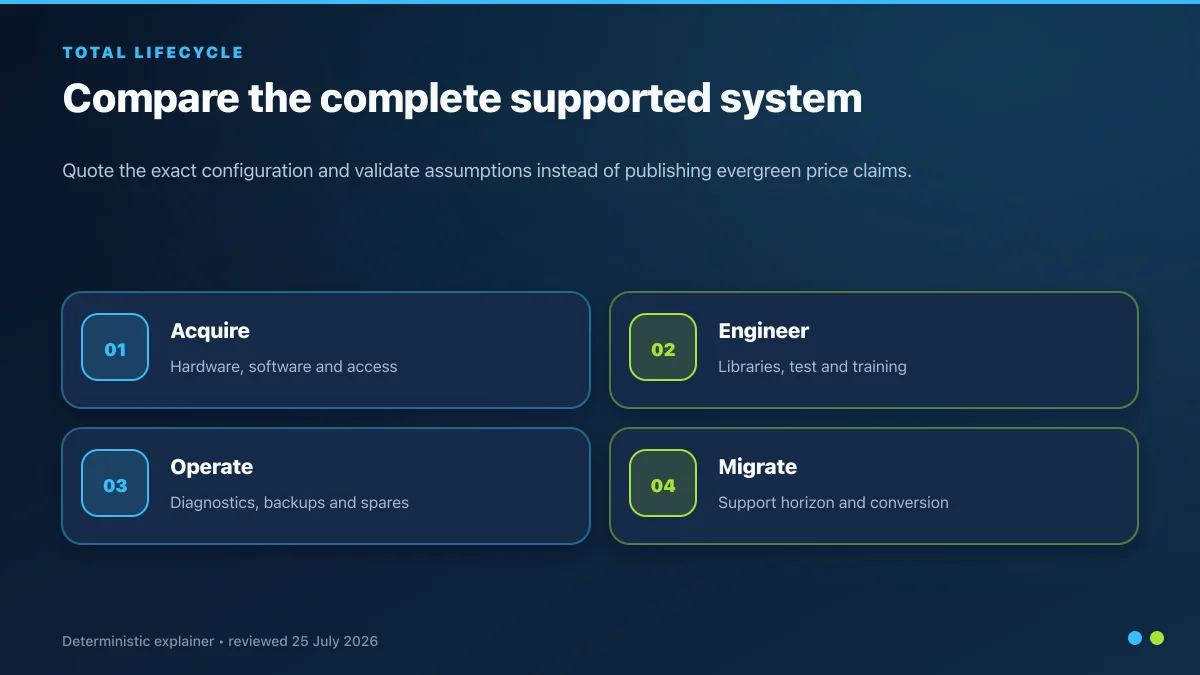
The PLC and I/O purchase is only one cost event. Engineering licenses, optional runtime features, annual support, specialist travel, spare stock, training, validation, cybersecurity maintenance and migration can outweigh the CPU price over a long service life. Use dated local quotes because public list prices rarely describe negotiated packages or every required entitlement.
| Lifecycle phase | Cost and risk to model | Evidence to collect |
|---|---|---|
| Acquire | CPU, I/O, power, networking, safety, motion, terminals, engineering and runtime licenses | Exact BOM, authorized quote, license metric, lead time, alternatives and expiry date |
| Engineer | Installation, hardware catalog, libraries, design, code review, simulation, FAT and documentation | Representative hours from the matched pilot and named deliverables |
| Commission | Travel, startup time, temporary licenses, vendor support, peer-device integration and production loss | Commissioning plan, support rate/coverage, escalation path and acceptance criteria |
| Operate | Backups, monitoring, user administration, change control, refresher training and support renewal | Annual operating model, responsibility matrix and verified restoration time |
| Maintain | Firmware/security review, compatibility testing, spare rotation, replacement and emergency response | Advisories, tested patch process, lifecycle status, spare health and response agreement |
| Migrate | Project conversion, I/O cutover, protocol replacement, validation, rollback and retraining | Migration assessment, pilot conversion, cutover test, rollback evidence and residual-risk register |
A defensible cost comparison
Use the same analysis period and workload for every candidate. Keep capital cost, internal labor, external services and downtime exposure separate; do not hide uncertain future values inside one precise total. Document low, expected and high scenarios for travel, commissioning overruns, failures and migration.
Expected lifecycle cost = acquisition + engineering + commissioning + operating support + expected maintenance + expected migration + risk allowance
The risk allowance is not an arbitrary brand penalty. It should trace to observable gaps such as a single local specialist, an untested legacy conversion, unavailable spares, unclear entitlement, or failure to restore the pilot. Once a gap is mitigated, update the value and retain the evidence.
Cybersecurity, recovery and safety are selection gates
NIST SP 800-82 Rev. 3 treats PLCs as operational technology whose security controls must account for performance, reliability and safety. A product-security brochure is not enough. The owner needs an asset/version inventory, supported update path, controlled engineering access, tested backups, incident procedures and a way to receive vendor advisories.
| Control objective | Ask each vendor/integrator to demonstrate | Acceptance evidence |
|---|---|---|
| Asset and version inventory | Export exact controller, module, firmware, software, package and library versions | Machine-readable inventory tied to catalog numbers and project backup |
| Engineering identity | Individual accounts, role separation, authentication options and auditable privileged changes | Access-control design, observed role test and joiner/mover/leaver procedure |
| Secure communications | Supported secure protocols, certificate lifecycle, remote-access boundary and legacy limitations | Architecture, configuration export, certificate-renewal test and documented exceptions |
| Vulnerability handling | Product security contact, advisory feed, affected-version identification and update/mitigation guidance | Subscription plus a tabletop response to one historical advisory |
| Backup and restore | Complete source, hardware configuration, device files, recipes, licenses, keys/certificates and restore prerequisites | Offline/immutable copy and timed restore to an approved spare or isolated test target |
| Update validation | Lab or staging method that preserves compatibility and safety/production evidence | Regression matrix, rollback trigger, approvals and post-update checks |
| Functional safety | Certified components, safety manual, version constraints, signatures and validation workflow | Safety lifecycle records reviewed by competent people; ordinary PLC simulation is excluded |
A vendor-neutral browser simulator can compare logic concepts and fault reasoning. It cannot validate a vendor's firmware, network stack, I/O timing, safety function, licensing behavior, online-change mechanism, or installed cybersecurity. Those claims require the selected tools, exact hardware and applicable lifecycle process.
Run the same matched engineering pilot
Marketing feature grids compare nouns. A pilot compares work. Freeze one small, representative problem and implement it in every surviving toolchain with the same requirements, test cases, time budget and evidence template.
Pilot I/O and control contract
Use a non-safety conveyor or pump sequence in isolated training hardware. The example below is intentionally simple enough to repeat but rich enough to expose task, timer, tag, diagnostic and recovery differences.
| Signal | Direction | Required behavior | Evidence to capture |
|---|---|---|---|
Start_Request |
Input/HMI request | Momentary request; cannot by itself hold the command true | Tag/device mapping, request consumption and held-button test |
Stop_Healthy |
Input | Command must drop when false | Input filtering assumption, scan trace and stop test |
Guard_Permissive |
Simulated non-safety input | Inhibits start and drops command; never represented as a validated guard safety function | Logic state, alarm and explicit safety disclaimer |
Drive_Ready |
Input/network data | Required before start; bad/stale quality is not treated as healthy | Device/profile setup, quality handling and disconnected-peer test |
Run_Command |
Output | One controlled writer; true only when request, permissives and state allow | Cross-reference/write ownership and output state trace |
Run_Feedback |
Input | Must arrive within five seconds after command | Timer implementation, timestamp/trace and timeout result |
Fault_Reset |
Input/HMI request | Clears a latched diagnostic only after the failed condition is healthy | Reset gating, held-reset test and retained-state behavior |
First_Out_Code |
Internal/HMI data | Records the first detected failure until valid reset | Data type, mapping, power-cycle result and alarm text |
Do not add vendor-exclusive features during the first pass. The purpose is to reveal the base workflow. A second optional pass can test a differentiator—integrated motion, redundancy, safety tooling, generated HMI objects, or a required protocol—using a separately approved requirement.
Pilot acceptance tests
| ID | Initial condition and stimulus | Expected control result | Comparison evidence |
|---|---|---|---|
| P01 | All conditions healthy; pulse start | Command asserts once the sequence accepts the request | Build status, online trace, state/tag visibility and elapsed engineering time |
| P02 | Guard permissive false; pulse start | Command remains false; diagnostic identifies the blocking condition | Permissive view, alarm clarity and no hidden bypass |
| P03 | Running; stop healthy becomes false | Command drops deterministically | Scan/task trace and output update observation |
| P04 | Command asserts; feedback remains false for five seconds | Command drops and feedback-timeout code latches | Timer boundary at 4.9/5.0/5.1 seconds and first-out result |
| P05 | Two faults occur one scan apart | First detected cause remains until valid reset; later fault remains observable | Task/scan ordering and event evidence |
| P06 | Reset held while failure remains active | Fault does not clear | Reset gating and held-input behavior |
| P07 | Failure healthy; pulse reset | Latch clears without starting the machine | Recovery trace and request state |
| P08 | Power cycle during fault and after healthy stop | Retention and restart behavior match the written specification | Cold/warm restart configuration and observed results |
| P09 | Communication data becomes stale or peer disconnects | Command follows defined fail behavior and diagnostic distinguishes communication loss | Device state, data quality/watchdog and recovery sequence |
| P10 | Restore project to a cleared spare or isolated target | Correct versions and prerequisites restore a runnable, matching project | Backup contents, restore time, missing dependencies and checksum/version record |
Measure the engineering workflow
Record facts, not impressions such as “easy” or “modern.” The first run measures onboarding plus implementation; a second run after training can separate learnability from long-term workflow.
| Workflow measure | Start | Stop | Record |
|---|---|---|---|
| Install and license | Clean supported workstation/VM is available | Required engineering environment opens legally | Download size/source, prerequisites, restarts, accounts, entitlement and elapsed time |
| Create and configure | Tool opens with frozen version | CPU, I/O and task/network configuration compile | Click path, imported profiles, warnings, assumptions and elapsed time |
| Implement | Approved I/O contract available | Code builds with required diagnostics | Languages used, code size, reusable objects, cross-reference quality and elapsed time |
| Simulate | Compiled project available | P01–P08 execute repeatably where supported | Simulation boundary, unsupported hardware behavior and evidence export |
| Connect and download | Approved isolated target is ready | Correct project runs on exact target | Discovery/security steps, firmware prompts, mode changes and elapsed time |
| Diagnose | One seeded failure is active | Investigator identifies the evidence-supported cause | Views used, trace/alarm quality, forcing controls and time to diagnosis |
| Compare and review | Baseline and changed project exist | Reviewer can identify and approve intended differences | Native compare coverage, export format, annotations and blind spots |
| Backup and restore | Running target and approved spare/test target exist | Restored target passes selected acceptance cases | Dependencies, licenses, firmware, certificates, device files and elapsed time |
Take screenshots only where they prove a named result: version/about dialog, hardware tree, successful compile with timestamp, trace around a boundary, diagnostic state, project comparison and restore result. Redact serial numbers, IP addresses, customer names, usernames, license identifiers and proprietary logic before a report leaves the project team.
Score the evidence, not the brand name
Reproducible vendor-selection matrix
Score each criterion from 0 to 3, but attach evidence to every non-zero score. Weighting is project-specific; do not publish a winner until the stakeholders approve the weights.
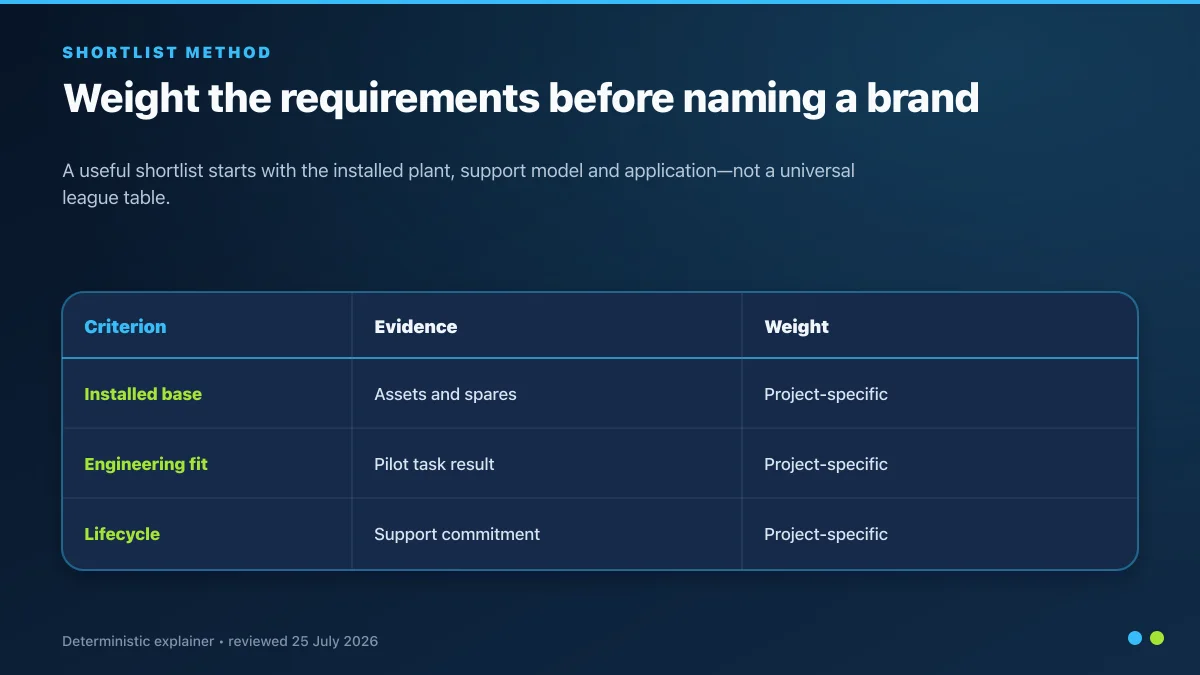
| Criterion | Evidence required | Mandatory? | Weight | Vendor score |
|---|---|---|---|---|
| Plant/customer standard | Approved-vendor list and installed-base inventory | ___ | ___ | ___ |
| Exact functional fit | CPU/module manuals mapped to the URS/FDS | ___ | ___ | ___ |
| Safety | Risk assessment and certified architecture evidence | ___ | ___ | ___ |
| Motion and timing | Axis/function list plus hardware test result | ___ | ___ | ___ |
| Communications | Certified profiles and integration test | ___ | ___ | ___ |
| Software/licensing | Dated distributor quote and entitlement terms | ___ | ___ | ___ |
| Lifecycle/spares | Official lifecycle notice and spare strategy | ___ | ___ | ___ |
| Local capability | Named integrators, training and response agreement | ___ | ___ | ___ |
| Cybersecurity | Product security documentation and plant controls | ___ | ___ | ___ |
| Total ownership cost | Dated BOM, engineering, training and support model | ___ | ___ | ___ |
Download the editable PLC vendor-selection scorecard CSV. Give every score an evidence URL or document identifier and review date. A score without evidence is zero until verified.
Use a 0–3 scale consistently:
- 0 — no evidence or fails: the requirement is not met, or the claim is unsupported.
- 1 — partial/high risk: evidence covers only part of the configured system or requires an unproven workaround.
- 2 — meets: the configured system passes the documented requirement and test.
- 3 — exceeds usefully: it passes and provides a project-valued advantage supported by evidence; unused features do not earn points.
Calculate weighted score = score × approved weight, but apply mandatory gates first. Keep raw evidence beside the total so a high number cannot hide an architecture that failed a required condition.
What is portable between PLC brands
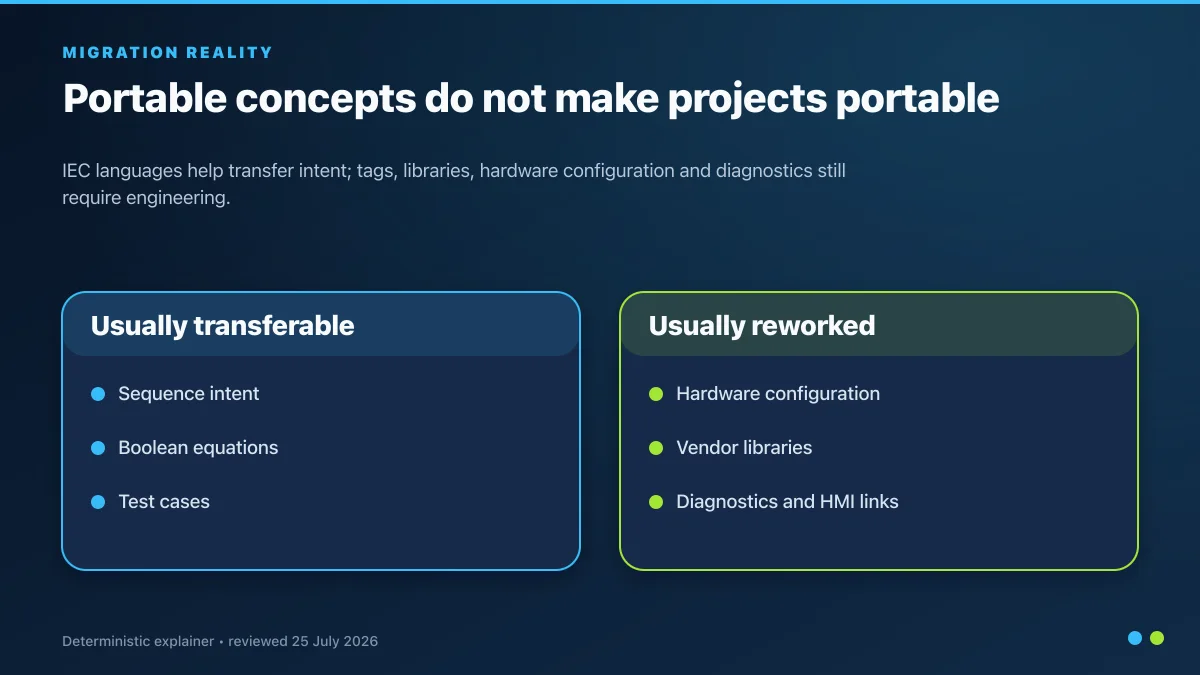
IEC 61131-3 language names create useful common ground, but they do not make whole projects interchangeable. Even familiar ladder instructions can differ in edge behavior, time bases, retentivity, conversion, overflow, task scheduling, I/O update, online change and vendor library semantics.
| Artifact or behavior | Usually transferable as intent | Requires target-specific rebuilding and proof |
|---|---|---|
| Functional requirements | Sequence, modes, permissives, trips, alarms, recovery and acceptance criteria | Mapping each requirement to the target architecture and verified implementation |
| I/O contract | Signal purpose, engineering units, valid range, fail state and update expectation | Module selection, addressing/tags, electrical configuration, filtering, diagnostics and quality |
| State model | Named states, allowed transitions and abnormal-state behavior | Task implementation, restart/retention, data types and target-specific execution |
| Basic algorithms | Equations, scaling intent, control narrative and test vectors | Numeric precision, libraries, time base, overflow, execution rate and tuning on the process |
| Test cases | Initial state, stimulus, expected result and acceptance boundary | Test harness, simulation limits, trace capture and physical I/O/process validation |
| Network data contract | Meaning, ownership, range, quality and freshness of exchanged data | Protocol stack, profile, device files, byte/word ordering, connection timing and diagnostics |
| Safety requirements | Required safety functions and lifecycle evidence | Certified target components, safety toolchain, signatures, calculations and validation |
| Source code | Small isolated standard-language fragments may guide a rewrite | Project structure, libraries, hardware config, HMI, motion, safety, communications and build output |
Treat migration as a new controlled implementation against retained requirements and tests. Automated import can accelerate it, but the converted project still needs compile review, semantic inspection, boundary tests, hardware configuration, communication proof, safety lifecycle work and rollback.
Final selection and decision record
Decision test
- Eliminate any candidate that fails a mandatory requirement.
- Build the same small sequence in the remaining engineering environments.
- Measure compile, simulation, diagnostics and recovery workflows.
- Test one required protocol with the real peer device.
- Price the exact BOM and licenses through authorized channels.
- Record the decision, assumptions, software versions and review date.
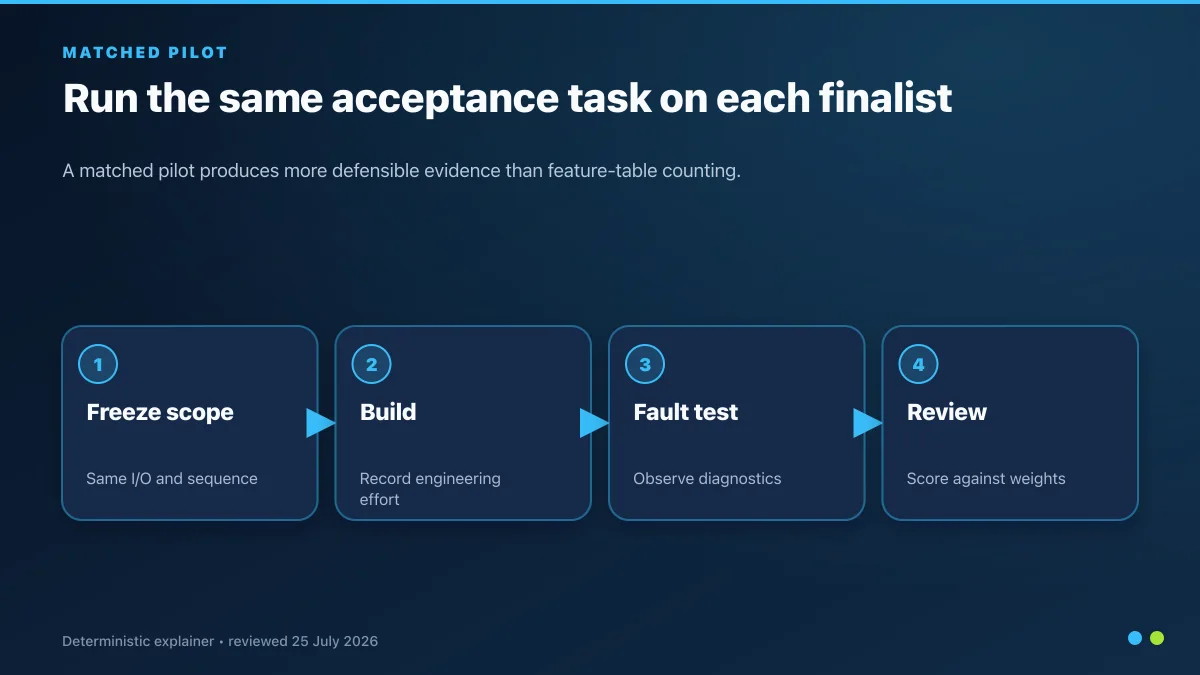
The decision record should name the approved scope, date, participants, candidates eliminated by mandatory gates, exact tested versions, score weights, evidence identifiers, unresolved risks, exception owners and review trigger. Reopen the decision if the project changes materially—for example, a new target country, different motion requirement, discontinued CPU, changed cybersecurity policy, or customer-mandated standard.
To compare transferable programming conventions before paying for multiple toolchains, run one request–permissive–command–feedback exercise in a vendor-neutral environment and document its assumptions. Then repeat the acceptance cases in each shortlisted vendor tool and exact target. Simulation is a learning aid; it does not certify vendor hardware, protocol behavior or a safety function.
What to learn first
Start with the platform used by nearby employers, customers or your current plant. Then learn a contrasting second ecosystem so you understand tags versus devices, vendor-specific timers, project structure and communications without assuming one platform's behavior is universal.
For a beginner without a target employer or plant, start with control fundamentals: I/O contracts, scan behavior, ladder and Structured Text, modes, interlocks, alarms, test design and fault diagnosis. Those skills transfer as reasoning. Once a target becomes clear, learn its current software, project structure, device configuration and diagnostic tools deeply enough to build and explain one tested machine sequence.
For a compact controller/HMI ecosystem that does not fit a Siemens-versus-Rockwell shortlist, use the Unitronics PLC programming guide to verify UniLogic/VisiLogic generation, I/O, communications, project ownership and troubleshooting evidence. If Schneider is shortlisted, use the Schneider PLC software guide to separate Machine Expert, Machine Expert Basic and Control Expert support before selecting hardware.
PLC brand comparison FAQs
What are the top PLC brands in 2026?
Common consideration sets include Siemens SIMATIC, Rockwell Automation/Allen-Bradley Logix, Mitsubishi MELSEC, Schneider Modicon, Beckhoff TwinCAT, Omron Sysmac, ABB AC500, B&R, Emerson PACSystems, Delta and AutomationDirect families. This is not a market-share ranking, and ABB/B&R are distinct toolchains even though this guide groups them in one comparison row. The useful list for a project is smaller: platforms that meet mandatory technical requirements, the plant/customer standard, regional delivery and lifecycle support.
Which PLC brand is best?
No brand is best without a project definition. In a brownfield plant, the supported installed standard often has the lowest operational risk. In a new machine, the best candidate is the one that passes every mandatory requirement and produces the strongest documented result in a matched pilot, lifecycle plan, local support check and exact commercial quote. If a comparison names a winner without application, region, catalog numbers, software versions, weights and evidence, treat the result as opinion.
Is Siemens better than Allen-Bradley?
Neither is universally better. Siemens SIMATIC and Rockwell Logix have different engineering, firmware, networking, licensing and installed-base contexts. Compare the exact SIMATIC CPU/TIA release with the exact CompactLogix or ControlLogix CPU/Studio 5000 release. Then test the required I/O, safety, motion, protocol, diagnosis, backup and restore workflows. Plant standards, regional skills and spare stock can dominate small feature differences. See the dedicated Siemens versus Allen-Bradley comparison for a narrower evidence surface.
Which PLC brand is easiest for beginners?
The easiest useful platform is usually the one a learner can access legally, practise safely, and connect to a real employment or plant goal. Freely downloadable tools can reduce entry friction, while an employer-standard platform may provide better mentoring and hardware access. Do not judge only the ladder editor. Include installation, licensing, hardware configuration, simulation, diagnostics, project comparison, backup and restoration. A vendor-neutral simulator can teach transferable logic before the learner commits to a vendor stack.
Which PLC programming software is free?
Free availability is family- and license-specific. AutomationDirect publishes free CLICK, Do-more Designer and Productivity Suite tools; ABB describes a free Basic Automation Builder license; other vendors may offer trials, limited editions or educational programs. Terms, operating-system support, registration, simulation and commercial-use rights can change. Verify the current official download and entitlement page for the exact controller family. “Free download” does not necessarily include every compiler, runtime, safety, motion or collaboration feature needed by a project.
Can PLC code be transferred between brands?
Requirements, state models, I/O contracts, equations and test cases transfer more reliably than a complete project. Some standard-language fragments can guide a rewrite, and vendor tools may offer import or conversion features, but hardware configuration, tasks, data types, timers, retentivity, libraries, communications, motion, safety, HMI objects and diagnostics remain target-specific. Treat migration as a controlled implementation. Preserve the original, document every conversion, compile and inspect the result, rerun boundary tests, and prove rollback.
How should PLC prices be compared?
Price the exact configured system through authorized channels on the same date and in the delivery region. Include CPU, I/O, power, terminals, networks, safety, motion, engineering licenses, runtime entitlements, support, training, spares, commissioning and expected migration. Do not compare a bare compact CPU with a complete redundant or safety architecture. Keep uncertain downtime and lifecycle risks visible as scenarios instead of manufacturing one precise total from assumptions.
Which PLC vendor has the best support?
Support is regional and contract-specific. Test it. Record the named distributor or integrator, supported languages, operating hours, escalation path, remote-access conditions, response commitments, training calendar, repair flow and availability of the exact spare modules. Submit one representative pre-sales compatibility question and one seeded pilot issue, then assess the documented response. A large global vendor can still be a weak local choice if the required product specialist, parts or entitlement are unavailable where the asset operates.
How many PLC brands should be included in a pilot?
Start broad on paper, eliminate candidates that fail mandatory requirements, and pilot the smallest defensible shortlist—often two or three. Piloting ten platforms wastes engineering effort and encourages shallow tests. Every pilot must use the same frozen I/O contract, acceptance cases, evidence template and evaluation period. Add a candidate only when it offers a credible project-valued alternative; do not include a brand merely to make the comparison look comprehensive.
What must a PLC purchase specification name?
Name the controller and module catalog numbers, approved alternatives, firmware baseline, engineering software release and edition, required licenses, device/profile files, supported protocols and roles, safety/motion options, environmental approvals, spare quantities, documentation, source-project handover, access credentials process, training, FAT/SAT evidence, backup/restore deliverables, cybersecurity advisory channel and lifecycle obligations. A specification that says only “Siemens PLC,” “Allen-Bradley PLC,” or “IEC 61131-3 PLC” leaves critical compatibility and ownership decisions unresolved.
Official vendor and standards sources
Evidence checked: August 29, 2026. These direct sources establish product and toolchain identities or the selection boundary; the configured project still needs catalog-specific manuals, certificates and release notes.
- Siemens: SIMATIC programmable controllers
- Siemens: TIA Portal engineering framework
- Siemens: STEP 7 in TIA Portal
- Siemens Industry Online Support: TIA Portal V21 trial and support packages
- Rockwell Automation: programmable controllers
- Rockwell Automation: Studio 5000 Logix Designer
- Rockwell Automation: Product Compatibility and Download Center
- Rockwell Automation: controller firmware and Logix Designer compatibility
- Mitsubishi Electric: MELSEC programmable controllers
- Mitsubishi Electric: GX Works3 operating manual
- Schneider Electric: Modicon PLCs and PACs
- Schneider Electric: EcoStruxure Control Expert
- Beckhoff: TwinCAT automation software
- Beckhoff: TwinCAT download finder
- Omron: Sysmac automation platform
- Omron: software revision change history
- ABB: AC500 programmable logic controllers
- ABB: Automation Builder engineering suite
- B&R: control systems
- B&R: Automation Studio V6 downloads
- Emerson: PACSystems PLCs
- Emerson: PAC Machine Edition 10 product data sheet
- Delta: PLC families and programming software
- AutomationDirect: PLC software and demos
- AutomationDirect: CLICK getting started
- NIST SP 800-82 Rev. 3: Guide to Operational Technology Security
Related research:
Now run it · free · no signup
Skip the installer and run PLC logic now
Run one guided program in your browser without an account or card, then create a free account when you want the practice library.
Ownership disclosure: PLC Programming IO and PLC Simulation Software are operated by the same publisher.

