Types of Industrial Sensors: The Complete Guide for Automation (2026)
A complete guide to the types of industrial sensors used in automation — proximity, photoelectric, temperature, pressure, flow, level — and how each wires to a PLC.
What Are Industrial Sensors and Why Do They Matter?
Industrial sensors are the eyes, ears, and nerve endings of any automated system. They convert a physical condition — distance, temperature, pressure, flow rate — into an electrical signal that a PLC or control system can act on. Without them, a PLC is blind: it cannot detect a part arriving on a conveyor, a tank reaching capacity, or a motor running too hot.
Every input card in a PLC chassis ultimately receives its signal from one of the sensor types covered in this guide. Understanding what each sensor measures, how it outputs that measurement, and how it wires into a PLC input module is fundamental to both system design and day-to-day troubleshooting. If you are new to the control-system side of automation, the PLC programming basics fundamentals guide provides a useful companion foundation.
This guide covers every major sensor category used in industrial automation, pairs each type with its PLC signal type, and ends with a master selection reference you can bookmark.
Sensor vs. Transducer: A Practical Distinction
The two terms are frequently used interchangeably on plant floors, but they have a technical difference worth knowing.
- A sensor detects a physical quantity and produces a raw electrical response (resistance change, voltage change, frequency shift).
- A transducer converts one form of energy to another — often the sensor element plus signal-conditioning circuitry in one housing.
In practice, most catalog parts sold as "sensors" already include integrated signal conditioning that outputs a clean 4–20 mA or 0–10 V signal, so they behave as complete transducers. The distinction matters most when you are specifying bare sensing elements versus field-ready, loop-powered devices.
1. Proximity Sensors
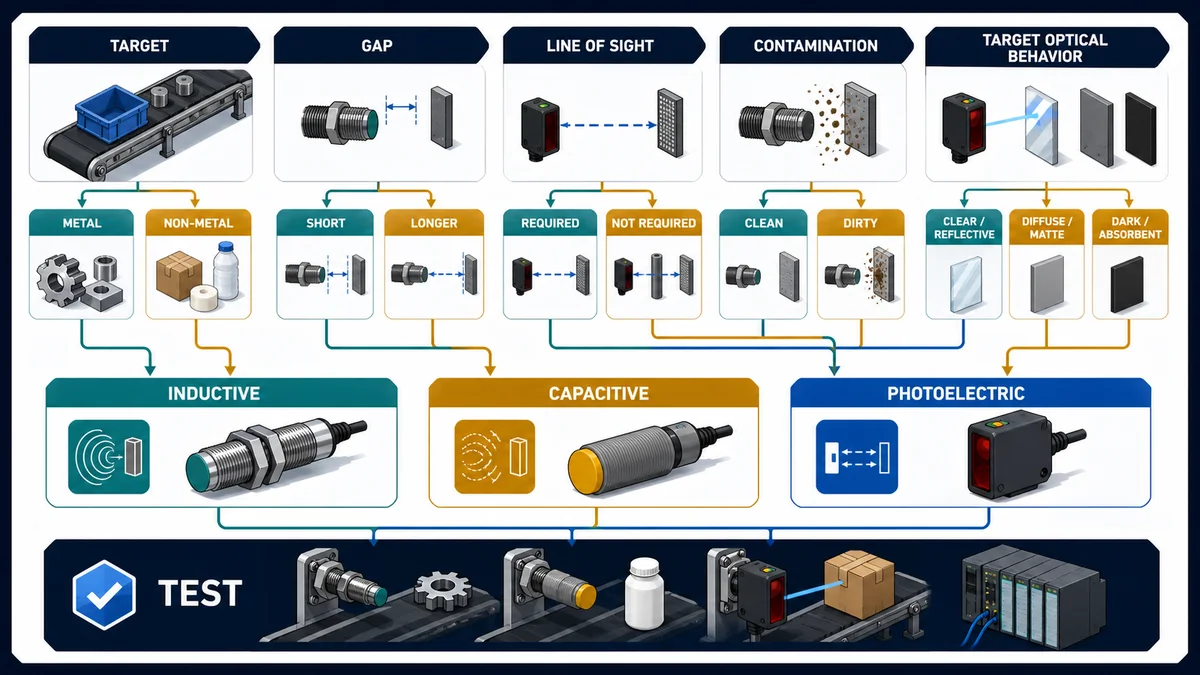
Proximity sensors detect the presence or absence of an object without physical contact. They are among the highest-volume discrete sensors in industrial automation.
Inductive Proximity Sensors
What they detect: Metallic objects (ferrous and, with lower range, non-ferrous).
How they work: An oscillator generates a high-frequency electromagnetic field at the face of the sensor. When a conductive metal target enters the field, eddy currents are induced, loading the oscillator and triggering the output.
Typical sensing ranges: 1 mm to 60 mm depending on target material and sensor diameter (M8, M12, M18, M30 barrel sizes are standard).
PLC signal: Discrete NPN or PNP transistor output, wired to a digital input card. Normally Open (NO) or Normally Closed (NC) models are available. Confirm the sink/source topology of your input card — most modern Siemens, Allen-Bradley, and Mitsubishi cards source current and require PNP (sourcing) sensors, while older designs may require NPN (sinking).
Common applications: Part detection on machining centers, end-of-travel detection, gear-tooth counting for speed measurement.
Capacitive Proximity Sensors
What they detect: Both metallic and non-metallic materials — plastics, liquids, wood, granules — by sensing changes in capacitance.
How they work: The sensor face acts as one plate of a capacitor. Any material with a dielectric constant higher than air shifts the oscillator frequency and triggers the output.
PLC signal: Discrete NPN/PNP, same wiring considerations as inductive sensors.
Common applications: Liquid level detection through non-metallic tank walls, pellet presence in hoppers, paper or label detection.
2. Photoelectric Sensors
Photoelectric sensors detect objects using a beam of light — typically modulated infrared or visible red — and a photodetector.
Three main operating modes:
| Mode | Configuration | Best use |
|---|---|---|
| Through-beam | Emitter and receiver in separate housings facing each other | Long range, high reliability, dusty environments |
| Retroreflective | Emitter and receiver in one housing; beam returns off a reflector | Medium range, one-cable installation |
| Diffuse (proximity mode) | Emitter and receiver in one housing; beam returns off the target itself | Short range, varied object surfaces |
PLC signal: Discrete NPN/PNP digital output to a standard digital input card. Background-suppression diffuse models use triangulation to reliably ignore the background, which is useful on conveyors with varied product colors.
Common applications: Object counting on conveyors, label detection, packaging verification, presence/absence checks on assembly fixtures.
3. Temperature Sensors
Temperature is one of the most frequently measured process variables in industry. Two sensor technologies dominate.
Thermocouples (TC)
How they work: The Seebeck effect generates a small millivolt EMF between two dissimilar metal junctions. Common types: J (iron/constantan, 0–750 °C), K (chromel/alumel, −200–1260 °C), T (copper/constantan, −200–350 °C).
PLC signal: Requires a thermocouple analog input module with cold-junction compensation built in. The raw millivolt signal is very low and noise-sensitive — do not run TC wiring in the same conduit as power cables.
Resistance Temperature Detectors (RTD)
How they work: The electrical resistance of a platinum element changes predictably with temperature. PT100 (100 Ω at 0 °C) and PT1000 are the industrial standards.
PLC signal: Requires a dedicated RTD analog input module that sources a small excitation current and measures the resulting voltage drop. RTDs are more accurate and stable than thermocouples but have a narrower range and are more fragile.
Common applications: Motor winding protection, oven/furnace control, food-process hygiene compliance, extruder temperature control.
4. Pressure Sensors and Transmitters
Pressure sensors measure absolute, gauge, or differential pressure in process pipework, hydraulic circuits, and pneumatic systems.
Technologies: Piezoresistive, ceramic capacitive, and thin-film strain-gauge sensing elements are all common in industrial transmitters.
PLC signal: The dominant industrial standard is 4–20 mA (two-wire, loop-powered) into an analog input card. 0–10 V is also used where loop impedance is not a constraint. At 4 mA the sensor outputs its zero-range value; at 20 mA it outputs full-scale. The 4 mA live-zero convention means a broken wire (0 mA) is immediately distinguishable from a true zero-pressure reading.
IP rating and wetted materials: Always specify the wetted materials (316 SS, Hastelloy, PVDF) relative to the process fluid and check the IP rating for washdown duty.
Common applications: Hydraulic system monitoring, compressed-air leak detection, filter differential pressure alarms, pump discharge monitoring.
5. Flow Sensors
Flow measurement covers volumetric flow rate, mass flow rate, and totalized volume.
Key technologies:
| Type | Principle | Suitable for |
|---|---|---|
| Electromagnetic (magflow) | Faraday induction in conductive liquids | Water, slurries, chemicals |
| Vortex | Frequency of vortex shedding from a bluff body | Steam, gas, clean liquids |
| Coriolis | Mass-proportional resonant frequency shift | High-accuracy mass flow, viscous fluids |
| Ultrasonic (clamp-on) | Transit-time difference | Retrofit, no process interruption |
| Thermal mass | Heat transfer rate proportional to mass flow | Gases, compressed air |
| Turbine / paddle wheel | Pulse output proportional to velocity | Clean, low-viscosity liquids |
PLC signal: Turbine and paddle-wheel meters output a pulse (frequency) signal wired to a high-speed counter input. Electromagnetic, vortex, Coriolis, and ultrasonic transmitters typically output 4–20 mA analog or a pulse train; many also offer HART or Profibus/PROFINET digital communication for diagnostics.
Common applications: Batch filling, utility metering, chemical dosing, boiler feedwater control.
6. Level Sensors
Level measurement determines the fill height of liquids, solids, or slurries in tanks and silos.
Key technologies:
| Type | Principle | Best for |
|---|---|---|
| Float switch | Mechanical float on reed switch | Simple high/low point detection |
| Ultrasonic (non-contact) | Time-of-flight echo off surface | Liquids and some bulk solids |
| Radar (guided or free-space) | Microwave time-of-flight | Foam, vapour, extreme temperatures |
| Hydrostatic (submersible pressure) | Liquid head pressure | Open tanks, wells |
| Capacitive | Dielectric change along a probe | Liquids, pastes, solids |
| Vibrating fork / tuning fork | Resonant frequency shift at contact | Point-level switch for liquids or solids |
PLC signal: Point-level switches (float, vibrating fork) output a discrete signal to a digital input. Continuous-level devices (ultrasonic, radar, hydrostatic) output 4–20 mA analog. Radar transmitters increasingly support PROFIBUS PA, HART, or IO-Link for remote configuration.
7. Position and Encoder Sensors
Position sensors measure linear or rotary displacement with varying degrees of resolution.
Rotary encoders produce pulse trains that a PLC's high-speed counter or motion module converts to position and velocity data. Incremental encoders output A/B quadrature pulses (and usually a Z index pulse). Absolute encoders output the actual angular position as a binary or Gray code word — no homing required after power loss. For a detailed comparison see our article on encoder vs resolver.
Linear position: Magnetostrictive linear position sensors and draw-wire encoders cover stroke lengths from millimeters to several meters, outputting either analog 4–20 mA or SSI/Profibus digital.
PLC signal: Incremental encoders wire to a dedicated high-speed counter module or the onboard HSC inputs on many compact PLCs. Absolute encoders connect via SSI, EnDat, BiSS, or fieldbus. For more on fieldbus options see the PLC communication protocols complete guide.
Common applications: CNC axis feedback, conveyor indexing, robotic joint position, web tension control.
8. Ultrasonic Sensors
Ultrasonic sensors use sound waves (typically 40–400 kHz) to measure distance or detect objects. Unlike photoelectric sensors they are not affected by target color or surface reflectivity.
PLC signal: Discrete NPN/PNP output for simple presence detection; analog 4–20 mA or 0–10 V for continuous distance measurement. Blind-zone limitations (typically 30–300 mm from the face) must be accounted for in installation design.
Common applications: Object detection on conveyors regardless of transparency, vehicle detection in parking systems, liquid level in tanks with condensation or foam.
9. Vision Sensors and Smart Cameras
Vision sensors combine a camera, LED illumination, and an embedded image processor in a single housing. They can verify part presence, inspect geometry, read barcodes and 2D matrix codes, and check print quality — all at machine cycle rates.
PLC signal: A vision sensor typically outputs one or more discrete pass/fail signals to digital input cards. Many also support EtherNet/IP, PROFINET, or Modbus TCP for result data and statistics, and serial RS-232/RS-422 for string data such as barcode content.
Common applications: Label inspection, assembly verification, traceability (QR/Data Matrix reading), solder-joint inspection, OCR for date codes.
10. Force and Load Sensors
Force sensors and load cells measure compressive, tensile, or shear forces.
How they work: A strain gauge — a foil resistor bonded to a metal spring element — changes resistance proportionally to applied force. A Wheatstone bridge amplifies the differential resistance change into a millivolt signal.
PLC signal: The raw millivolt output is too small for standard analog cards. A load-cell amplifier or weighing module converts it to 4–20 mA or a digital value over a fieldbus. Dedicated weighing modules (e.g., Siemens SIWAREX, Allen-Bradley 1734-WFCA) handle calibration, tare, and peak-capture internally.
Common applications: Checkweighers, press force monitoring, tank weighing for batch control, tension control in web processes.
Master Signal Table: Which Sensor Connects to Which PLC Input
This is the reference that most generic sensor lists omit. Every sensor produces a signal; every PLC input card expects a specific signal type. Mismatching them is one of the most common wiring errors in commissioning.
| Sensor Type | Output Signal | PLC Input Card Type | Wiring Notes |
|---|---|---|---|
| Inductive proximity | NPN or PNP discrete | Digital input (DI) | Match sink/source; NPN = sinking (common positive), PNP = sourcing (common negative) |
| Capacitive proximity | NPN or PNP discrete | Digital input (DI) | Same as inductive; adjust sensitivity for target material |
| Photoelectric (through-beam, retro, diffuse) | NPN or PNP discrete | Digital input (DI) | Check NPN/PNP; some models offer both via teach button |
| Float/vibrating fork level switch | Dry contact or NPN/PNP | Digital input (DI) | Check contact rating; relay output models suit higher-voltage cards |
| Thermocouple (J, K, T, E) | Millivolt analog | TC analog input module | Use extension-grade TC wire; maintain cold-junction compensation |
| RTD (PT100, PT1000) | Resistance (2-, 3-, or 4-wire) | RTD analog input module | 3-wire preferred in field; 4-wire for highest accuracy |
| Pressure transmitter | 4–20 mA (loop-powered) | Analog input (AI), 4–20 mA | Loop supply from card or external; check max loop impedance |
| Pressure transmitter | 0–10 V | Analog input (AI), 0–10 V | Lower noise immunity than 4–20 mA; suitable for cabinet-mounted sensors |
| Flow (electromagnetic, vortex) | 4–20 mA or pulse | Analog input (AI) or HSC | Pulse output → high-speed counter module for totalization |
| Turbine / paddle-wheel flow | Pulse (open-collector NPN) | High-speed counter (HSC) | Typically 5–24 V open-collector; check max pulse frequency |
| Ultrasonic level / distance | 4–20 mA analog | Analog input (AI), 4–20 mA | Verify blind zone and beam angle vs. tank geometry |
| Radar level | 4–20 mA + HART | Analog input (AI) + HART modem | HART enables remote diagnostics without process interruption |
| Incremental encoder | A/B quadrature pulses + Z | HSC module or onboard HSC | Differential (RS-422) preferred for noise immunity; check max frequency |
| Absolute encoder | SSI, EnDat, BiSS, or fieldbus | Dedicated encoder / motion module | SSI most common; requires matching clock frequency |
| Vision sensor | Discrete pass/fail + Ethernet | Digital input (DI) + EtherNet/IP or PROFINET | Digital lines give go/no-go; network interface gives inspection details |
| Load cell / force sensor | Millivolt (via amplifier: 4–20 mA) | Analog input (AI) or weighing module | Shielded cable mandatory; shield one-end grounded |
| IO-Link sensor (any type) | IO-Link (3-wire, 24 V) | IO-Link master module | Single 3-wire unshielded cable carries power + bidirectional data; replaces multiple discrete/analog runs |
IO-Link deserves special mention. It is a point-to-point sensor communication protocol (IEC 61131-9) that runs over standard 3-wire unshielded cable and allows any IO-Link-capable sensor — regardless of whether it measures proximity, pressure, temperature, or displacement — to deliver process data, diagnostic data, and parameter access to the PLC over the same wire. It eliminates the need to match analog signal types and simplifies commissioning. For an in-depth treatment see the IO-Link protocol guide and the broader what is PLC programming guide.
How to Select the Right Industrial Sensor
Use this checklist before specifying any sensor for a new application:
- Define the measured variable — Is it presence/absence (discrete), or a continuous measurement (analog)?
- Target material — Metal only (inductive), any solid (capacitive/photoelectric/ultrasonic), liquid (capacitive, ultrasonic, radar, pressure), gas (thermal mass, vortex, pressure)?
- Required range and resolution — Match sensor sensing range and output resolution to process requirements; over-ranging wastes budget.
- Environmental conditions — Temperature limits, IP/NEMA rating for washdown or immersion, ATEX/IECEx rating for hazardous areas, chemical compatibility of housing and seals.
- Output signal vs. available PLC card — Confirm the PLC input card type before ordering. Mixing 4–20 mA sensors with 0–10 V cards (or NPN sensors with sourcing inputs) is a common commissioning error.
- Mounting and installation constraints — Flush vs. non-flush inductive mounting, through-beam vs. diffuse photoelectric, clamp-on vs. inline flow.
- Update rate — High-speed counting applications need sensors with fast switching frequency (check kHz spec); slow process loops tolerate slower sensors.
- Diagnostic requirements — If remote condition monitoring matters, specify a sensor with IO-Link or HART for over-the-wire parameter access and diagnostics.
Industrial Sensor Applications by Industry
| Industry | Typical Sensor Mix |
|---|---|
| Automotive assembly | Inductive proximity (part present), vision (assembly verification), force (press monitoring), encoder (robot position) |
| Food and beverage | Capacitive level, electromagnetic flow, RTD temperature (CIP compliance), photoelectric (label/fill check) |
| Pharmaceutical | Ultrasonic level, Coriolis mass flow, RTD/TC (autoclave), load cell (dispensing) |
| Oil and gas | ATEX pressure transmitters, guided-wave radar level, vortex steam flow, vibrating-fork point-level |
| Water and wastewater | Electromagnetic flow, ultrasonic level, submersible pressure, turbidity/pH (specialty electrochemical) |
| Discrete manufacturing | Inductive/photoelectric (part detection), encoder (indexing), vision (quality), capacitive (bin level) |
| Pulp and paper | Radar level (black liquor), load cell (reel tension), non-contact temperature (IR pyrometer), web tension |
Frequently Asked Questions
What are the main types of industrial sensors?
The main types of industrial sensors used in automation are: proximity sensors (inductive and capacitive), photoelectric sensors, temperature sensors (thermocouples and RTDs), pressure sensors, flow sensors, level sensors, position and encoder sensors, ultrasonic sensors, vision sensors, and force/load cells. Each type addresses a distinct measurement need and produces a signal — discrete, analog, or networked — suited to a corresponding PLC input card.
What sensors are used in a PLC system?
A PLC can accept signals from virtually any industrial sensor provided the signal type matches the input card. Digital input cards receive discrete NPN/PNP signals from proximity, photoelectric, and point-level switches. Analog input cards receive 4–20 mA or 0–10 V signals from pressure, flow, level, and temperature transmitters. Dedicated modules handle thermocouples, RTDs, high-speed encoder pulses, and load cells. IO-Link master modules connect any IO-Link sensor over standard 3-wire cable, delivering both process data and diagnostics.
What is the difference between a sensor and a transducer?
A sensor detects a physical quantity and produces a raw electrical response. A transducer converts one form of energy to another and usually includes signal conditioning. In industrial practice most catalog "sensors" already contain integrated conditioning and output a standard signal (4–20 mA, NPN/PNP, etc.), so they function as complete transducers. The distinction matters most when specifying bare sensing elements versus complete field-ready transmitters.
How do you choose an industrial sensor?
Select an industrial sensor by first defining the physical variable being measured and the required output type (discrete or analog). Then consider target material, sensing range, environmental conditions (IP rating, temperature, hazardous area classification), compatibility with the available PLC input card type, mounting constraints, required update rate, and whether remote diagnostics (IO-Link or HART) are needed. Matching the sensor output to the PLC input card type before ordering prevents the most common commissioning errors.