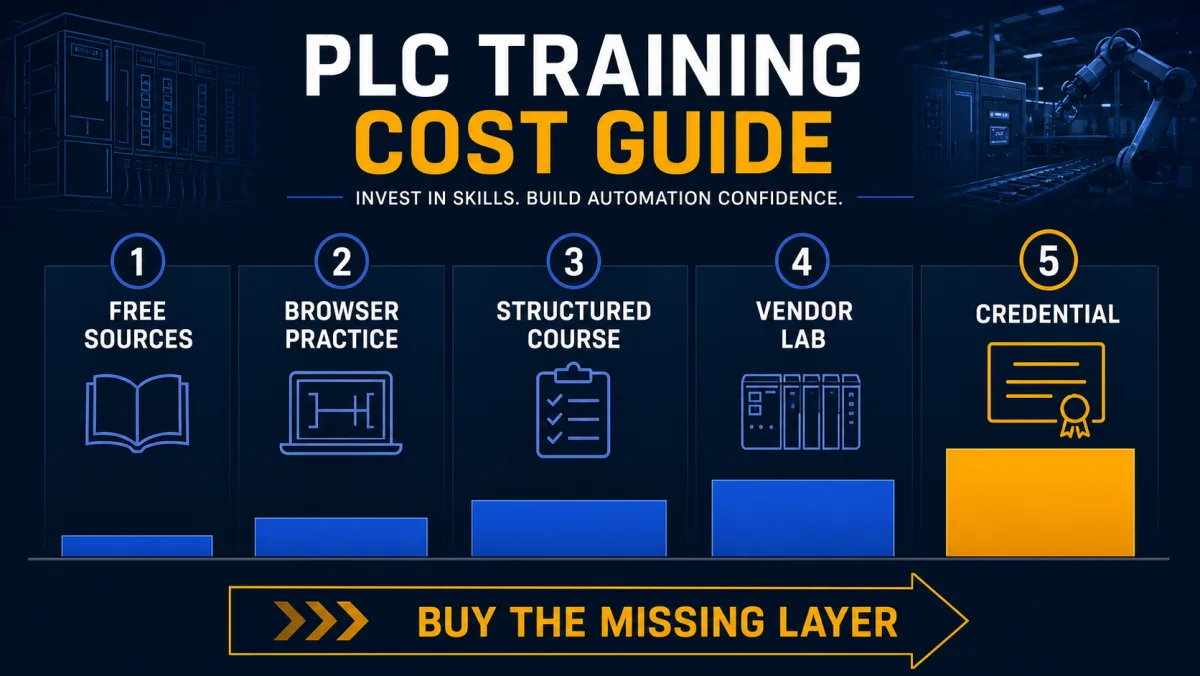
RealPars Alternative: Honest 2026 PLC Training Comparison
Looking for a RealPars alternative for PLC training? This honest review compares RealPars against free and paid alternatives including browser simulators, Codesys, OpenPLC, PLC Academy, Udemy, and self-taught paths.
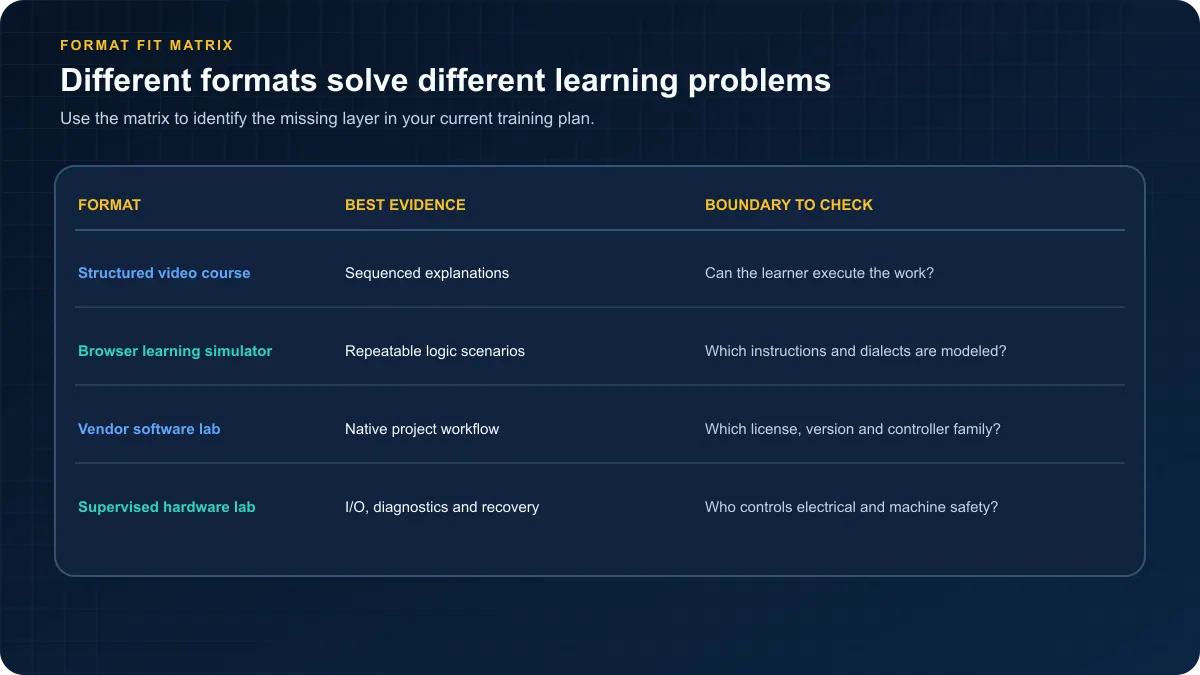
RealPars is a broad industrial-automation learning platform with courses, guided paths, live classes, community features, projects and completion certificates. It is one possible theory-and-guidance layer—not a complete substitute for executable PLC practice, a vendor engineering environment, supervised hardware work or target-machine validation.
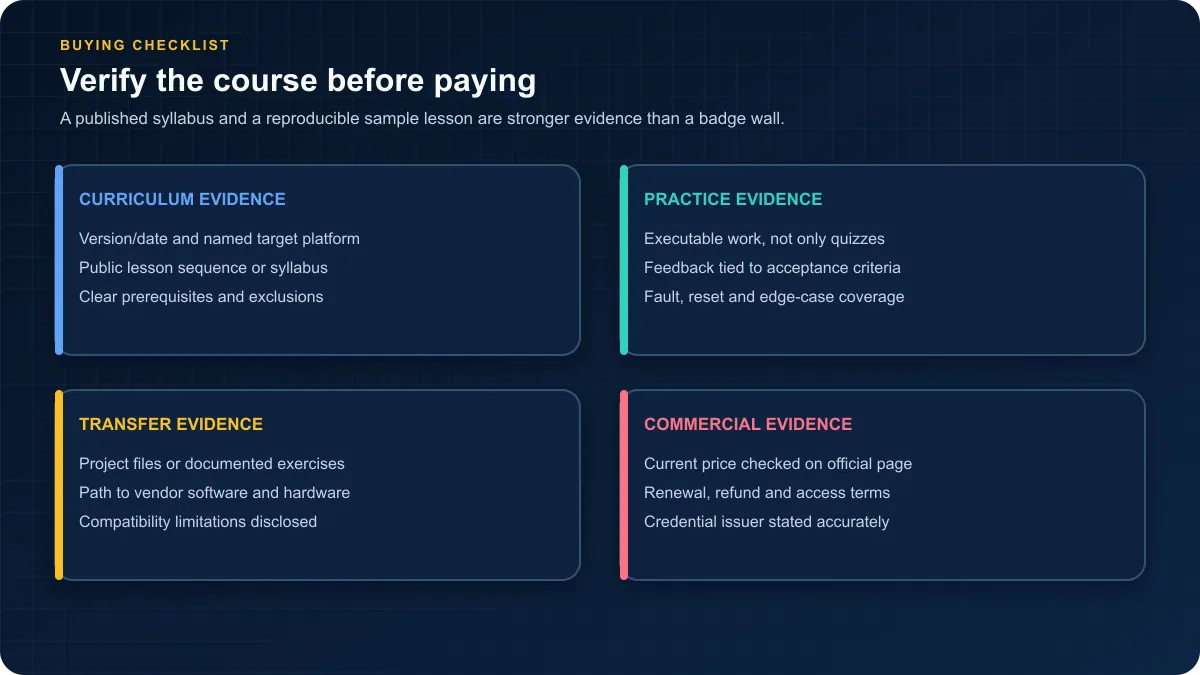
This comparison was reviewed on 25 July 2026. Current RealPars facts come from its official individual-pricing page, course catalog and Help Center pricing record. Third-party prices and catalogs change, so verify the official checkout and syllabus before buying.
Ownership disclosure: plcprogramming.io and PLC Simulation Software are operated by the same publisher. The simulator is included below where it fits the learning objective, with its limitations and source facts stated explicitly.
What RealPars Is
RealPars is a subscription learning platform for industrial automation. Its public catalog includes PLC programming, sensors, PID control, networking, HMI, SCADA, robotics and related topics. The exact catalog changes; inspect the individual course page for its lesson count, level, prerequisites, exercise format and named certificate issuer.
Official individual terms reviewed 25 July 2026:
- $60 per month on monthly billing.
- $50 per month billed yearly, or $600 per year.
- A 7-day trial that continues to a paid membership unless canceled.
- Cancellation takes effect at the end of the current billing cycle; the official FAQ says partial refunds are not offered.
Those terms are sourced directly from the RealPars pricing FAQ and June 2026 Help Center article, but checkout is the final authority.
What RealPars Does Well
Structured explanations. Guided paths can reduce the work of assembling a curriculum from unrelated videos and articles.
Broad automation catalog. A learner can move from PLC fundamentals into instrumentation, networking, HMI, SCADA and other automation topics within one membership.
Live and community layers. The official membership page lists live classes, Q&A, community access, challenges and projects in addition to on-demand lessons.
Course certificates. RealPars issues completion certificates, and some course pages name an industry partner as issuer. Check the specific course: a completion certificate is not automatically the same thing as a manufacturer certification exam or regulated qualification.
Low setup for theory. Browser delivery makes it easy to study without first assembling a controller rack or installing every vendor tool.
Where RealPars Falls Short
Course activity is not the same as target execution. RealPars advertises projects and challenges, but a prospective learner should still verify whether the exact PLC course includes editable logic, runtime state, simulated I/O, feedback against acceptance criteria and downloadable work.
Third-party software and hardware are course-specific. Do not assume the membership includes a vendor license, emulator or physical PLC. Read each exercise requirement and budget the transfer step separately.
Access is membership-based. RealPars states that access continues while the membership is active. Compare that model with one-time course access, open resources or employer-funded training based on how often you expect to revisit material.
Version evidence varies by course. Confirm the controller family, software release and project files on the course page. A generic “PLC programming” label does not establish compatibility with your plant.
The annual commitment matters. Compare the $600 annual plan with the number of courses you will actually complete, the practice layer you still need and any employer reimbursement.
The Full Alternative Landscape
PLC Academy (plcacademy.com)
A specialist training provider with its own catalog and commercial terms. Compare the public syllabus, named platform versions, exercise files, instructor access, credential issuer, refund terms and current checkout rather than relying on an old price range.
Udemy
Individual courses can be useful for a narrow topic or vendor. Quality, recency, support and exercise depth vary by instructor and course, so inspect the last-update date, sample lessons, project files, reviews and access terms before purchase.
YouTube channels
Free video can explain a specific instruction or workflow quickly. Prefer channels that show the target software version, make project files available, correct old material and demonstrate test results. Build your own sequence because a collection of good videos is not automatically a curriculum.
PLC Simulation Software
PLC Simulation Software is our browser-based learning product. Its versioned product facts, reviewed 24 July 2026, record:
- A non-expiring free account with no credit card required.
- Twelve core lessons and eight listed learning dialects.
- 140 published source-catalog records; scenario availability varies by account, plan, entitlement and staged rollout.
- Basic pricing of $12 monthly or $99 annually and Pro pricing of $29 monthly or $249 annually in the current product-facts record.
Use it for repeatable learning exercises and simulated I/O. Do not treat it as a production controller, an exact vendor-firmware emulator, a hardware engineering IDE, manufacturer certification or a replacement for target-hardware and safety validation.
PLC-Fiddle and other browser sandboxes
A lightweight sandbox can be useful for testing a small ladder idea with little setup. Verify supported instructions, save/export behavior, browser compatibility, data handling and whether the execution model matches what you intend to learn.
Factory I/O and virtual-factory tools
A 3D process model can make conveyors, sensors and actuators more tangible. It normally needs a compatible controller, emulator or driver path, so verify the published Factory I/O driver list, target software, licensing and computer requirements before assuming integration.
Codesys + Raspberry Pi / Arduino
This path moves closer to project configuration and real I/O. Runtime licensing, supported targets and demo behavior can change, so verify the relevant CODESYS Store or OpenPLC documentation for the exact device. See our Arduino and Raspberry Pi PLC guide.
Use an isolated low-voltage trainer and competent supervision. A hobby board or soft PLC does not establish production suitability, electrical compliance or machine-safety performance.
TVET / community college courses
Classroom programs can provide scheduled instruction, supervised lab access and a formal education record. Compare accreditation, instructor experience, actual lab hours, controller families, class size and progression routes. Tuition and funding are location-specific.
Strengths: real hardware in a lab, immediate instructor help, formal credential on completion. Weaknesses: schedule-bound, geography-bound, instructor quality varies wildly.
Best for career-changers needing a formal credential for employer signalling or for apprenticeship frameworks that require classroom hours.
Vendor training (SITRAIN, Rockwell Training Services)
Official or authorized training is the most direct path when a role requires a specific vendor workflow or certification. Verify that the exact course maps to the controller family, software release and assessment you need; “vendor training” is not one interchangeable product.
Strengths: native workflow, platform-specific terminology and a clearer transfer path. Weaknesses: vendor scope, scheduling and potentially higher commercial friction.
Employer-sponsored training
If you are already employed, ask whether the company will fund training tied to an actual equipment roadmap. A useful proposal names the skill gap, course, practice project, supervisor, expected evidence and target date.
Which Alternative Fits Your Situation?
You're a total beginner with zero PLC background
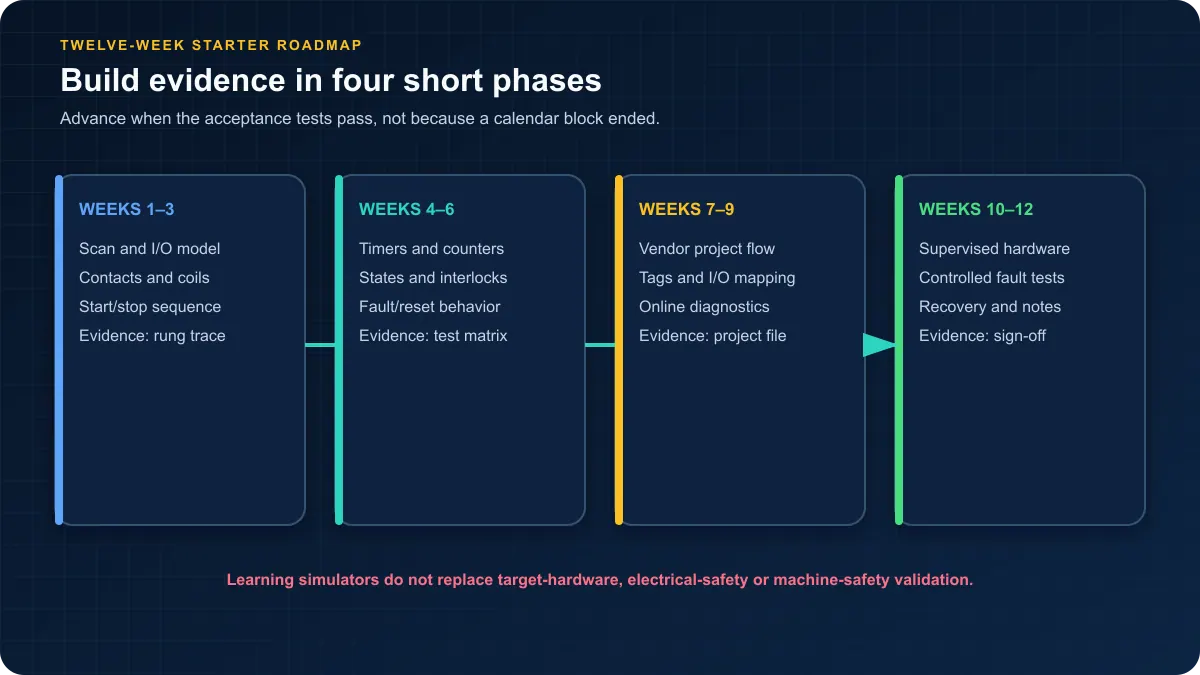
- First: use a structured course or curated fundamentals sequence for the scan model, I/O, contacts, coils and basic safety boundaries.
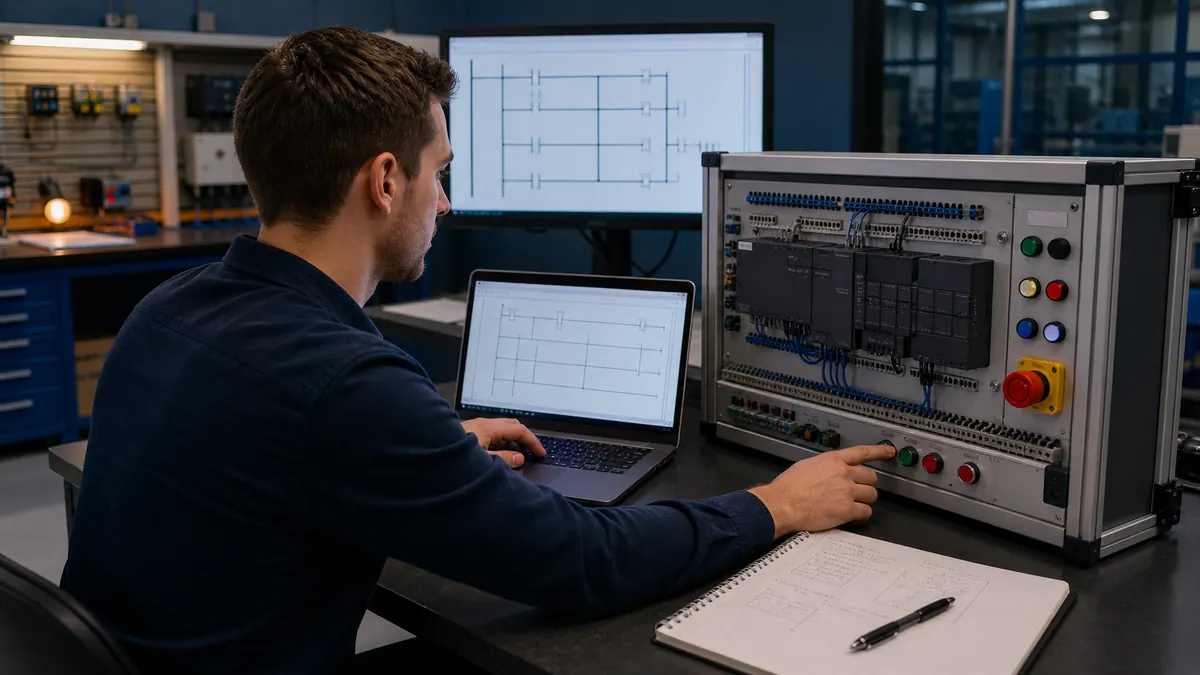
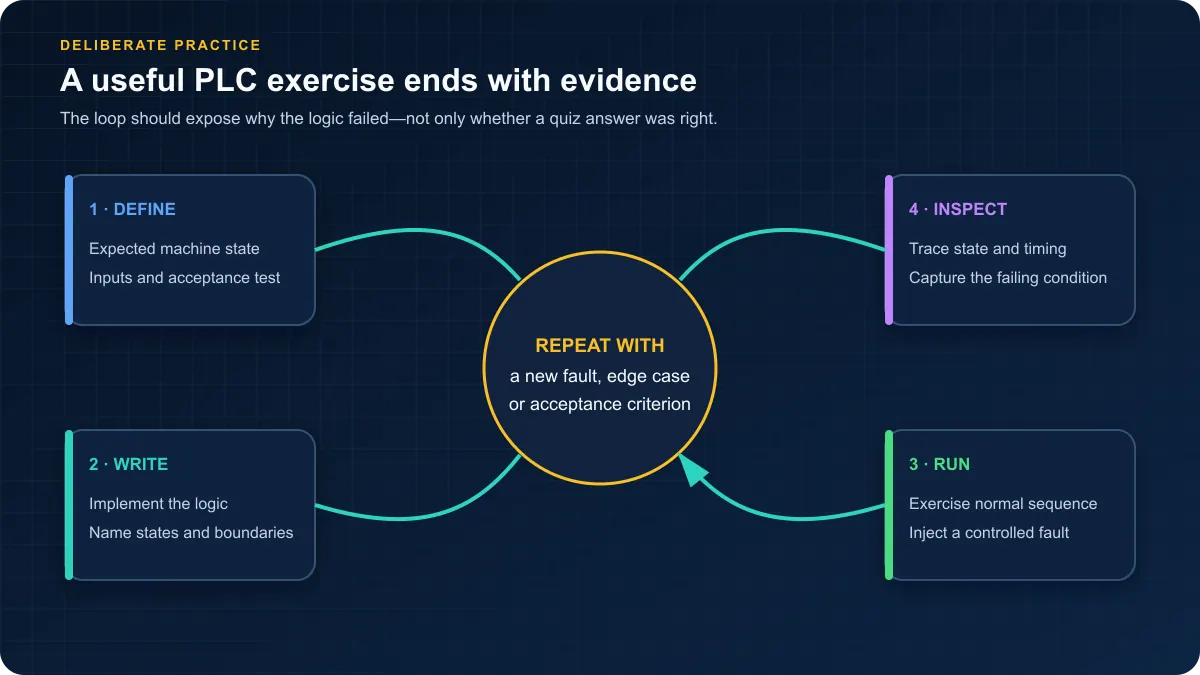
- Then: add an executable browser exercise and trace why the output changes on each scan.
- Next: reproduce the same small sequence in the vendor environment relevant to your target job.
- Finally: validate it on an isolated, supervised trainer before touching production equipment.
You're an electrician transitioning to PLC technician
- Primary path: training on the controller family used by your employer, combined with supervised troubleshooting and documentation tasks.
- Supplement: a broad course for gaps and a simulator for repeatable timer, counter, interlock and sequence work.
You're a software engineer crossing to OT
- Start with the PLC scan model, deterministic state, I/O boundaries, failure behavior and safe commissioning—not only syntax.
- Use the structured text guide, then reproduce the logic in a relevant vendor project and supervised I/O lab.
You're a career-changer seeking a credentialed path
- Compare accredited local programs or apprenticeships for the formal education layer.
- Use online theory and browser practice between labs, but verify which credential employers in your target market recognize.
You're self-paying and budget-conscious
- Start with official documentation, a curated free learning sequence and a non-expiring simulator account.
- Pay only when a course closes a named gap that free material and deliberate practice did not close.
You work at a plant and need specific vendor depth
- Use official or authorized vendor training for the exact controller and software release.
- Pair it with a plant-safe practice project, change-control process and supervised recovery test.
The Honest Answer: Choose a Stack, Not a Winner
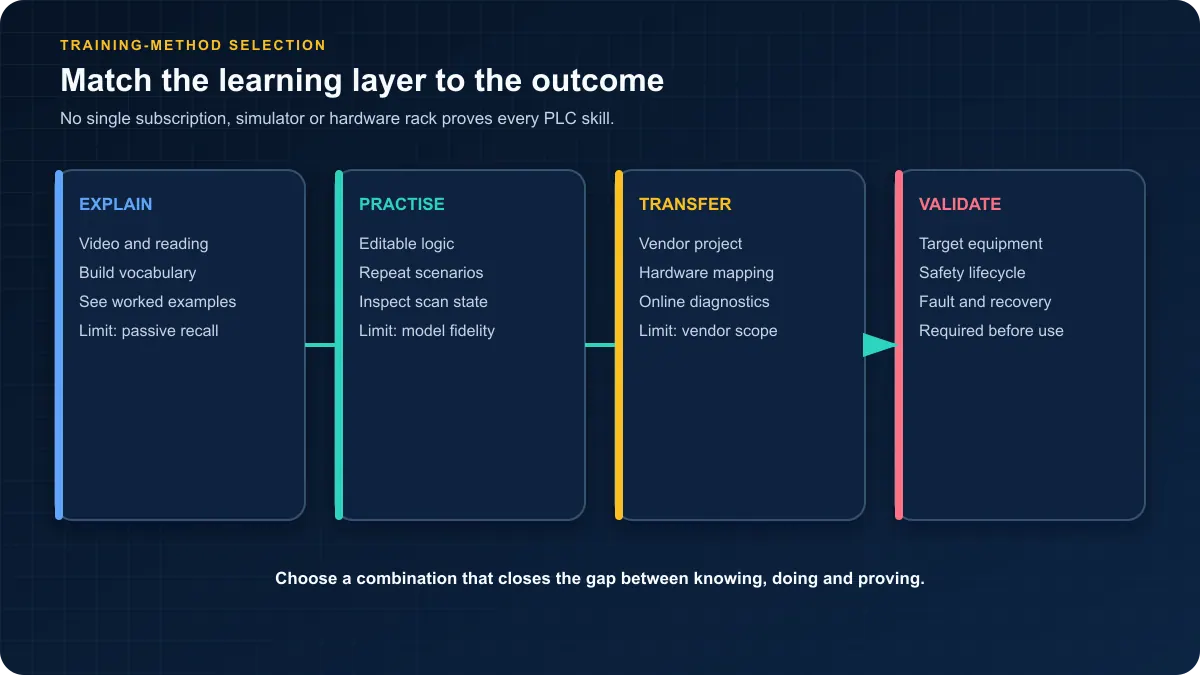
RealPars can cover a broad explanation, community and guided-learning layer. Its value depends on how much of the catalog you will use and whether the exact courses provide the activities and certificate issuer you need. It should be evaluated as part of a learning stack:
- Active practice in a documented simulator or supervised hardware lab
- Reference reading like pillar guides and specific tutorials
- Vendor-specific transfer for your target controller and project workflow
- Validation evidence covering normal state, faults, reset and recovery
Treating any single resource as complete creates blind spots. A small portfolio containing logic, test matrices, fault evidence and version notes is more inspectable than a list of hours watched.
Key Takeaways
- RealPars currently lists a 7-day trial, $60 monthly billing and a $600 annual individual plan; recheck the official page before purchase.
- Compare alternatives by evidence: syllabus, executable work, feedback, version, project files, access terms and credential issuer.
- PLC Simulation Software is our related browser practice product; it has a free account and documented limitations, and it does not replace vendor tools or target-hardware validation.
- Vendor training is the direct route when a job requires a specific platform or assessment.
- A strong path combines explanation, deliberate practice, native project transfer and supervised validation.