PLC Training Cost 2026: Courses, Labs and Skills Proof
Compare current PLC training prices, total path cost, prerequisites, role fit, practical assessment, vendor labs, certificates, and evidence before paying.
PLC training can start at $0, but there is no honest universal price for becoming job-ready. Current public examples span a free browser-practice tier, individual subscriptions from $12 per month, course memberships at $60 per month, and manufacturer-led courses priced in the thousands. The correct comparison is not “which tuition is cheapest?” It is “which missing skill layer does the price buy, and what evidence will prove the learner can perform?”
This page owns PLC training cost, PLC course fees, total path cost, prerequisites, and skills-assessment value. The PLC training homepage owns the broader curriculum and “PLC training” query. The course comparison owns provider selection. The interactive PLC training product owns executable browser practice. Keeping those jobs separate avoids turning a price guide into a duplicate course directory.
This guide was reviewed on 30 August 2026. Prices below are point-in-time examples from first-party pages; taxes, exchange rates, regional catalogues, travel, software, hardware, access terms, and employer funding vary. Verify the exact checkout or written quote before purchase.
Ownership disclosure: PLC Programming IO and PLC Simulation Software share ownership. Product facts, prices, free-tier terms, and limitations are linked to a versioned public record. The product is included where its practice layer fits, not presented as a substitute for vendor software, supervised hardware work, formal certification, or machine-safety validation.
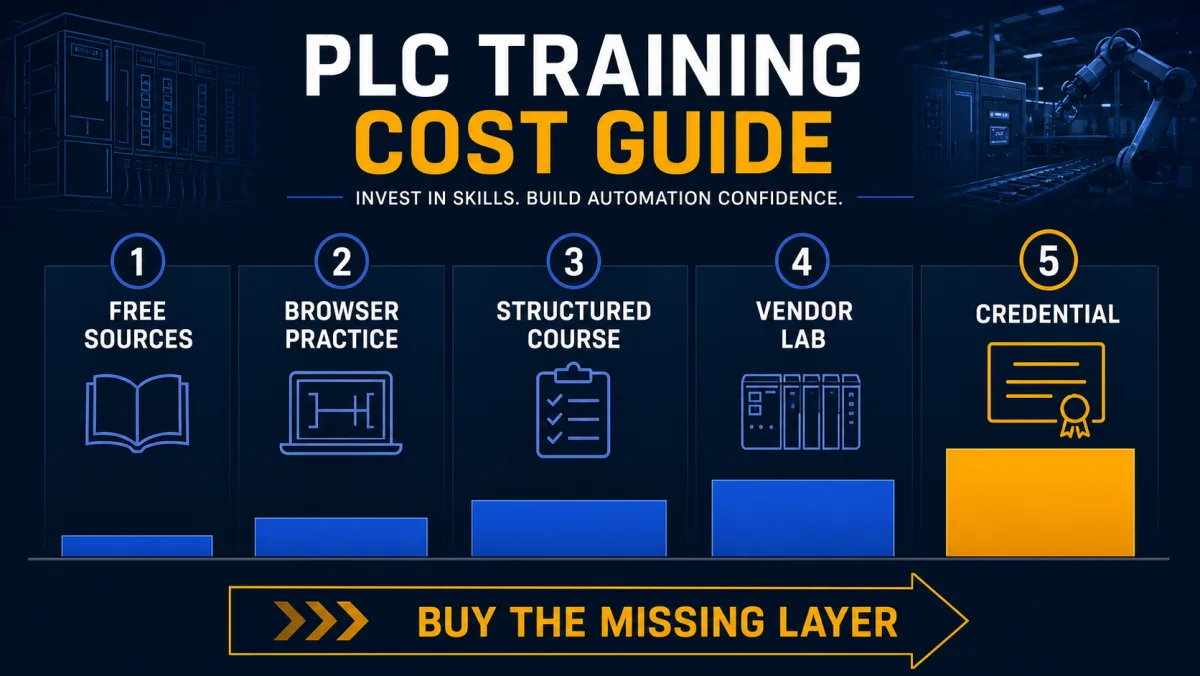
PLC training cost: current short answer
The table compares public examples available on the review date. It does not claim that products with different scope are interchangeable.
| Training example | Published price on review date | What the price can buy | Important boundary |
|---|---|---|---|
| Official manuals, product help, public lessons | Often $0 to access | Reference, terminology, instruction behavior, application examples | No guaranteed sequence, feedback, project review, hardware, or credential |
| PLC Simulation Software free account | $0; no card; no expiry | Eligible browser lessons and practice; 27 published scenario records identified as free-tier in product facts | Learning model; access varies by account/entitlement; not vendor firmware |
| PLC Simulation Software Basic | $12 monthly or $99 annually | Paid individual browser-practice layer under facts version 2026-08-09.1 | Verify live entitlements and staged feature availability |
| PLC Simulation Software Pro | $29 monthly or $249 annually | Higher individual plan under the same versioned record | Not a production IDE, controller, certification, or physical lab |
| PLC Simulation Software managed team seat | $199 per seat annually; five-seat minimum | Managed organizational practice seats; organization creation is free | Annual-only published team-seat term; bulk/academic quote may differ |
| RealPars individual membership | $60 billed monthly or $600 annually; 7-day trial | 120+ courses, classes, projects/challenges, community, and completion certificates described by RealPars | Trial continues to paid access; verify cancellation/refund and exact content |
| Siemens TIA Portal 1A course example | €1,050 for two days on the current Netherlands page | Face-to-face S7/TIA fundamentals with practical exercises | One region/course/date; tax, travel, language, availability, and target version vary |
| Siemens TIA Programming Expert example | €1,860 for three days on its published 2026 course sheet | Advanced S7-1500/SCL topics and virtual-plant exercises | Requires prior TIA and SCL competence; not a beginner course |
| Siemens India S7-1200 online example | ₹30,000 plus 18% GST for five days on its 2026 sheet | Online instruction and a virtual-lab route | Regional price, stated software/PC requirements, and specified course version |
| CODESYS Academy V3 Essentials online example | €1,716 plus VAT for a listed 2027 intake | Manufacturer-led essentials with practical exercises and a completion certificate | Future intake and regional tax; verify current date, language, seats, and terms |
| CODESYS North America intensive example | $2,750 per person for a listed 30-hour 2026 course | Manufacturer-led basic/advanced modules, labs, and final project | Intended for experienced controls engineers; date/location requirements apply |
| Rockwell Logix certificate path | Current official course sequence and durations; price routed through Training Services/local channel | Named Studio 5000 courses, hands-on exercises, final assessment, Certificate of Achievement | Traditional assessment may add charges; region, schedule, prerequisites, and elective change total |
Three cautions matter. First, the RealPars page displays an annual equivalent of $50/month but charges $600 for the annual billing choice; compare cash paid and cancellation terms, not only the normalized monthly figure. Second, a manufacturer course fee may exclude tax, travel, prerequisite courses, software after class, or a separate assessment. Third, a completion certificate is not automatically a vendor certificate program or an independent professional certification.
Why broad PLC training and PLC training cost need separate owners
Fresh Mangools data on 30 August 2026 estimated 6,100 global searches for “PLC training” and only 20 for “PLC training cost.” The parent term deserves a broad learning hub. The cost modifier is a smaller but more commercial decision task involving fees, prerequisites, quotes, access terms, and outcomes.
| Search task | Correct owner | What the page should answer |
|---|---|---|
| What is PLC training and what should I learn? | PLC training homepage | Curriculum, practice loop, learning routes, product proof, limitations |
| How much does PLC training cost? | This page | Current price evidence, total path cost, quote comparison, prerequisites, assessment |
| Which PLC training program is best? | Program comparison | Provider shortlist, format tradeoffs, selection method |
| Which online PLC course should I choose? | Online course comparison | Course-specific fit and current course evidence |
| Where can I practise PLC logic? | Interactive training platform | Runnable lessons, scenarios, feedback, learner evidence |
| Which credential do I need? | Certification blueprint | Issuer, requirement, assessment, recognition, renewal |
This separation also protects conversion measurement. A broad homepage signup and a price-guide click have different intent. Track the cost-guide campaign through activation, checkout, and paid signup; do not remove its CTA merely because it sends fewer clicks if those clicks produce more paid users or more revenue per visitor.
Calculate total path cost, not only tuition
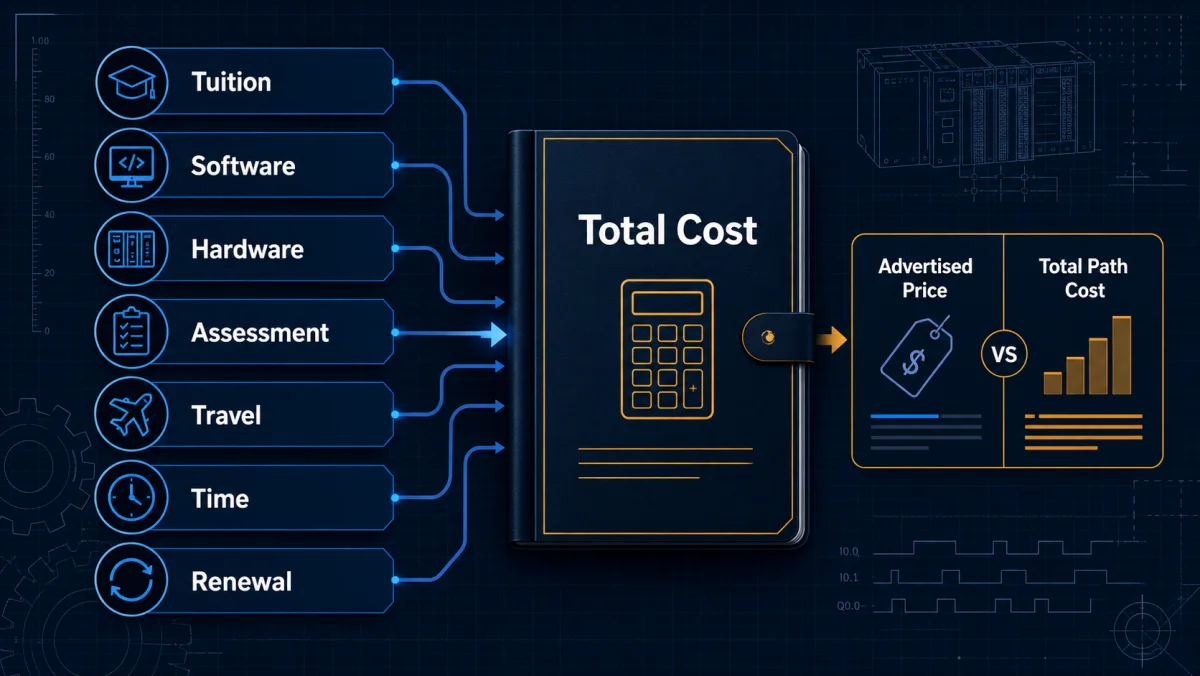
The advertised fee is one variable:
Total path cost = tuition + required software + hardware/lab + assessment + travel + time + renewal − confirmed funding.
“Time” should be recorded even when no invoice exists. A week in class, evening study, travel, setup, and repeated practice all consume capacity. Do not invent a wage value when comparing personally; record hours separately or use an agreed employer cost rate.
| Cost line | Evidence to collect | Common omission |
|---|---|---|
| Tuition/subscription | Checkout total, currency, tax, billing period, renewal date | Advertising an equivalent monthly price while billing annually |
| Software/runtime | Exact edition, license term, target support, student entitlement | Assuming classroom access continues after the course |
| Hardware/lab | Controller, I/O, process model, individual hands-on hours, supervision | Calling instructor demonstration “hands-on” for every attendee |
| Assessment | Exam, retake, proctoring, identity check, pass rule, expiry | Treating course attendance as assessed competence |
| Travel | Transport, hotel, meals, visa, local travel, insurance | Comparing remote and classroom tuition without travel |
| Time | Scheduled hours, preparation, practice, missed work, timezone | Treating self-paced material as zero-effort |
| Renewal | Subscription renewal, recertification, continuing development, software maintenance | Ignoring year-two cost |
| Funding | Employer budget, apprenticeship support, grant, tax treatment | Counting possible funding before written approval |
Worked comparison template
Suppose option A is a low-cost video subscription and option B is an instructor-led vendor class. Do not declare A cheaper until the required result is named.
| Comparison field | Option A | Option B |
|---|---|---|
| Required outcome | Example: interpret and modify a motor sequence | Same exact outcome |
| Price/date/currency | Copy from current checkout | Copy from written quote |
| Executable practice | Number and nature of exercises | Individual hardware/virtual lab hours |
| Feedback | Automated, peer, instructor, none | Instructor ratio and review method |
| Target transfer | Project format and software access | Exact controller/software release |
| Assessment | Known/hidden cases and pass rule | Practical/written exam and retake |
| Post-course access | Access duration and downloadable evidence | Software/files/support after class |
| Remaining gap | What still needs purchase/supervision | What still needs purchase/supervision |
The lower total is the option that reaches the required evidence with fewer unresolved layers—not automatically the smallest first invoice.
Choose PLC training by job role
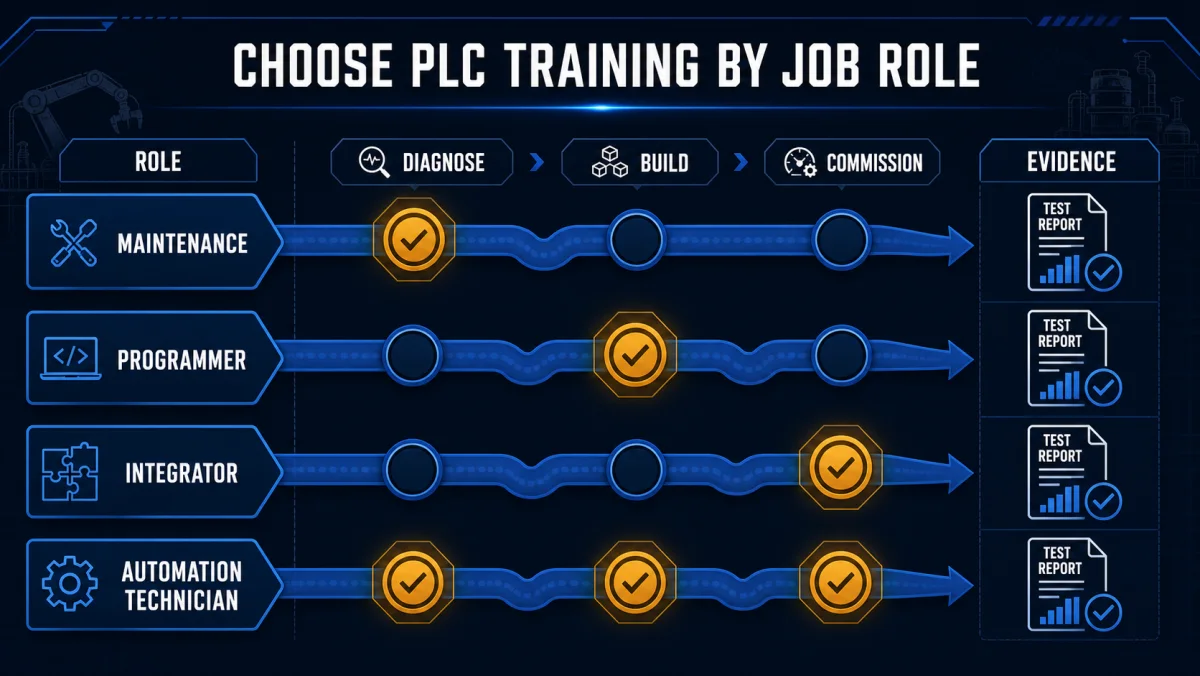
The same course can be excellent for one role and poor value for another. Build the purchase decision from representative work.
| Role | Primary performance target | Practical assessment before buying | Training layer most likely to matter |
|---|---|---|---|
| Maintenance technician | Find the first failed boundary and restore under procedure | Diagnose an injected request/input/command/feedback fault; explain the evidence | Troubleshooting labs, prints, online monitoring, backup/restore, supervised equipment |
| PLC programmer | Convert requirements into tested controller logic | Write an I/O contract, sequence, timeout, reset, and acceptance matrix | Structured instruction, executable practice, native project workflow, review |
| Systems integrator | Integrate PLC, HMI, network, drive/instrument, and site acceptance | Map one end-to-end signal and diagnose a broken handoff | Multi-system labs, network tools, commissioning workflow, documentation |
| Automation technician | Diagnose, modify, test, document, and hand off across disciplines | Complete both fault diagnosis and small controlled change tasks | Balanced PLC/electrical/HMI/network practice plus supervised field transfer |
| Controls engineer | Define architecture, standards, validation, and lifecycle evidence | Review a design and produce traceable requirements/tests | Advanced vendor courses, standards, simulation, peer review, representative system |
| Electrician moving into PLCs | Relate drawings and devices to the program without exceeding authorization | Trace source/input/tag/logic/output/load on a de-energized trainer | I/O, drawings, instrumentation, electrical safety, monitored logic and troubleshooting |
Collect role evidence before requesting a quote
Use at least five representative job postings, the installed equipment list, recent work orders, or an approved role standard. Record:
- controller, HMI, SCADA, drive, motion, safety, and network families;
- whether the work is programming, maintenance, integration, operation, or supervision;
- expected electrical/instrumentation knowledge and authorization;
- languages and project formats used;
- required credential issuer and exact title, if any;
- shift, travel, commissioning, documentation, and troubleshooting expectations; and
- which tasks require supervised physical demonstration.
A course that broadly says “industrial automation” may still omit the target controller or the diagnostic task that drove the purchase.
PLC course prerequisites: test them before paying
Prerequisites are not an administrative nuisance. They protect the learner from spending an advanced course on basics the instructor assumes. Siemens' current TIA Programming Expert sheet, for example, requires prior TIA knowledge, practical experience, and basic SCL knowledge. CODESYS' North America intensive targets experienced control engineers and expects general industrial-controls programming knowledge.
| Prerequisite layer | Quick pre-course task | Evidence of readiness | If not ready |
|---|---|---|---|
| Electrical/I/O vocabulary | Explain a digital input and output path from field condition to load | Correct source/return, true state, and isolation boundary | Take fundamentals and supervised low-voltage trainer work first |
| Boolean/scan model | Predict a start/stop rung for four input combinations across scans | Truth table and stop-priority trace match observed behavior | Use free fundamentals and basic simulator exercises |
| Timers/counters | Predict enable, elapsed, done, reset, and edge behavior | Boundary cases pass without random edits | Practise timed/counted exercises before vendor course |
| Program structure | Separate request, permissive, command, feedback, fault, and recovery | Small program has clear output ownership | Take structured programming fundamentals |
| Target software | Create/open project, navigate hardware tree, cross-reference a tag | Task completed in the exact supported release | Arrange software orientation or lab access |
| Troubleshooting | Diagnose one injected input or feedback fault | First failed boundary and controlled test are explained | Choose a maintenance/troubleshooting course, not advanced programming |
| Safety boundary | State what simulation and ordinary PLC logic cannot validate | Uses risk assessment, procedure, qualified supervision, and independent safety validation correctly | Complete required safety/electrical training before equipment work |
Passing does not require perfection. It means the learner can spend paid class time on the advertised level instead of reconstructing every prerequisite.
A practical PLC skills assessment before enrollment
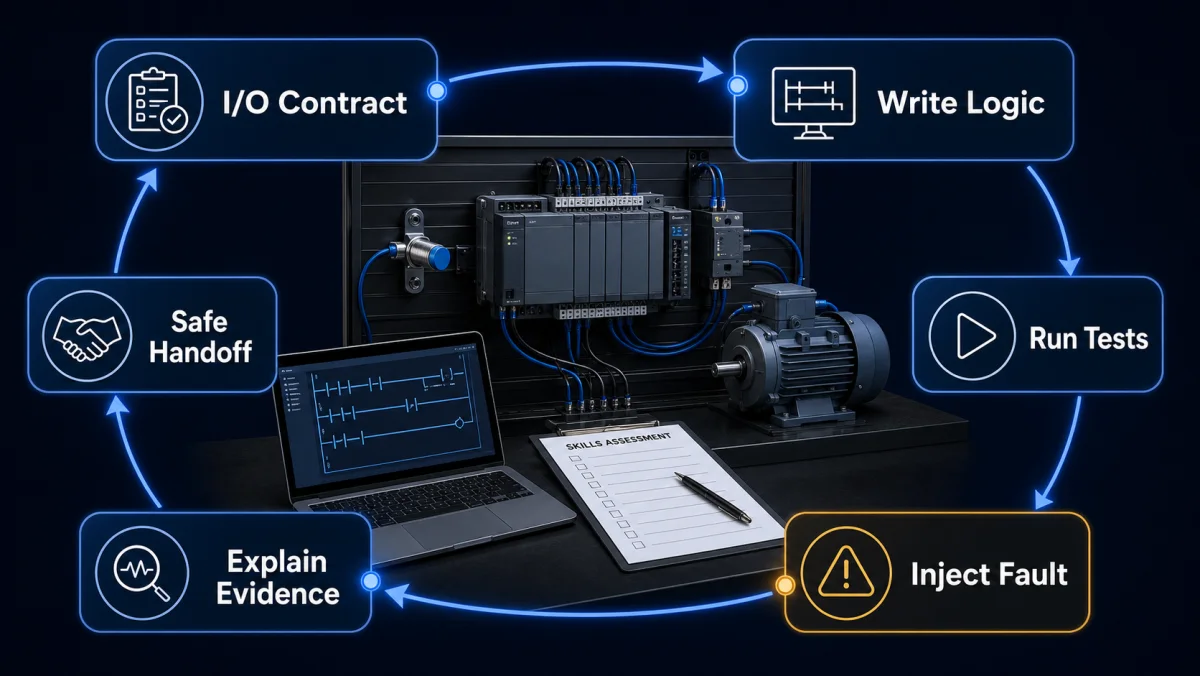
Use the same forty-five- to ninety-minute task before and after training. A repeat of the identical problem can reward memory, so the post-test should be an equivalent unseen variant.
Assessment brief
Control an ordinary conveyor model. A start edge may request motion when process permissives are healthy. A warning precedes the command. Running feedback must appear within a stated time; missing feedback latches a first-out fault. Stop clears the request. Reset is rejected until the request is off and feedback is absent. The model is not a safety function.
| Deliverable | Scoring question | 0 points | 1 point | 2 points |
|---|---|---|---|---|
| I/O contract | Are types and true states explicit? | Missing | Partial/ambiguous | Complete and testable |
| Priority | Does stop/lost permissive win? | Wrong/accidental | Implemented, not tested | Stated and simultaneous case passes |
| Timing | Are warning and feedback timers correct? | Broken | Nominal only | Entry, abort, timeout, reset pass |
| Diagnosis | Is the failed boundary visible? | No fault evidence | Generic fault | First-out feedback timeout and state retained |
| Recovery | Are reset and restart deliberate? | Surprise restart | One reset case | Reset rejection and restart policy pass |
| Explanation | Can the learner trace the result? | Guesses | Describes code only | Connects request through feedback and evidence |
| Target transfer | Is vendor-specific behavior recorded? | Assumes portability | Mentions platform | Version/task/library/I/O deviations documented |
| Safe handoff | Are physical/safety limits explicit? | Unsafe claim | Generic warning | Exact validation and authorization boundary |
Score each row 0–2 for a maximum of 16. Use the result as a gap map, not an employment verdict. A course should define which rows it expects to improve.
The PLC practice exercises provide more problem contracts. The browser training path can supply repeatable logic scenarios and learner evidence before vendor-project and supervised-bench validation.
Score a PLC course before comparing its price
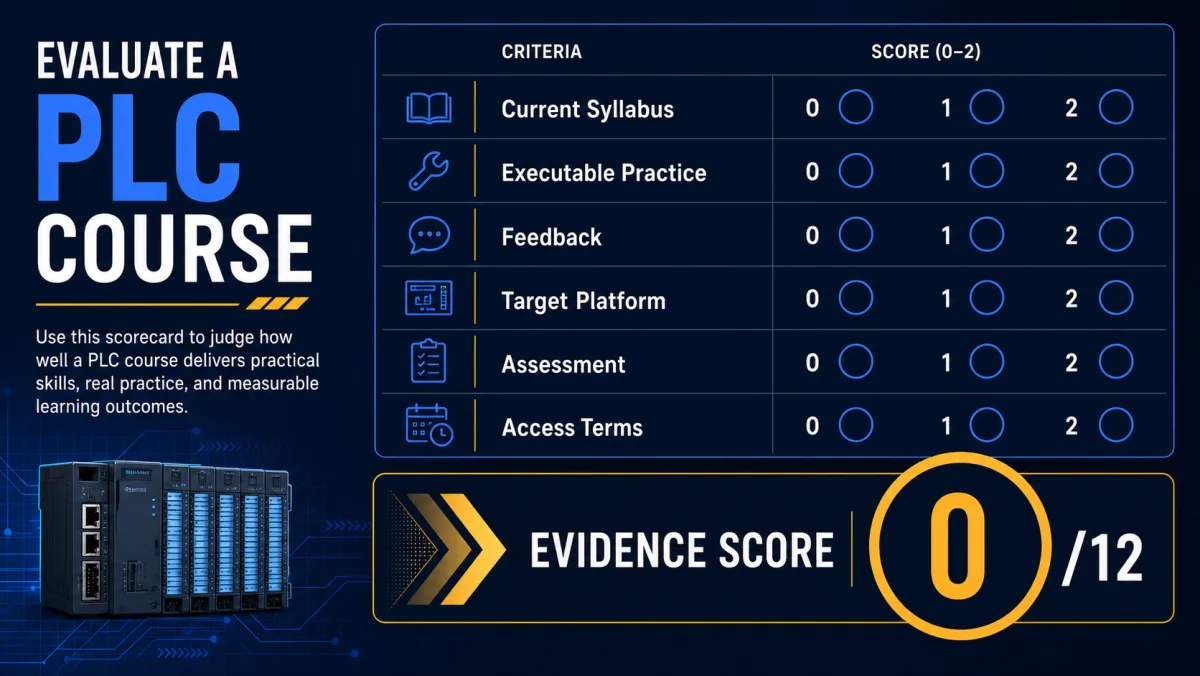
Give each criterion 0, 1, or 2. Ask the provider for evidence when the public page is unclear.
| Criterion | 0 | 1 | 2 |
|---|---|---|---|
| Current syllabus | No version/date | Topics but weak target context | Controller/software/release and outcomes are explicit |
| Executable practice | Watching only | Guided copy-along | Learner builds/tests equivalent and unseen cases |
| Feedback | None | Generic/peer | Qualified review of the learner's actual evidence |
| Target platform | Not stated | Brand named | Exact software, controller, project format, and access stated |
| Assessment | Attendance only | Quiz/known task | Practical unseen task with criteria and remediation |
| Access terms | Hidden | Basic duration shown | Billing, renewal, cancellation, files, support, and post-course access clear |
| Prerequisites | None stated | Generic experience | Entry task or detailed competence prerequisites |
| Transfer | Ends with course | Suggested next step | Vendor project, supervised bench, and work handoff defined |
Interpretation for this editorial scorecard:
| Score | Decision use |
|---|---|
| 0–5 | Insufficient public evidence; request answers before paying |
| 6–10 | Some value, but identify missing practice/assessment/transfer layers and price them |
| 11–13 | Strong candidate if it matches the role and target platform |
| 14–16 | Evidence-rich offer; still verify checkout, instructor, date, hardware, and credential terms |
Course completion, certificate program, and professional certification
These terms change the cost calculation.
| Artifact | What it normally records | Cost questions |
|---|---|---|
| Completion certificate | Completion/attendance under the provider's rules | Is assessment required? Can anyone verify it? Does it expire? |
| Vendor certificate program | Named vendor curriculum plus specified assessment | Which prerequisite/core/elective courses, assessment fees, deadline, and retakes? |
| Accredited education credit | Credit from a recognized education provider under its rules | Tuition, residency, credits, lab fees, transferability, funding |
| Professional certification | Independent body evaluates published eligibility/body of knowledge | Application/exam, review course, retake, renewal, experience evidence |
Rockwell's current Logix Programmer traditional path lists three core courses totaling eight training days, an elective, and the T-CLXPT assessment, with all requirements completed within 18 months. Its accelerated CCP250 path is five days and includes its assessment, subject to prerequisites. That is more precise than saying “Allen-Bradley certification cost” as if one universal checkout exists.
ISA illustrates a different model. Its current FAQ lists CAP and CCST exam fees by member/non-member status and separate recertification fees. The CAP page states education/work-experience requirements and a 175-question, four-hour exam. ISA is an automation-professional certification body; it is not merely a PLC software course vendor. Verify whether the target employer asks for a specific vendor path, professional certification, accredited credit, or practical experience.
Budget routes that limit waste
These are staged planning patterns, not price promises.
Route A: self-funded beginner
- Use the broad PLC training curriculum, official documentation, and a free practice account.
- Complete Boolean, timer, sequence, analog, and troubleshooting assessments.
- Buy one missing layer—structured explanation, more executable practice, or target-software access.
- Delay hardware purchases until the target platform and supervised practice need are known.
- Preserve a small portfolio: I/O contract, code, tests, trace, fault explanation, limitations.
Route B: maintenance technician with employer funding
- Map frequent assets and failure modes from approved work data.
- Baseline an equivalent fault-diagnosis task.
- Select native maintenance/troubleshooting instruction and representative lab access.
- Agree on supervised transfer and an equivalent post-course fault.
- Measure time-to-diagnosis, unnecessary changes avoided, evidence quality, and safe handoff—not only completion.
Route C: programmer changing platforms
- Prove portable logic fundamentals before buying brand-specific basics.
- Take the target vendor's entry assessment or documented prerequisite check.
- Buy the shortest course that closes engineering-tool, hardware configuration, library, task, and diagnostic gaps.
- Rebuild an existing acceptance-tested sequence in the native project.
- Review deviations with an experienced platform user and validate on representative hardware.
Route D: candidate needing a credential
- Obtain the exact credential title from the employer, institution, licensing rule, or contract.
- Verify issuer, prerequisites, required courses, assessment, recognition, expiry, and renewal.
- Quote the complete path, not a single course.
- Keep practical evidence alongside the credential.
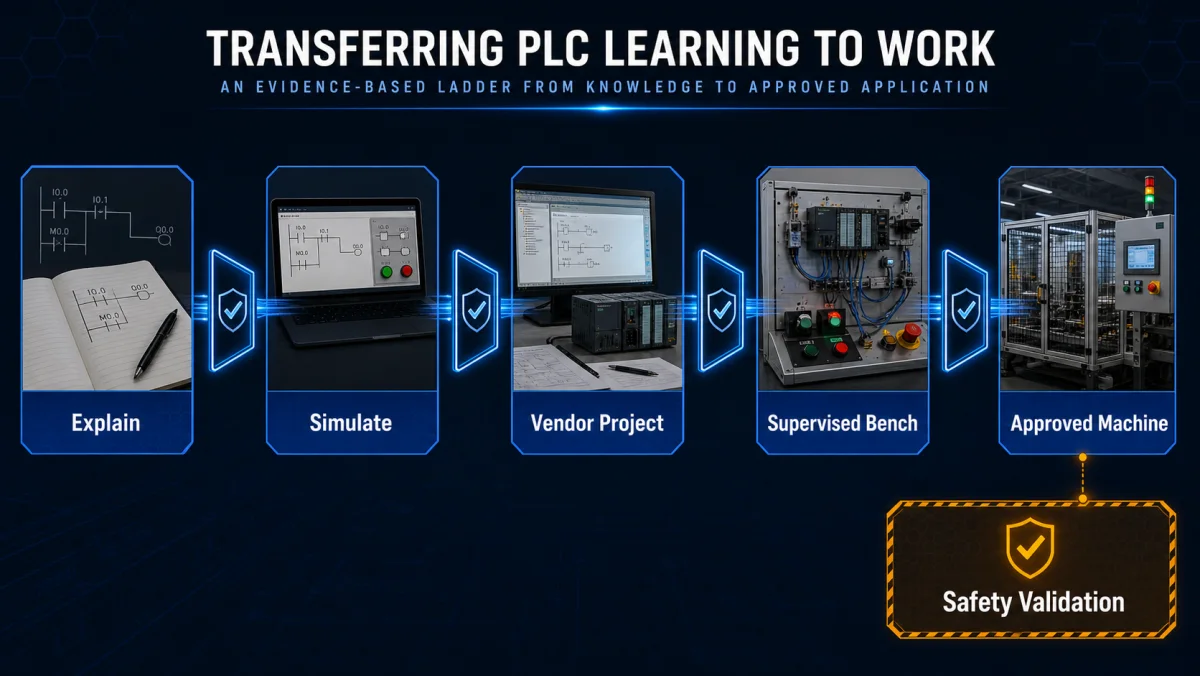
Transfer learning through five evidence gates
Training creates value only when knowledge transfers to the permitted work context.
| Gate | Passing evidence | What remains unproved |
|---|---|---|
| Explain | Learner predicts scan/state behavior and identifies assumptions | Executable behavior |
| Simulate | Defined normal and fault cases pass in the learning model | Vendor compiler/runtime and physical I/O |
| Vendor project | Exact project compiles/runs in the selected software and task | Representative electrical/device behavior |
| Supervised bench | Controller, I/O, device, backup, and recovery cases pass under supervision | Installed-machine dynamics and site acceptance |
| Approved machine | Authorized tests pass under the project procedure | Ongoing change control, maintenance, and independent safety lifecycle evidence |
Measure whether paid PLC training was worth it
Do not promise that a course will cause a salary increase or job offer. Measure the outcome the purchase was designed to change.
| Intended outcome | Before/after measure | Guardrail |
|---|---|---|
| Faster diagnosis | Time and evidence steps on equivalent unseen faults | Do not reward unsafe shortcuts or uncontrolled changes |
| Better programming | Acceptance-case pass rate and review defects | Use equivalent task difficulty and target context |
| Better transfer | Deviations found moving from model to vendor project/bench | Record platform differences, not only pass/fail |
| Fewer repeat faults | Approved first-out evidence and verified recovery quality | Control for equipment and process changes |
| Credential gate | Exact credential earned and accepted for stated requirement | Do not substitute a generic completion badge |
| Learner retention | Equivalent task after a delay | Course completion on the same day is not retention |
| Commercial simulator value | Activation, exercise completion, checkout, paid signup, retained practice | Evaluate revenue/qualified outcomes, not CTA clicks alone |
For a team, compare the same role cohort, task, and observation window where possible. For an individual, keep a dated portfolio and repeat an unseen task after two to four weeks.
Frequently asked questions
How much does PLC training cost in 2026?
Entry can be $0 with official resources and a free simulator tier. Current public examples on this page range from $12 monthly for paid browser practice to manufacturer-led courses in the low thousands, but they buy different layers. Add software, hardware, assessment, travel, time, tax, renewal, prerequisite courses, and any confirmed funding to compare total path cost.
Why are many Siemens and Rockwell PLC training prices not universal?
Vendor training is sold through regional catalogues, training portals, local organizations, and authorized channels. The course code, software/controller release, duration, language, delivery mode, tax, travel, prerequisites, assessment, and date can differ. Use the exact current course page or written local quote; do not reuse a price from another country as a promise.
How much does Allen-Bradley or Rockwell PLC certification cost?
Rockwell publishes named Logix certificate curricula, course durations, electives, assessment routes, and completion windows, but the total price depends on regional courses and the selected path. Request a written quote listing every required course, elective, assessment, materials, tax, travel, cancellation, and retake. Distinguish a course-completion record from the full Certificate Program.
What does Siemens PLC training cost?
There is no single worldwide figure. Current first-party examples include €1,050 for a two-day TIA Portal course in the Netherlands, €1,860 for a three-day advanced programming course, and ₹30,000 plus tax for a five-day India online S7-1200 course. They differ in level, region, delivery, and prerequisites; verify the exact listing for your date.
Is online PLC training cheaper than classroom training?
It often removes travel and may lower tuition, but total value depends on executable practice, feedback, target software, assessment, and transfer. Online manufacturer courses can still cost thousands. A lower-cost subscription may be best for repeated logic practice, while an instructor-led lab may be justified when qualified feedback or representative hardware is the missing layer.
Is paid PLC training worth it?
It is worth considering when it closes a named gap and produces observable evidence: a tested program, faster fault diagnosis, native project competence, supervised hardware performance, or an explicitly required credential. It is poor value when it duplicates material already mastered or ends without practice, feedback, assessment, or transfer.
What prerequisites do I need before a PLC course?
They depend on the course. Beginner training may assume only basic electrical/automation vocabulary; advanced vendor programming can require prior project, platform, or language experience. Run a pre-course task covering I/O semantics, Boolean/scan behavior, timers, program structure, software navigation, troubleshooting, and the safety boundary, then buy the level matching the gaps.
How should I assess PLC skills before paying for training?
Use a short practical task with an I/O contract, logic requirement, normal and fault cases, first-out diagnosis, reset/restart rule, explanation, and safe handoff. Score explicit criteria and repeat an equivalent unseen variant after training. A multiple-choice quiz alone cannot establish programming or troubleshooting performance.
Is a PLC course certificate the same as certification?
No. A completion certificate, vendor certificate program, accredited education credit, and independent professional certification have different issuers, eligibility, assessment, recognition, expiry, and renewal. Record the exact title and verify that it satisfies the target requirement before paying.
Can a browser simulator replace vendor training and real hardware?
No. It can make logic practice, deterministic scenarios, fault injection, and repeated assessment accessible. It cannot prove every vendor instruction/firmware behavior, native project workflow, physical wiring, device dynamics, machine response, safe commissioning, or functional-safety performance. Use it as one evidence gate before target-specific and supervised validation.
Primary sources, review scope, and limitations
- PLC Simulation Software versioned product facts
- PLC Simulation Software current pricing
- RealPars individual pricing
- RealPars Help Center pricing record, 10 June 2026
- Rockwell Automation Certificate Programs
- Rockwell Accelerated Logix 5000 Programmer Certificate Level 1
- Siemens TIA Portal System Course 1A page
- Siemens TIA Portal Programming Expert course sheet
- Siemens India online S7-1200 course sheet
- CODESYS Academy training overview
- CODESYS Academy V3 Essentials online listing
- CODESYS Academy Intensive North America
- ISA certification fees FAQ
- ISA Certified Automation Professional program
- IEC 61131-3:2025 publication record
- NIST SP 800-82 Rev. 3: Guide to Operational Technology Security
- OSHA 29 CFR 1910.147 control of hazardous energy
- OSHA electrical safety resources
Review scope: price statements were checked against the linked first-party pages on 30 August 2026. Mangools validated a small, low-difficulty cost cluster and a much larger broad-training cluster; its estimates are not traffic guarantees. Course examples are evidence that the market spans multiple price layers, not a universal range or endorsement.
Limitations: currencies, taxes, dates, availability, versions, instructors, entitlements, trial terms, cancellation, and regional quotes can change. The skills assessment is an editorial framework, not an accredited exam or authorization to work on equipment. Training and simulation do not replace employer authorization, risk assessment, hazardous-energy control, qualified electrical work, current manufacturer instructions, representative hardware tests, site acceptance, or independent machine-safety validation.
Next: use the PLC training curriculum, compare current training programs, or start the hands-on PLC training path.


