Is PLC Certification Worth It? What Employers Actually Check (2026)
PLC certification alone rarely gets you hired — but in the right situations it's the cheapest tie-breaker you can buy. An honest look at when certs pay off, when they don't, and what employers actually screen for.
Ask "is PLC certification worth it" on any automation forum and you'll get the same two camps shouting past each other: the "paper means nothing, experience is everything" crowd and the "my cert got me a raise" crowd. Both are telling the truth — about their own situation. This guide skips the forum noise and lays out when certification actually moves the needle, when it's a waste of money, and what hiring managers genuinely look at before they ever read the certifications line on your CV.
The short answer
PLC certification alone rarely gets you hired. What it does is tie-break: when two candidates look similar on paper, the certificate wins. It also unlocks vendor ecosystems — a Siemens shop values SITRAIN, a Rockwell shop values Studio 5000 credentials — and it matters most when your employer is paying for it, not you.
That's the honest 50-word version. The longer version depends entirely on who you are, who's paying, and what platform your target employers run. Let's break it down.
What employers actually screen for
Read a few dozen PLC programmer or controls engineer job postings and a pattern jumps out fast. The requirements lists are dominated by two things: a named platform and years of hands-on experience. "3+ years with Allen-Bradley Studio 5000." "Experience commissioning Siemens S7-1500 with TIA Portal." "Familiarity with FactoryTalk View HMI development." Certifications, when they appear at all, sit in the "nice to have" column — usually phrased as "vendor certification a plus."
That tells you what the screen actually is. The hiring manager isn't asking "is this person certified?" They're asking "can this person walk onto our plant floor, open our project files, and not break production?" The fastest evidence for that is demonstrated work: machines you've commissioned, projects you've documented, logic you can explain under questioning. A technical interviewer can tell within ten minutes of conversation whether you've actually debugged a fault on a live line or only watched videos about it.
Certificates can't fake that conversation. What they can do is get you into the conversation. An applicant tracking system or a non-technical recruiter doing the first CV pass has no way to evaluate "self-taught, built six projects." A recognised vendor credential is a checkbox they understand. So the realistic model is this: experience and projects win interviews; certification helps you get shortlisted for them. Treat it as a door-opener and tie-breaker, never as a substitute for being able to do the work.
One more observation worth internalising: nobody hires a "certified PLC programmer" in the abstract. They hire someone for their platform, their industry, their installed base. A wall of generic certificates is worth less than one targeted credential plus proof you've used that platform in anger.
When certification IS worth it
There are five situations where certification genuinely pays for itself.
1. You're a career changer with no industrial track record. If you're coming from IT, electrical work, the military, or a completely unrelated field, you have a credibility gap that a portfolio alone may not close. A recognised certification is a signal to a skeptical hiring manager that you've done structured training on the actual platform — it converts "claims to know PLCs" into "has third-party verification." For career changers, this is the single strongest use case.
2. Your employer is paying. This one is almost a no-brainer. If your company offers training budget or a vendor sends your shop to official courses, take it every time. The cost-benefit calculation that makes self-funded certification questionable disappears entirely when the cost is zero to you. You keep the credential when you change jobs; the company keeps the invoice.
3. You're targeting a vendor-locked shop. Plenty of plants are single-vendor by policy. A Siemens house — common across Europe and much of Asia — places real weight on SITRAIN credentials because they map directly onto the systems running the plant. A Rockwell-standardised North American facility reads Studio 5000 certification the same way. When the employer's entire installed base is one ecosystem, that vendor's certificate is the closest thing to a pre-qualification stamp.
4. You work in government, utilities, or unionised environments. These employers often run formal pay scales and progression frameworks where credentials trigger pay steps or grade promotions regardless of what your manager thinks of your work. In that world, certification isn't a tie-breaker — it's a documented input to a formula. If a certificate moves you up a band, the maths is simple.
5. You need credentials for visa or immigration purposes. Skilled-migration pathways and work-permit assessments frequently require documented, verifiable qualifications. Self-taught skill is real, but it doesn't survive a points-based assessment form. If your career plan involves moving countries, formal credentials carry weight that has nothing to do with hiring managers at all.
If you fit one of these five, certification is worth serious consideration. If you don't, read the next section before spending anything.
When it's NOT worth it
Don't self-fund $3,000+ before you've learned fundamentals. This is the most common and most expensive mistake. Official vendor training assumes you'll absorb a platform in a 5-day firehose, and beginners who arrive without grounding in ladder logic, I/O concepts, and basic program structure retain a fraction of it. You end up paying premium prices to learn things you could have learned for free or nearly free — then sitting an exam on shaky foundations. Learn the fundamentals cheaply first; certify when the course content will actually stick.
Don't collect certificates instead of building things. There's a failure mode where someone accumulates four or five credentials and zero projects, on the theory that more paper means more employability. It doesn't. The second a technical interview starts, the gap shows. Every hour and dollar spent on a third or fourth certificate would return more as a documented, working project you can demonstrate and discuss. One targeted cert plus a real portfolio beats a stack of certificates every time.
Don't certify on a platform your target employers don't run. A Siemens certification is close to worthless in a region or industry that's wall-to-wall Allen-Bradley, and vice versa. Before spending anything, search the actual job postings in your target market and count which platforms appear. Certify for the ecosystem you'll be hired into, not the one with the most convenient course schedule or the nicest brochure.
The thread connecting all three: certification is a multiplier on existing skill and a key to specific doors. Multiplying zero, or unlocking doors you'll never walk through, costs the same and returns nothing.
Certification vs portfolio: the hybrid path
The forum debate frames this as either/or. The people who actually get hired treat it as both/and — in a specific order.
Build first. A portfolio of documented projects is the strongest hireability asset available to someone without years on a plant floor, and it costs almost nothing to build. Work through structured problems — our 50 PLC practice exercises go from basic interlocks to full sequencing logic — and document each one: the problem, your I/O list, the ladder logic, what went wrong, how you fixed it. You don't need hardware to do this; here's how to practice PLC programming at home with simulators and free tools.
Then certify once, deliberately. With fundamentals in place and projects to show, pick the single certification that matches your target employers' platform and add it. Now the credential sits on top of demonstrable skill instead of substituting for it. Your CV passes the recruiter screen because of the cert; you pass the technical interview because of the portfolio. Each covers the other's blind spot.
This hybrid path is also dramatically cheaper than the certificate-collecting route. Free and low-cost practice covers the learning; you spend real money exactly once, on the credential with the highest payoff for your specific market. And when you sit that official course, you'll be the person in the room who already understands the material and is there to formalise it — which is precisely the student those courses are designed for.
Which certifications carry weight
Not all certificates are equal. Here's how the main options actually rank in hiring conversations.
Siemens SITRAIN. Siemens certifies through SITRAIN, its official training division, with paths covering TIA Portal, S7-1200, and S7-1500. These carry real weight anywhere Siemens dominates the installed base — most of Europe, large parts of Asia, and process industries globally. Total investment for the flagship TIA Portal instructor-led path runs €1,950–€3,500 including training, materials, and exam; the online self-paced route is €1,550–€2,700 plus a separate €300–€500 exam fee. Full breakdown of paths, exam format, and ROI in our Siemens PLC certification guide.
Rockwell / Allen-Bradley. Studio 5000 and FactoryTalk View credentials are the equivalent currency in North America, where Allen-Bradley dominates manufacturing, food processing, automotive, and pharma. Expect $2,700–$4,900 all-in for the instructor-led route or $2,000–$3,400 online, with exams at $400–$600. Details, study strategy, and salary data in our Allen-Bradley certification guide.
ISA CCST. The International Society of Automation's Certified Control Systems Technician is the main vendor-neutral option. It certifies technician-level competency across calibration, loop checking, troubleshooting, and maintenance of control systems generally, with tiered levels based on documented work experience. It's broader than PLC programming specifically — more instrumentation-and-controls than pure programming — and it's most valued in process industries and maintenance roles where multi-vendor competency matters more than depth on one platform. If your target employers run mixed fleets, it's the credential to look at.
College and TVET certificates. Formal qualifications in electrical engineering, mechatronics, or industrial automation from colleges and technical institutes occupy a different category: they're slower and usually broader than vendor training, but they satisfy degree/diploma requirements in job postings that vendor certs can't, and they often include genuine lab time on real hardware. For school-leavers and anyone whose target roles list a formal qualification as a hard requirement, this route does double duty.
The pattern across all four: weight is contextual. The "best" certification is the one that matches the systems your target employer already owns.
FAQ
Can I get a PLC job without certification?
Yes — and most working PLC programmers have no certification at all. They got in through electrical or maintenance roles, employer training, or demonstrated projects. Experience on the employer's platform dominates every hiring decision. Certification helps you get shortlisted, especially as a career changer, but it has never been a licence-style requirement for the job.
Which PLC certification is most recognized?
There's no single global standard — recognition is regional and vendor-driven. Siemens SITRAIN credentials carry the most weight where Siemens dominates (Europe, much of Asia); Rockwell's Studio 5000 certification matters most in North America. ISA's CCST is the strongest vendor-neutral option, valued in process industries and multi-vendor maintenance environments.
How much does PLC certification cost?
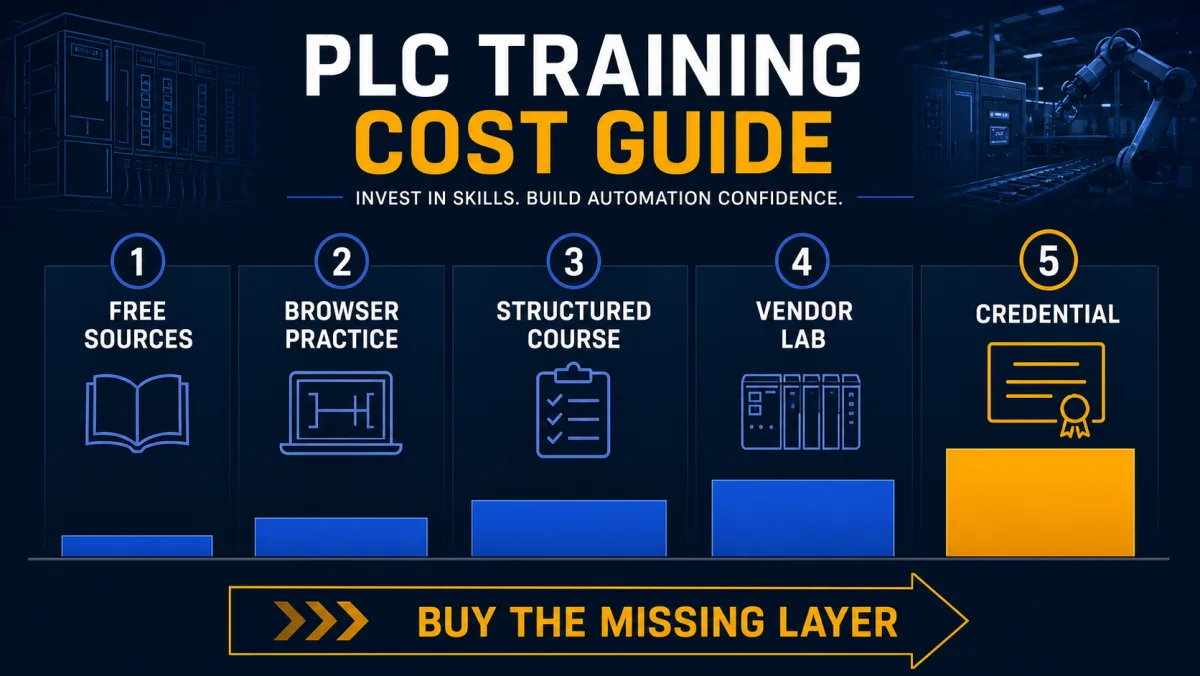
Vendor certification is a four-figure investment: Siemens TIA Portal runs €1,950–€3,500 all-in for instructor-led training (€1,550–€2,700 online, plus a separate €300–€500 exam fee), while Allen-Bradley paths total $2,700–$4,900 instructor-led or $2,000–$3,400 online. For the full landscape including cheaper routes, see our PLC training cost guide.