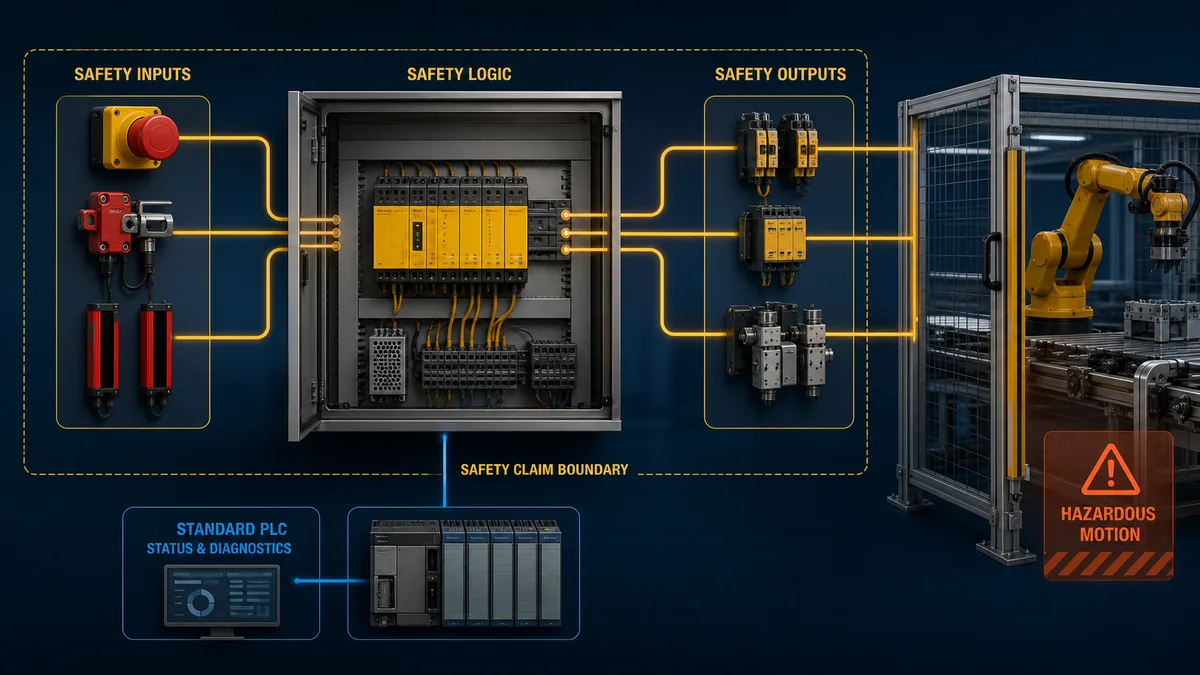
SIL vs PL (Performance Level): Differences and How They Map
SIL vs Performance Level compared — IEC 62061 vs ISO 13849, the rating scales, how PL and SIL map to each other, and which standard to use for machinery.
SIL (Safety Integrity Level) and PL (Performance Level) are both measures of safety function reliability, but they come from different standards, use different methodologies, and target different industry sectors. SIL is defined in IEC 61508 and applied to machinery via IEC 62061; PL is defined in ISO 13849-1. The two scales overlap but are not identical, and choosing the wrong framework for your application creates compliance gaps that auditors and notified bodies will flag.
Quick Answer: SIL vs PL
| Question | Answer |
|---|---|
| Same thing? | No — different standards, different methodologies |
| Interchangeable on paper? | Roughly, via the mapping table in ISO 13849-1 Annex K |
| Who uses SIL? | Process industry, complex electronics, functional safety per IEC 61508/62061 |
| Who uses PL? | Machine builders, mechanical/electromechanical safety per ISO 13849 |
| Highest level for machinery? | SIL 3 (IEC 62061) / PLe (ISO 13849) |
| Conversion possible? | Approximate only — do not substitute without engineering review |
For most machine builders using standard electromechanical safety components (safety relays, light curtains, two-hand controls), ISO 13849-1 and PL is the correct starting point. For machines with complex programmable electronics, high-volume production systems, or process equipment, IEC 62061 and SIL is more appropriate — or both standards apply simultaneously.
What SIL Is (IEC 61508 and IEC 62061)
Safety Integrity Level is a discrete performance target for a complete safety function. IEC 61508 — the parent standard for all functional safety — defines four SIL levels expressed as ranges of Probability of Failure on Demand (PFD) for low-demand mode systems:
| SIL Level | PFD Range | Risk Reduction Factor |
|---|---|---|
| SIL 1 | 10⁻² to 10⁻¹ | 10 to 100 |
| SIL 2 | 10⁻³ to 10⁻² | 100 to 1,000 |
| SIL 3 | 10⁻⁴ to 10⁻³ | 1,000 to 10,000 |
| SIL 4 | 10⁻⁵ to 10⁻⁴ | 10,000 to 100,000 |
IEC 62061 is the machinery-sector application of IEC 61508. It covers Safety-Related Control Systems (SRCS) on machines that include programmable electronics — safety PLCs, drives with integrated safety, configurable safety controllers. IEC 62061 uses SIL 1, SIL 2, and SIL 3 only (SIL 4 is excluded from machinery applications because machinery hazards rarely demand that level of risk reduction). The standard introduces the concept of the Subsystem — sensor, logic, actuator — and requires calculating a Subsystem Failure Rate (PFHD: Probability of dangerous Failure per Hour) for continuous-demand mode operations.
Key IEC 62061 concepts:
- PFHD (probability of dangerous failure per hour) — the primary metric for continuous-demand safety functions, typical for most machinery
- Architecture constraints — the standard specifies hardware fault tolerance requirements for each SIL level
- Common Cause Failure (CCF) — must be addressed through separation, diversity, and periodic proof-testing
- Safety Requirement Specification (SRS) — a documented starting point for each safety function
Because IEC 62061 is built on a functional safety framework, it demands a full safety lifecycle: hazard analysis, SRS, design, verification, validation, operation, and modification — all documented.
What PL Is (ISO 13849-1)
Performance Level is the safety-rating system defined in ISO 13849-1:2015. Where SIL assigns a numeric target probability, PL uses a lettered scale from PLa (lowest) to PLe (highest). Each PL corresponds to an average probability of dangerous failure per hour (PFHd) range:
| Performance Level | PFHd Range | Approximate SIL Equivalent |
|---|---|---|
| PLa | ≥ 10⁻⁵ to < 10⁻⁴ | — (below SIL 1) |
| PLb | ≥ 3×10⁻⁶ to < 10⁻⁵ | SIL 1 |
| PLc | ≥ 10⁻⁶ to < 3×10⁻⁶ | SIL 1 |
| PLd | ≥ 10⁻⁷ to < 10⁻⁶ | SIL 2 |
| PLe | ≥ 10⁻⁸ to < 10⁻⁷ | SIL 3 |
Beyond the PFHd number, achieving a given PL requires satisfying four parameters simultaneously:
- Category — the structural architecture of the safety circuit (B, 1, 2, 3, or 4), inherited from the earlier EN 954-1 standard. See safety categories for a detailed breakdown of each architecture.
- DC (Diagnostic Coverage) — the fraction of dangerous failures detected by diagnostic functions, classified as none (<60%), low (60–90%), medium (90–99%), or high (≥99%).
- MTTFd (Mean Time To dangerous Failure) — a reliability metric for each individual channel, based on component B10d values from manufacturer datasheets.
- CCF (Common Cause Failure) — a scored checklist (ISO 13849-1 Annex F) requiring a minimum score of 65 out of 100.
ISO 13849-1 provides the SISTEMA software tool (free, published by the German IFA institute) for calculating PL from component data. This makes PL calculations more accessible to machine builders who do not have dedicated functional safety engineers — you enter B10d values, DC values, and architecture, and SISTEMA outputs the achieved PL.
The Two Machinery Standards: IEC 62061 vs ISO 13849-1
Both IEC 62061 and ISO 13849-1 are harmonized under the EU Machinery Directive (and its successor, the Machinery Regulation EU 2023/1230, which takes full effect in January 2027). Using either standard correctly gives a presumption of conformity for safety-related control system requirements.
| Dimension | IEC 62061 | ISO 13849-1 |
|---|---|---|
| Rating scale | SIL 1 / 2 / 3 | PLa / PLb / PLc / PLd / PLe |
| Technology scope | Electrical, electronic, programmable electronic | Electrical, electronic, programmable electronic, mechanical, pneumatic, hydraulic |
| Primary metric | PFHD (per hour, continuous demand) | PFHd + Category + DC + MTTFd |
| Calculation tools | Reliability block diagrams, Markov models | SISTEMA (IFA), simplified equations |
| Safety lifecycle | Full IEC 61508-derived lifecycle required | Lifecycle steps specified but lighter in practice |
| Complex electronics | First-choice standard | Permitted but IEC 62061 preferred |
| Mechanical safety components | Not covered | Covered — springs, cams, mechanical interlocks included |
| Process industry alignment | High — consistent with IEC 61511 | Low — machinery-specific |
| Entry complexity | Higher | Lower for simple architectures |
The critical technology scope difference: ISO 13849-1 explicitly covers non-electrical technologies. A pneumatic valve with a mechanical detent, a cam-operated limit switch, a centrifugal speed governor — all can be assessed under ISO 13849-1. IEC 62061 covers only E/E/PE (electrical, electronic, programmable electronic) elements. For machines where the safety chain includes purely mechanical components, ISO 13849-1 is the only complete option.
The methodology difference: IEC 62061 uses a subsystem-based reliability calculation and demands you address the full safety lifecycle with documentation. ISO 13849-1 uses a more structured input model (Category + DC + MTTFd) that experienced engineers find faster for standard architectures. For novel or complex systems, IEC 62061's Markov model approach offers more flexibility.
Mapping Table: PL to SIL and SIL to PL
ISO 13849-1 Annex K provides the normative mapping between PL and SIL. This mapping is based on equivalent PFHd ranges:
| Performance Level | PFHd Range | SIL Equivalent |
|---|---|---|
| PLa | ≥ 10⁻⁵ to < 10⁻⁴ | No direct SIL equivalent |
| PLb | ≥ 3×10⁻⁶ to < 10⁻⁵ | SIL 1 |
| PLc | ≥ 10⁻⁶ to < 3×10⁻⁶ | SIL 1 |
| PLd | ≥ 10⁻⁷ to < 10⁻⁶ | SIL 2 |
| PLe | ≥ 10⁻⁸ to < 10⁻⁷ | SIL 3 |
Critical limitation of this mapping: The PFHd equivalence is necessary but not sufficient. A component claiming PLd does not automatically satisfy SIL 2, because:
- ISO 13849-1 requires the Category (structural architecture) to be met — a single-channel Category 1 design cannot achieve PLd regardless of component MTTFd.
- IEC 62061 imposes hardware fault tolerance requirements at each SIL that must be independently verified.
- Systematic capability requirements differ between the two standards — a device validated under ISO 13849-1 carries a systematic integrity claim that does not automatically transfer to IEC 62061.
When a component datasheet lists both PL and SIL ratings (common for safety sensors, safety relays, and safety PLCs), the manufacturer has validated the device under both standards separately. You can use such components in either framework — but the overall safety function verification must still be completed in the framework you are applying.
PLa has no SIL equivalent. PLa covers PFHd values from 10⁻⁵ to 10⁻⁴ per hour — higher failure rates than SIL 1 tolerates. PLa is used for low-risk applications (Category B or Category 1 architectures) where risk assessment shows the residual risk is acceptable without reaching SIL 1 performance.
Key Differences: Technology Scope and Methodology
Scope of Technology
ISO 13849-1 was designed from the ground up to handle the full range of technologies found in machinery safety circuits. The Performance Level assessment process accommodates springs, mechanical locks, cam-operated switches, and pneumatic circuits alongside electronic components. This matters practically: most industrial machines combine electrical and mechanical safety elements. A guard lock with a mechanical tongue and a solenoid release, assessed as a whole subsystem, fits naturally in the ISO 13849-1 framework.
IEC 62061 draws a hard boundary at E/E/PE. Mechanical elements within an IEC 62061 safety function are treated as having ideal reliability (or assessed separately using other methods) and then integrated at the architecture level. This is workable but adds engineering effort.
Methodology Depth
IEC 62061's full safety lifecycle is demanding. It requires:
- A Hazard and Risk Assessment (or reference to one under ISO 12100) that explicitly quantifies tolerable risk
- A Safety Requirement Specification for each safety function
- Subsystem design with documented PFHD calculations
- Validation testing per IEC 62061 Clause 8
- A Safety Manual for each programmable subsystem
ISO 13849-1 references a lifecycle (Clause 4) but the standard is structured so that a competent engineer with SISTEMA can produce a compliant PL assessment without the full lifecycle documentation burden. For simple two-channel safety relay circuits, the assessment is often a single SISTEMA report plus a brief design rationale.
Harmonization and Dual Application
For machines with complex programmable electronics (safety PLCs, integrated drive safety functions, configurable safety systems), the standards allow dual application. A machine builder may:
- Apply ISO 13849-1 to the mechanical and simple electromechanical portions of the safety circuit
- Apply IEC 62061 to the programmable subsystems
- Document both assessments and reference the relevant required PL/SIL from the risk assessment
This is explicitly permitted and common in practice for complex automated cells and robotic systems.
Which Standard to Use
Use ISO 13849-1 / PL when:
- You are building standard industrial machinery with electromechanical safety components (safety relays, door switches, two-hand controls, light curtains)
- Your safety chain includes mechanical, pneumatic, or hydraulic elements
- You are a machine builder targeting the EU Machinery Directive / Machinery Regulation
- Your safety PLC vendor provides SISTEMA-compatible B10d and DC data for their safety modules
- You need a faster, less documentation-intensive path for Category 3 or Category 4 architectures
- The required safety performance from your risk assessment is PLd or below
Use IEC 62061 / SIL when:
- Your safety system is primarily programmable — safety PLCs with complex logic, drives with integrated safety, configurable safety controllers with many interconnected safety functions
- You are supplying equipment to the process industries (oil and gas, chemical, pharmaceutical) where IEC 61511 alignment is expected
- Your machine has novel technology where standard SISTEMA library elements do not exist
- Your risk assessment demands SIL 3 performance across complex multi-channel architectures
- Your customer or notified body explicitly requires IEC 62061 documentation
- You are working in sectors (defence, nuclear adjacent, rail) where IEC 61508 certification of subsystems is required
When both apply:
A large automated manufacturing cell — robotic welding line, for example — will often require both. The robot controller and safety PLC logic are assessed under IEC 62061; the mechanical guarding interlocks, light curtains, and area scanners are assessed under ISO 13849-1. The overall risk assessment (ISO 12100) sets the required PL/SIL for each safety function, and each subsystem is verified against its applicable standard.
The Convergence Note: IEC/TS 62046 and Future ISO/IEC 17305
The industry has long recognised the burden of maintaining two parallel standards. IEC/TS 62046:2008 provides guidance on combining the two approaches. More significantly, ISO/IEC 17305 — a joint project between ISO TC 199 and IEC TC 44 — is intended to create a single unified machinery safety standard merging ISO 13849-1 and IEC 62061. As of 2026, work is ongoing; neither standard is being withdrawn in the short term, and compliance with either (or both) remains valid for CE marking under the Machinery Regulation.
Practical Guidance for Controls Engineers
Step 1 — Start with risk assessment. ISO 12100 defines the risk assessment process. The output is a required performance level (PLr) or required SIL for each safety function. Do this before choosing a standard.
Step 2 — Identify your technology mix. If any safety function includes mechanical, pneumatic, or hydraulic elements as part of the rated safety chain, ISO 13849-1 must be used for that function (or those elements assessed separately).
Step 3 — Check your safety PLC vendor. Most safety PLC vendors (Siemens, Rockwell, Pilz, Sick, Schmersal) publish SISTEMA library elements AND IEC 62061 PFHD data. The vendor documentation will indicate which standards their devices are validated under.
Step 4 — Use SISTEMA for ISO 13849-1. Download SISTEMA from the IFA website (free). Build your subsystem architecture, enter B10d and DC values from component datasheets, run the calculation. The report is your compliance evidence.
Step 5 — For IEC 62061, document the safety lifecycle. Even for simple functions, produce an SRS and a validation test record. Notified bodies increasingly inspect for lifecycle documentation, not just the PFHD calculation.
Step 6 — Match the mapping, not just the number. When a component datasheet shows PLd/SIL 2, verify the component's systematic capability (SC) and architecture constraints meet your specific design before relying on it for either standard.
Frequently Asked Questions
What is the difference between SIL and PL? SIL (Safety Integrity Level) is a performance target defined in IEC 61508 and used in machinery via IEC 62061. PL (Performance Level) is a performance rating defined in ISO 13849-1. Both quantify the reliability of safety functions, but SIL uses a numeric level (1–3 for machinery) with a PFH metric, while PL uses a lettered scale (PLa–PLe) that combines PFH with structural architecture requirements.
How does PL map to SIL? PLb and PLc both map to SIL 1. PLd maps to SIL 2. PLe maps to SIL 3. PLa has no SIL equivalent. The mapping is based on equivalent PFHd ranges from ISO 13849-1 Annex K, but component-level PL and SIL ratings must be independently verified — a PLd rating does not automatically satisfy all SIL 2 requirements.
Is ISO 13849 or IEC 62061 better? Neither is universally better. ISO 13849-1 is better suited to machines with mechanical or simple electromechanical safety circuits and is generally faster to apply for standard architectures. IEC 62061 is better suited to complex programmable electronics and process industry alignment. Many machines use both.
Can you convert PL to SIL? You can approximate — using the mapping table from ISO 13849-1 Annex K — but conversion is not a direct substitution. Achieving a given SIL or PL requires satisfying all requirements of the applicable standard, not just meeting a matching PFHd number. A component certified to PLd is not automatically certified to SIL 2 unless the manufacturer has independently validated it under IEC 62061.
For deeper background on the broader functional safety framework that both standards sit within, see Functional Safety Basics and Functional Safety vs Process Safety.