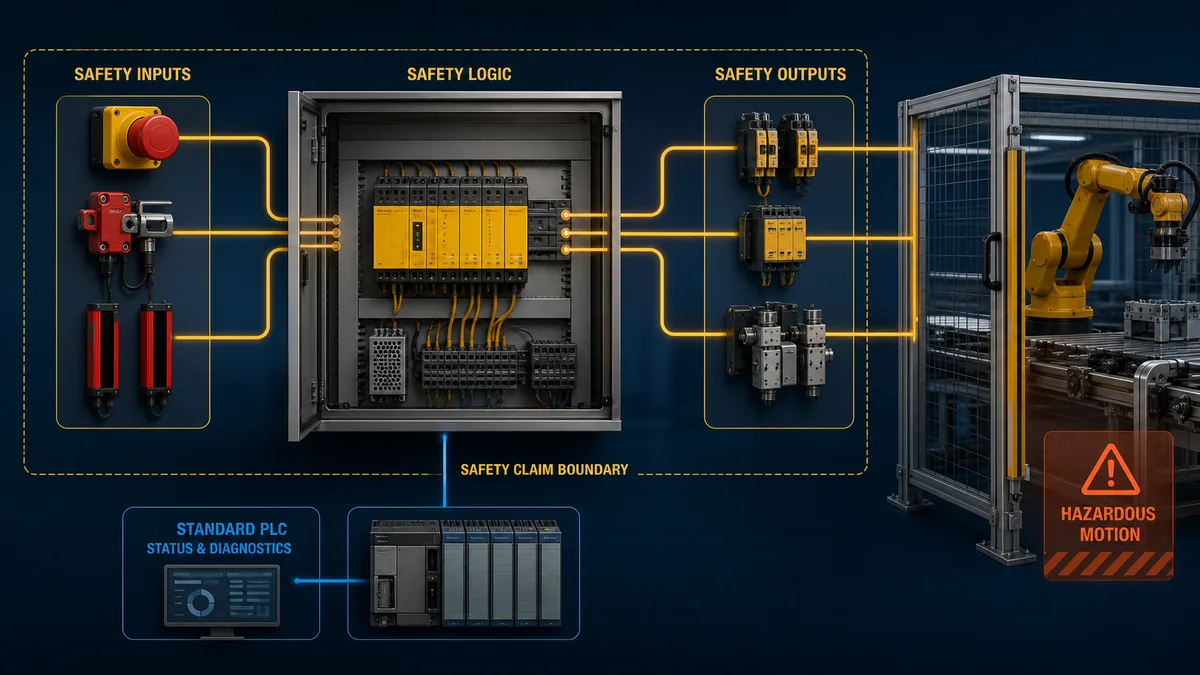
Functional Safety vs Process Safety: The Difference, Clearly Explained
Functional safety vs process safety — how they differ, how they relate (layers of protection), and where the safety PLC and safety instrumented function fit in.
Process safety is the discipline concerned with preventing major accidents — fires, explosions, toxic releases, and uncontrolled chemical reactions — that originate from the process itself. Functional safety is the standards-based subset of that discipline that uses instrumented protective functions (defined under IEC 61511 for process industries and IEC 61508 for general equipment) to deliver a specific, quantified share of the required risk reduction. In plain terms: process safety is the goal; functional safety is one of the engineered layers used to achieve it.
Both terms circulate heavily in the same facilities and in the same conversations, which is why they are so often conflated. This article draws a precise line between them, shows how they nest inside a Layer of Protection Analysis (LOPA), and explains where the safety PLC and the safety instrumented function (SIF) fit in — a question that trips up engineers coming from machinery or discrete-automation backgrounds.
Quick Answer: Functional Safety vs Process Safety
| Process Safety | Functional Safety | |
|---|---|---|
| Scope | All major accident hazards from process materials and energy | Hazards addressed by instrumented protective functions |
| Governing standards | IEC 61511, IEC 61882 (HAZOP), API 752/753, PSM regulations | IEC 61511 (process), IEC 61508 (equipment), ISO 13849 (machinery) |
| Who owns it | Process safety engineer / HSE lead | Functional safety engineer / instrument and control engineer |
| What it protects against | Loss of containment, runaway reactions, BLEVE, toxic release | Demand events on a specific protective function (e.g., high-pressure shutdown) |
| Example | A full process hazard analysis for a distillation column | Designing and verifying the SIL 2 high-pressure shutdown SIF on that column |
| Risk reduction tool | All layers of protection (physical, procedural, engineered) | Safety instrumented system (SIS) as one layer |
The short version: functional safety is always a subset of process safety, never a parallel or competing discipline.
What Is Process Safety?
Process safety manages the risk of catastrophic events arising from the chemical, physical, and energy content of a process. The hazards it addresses include:
- Loss of containment — leaks, ruptures, and spills of flammable, toxic, or reactive materials
- Runaway reactions — uncontrolled exothermic chemistry generating heat or pressure beyond design limits
- Boiling liquid expanding vapor explosions (BLEVE) — rapid depressurization of superheated liquids
- Toxic releases — atmospheric dispersion of materials harmful at low concentrations
Process safety work encompasses the entire lifecycle of a facility: conceptual design, process hazard analysis (PHA/HAZOP), inherent safety reviews, layer of protection analysis (LOPA), mechanical integrity programs, management of change (MOC), and incident investigation.
Critically, process safety uses all available protection layers — not just instrumented systems. Those layers include inherently safer design (reducing inventory or substituting less hazardous materials), physical protection (pressure relief valves, rupture discs), procedural controls (operator response, permit-to-work), and passive safeguards (dikes, blast walls). The instrumented layer — the Safety Instrumented System — is powerful but it is one layer among several.
Process safety regulations such as OSHA PSM (29 CFR 1910.119) in the US and the Seveso III Directive in Europe set the legal framework, but the engineering methodology is largely captured in IEC 61511 and the AIChE Center for Chemical Process Safety (CCPS) guidelines.
What Is Functional Safety?
Functional safety is the part of the overall safety of a system that depends on the correct functioning of electrical, electronic, and programmable electronic (E/E/PE) safety-related systems in response to their inputs. The definition comes directly from IEC 61508, the base standard, which then spawned IEC 61511 for the process sector.
Functional safety work asks a specific question: given a defined hazardous event (a "demand"), does the safety function reduce the risk of that event causing harm to an acceptable level? The answer is expressed as a Safety Integrity Level (SIL) — SIL 1 through SIL 4 — which maps to a target probability of failure on demand (PFD) for the protective function.
Key concepts in functional safety include:
- Safety Instrumented Function (SIF) — a single protective function, such as "close the feed isolation valve if reactor pressure exceeds 15 bar"
- Safety Instrumented System (SIS) — the hardware and software that implements one or more SIFs (sensors, logic solver, final elements)
- SIL verification — demonstrating through calculation (reliability analysis) that the SIF achieves the target PFD
- Proof testing — periodic testing of the SIF to detect dangerous undetected failures
- Functional safety management — the organizational and procedural framework ensuring the SIS is designed, operated, and maintained correctly
Functional safety is not limited to process industries. IEC 61508 applies to any safety-related E/E/PE system. ISO 13849 and IEC 62061 extend the same logic to machinery safety (performance levels, SISTEMA calculations). But when engineers in oil and gas, chemical, or petrochemical facilities say "functional safety," they almost always mean IEC 61511 and SIL-rated SIS design.
For a deeper treatment of the SIL concept, see the site's article on SIL (Safety Integrity Level) and the overview of functional safety basics.
How Process Safety and Functional Safety Relate: Layers of Protection
The cleanest way to understand the relationship is through Layer of Protection Analysis (LOPA).
LOPA is a semi-quantitative risk analysis technique used within the process safety framework. Starting from a HAZOP-identified hazard scenario, LOPA assigns an initiating event frequency (how often the hazard demand occurs) and then stacks independent protection layers (IPLs) — each capable of reducing risk by a factor of 10 or more — until the residual risk falls below the facility's tolerable risk criteria.
A typical LOPA stack for a high-pressure shutdown scenario might look like this:
- Basic process control system (BPCS) — the standard PLC/DCS maintains pressure within normal operating range (IPF ~10x reduction; not credited as a safety layer in strict LOPA because it can be the initiating cause)
- High-pressure alarm + operator response — credited as one IPL with a probability of failure on demand of 0.1 (i.e., 10x risk reduction) if the operator has adequate time and procedure
- Safety instrumented function — high-pressure shutdown (HIPPS) — the instrumented protective function; SIL target calculated from the residual risk gap after crediting layers above
- Pressure relief valve — passive mechanical layer, typically credited at PFD 0.01 (100x)
- Dike or blast wall — consequence-reduction layer (passive)
The SIF in step 3 is where functional safety lives. Its SIL target is determined by the process safety analysis (LOPA). The design and verification of that SIF — sensor selection, logic solver architecture, final element proof test intervals — is the functional safety engineering work governed by IEC 61511.
In other words: process safety sets the risk reduction target; functional safety engineering delivers it through the SIS.
A Note on Occupational Safety
A common source of confusion is the term "safety" itself, which encompasses three distinct disciplines in industrial facilities:
- Occupational (personal) safety — slips, trips, falls, struck-by events, manual handling injuries. Governed by HSE management systems (ISO 45001, OSHA 1910 General Industry). Not the subject of IEC 61511 or LOPA.
- Process safety — major accident hazard prevention (described above)
- Functional safety — the standards-based instrumented subset of process safety (described above)
A fatality from a fall from height is an occupational safety failure. A fatality from a vapor cloud explosion following loss of containment is a process safety failure. The two disciplines overlap in the same facility but use different methodologies, different standards, and different risk tolerances. Functional safety is never about occupational safety.
Where the PLC Fits: The Safety Instrumented Function and the Safety PLC
For engineers coming from machinery or discrete-automation backgrounds, the most common confusion is about where the PLC sits in the functional safety picture. The answer requires understanding the SIF architecture.
A Safety Instrumented Function has three functional elements:
- Sensor (initiator) — detects the process deviation (e.g., a SIL-rated pressure transmitter)
- Logic solver — evaluates the sensor signal and trips when the setpoint is exceeded
- Final element (actuator) — takes the protective action (e.g., closes an isolation valve via a solenoid)
The logic solver is where the safety PLC lives. A standard programmable logic controller is not suitable as a logic solver for SIL-rated SIFs because it lacks the hardware fault tolerance, diagnostic coverage, and systematic capability requirements of IEC 61511 Clause 11. A safety PLC (compared to a standard PLC here) is purpose-built with:
- Redundant processors running the same program in parallel with cross-comparison (1oo2, 2oo3, or similar voting architectures)
- Internal diagnostics achieving high diagnostic coverage (DC) to detect dangerous hardware faults before they cause a missed trip
- Certified software development lifecycle under IEC 61508 Part 3 (the tool and compiler are part of the certification)
- Proof test support — dedicated function blocks and diagnostic registers that record proof test results
Concrete LOPA-Tied Example
Consider a high-pressure shutdown SIF on a gas separator:
- Initiating event: control valve fails open, overpressuring the separator
- LOPA residual risk gap: requires 100x risk reduction (PFD target of 0.01) from the SIF — that is SIL 2
- SIF architecture: 1oo2 (one-out-of-two) voted pressure transmitters feeding a SIL 2-certified safety PLC, tripping a de-energize-to-trip solenoid on the feed isolation valve
- Logic solver: the safety PLC executes the trip logic, monitors the sensor channels for disagreement, and latches the trip until manually reset with a qualified operator confirmation
The safety PLC in this example is not doing process control — that is the standard PLC/DCS. The safety PLC runs only the SIFs assigned to it, completely isolated in software and (typically) hardware from the basic process control system. This separation is required by IEC 61511 to prevent common-cause failures.
For engineers familiar with industrial control systems, the architectural separation between the BPCS (standard PLC or DCS) and the SIS (safety PLC) is one of the most important concepts to internalize. IEC 61511 Clause 9 addresses this independence requirement in detail.
The e-stop and safety circuit ladder logic article covers a simpler machinery-sector SIF implementation that illustrates the same principle at a smaller scale.
Summary: Key Distinctions
- Process safety is the overarching discipline; functional safety is a standards-governed subset focused specifically on E/E/PE protective functions.
- Process safety uses all protection layers — inherent design, passive safeguards, procedures, and instrumented systems. Functional safety addresses only the instrumented layer.
- The SIL target for a SIF is determined by the process safety analysis (LOPA). Meeting that SIL is a functional safety engineering task governed by IEC 61511.
- The safety PLC is the logic solver element of a SIF. It must be certified and architecturally separate from the standard process control system.
- Occupational (personal) safety is a third, separate discipline unrelated to functional or process safety methodologies.
Frequently Asked Questions
Is functional safety part of process safety?
Yes. Functional safety is a subset of process safety. Process safety encompasses all measures — design, physical, procedural, and instrumented — used to prevent major accidents. Functional safety specifically governs the instrumented protective functions delivered by safety instrumented systems, as defined under IEC 61511 (process sector) and IEC 61508 (general equipment). The SIL target for any safety instrumented function is determined by the broader process safety risk analysis (LOPA), and the functional safety engineering work delivers that target.
What is the difference between functional safety and occupational safety?
Occupational safety (also called personal safety) addresses injuries to people from everyday workplace hazards: slips, trips, falls, manual handling, struck-by incidents. It is governed by management system standards such as ISO 45001 and general-industry OSHA regulations. Functional safety, by contrast, addresses the reliability of instrumented protective functions that prevent major accident hazards — fires, explosions, toxic releases — arising from process materials and energy. The two disciplines coexist in the same facilities but use entirely different methodologies, standards, and risk criteria.
What is process safety?
Process safety is the engineering and management discipline concerned with preventing catastrophic accidents caused by the chemical, physical, and energy hazards inherent in a process. It covers the entire facility lifecycle, including hazard identification (HAZOP, What-If), quantitative risk analysis, layer of protection analysis (LOPA), mechanical integrity, management of change, and emergency response. The governing body of knowledge is largely held by the AIChE Center for Chemical Process Safety (CCPS), with standards including IEC 61511, API RP 750, and OSHA 29 CFR 1910.119 (PSM).
What standards apply to process safety?
The primary standards and regulations for process safety in the process industries are: IEC 61511 (functional safety of safety instrumented systems in the process sector — the central technical standard), IEC 61882 (HAZOP study methodology), API RP 14C / API RP 750 (oil and gas facilities), OSHA 29 CFR 1910.119 (Process Safety Management in the US), and the EU Seveso III Directive (Control of Major Accident Hazards in Europe). For machinery and general equipment, IEC 61508 is the base functional safety standard, with sector-specific standards such as ISO 13849 for machinery and IEC 62061 for complex control systems.