Best SCADA Software 2026: 10 Platforms Compared
Compare 10 SCADA platforms by architecture, licensing visibility, controller ecosystem, deployment model, security workflow, and best-fit use case.
There is no single best SCADA platform for every plant. Ignition is a strong editorial starting point for vendor-neutral, web-oriented projects with public software pricing. AVEVA System Platform, Siemens WinCC, Rockwell FactoryTalk View SE, GE Vernova iFIX, and EcoStruxure Plant SCADA are usually shortlisted where an installed vendor ecosystem matters. ABB System 800xA and Honeywell Experion belong in larger process-control conversations, while Rapid SCADA and Fernhill can suit smaller or carefully supported deployments.
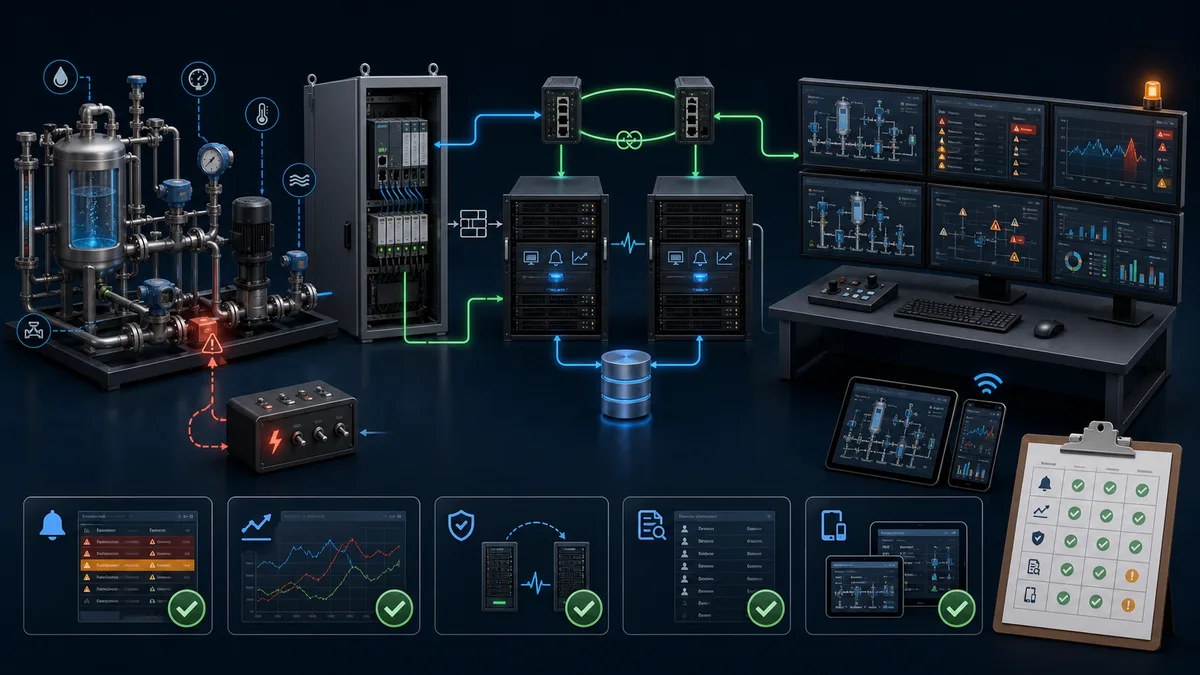
For a first shortlist, match the platform to the installed PLC/DCS estate, redundancy target, historian and alarm requirements, cybersecurity architecture, support model, and migration constraints. Then run a representative pilot; a generic score cannot replace that evidence.
New to the subject? Start with the SCADA tutorial for beginners, then use the SCADA architecture guide to define your layers and interfaces.
SCADA software comparison at a glance
| Platform | Editorial best fit | Architecture emphasis | Price evidence |
|---|---|---|---|
| Ignition | Vendor-neutral integration and web visualization | Gateway and modular applications | Vendor publishes configurable prices |
| AVEVA System Platform | Object-based plant applications and AVEVA estates | Distributed system platform | Quote required |
| Siemens WinCC | Siemens automation and TIA-integrated projects | HMI to plant visualization, edition dependent | Quote/reseller dependent |
| FactoryTalk View SE | Rockwell Logix and FactoryTalk estates | Distributed HMI/SCADA | Quote/reseller dependent |
| GE Vernova iFIX | Existing iFIX sites and process visualization | HMI/SCADA with Proficy integrations | Quote required |
| EcoStruxure Plant SCADA | Schneider and legacy Citect estates | Plant visualization and control | Quote required |
| ABB System 800xA | Large ABB process-control environments | Integrated DCS/automation system | Quote required |
| Honeywell Experion PKS | Large Honeywell process environments | DCS/process knowledge system | Quote required |
| Rapid SCADA | Open-source and smaller custom projects | Server, web, and modular drivers | Open-source; services may cost extra |
| Fernhill SCADA | Small systems and protocol-focused deployments | Cross-platform SCADA | Free tag-limited tier; paid licences published |
This is an editorial order for comparison, not a measured performance leaderboard. A platform ranked later can be the correct—and lower-risk—choice when it matches the existing controllers, trained staff, validated libraries, and long-term support plan.
Table of contents
How we compare SCADA platforms
This guide is a source-led editorial comparison. It does not claim that all ten products were installed in one laboratory, tested against identical PLCs, or scored by an unnamed reviewer panel. It also does not present private customer data, undocumented uptime measurements, or market-share estimates.
Evidence labels
- Vendor-verified: the linked manufacturer page supports the described product scope.
- Project-verified: an open-source project’s own site or documentation supports the description.
- Quote required: the product is documented, but public list pricing is not available for a representative system.
- Editorial fit: our practical interpretation of where a platform belongs on a shortlist.
- Verify for your release: an edition, module, driver, operating system, or licensing term can change.
The seven selection dimensions
- Controller connectivity: native drivers, OPC UA, MQTT/Sparkplug, Modbus, and any legacy protocols you actually use.
- Application architecture: single node, redundant pair, distributed sites, thin clients, edge gateways, and cloud-connected services.
- Operations: alarm lifecycle, historian, audit trail, reporting, recipes, security roles, and mobile workflows.
- Engineering: reusable objects, templates, source comparison, deployment controls, testability, and recovery.
- Lifecycle: vendor support, integrator availability, upgrades, backward compatibility, and licence continuity.
- Cybersecurity: identity, least privilege, secure communications, patching, logging, backup, segmentation, and recovery.
- Cost evidence: which prices are published and which require a dated, written quote.
We do not assign a 9.2/10 score because the weights differ by project. For a small water site, open protocols and remote support may dominate. For a validated pharmaceutical plant, change control and audit evidence may dominate. For a brownfield factory, driver compatibility and migration risk may dominate.


Live mini-lab
Try it: press START, then STOP
A stop-dominant seal-in rung: START latches the motor output through its own contact, and STOP breaks the circuit.
Watch the output lamp: it stays on after START until you press STOP.
Free · no signup to try · runs in your browserOpens plcsimulationsoftware.com — same team
The 10 SCADA platforms
1. Ignition by Inductive Automation
Editorial fit: System integrators, multi-vendor plants, web-oriented visualization, SQL-connected applications, and teams that value a modular platform.
Source status: Vendor-verified platform and vendor-published configurable pricing.
The official Ignition overview describes a gateway-based industrial application platform with SCADA, HMI, historian, alarming, reporting, and integration modules. Its official pricing tool is unusually useful because it separates platform, solution-suite, module, redundancy, and support choices.
Shortlist Ignition when:
- The plant has controllers from several vendors.
- Browser-delivered or responsive applications are a priority.
- SQL, OPC UA, MQTT, or enterprise integration is central to the design.
- The team wants to price modules without relying entirely on a sales quote.
Verify before committing:
- Which device drivers and third-party modules support the exact controller firmware.
- Whether Perspective, Vision, historian, reporting, alarm notification, redundancy, or MQTT modules are required.
- Gateway sizing, database sizing, store-and-forward behavior, and redundant failover.
- Identity-provider, certificate, patching, backup, and disaster-recovery procedures.
- Integrator experience with the chosen architecture—not just basic screen building.
2. AVEVA System Platform
Editorial fit: Large object-oriented applications, existing AVEVA/Wonderware estates, and manufacturing sites that already use AVEVA operations products.
Source status: Vendor-verified product; representative system pricing requires a quote.
AVEVA System Platform is the current vendor source for the product historically associated with Wonderware System Platform. It emphasizes standards-based control, supervisory applications, reusable plant models, and integration within the AVEVA portfolio.
Shortlist it when:
- Existing applications, templates, historians, and staff are already AVEVA-based.
- A plant-wide object model and reusable equipment templates are important.
- The broader AVEVA operations stack is part of the roadmap.
- Migration compatibility outweighs the appeal of a greenfield platform change.
Verify before committing:
- Exact roles of System Platform, InTouch, Operations Control, historian, clients, and web components.
- Migration path for legacy Galaxy, graphics, scripts, drivers, and historian data.
- Licence metrics, development seats, runtime nodes, client access, redundancy, and support.
- Supported operating systems, database versions, virtualization, and patch cadence.
3. Siemens WinCC
Editorial fit: Siemens automation estates, TIA-integrated projects, and plants where SIMATIC engineering consistency matters.
Source status: Vendor-verified family; capabilities and licences depend on the selected WinCC product.
Siemens uses the WinCC name across more than one visualization scope. The official WinCC Unified page is one starting point, but the correct product may differ for a machine HMI, a TIA Portal project, or a plant-level supervisory system.
Shortlist WinCC when:
- The control layer is predominantly SIMATIC.
- Shared Siemens engineering, diagnostics, and tag workflows reduce integration risk.
- Siemens support, training, and lifecycle standards are already established.
- Existing WinCC applications must be extended or migrated.
Verify before committing:
- The exact WinCC product, edition, client model, tag scale, and redundancy option.
- Compatibility with the target TIA Portal, PLC firmware, panels, operating systems, and databases.
- Web-client, reporting, historian, audit, and remote-access requirements.
- Migration tools and manual rework for legacy graphics and scripts.
For engineering context, see the TIA Portal programming tutorial.
4. Rockwell FactoryTalk View Site Edition
Editorial fit: Rockwell Logix plants, FactoryTalk estates, and North American discrete manufacturing with established Rockwell support.
Source status: Vendor-verified product family; licensing requires current vendor or distributor confirmation.
The official FactoryTalk View page covers the visualization family, including Site Edition for distributed applications.
Shortlist FactoryTalk View SE when:
- ControlLogix or CompactLogix tags and diagnostics dominate the project.
- The plant already uses FactoryTalk services, historian, asset, or batch products.
- Maintenance teams have Rockwell training and established activation procedures.
- A brownfield extension should preserve existing displays and operating practices.
Verify before committing:
- Site Edition architecture, server/client counts, display limits, and redundancy.
- Compatibility among Logix firmware, FactoryTalk services, historian, and operating systems.
- Thin-client, web, remote-access, and mobile requirements.
- Activation-server recovery and offline support procedures.
Use the FactoryTalk View Studio tutorial for a practical introduction.
5. GE Vernova Proficy iFIX
Editorial fit: Existing iFIX installations, process visualization, and sites using other Proficy products.
Source status: Vendor-verified product; representative pricing requires a quote.
The current manufacturer source is GE Vernova’s Proficy iFIX page. It describes HMI/SCADA visualization, alarm, historian, and integration capabilities within the Proficy portfolio.
Shortlist iFIX when:
- A large installed iFIX application would be costly or risky to replace.
- Proficy historian, MES, or analytics products are already part of the architecture.
- The support team understands iFIX configuration, scripting, drivers, and recovery.
Verify before committing:
- Upgrade path for pictures, scripts, security, drivers, and custom components.
- Web and remote-client architecture for the selected release.
- Redundancy, historian, alarm, audit, and licensing options.
- Whether a modernization pilot preserves required behavior without unsupported components.
6. EcoStruxure Plant SCADA
Editorial fit: Schneider Electric automation estates, mining and infrastructure projects with an established Citect base, and teams migrating legacy Citect applications.
Source status: Vendor-verified product family; pricing requires a quote.
EcoStruxure Plant SCADA is Schneider Electric’s current product path for the SCADA platform associated with Citect.
Shortlist it when:
- Existing Citect projects, drivers, templates, and staff knowledge have material value.
- Schneider PLCs, power products, or EcoStruxure services are central to the site.
- The project needs a supported migration rather than a full re-platform.
Verify before committing:
- Migration support for the exact legacy Citect version and custom code.
- Driver, protocol, redundancy, historian, client, and web requirements.
- Licence metrics and support terms for development, servers, clients, and standby nodes.
- Supported Windows, database, virtualization, and cybersecurity configurations.
7. ABB Ability System 800xA
Editorial fit: Large process plants with ABB control infrastructure and projects that need integrated process control, electrical, and safety workflows.
Source status: Vendor-verified system; quote and engineering study required.
ABB describes System 800xA as an integrated automation system. It should not be compared with a lightweight SCADA package using licence price alone; the scope can include DCS functions, controllers, engineering, operations, electrical integration, and lifecycle services.
Shortlist it when:
- The project is fundamentally an ABB process-control or DCS architecture.
- Integrated process, electrical, and safety engineering is required.
- The owner has the governance, support contract, and competent resources for a large control system.
Verify before committing:
- Boundary between DCS, SCADA, electrical control, safety, historian, and third-party systems.
- Controller, server, client, network, domain, and virtualization architecture.
- Cybersecurity hardening, patch qualification, backup, restore, and lifecycle services.
- Migration and cutover plan for a live process.
8. Honeywell Experion PKS
Editorial fit: Large Honeywell process-control environments, continuous process plants, and projects where DCS lifecycle services are central.
Source status: Vendor-verified system; quote and project engineering required.
The official Experion PKS page describes a process knowledge system rather than a simple standalone SCADA editor.
Shortlist it when:
- The control architecture is Honeywell-based and process-oriented.
- The project includes DCS controllers, operations, safety interfaces, historian, and lifecycle support.
- Migration from an existing Honeywell system must preserve validated behavior and operator familiarity.
Verify before committing:
- Complete system scope, controller generations, servers, clients, domains, and networks.
- Safety and third-party integration boundaries.
- Patch, antivirus/application-control, backup, disaster-recovery, and obsolescence plans.
- Cutover, operator training, alarm rationalization, and validation responsibilities.
9. Rapid SCADA
Editorial fit: Open-source evaluation, education, smaller telemetry systems, and teams able to own integration and support.
Source status: Project-verified open-source platform; professional services and engineering still cost money.
The Rapid SCADA project publishes the software, documentation, licensing information, and supported architecture.
Shortlist it when:
- Source availability and low software-licence cost are explicit requirements.
- The project can be supported by in-house developers or a qualified integrator.
- Required protocols, alarm behavior, historian, user management, and deployment scale are proven in a pilot.
Verify before committing:
- Licence obligations for the selected edition and any modules.
- Driver maturity for every field device.
- Security update, disclosure, logging, backup, and restore process.
- Availability of competent support during plant incidents.
- Production load, redundancy, data retention, and failover behavior.
10. Fernhill SCADA
Editorial fit: Small systems, protocol gateways, education, and teams that need a cross-platform SCADA option with a limited free tier.
Source status: Vendor-verified product and published licensing tiers.
The official Fernhill SCADA site documents supported operating systems, drivers, development tools, and licence options.
Shortlist it when:
- The required tag count and architecture fit the product’s supported scope.
- Linux or another supported operating system is part of the design.
- Protocol connectivity and a compact deployment matter more than a broad enterprise suite.
Verify before committing:
- Tag counting, licence tier, redundancy, historian, and client requirements.
- Driver support for exact device models and protocol functions.
- Security model, remote access, patching, backup, and support response.
- Load and recovery behavior using your expected tag and alarm rates.
Feature and evidence matrix
The table deliberately avoids universal checkmarks. A capability can be native in one edition, an add-on in another, or available only through a partner.
| Platform | Main ecosystem | Web/thin-client path | Historian path | Redundancy path | Price status |
|---|---|---|---|---|---|
| Ignition | Multi-vendor | Perspective or other modules | Modular | Licensed architecture | Vendor-published configurator |
| AVEVA System Platform | AVEVA | Product/edition dependent | AVEVA portfolio | Architecture dependent | Quote |
| Siemens WinCC | Siemens | WinCC product dependent | Product/option dependent | Product/option dependent | Quote/reseller |
| FactoryTalk View SE | Rockwell | FactoryTalk options | FactoryTalk portfolio | Edition/architecture dependent | Quote/reseller |
| iFIX | Proficy | Product/option dependent | Proficy portfolio | Architecture dependent | Quote |
| Plant SCADA | Schneider | Product/option dependent | Product/option dependent | Architecture dependent | Quote |
| System 800xA | ABB | System architecture | Integrated/portfolio | System architecture | Quote |
| Experion PKS | Honeywell | System architecture | Integrated/portfolio | System architecture | Quote |
| Rapid SCADA | Open-source | Project web application | Project/module dependent | Must be engineered and tested | Open-source |
| Fernhill SCADA | Fernhill | Product supported clients | Product capability | Verify required design | Published tiers |
For every “dependent” cell, request the exact product code, module, edition, and support statement in the proposal. A vendor family name is not enough evidence.
Best fit by project type
Multi-vendor manufacturing
Start with controller-driver coverage, OPC UA behavior, database integration, reusable equipment models, and integrator competence. Ignition is a sensible first candidate; AVEVA, iFIX, or another established platform may be lower risk when an installed base already exists.
Siemens or Rockwell-standard plant
Native ecosystem integration can simplify tag browsing, diagnostics, and support. Compare WinCC in Siemens estates and FactoryTalk View SE in Logix estates, but still test historian, alarms, web clients, redundancy, and third-party devices.
Water and wastewater
Prioritize store-and-forward, remote-site communications, alarm routing, auditability, redundancy, simple operator workflows, and support during communications failures. Do not infer suitability from a generic “water” badge; simulate a lost remote link, stale data, failover, and backfill.
Process industries
Separate the SCADA question from the DCS and safety-system questions. AVEVA, Siemens, iFIX, Plant SCADA, System 800xA, and Experion may all enter the discussion, but their scopes differ. Define controller ownership, safety boundaries, advanced control, batch, historian, and operator-station requirements first.
Small or educational system
Rapid SCADA, Fernhill, Ignition Maker Edition for eligible non-commercial use, or a browser-based PLC/SCADA learning environment can reduce initial friction. “Free software” does not remove engineering, cybersecurity, backups, hardware, support, or downtime cost.

SCADA security requirements
A product feature list is not a security architecture. NIST SP 800-82 Rev. 3 provides official guidance for securing operational technology while accounting for OT performance, reliability, and safety requirements.
Use a risk-based design that covers:
- Zones and conduits between controllers, SCADA servers, historians, engineering workstations, business systems, remote access, and cloud services.
- Named accounts, role-based access, least privilege, privileged-access review, and removal of shared administrator credentials.
- Certificate and key lifecycle for TLS, OPC UA, MQTT, web clients, and API integrations.
- Allowlisted remote access with MFA, session approval, logging, timeout, and emergency revocation.
- Patch qualification, maintenance windows, rollback, and vendor-notification monitoring.
- Centralized logs, time synchronization, alarm and audit retention, and incident-response access.
- Offline, immutable, and tested backups of projects, servers, licences, databases, certificates, and configuration.
- Recovery exercises that prove the team can rebuild the service, reconnect devices, and validate control data.
Do not write “IEC 62443 compliant” or “NIST compliant” into a scorecard without defining the applicable standard part, system boundary, evidence, and responsible assessor.

Pricing and lifecycle cost
Pricing transparency
| Platform | Licence status | What to request |
|---|---|---|
| Ignition | Public configurable pricing | Platform, suites/modules, redundancy, support, gateways |
| AVEVA System Platform | Quote required | Development, platform nodes, clients, historian, support |
| Siemens WinCC | Quote/reseller dependent | Exact WinCC product, tags, servers, clients, redundancy, options |
| FactoryTalk View SE | Quote/reseller dependent | Server/client licences, displays, FactoryTalk services, support |
| iFIX | Quote required | Development, runtime, clients, web, historian, redundancy, support |
| Plant SCADA | Quote required | Development, runtime, clients, points/tags, redundancy, support |
| System 800xA | Engineered quote | Full system hardware, software, engineering, lifecycle services |
| Experion PKS | Engineered quote | Full system hardware, software, engineering, lifecycle services |
| Rapid SCADA | Open-source terms | Modules, integration, engineering, support, hosting |
| Fernhill SCADA | Published tiers | Tag tier, clients, support, required deployment licences |
Build a defensible lifecycle model
Use:
lifecycle cost = software + support + infrastructure + engineering + migration + validation + training + cybersecurity + planned upgrades + recovery capability
Record currency, region, tax, quote date, reseller, support term, upgrade rights, and system assumptions. Do not compare a bare server licence with a turnkey, redundant, validated deployment.
Request these line items:
- Development seats and concurrent-user rules.
- Runtime servers, clients, tags/points, drivers, and protocol options.
- Redundant nodes, disaster-recovery environment, and test environment.
- Historian, reporting, alarm notification, audit trail, recipe, and web/mobile components.
- Database, operating-system, virtualization, backup, identity, and monitoring infrastructure.
- Integrator engineering, graphics conversion, script remediation, FAT, SAT, and cutover.
- Training for operators, maintenance, engineering, IT/OT security, and administrators.
- Annual support, upgrade protection, major-version migration, and obsolete-hardware risk.

How to run a SCADA proof-of-fit
Build a representative pilot from a disclosed acceptance script. Save screenshots, configuration exports, logs, quote assumptions, and defect records.
Minimum pilot scenario
- Connect one controller through the production protocol and one simulated third-party device.
- Display digital, analog, calculated, stale, bad-quality, and out-of-range states.
- Configure an alarm with delay, priority, shelving, acknowledgement, return-to-normal, and audit trail.
- Historize data through a network interruption and verify backfill behavior.
- Test a named operator, supervisor, engineer, and administrator with least-privilege roles.
- Fail the primary server or gateway and record what operators see.
- Restore the application and data on a clean recovery environment.
- Export a change that a second engineer can review.
Evidence table
| Requirement | Evidence | Pass condition |
|---|---|---|
| Driver compatibility | Device, firmware, test log | Required values and quality states are correct |
| Alarm behavior | Alarm/event export and timestamps | Matches the alarm philosophy |
| Historian recovery | Interruption and backfill record | No unexplained gap or duplicate data |
| Role security | Account/permission test | Each role can do only approved actions |
| Redundancy | Failover trace and operator record | Meets the recovery objective |
| Performance | Disclosed tag/alarm/client load | Meets agreed response thresholds |
| Backup and restore | Clean restore record | Service is reproducible |
| Change review | Before/after artifact | Reviewer can identify every change |
Only publish performance comparisons if candidates use the same server resources, project, data rates, clients, network conditions, warm-up, and timing method.
Frequently asked questions
What is the best SCADA software in 2026?
There is no universal winner. Ignition is a strong first candidate for vendor-neutral, web-oriented projects with public pricing. A native or existing platform can be safer for Siemens, Rockwell, AVEVA, GE, Schneider, ABB, or Honeywell estates. Use a project-specific proof-of-fit.
How much does SCADA software cost?
Some projects can start with open-source software or an eligible free edition. Commercial platforms may license servers, tags, clients, modules, redundancy, historians, and support separately. Obtain a dated quote for the complete architecture; do not use an unsupported internet range as a budget.
Is Ignition free?
Ignition offers a resettable trial and Maker Edition for eligible non-commercial use. Production commercial systems require appropriate licences. Check the official product and pricing pages for current terms.
Is open-source SCADA safe for production?
Open-source licensing does not answer the production-safety question. Assess architecture, secure defaults, update process, vulnerability handling, protocol drivers, support ownership, redundancy, backups, recovery, and the competence of the team operating it.
What is the difference between HMI and SCADA?
An HMI often provides visualization and control for one machine or local process. SCADA typically supervises a wider system and adds centralized alarming, history, users, communications, reporting, and distributed operations. Product boundaries overlap, so define required functions rather than relying on the label.
Can SCADA work with any PLC?
Only when a supported driver or standard interface covers the exact controller and required data. Verify firmware, addressing, data types, quality codes, timestamps, write behavior, redundancy, and communication-loss handling.
Should SCADA be cloud-based?
Cloud, hybrid, and on-premises designs can all be valid. Decide from latency, loss-of-connectivity behavior, safety boundaries, data governance, recovery, identity, patching, remote access, and regulatory requirements. Keep essential local control independent of an unreliable external connection.
How should I compare alarm management?
Test priorities, delays, deadbands, acknowledgement, shelving/suppression, state transitions, audit trail, flood behavior, notification, and reporting against a written alarm philosophy. A checkmark beside “alarms” is not enough.
How long does a SCADA migration take?
It depends on screen count, tags, scripts, custom controls, drivers, historian volume, validation, outage windows, training, and whether the new system runs in parallel. Inventory the existing application and pilot representative conversions before publishing a schedule.
What should a SCADA request for proposal include?
Include the architecture, tag and alarm loads, clients, protocols, redundancy and recovery objectives, historian retention, cybersecurity controls, migration inventory, acceptance tests, deliverables, training, support, licensing assumptions, and source-file ownership.
Make the SCADA decision from evidence
Use this sequence:
- Define the control-system boundary and mandatory requirements.
- Remove products that cannot support the exact controllers, redundancy, security, historian, and lifecycle.
- Obtain written, dated bills of materials.
- Run the same representative pilot for each finalist.
- Score only the evidence your engineering, operations, maintenance, security, and purchasing teams agree matters.
- Record assumptions and retest them before each major upgrade.
- Review SCADA best practices
- Compare SCADA, DCS, and PLC roles
- Learn SCADA architecture
- Practise the PLC side in PLC Simulation Software
Ownership disclosure: PLC Programming IO and PLC Simulation Software share ownership. The linked product is a browser-based PLC training environment, not a SCADA runtime and not one of the SCADA platforms ranked above.
Review our testing methodology, editorial policy and corrections policy. Product facts were checked against the manufacturer or project pages linked in each platform section on 25 July 2026.
Now run it · free · no signup
Practise the PLC side of a SCADA system
Complete a guided first program in the browser without an account, then build the tags, alarms and operator views a SCADA layer reads.
Ownership disclosure: PLC Programming IO and PLC Simulation Software are operated by the same publisher.
