DCS vs PLC vs SCADA: Differences & Use Cases
Compare DCS, PLC, and SCADA architectures, control ownership, availability, engineering workflow, and a quote-based method for choosing the right system.
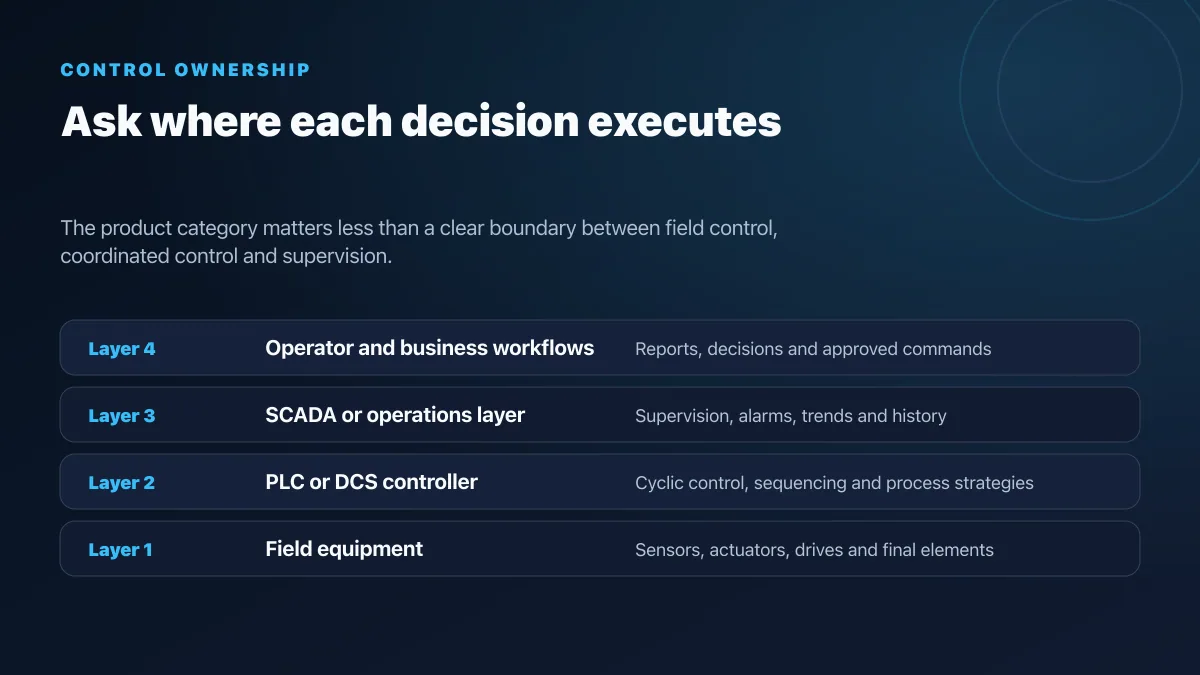
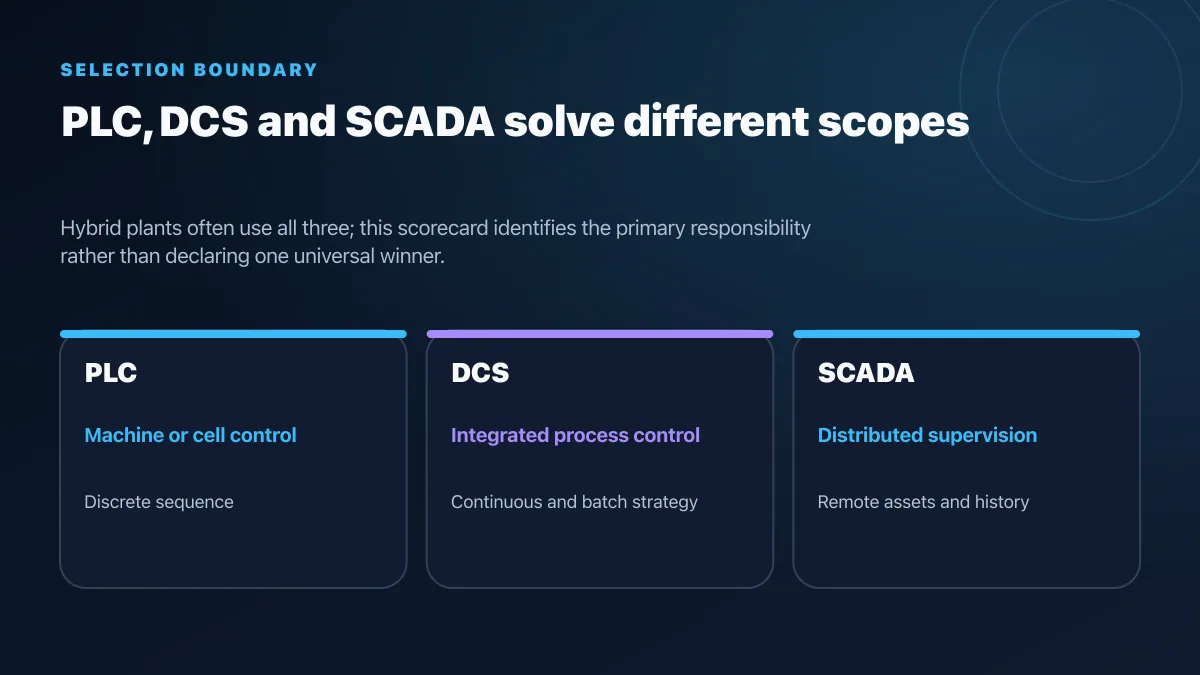
A PLC executes control logic close to a machine or process. A DCS integrates distributed controllers, process-control engineering, and plant operations in one system family. SCADA supervises controllers and remote assets through displays, alarms, history, and approved commands. They are overlapping architectural layers, not three interchangeable boxes; many plants use more than one.

Introduction: Clarity on Industrial Control Systems
Engineers and managers frequently encounter confusion when comparing DCS vs PLC vs SCADA systems. While these terms are often used interchangeably in casual conversation, they represent fundamentally different control architectures with distinct purposes, capabilities, and cost profiles. Understanding the PLC DCS SCADA difference is essential for making informed technology decisions that impact automation project success.
The confusion arises because these systems overlap significantly. A single integrated automation solution might incorporate PLC hardware, DCS principles, and SCADA software—yet calling such a system a "DCS vs PLC vs SCADA" choice oversimplifies the decision landscape. Each technology evolved to solve specific industrial problems, and each excels in particular application domains. If you've already read our SCADA vs DCS guide, this article broadens the perspective to include PLCs and clarifies when each technology dominates.
This guide distinguishes DCS, PLC, and SCADA systems by control ownership, engineering workflow, availability, recovery, and lifecycle evidence. For deeper SCADA knowledge, explore our SCADA best practices guide.
What is a PLC (Programmable Logic Controller)?
Definition and Core Architecture
A Programmable Logic Controller (PLC) is an industrial controller used for machine and process automation. Its task model, I/O update model, program organization, environmental ratings, communications, and optional safety functions depend on the exact controller family and configuration. Many PLC applications use a cyclic scan, but task schedules and I/O updates must be checked in the target platform rather than inferred from the category name.
Key Characteristics:
- Real-time processing: Scheduled controller tasks designed for predictable machine or process control
- Discrete I/O focus: Optimized for digital inputs/outputs with parallel I/O cards capable of handling high-speed digital signals
- Modular architecture: Compact design with multiple module types (analog, digital, communication, specialized motion/safety)
- Deterministic control: Response can be engineered and measured against an application deadline
- Local intelligence: Critical control can remain local even when visualization or history is unavailable
- Execution observability: Task timing, I/O updates, faults, and program state can be monitored during commissioning
Typical PLC Applications
PLCs excel in discrete manufacturing and machine control applications:
- Assembly machines: Robot coordination, part handling, sequencing
- Packaging equipment: Conveyor control, filling, sealing, labeling operations
- Machine tools: CNC machines, lathes, presses with automated indexing
- Material handling: Transfer systems, sorters, automatic storage and retrieval systems
- Test equipment: Automated quality control, parametric testing
PLC Scalability and Limitations
PLC capacity is model-specific. A compact controller and a large redundant controller can both be called PLCs while differing substantially in I/O, tasks, motion, safety, networking, and memory. Freeze the I/O list, task deadlines, availability target, protocol set, safety boundary, and lifecycle horizon before deciding that a project has exceeded a PLC architecture.
PLC Cost Profile
Quote the complete PLC architecture, not a controller sticker price. Include CPU, local and remote I/O, power, networking, safety, enclosure, engineering software, runtime licenses, spares, design, panel build, FAT, installation, SAT, training, and support. Cost per I/O is misleading unless the compared systems have the same signal mix, redundancy, environmental rating, and engineering scope.
What is a DCS (Distributed Control System)?
Definition and Core Architecture
A Distributed Control System (DCS) represents an evolution beyond single-point control, distributing control logic across multiple autonomous controllers that communicate via industrial networks. DCS systems maintain central supervisory oversight while delegating specific control functions to distributed modules responsible for coordinating unit operations, optimizing energy flows, and managing interdependencies. The DCS architecture evolved specifically for continuous process industries where coordinating multiple process units and maintaining operation through component failures is essential.
Key Characteristics:
- Distributed intelligence: Control functions spread across multiple networked controllers, each managing specific process units or operational domains
- Redundancy and fault tolerance: Product-dependent controller, network, server, and I/O redundancy options
- Process-oriented architecture: Optimized for continuous and batch processes with analog control loops rather than discrete sequencing
- Integrated trending and analytics: Real-time data collection, historical analysis, advanced alarming, and process optimization
- Regulated-workflow support: Product features may support audit trails, batch records, access control, and validation, but compliance belongs to the implemented and governed system
- Inter-unit coordination: Synchronized control across interdependent process units with feed-forward and feedback optimization
Typical DCS Applications
DCS systems dominate process industries where continuous operation and data integrity are critical:
- Refining and petrochemicals: Crude processing, product separation, purification
- Power generation: Boiler control, turbine coordination, grid tie-in
- Pharmaceutical manufacturing: Batch control, environmental monitoring, recipe documentation
- Water treatment: Multi-stage processing, chemical dosing, quality monitoring
- Food and beverage: Recipe management, temperature zones, production tracking
- Chemical processing: Multi-unit operations, inventory management, safety interlocks
DCS Scalability and Capabilities
DCS capacity and availability are configured, licensed, and tested per product release and project architecture. Compare the required controller load, I/O mix, redundancy, historian retention, operator seats, batch functions, and recovery targets against current vendor documentation and a witnessed proof of fit.
DCS Cost Profile
Request a requirements-based DCS quote covering controller and network redundancy, I/O and marshalling, operator stations, historian, batch or advanced-control options, cybersecurity, engineering seats, runtime licenses, virtualization, FAT/SAT, validation, training, support, and spares. Record recurring terms separately from one-time engineering and hardware.
What is SCADA (Supervisory Control and Data Acquisition)?
Definition and Core Architecture
SCADA represents a software-centric approach to supervisory monitoring and historical data analysis. SCADA systems collect data from field devices (PLCs, DCS modules, meters, sensors, variable frequency drives), display operational status through graphical interfaces, and enable operators to issue commands and setpoint adjustments. Critical distinction: SCADA supervises and monitors—it does not execute real-time control logic. Instead, SCADA provides a unified view of distributed equipment and facilitates operator control while logging data for analysis and compliance.
Key Characteristics:
- Software-focused: Runs on supported server, workstation, virtualized, or cloud infrastructure defined by the product
- Real-time visualization: Graphical human-machine interfaces (HMI) displaying equipment status, alarms, trends, and operational metrics for operator situational awareness
- Historian functionality: Time-series data logging, trend analysis, historical reporting, and long-term pattern analysis
- Alarm management: Sophisticated notification, escalation, and acknowledgment systems with customizable alert logic
- Loose coupling: Communicates with control systems via open protocols (Modbus TCP, Ethernet/IP, OPC-UA) rather than proprietary vendor-specific connections
Typical SCADA Applications
SCADA systems are essential wherever geographically distributed facilities require centralized oversight:
- Electric utility distribution: Substation monitoring, load balancing, fault detection
- Water distribution networks: Reservoir levels, pump stations, pressure management
- Gas pipeline networks: Compressor status, pressure monitoring, flow optimization
- HVAC systems: Building thermal management across multiple zones and facilities
- Renewable energy: Wind farm coordination, solar array monitoring, grid integration
- Manufacturing monitoring: Plant-wide KPI tracking, production analytics, quality trending
SCADA Scalability and Capabilities
SCADA scale depends on licensed tags or devices, scan and subscription rates, historian load, client count, network design, server resources, redundancy, and the field controllers below it. Test those constraints with the exact product version instead of assuming the category has no practical limit.
SCADA Cost Profile
SCADA quotes must normalize the licensing metric: tags, devices, clients, servers, sites, historian capacity, redundancy, protocol drivers, or subscription usage. Add servers or cloud resources, identity, backups, WAN/security infrastructure, field controllers, engineering, testing, training, and support. A SCADA license alone is not a complete control-system cost.
Live mini-lab
Try it: press START, then STOP
A stop-dominant seal-in rung: START latches the motor output through its own contact, and STOP breaks the circuit.
Watch the output lamp: it stays on after START until you press STOP.
Free · no signup to try · runs in your browserOpens plcsimulationsoftware.com — same team
Key Differences: DCS vs PLC vs SCADA Comparison
| Factor | PLC | DCS | SCADA |
|---|---|---|---|
| Primary Function | Local machine or process control | Integrated distributed process control and operations | Supervisory visibility, history, alarms, and approved commands |
| Execution Model | Product-specific cyclic or scheduled tasks | Distributed controller tasks coordinated within an integrated system | Server and client services above field control |
| Data Emphasis | I/O, sequence, interlocks, motion, and control | Process objects, loops, units, batches, and operations | Tags, events, alarms, trends, and remote assets |
| Response evidence | Measure the full I/O–task–actuator chain | Measure controller, network, I/O, and redundancy modes | Do not place time-critical control in an unvalidated supervisory path |
| Application fit | Common in machines, cells, and packaged systems | Common in continuous and batch plants | Common in plant-wide and geographically distributed supervision |
| Redundancy | Available in selected families and architectures | Available at selected controller, network, I/O, and server layers | Available at server, historian, and network layers; field redundancy remains separate |
| Cost comparison | Quote complete control BOM and engineering | Quote integrated control, operations, history, redundancy, and services | Quote supervisory stack plus the field controllers it depends on |
| Safety boundary | Safety-rated PLCs exist; verify the selected architecture and certification | Safety systems may be integrated or separate; verify the safety lifecycle | SCADA is not the safety logic solver |
| Recovery | Controller, program, I/O, network, and spare strategy | Defined failover, server, controller, and operations recovery | Server, historian, communications, identity, and field-state recovery |
Decision Matrix: Which System Wins for Your Situation?
The AI-generated comparison tables you'll find in search results cover three or four rows. Real project decisions turn on eight or more axes. The table below gives you a working scorecard — scan down the row that matches your top constraint and read across.
| Decision Axis | PLC evidence | DCS evidence | SCADA evidence |
|---|---|---|---|
| Control ownership | Which logic must remain local to a machine or packaged unit? | Which loops, units, and operations need one integrated engineering model? | Which controllers and sites need one supervisory view? |
| Timing | Measured task, I/O, network, and output response on the target controller | Measured controller and process-network performance in required redundancy modes | Poll, subscription, historian, alarm, and command latency under expected load |
| Availability | Controller, I/O, power, network, program, and spare strategy | Required redundancy layers and witnessed failover behavior | Server, historian, WAN, identity, backup, and reconnect behavior |
| Safety | Selected safety controller and validated safety function | Selected SIS or integrated safety architecture and lifecycle | Status and alarms only; no claim that supervision performs the safety function |
| Scale | Exact model limits and expansion architecture | Exact release, node, controller, I/O, and historian limits | Exact tag/device, client, historian, scan-rate, and server limits |
| Lifecycle | Engineering tools, firmware, spares, support, and migration path | Integrated platform support, upgrades, services, and validation impact | Runtime licensing, OS/database support, drivers, patches, and field compatibility |
Process Type: The Single Most Important Axis
If your process is primarily discrete—solenoids, conveyors, robots, and machine sequences—a PLC architecture is a common starting point. If it is continuous or batch—many interacting loops, units, recipes, and operator workflows—a DCS deserves evaluation. This is a starting hypothesis, not a procurement rule: modern PLC and DCS portfolios overlap, and hybrid plants commonly use both.
Response Time and Safety Interlocks
Derive any safety response requirement from the machine risk assessment and validated safety design. Then allocate the time budget across the sensor, safety logic solver, network where applicable, output device, and mechanical stopping system. Neither “PLC” nor “DCS” proves a response time by itself, and SCADA should not be assigned a safety function merely because it can display or command the process.
Geographic Distribution
SCADA's primary reason to exist is geography. When your assets are separated by kilometers rather than meters — water pump stations, electrical substations, pipeline compressor stations, wind turbines — SCADA with RTU telemetry over cellular, radio, or fiber is the standard approach. PLCs can be networked across facilities using industrial Ethernet, but the supervisory and historian layer above them is functionally SCADA whether or not you call it that.
System Architecture: How the Layers Fit Together
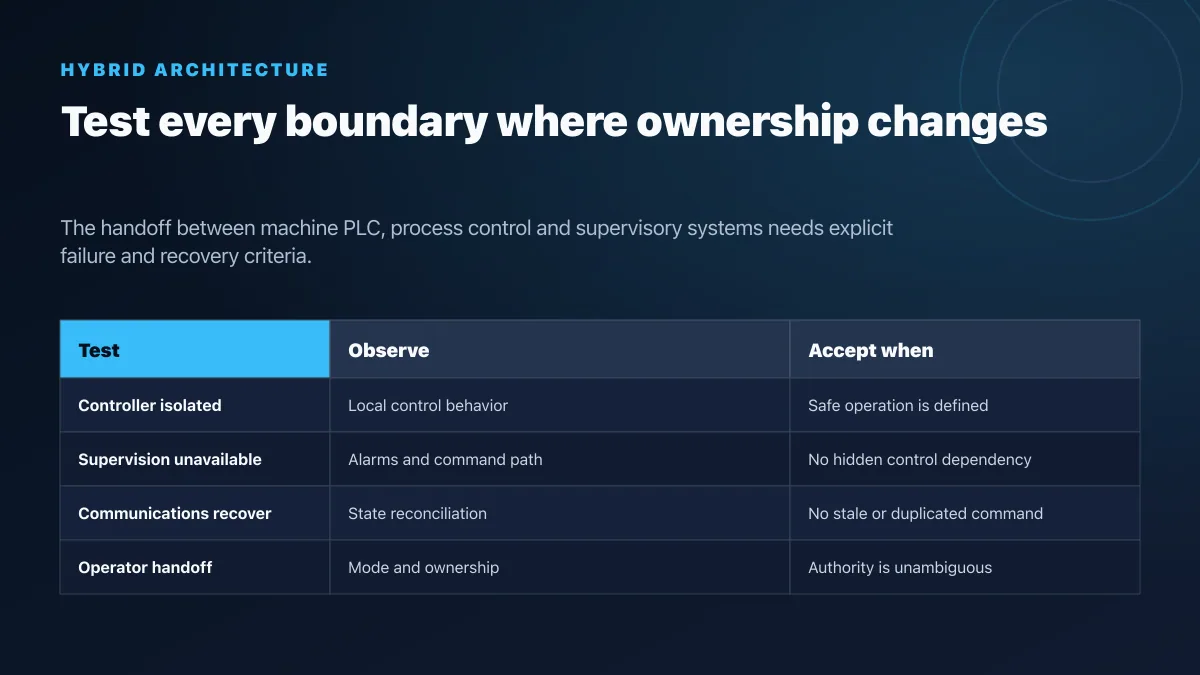
One detail that comparison articles often miss is the ownership boundary between layers. A hybrid architecture is valid only when local control, process coordination, supervision, modes, commands, and recovery are unambiguous.
PLC + SCADA Architecture (Discrete / Infrastructure)
┌─────────────────────────────────────────────────────┐
│  ENTERPRISE / SCADA LAYER                           │
│  Historian · Dashboards · Alarm Management · Reports│
└────────────────────┬────────────────────────────────┘
                     │  OPC-UA / Modbus TCP / Ethernet/IP
        ┌────────────┴────────────┐
        │                         │
┌───────┴──────┐         ┌────────┴──────┐
│   PLC / RTU  │   ...   │   PLC / RTU   │
│  (Site A)    │         │  (Site B)     │
└───────┬──────┘         └────────┬──────┘
        │ Digital/Analog I/O      │ Digital/Analog I/O
┌───────┴──────┐         ┌────────┴──────┐
│ Field Devices│         │ Field Devices │
│ Sensors,     │         │ Sensors,      │
│ Actuators,   │         │ Actuators,    │
│ Drives, Valves         │ Drives, Valves│
└──────────────┘         └───────────────┘
The intended pattern is that field controllers continue their defined local behavior when supervision is unavailable. That outcome is not automatic: test any remote permissives, recipes, time synchronization, identity services, database dependencies, and stale commands that could still affect operation.
DCS Architecture (Continuous Process)
┌──────────────────────────────────────────────────────┐
│  OPERATOR STATIONS + ENGINEERING WORKSTATION         │
│  (Integrated HMI, Historian, Alarm Management)       │
└─────────────────┬────────────────────────────────────┘
                  │  Proprietary Control Network (redundant)
     ┌────────────┼────────────┐
     │            │            │
┌────┴────┐  ┌────┴────┐  ┌───┴─────┐
│Controller│  │Controller│  │Controller│
│  Node 1  │  │  Node 2  │  │  Node 3 │
│(Unit A)  │  │(Unit B)  │  │(Unit C) │
└────┬─────┘  └────┬─────┘  └────┬────┘
     │              │              │
  I/O Bus        I/O Bus        I/O Bus
     │              │              │
Field instruments, transmitters, control valves
(temperatures, pressures, flows, levels)
In a DCS, operator, engineering, controller, alarm, and historian functions are commonly delivered as an integrated system family. Exact server roles, networks, protocols, redundancy, and third-party interfaces vary by product and release; verify them in the proposed architecture rather than assuming every DCS uses one proprietary redundant pattern.
Is PLC Becoming Obsolete?
No — but the boundaries are blurring. Two trends deserve an honest assessment.
Soft PLCs and PC-based control can run IEC 61131-3 applications on industrial computers with real-time runtimes. Their task performance, isolation, hardware support, operating-system relationship, and safety suitability are product- and configuration-specific, so compare a measured representative project instead of a universal scan-time claim.
IEC 61131-3 standardization gives engineers shared language concepts such as Ladder Diagram, Structured Text, and Function Block Diagram. It does not make projects hardware-swappable: libraries, task models, I/O configuration, safety blocks, communications, and file formats remain platform-specific.
Dedicated controller hardware persists because projects may require documented environmental ratings, long lifecycle support, validated safety options, predictable task scheduling, and established maintenance practices. Those attributes must still be verified for the exact product and architecture.
Scan Time in Practice: Why It Matters
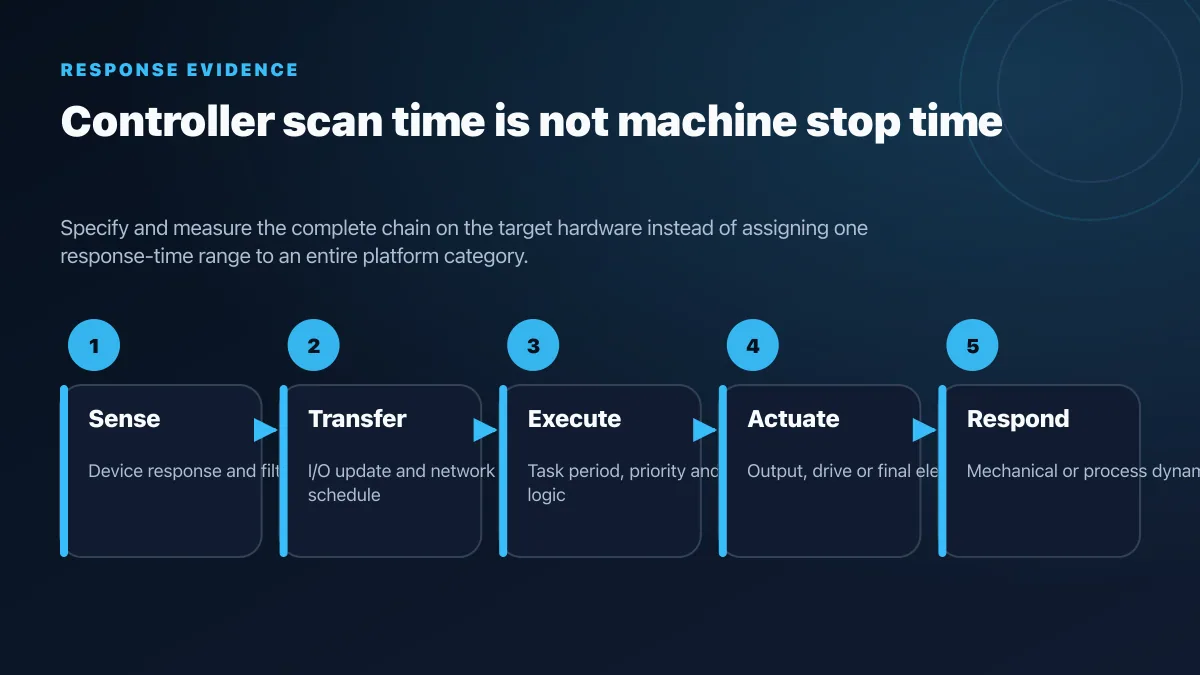
Scan time is a measured property of one controller project, not a fixed property of “PLC” or “DCS.” Record the configured task periods, actual execution time, worst-case load, I/O update behavior, network schedule, output response, and the process or mechanical deadline. For safety functions, use the response-time calculation and validation required by the safety design.
The practical distinction is task fit: a fast discrete or motion application usually needs a tightly bounded local control path, while a slow process loop may prioritize integrated operations, alarming, history, and coordinated strategies. A witnessed benchmark resolves the overlap.
Industry-Vertical Guidance: Common Starting Architectures
Real project decisions are also shaped by sector-specific regulatory context and installed-base norms. The table below summarizes the dominant choice by vertical and the key regulatory or operational drivers.
| Industry Vertical | Dominant System | Key Driver |
|---|---|---|
| Oil & Gas (upstream/midstream/downstream) | Often DCS with separate or integrated safety systems | Continuous process, availability, operations integration, and IEC 61511 lifecycle |
| Water / Wastewater | PLC + SCADA with RTU telemetry | Geographically dispersed pump stations; limited budgets; EPA/state monitoring requirements |
| Pharmaceutical / Biotech | DCS or validated PLC/SCADA architecture | Electronic records, batch documentation, data integrity, and validation |
| Discrete / Automotive Manufacturing | PLC (Allen-Bradley, Siemens S7, Mitsubishi) | High-speed discrete sequencing, robot integration, lean manufacturing cycle times |
| Power Generation & Utilities | SCADA + EMS / DCS hybrid | NERC CIP cybersecurity compliance, load dispatch, SCADA for wide-area visibility, DCS for individual unit control |
| Food & Beverage | DCS for continuous lines; PLC for packaging | Recipe management, CIP/SIP hygiene cycles, traceability; packaging cell speed favors PLC |
| Building Automation / HVAC | SCADA / BMS (BACnet, Modbus) | Multi-zone comfort control, energy management, single-building to campus scale |
Oil and Gas: Why DCS Is Often Evaluated
Refineries and chemical plants often evaluate DCS platforms because integrated controller, operator, alarm, historian, change-management, and process-control workflows can reduce custom integration. Safety Instrumented System scope remains governed by the site safety lifecycle; it should not be inferred from the DCS label or from an integrated engineering interface.
Water/Wastewater: PLC + SCADA + RTU Telemetry
Utilities often operate remote pump stations, lift stations, reservoirs, and dosing points across a service territory. A common architecture uses PLCs or RTUs at remote sites and a central SCADA over the utility's approved communications network. Platform selection still depends on installed assets, support, procurement, cybersecurity, telemetry performance, licensing, and recovery requirements.
Pharma and Biotech: DCS Plus Validation
FDA 21 CFR Part 11 sets requirements for covered electronic records and signatures; it does not certify a product or architecture by category. A regulated project must define intended use, access control, audit trails, records, signatures where applicable, change control, testing, backup, and operating procedures. DCS and PLC/SCADA solutions can both require substantial validation evidence.
When to Use Each System
Choose PLC When:
Machine control requirements are primary: Your system controls specific equipment (filling machine, assembly cell, conveyor system) with deterministic real-time requirements and logical sequencing that cannot tolerate communication latency.
Budget is constrained: A PLC architecture may have less platform overhead for a machine-scale application, but prove it with matched quotes. Hold I/O mix, redundancy, safety, networking, engineering, test, outage, support, and lifecycle assumptions constant.
Discrete manufacturing focus: Discrete part handling, assembly, packaging, and material movement are your core processes rather than continuous analog process control.
Single or coordinated facility: Control requirements fit within a single factory building or adjacent production cells communicating via local Ethernet.
Simplicity is valued: Your team prefers straightforward hardware, accessible IEC 61131-3 programming, and minimal ongoing engineering overhead.
Team expertise aligns: Your existing engineering team has PLC programming expertise and vendor relationships, making platform continuity valuable.
Example: A packaging machinery company might begin with a PLC architecture for filling, capping, conveyor, and reject sequencing, then verify the complete response and safety requirements on the selected controller and I/O.
Choose DCS When:
Continuous process industries are your domain: Chemical plants, refineries, power generation, pharmaceuticals, food processing—industries where continuous monitoring and coordinated multi-unit control are fundamental.
Regulated operations are critical: Your project needs governed electronic records, audit trails, batch workflows, change control, and validation evidence. Evaluate product capabilities and the complete operating procedure; no platform is compliant by name alone.
Integrated process scope is large: Your process includes many interdependent loops, units, operator workflows, alarms, and history requirements that benefit from one engineering model.
Availability is non-negotiable: Your process needs defined controller, network, I/O, server, power, and recovery behavior that the proposed DCS architecture can demonstrate.
Advanced process optimization drives value: Process optimization, energy efficiency, yield maximization, and quality consistency justify DCS sophistication and cost.
Example: A pharmaceutical company manufacturing biological therapeutics would choose DCS for sterile fill-finish operations requiring precise temperature/humidity control, recipe documentation, lot traceability, and comprehensive validation.
Choose SCADA When:
Geographically distributed assets require centralized monitoring: Your facilities span multiple locations (substations, pump stations, warehouses, factories) requiring unified visibility from central control room or remote operations center.
Utility or infrastructure focus: Electric distribution, water systems, pipelines, telecommunications infrastructure, renewable energy plants—industries where dispersed remote equipment requires coordinated oversight and balancing.
Legacy device integration is necessary: You supervise equipment running proprietary systems, older PLCs, smart meters, variable frequency drives, or specialized sensors communicating via open protocols like Modbus TCP or Ethernet/IP.
Data analytics and trending drive operational decisions: Your business value comes from understanding historical patterns, predictive maintenance optimization, KPI tracking, energy efficiency analysis, and regulatory compliance reporting rather than real-time control execution.
IT infrastructure exists: Your organization has IT departments, server infrastructure, database expertise, cybersecurity practices, and cloud integration capabilities supporting enterprise SCADA deployment.
Operator interface requirements are sophisticated: Your operations teams require customizable dashboards, drill-down capabilities, trend visualization, and sophisticated alarm management beyond basic equipment status monitoring.
Example: A water utility would choose SCADA to monitor reservoir levels, pressure zones, pump stations, water quality, and energy consumption across its service territory, providing centralized dispatch while individual controllers at each pump station execute local real-time control and optimization independent of central SCADA.
Cost Comparison: A Quote-Based Method
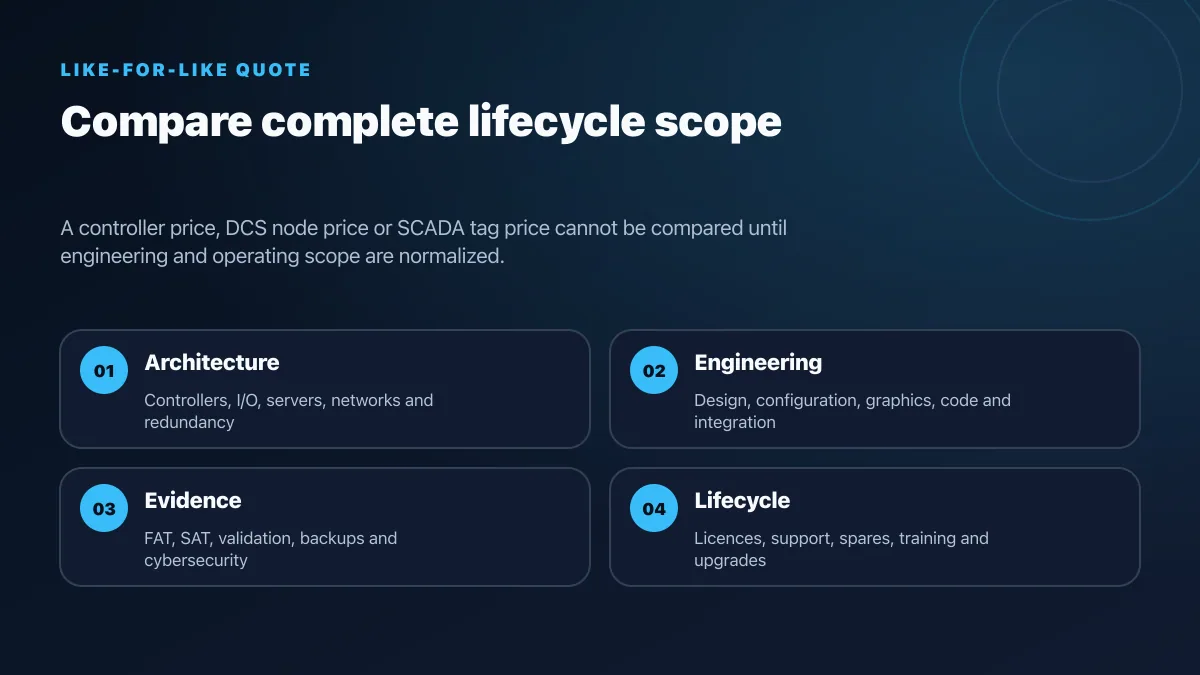
There is no credible universal price band or savings percentage for DCS, PLC, or SCADA. Compare architectures against one frozen requirements pack and a common evaluation horizon.
| Cost group | Include in every alternative |
|---|---|
| Control | CPUs/controllers, I/O mix, safety, redundancy, networks |
| Supervision | HMI/SCADA, historian, alarms, reports, clients |
| Engineering | Design, configuration, code, graphics, interfaces, reviews |
| Verification | Simulation, FAT, SAT, cybersecurity, safety, validation |
| Deployment | Panels, field work, travel, outage, rollback, stabilization |
| Lifecycle | Licenses, support, updates, spares, training, backups, recovery |
Issue the same I/O list, availability target, process narratives, alarm philosophy, data-retention requirement, security zones, acceptance tests, and support period to each bidder. Record exclusions and assumptions. Calculate present value over the agreed horizon and run sensitivity cases for engineering hours, outage duration, expansion, and support renewal.
The result may favor a PLC, a DCS, or a layered PLC/RTU-plus-SCADA architecture. It is evidence for this project—not a reusable claim that one category always saves a fixed percentage.
FAQ: DCS vs PLC vs SCADA
Can SCADA replace a PLC? SCADA does not replace the need for a field controller where the process requires local cyclic or safety control. A SCADA application can supervise PLCs, RTUs, DCS controllers, or other dedicated controllers, but its command path must be designed and tested for the intended role.
Can a PLC function as a DCS? A PLC-based architecture can implement large process systems, and modern PLC portfolios may offer redundancy, process libraries, historians, and integrated operations. Compare the required engineering model, availability, lifecycle, validation, and operator workflow with a DCS proposal rather than relying on an I/O threshold.
What's the difference between DCS and SCADA? A DCS includes distributed control and an integrated operations environment. SCADA primarily supervises field controllers and provides visualization, alarms, history, and commands. Neither category makes an implemented system compliant without configuration, procedures, validation, and governance.
Do I need SCADA if I have a PLC? SCADA adds value when: (1) Operators require real-time visualization, (2) Historical trending drives decisions, (3) Geographically distributed facilities require centralized oversight. For small dedicated systems, SCADA may be unnecessary overhead.
How does redundancy differ across PLC/DCS/SCADA? Each product family offers different redundancy options. Map every required layer—power, controller, I/O, network, server, historian, identity, and communications—and witness its failure and recovery behavior.
What's the most common combination? PLC + SCADA is a common layered pattern: PLCs execute machine or process control while SCADA supervises multiple controllers, presents operator interfaces, and records operational data.
Can DCS and PLC systems communicate? Yes, when both systems support a common interface or a validated gateway. Define data ownership, quality, timestamps, command authorization, stale-data behavior, timeout, restart, and cybersecurity requirements at that boundary.
Which system is most cost-effective? There is no universal winner. Issue a matched requirements pack and compare hardware, software, engineering, testing, outage, support, spares, training, upgrades, and recovery over the same horizon.
What about Industry 4.0 and IoT? Modern systems integrate cloud connectivity and advanced analytics. PLCs connect to edge computing platforms; DCS systems embed OPC-UA and historian functionality; SCADA systems leverage cloud databases and machine learning analytics.
How do I choose between SCADA implementations? Compare supported protocols, licensing metric, historian and alarm requirements, deployment model, identity, redundancy, backup, patching, engineering workflow, field-controller compatibility, support, and a witnessed failure-recovery test.
Primary sources and review basis
- NIST SP 800-82 Rev. 3: Guide to Operational Technology Security — OT architecture, risk, segmentation, and operational constraints.
- ISA-95 standard overview — enterprise-control system integration terminology.
- FDA 21 CFR Part 11 — requirements for covered electronic records and electronic signatures.
- IEC 61131-3 overview — programmable-controller programming language framework.
Product limits, redundancy modes, safety certifications, licences, and lifecycle status change by controller family and release. Verify them in current vendor documentation and the project quotation. This page was technically reviewed on 2026-07-25.
Conclusion: Making the Right Choice
Understanding DCS vs PLC vs SCADA differences transforms technology selection from confusing terminology into clear architectural decisions. Each system evolved to solve distinct problems:
- PLC: Local machine or process control with a controller-focused engineering workflow
- DCS: Distributed continuous process control with built-in redundancy and compliance
- SCADA: Supervisory monitoring and historical analysis of distributed systems
The best decision aligns technology with your core requirements: real-time response needs, geographic scale, regulatory compliance, budget constraints, and team expertise. Many modern facilities employ all three—PLCs and DCS systems providing real-time control, SCADA software visualizing and analyzing operational data across the enterprise.
Your technology foundation enables or constrains future capabilities. Choose wisely based on your specific requirements rather than defaulting to industry trends or familiar platforms. With clear understanding of these three foundational technologies, you'll make automation decisions that serve your organization for years to come.
Now run it · free · no signup
Practise the PLC side of a SCADA system
Complete a guided first program in the browser without an account, then build the tags, alarms and operator views a SCADA layer reads.
Ownership disclosure: PLC Programming IO and PLC Simulation Software are operated by the same publisher.


