Siemens PLC Certification: SITRAIN Paths (2026)
Use official SITRAIN listings to choose a Siemens PLC course or exam, verify regional requirements, and prepare with practical TIA Portal evidence.
Quick answer: Siemens PLC certification is not one universal Foundation–Professional–Specialist ladder. SITRAIN offerings vary by country, language, job role, controller generation, and delivery format. Start with the official listing for your region, record the exact course or exam code, and verify prerequisites, assessed tasks, fee, dates, and credential validity before paying.
Evidence status — reviewed July 25, 2026: Siemens currently lists an exam for the Siemens Certified Programmer with TIA Portal. Its official page describes a practical programming exam and a learning path, but also tells candidates to confirm regional availability. Siemens' TIA-SERV1 course page describes preparation toward service-technician credentials. Names, sequence, fees, language, duration, and renewal rules can differ by regional catalog.
Certification can document completion of a defined assessment. It does not by itself prove that someone can design a safe machine, commission a production system independently, or command a fixed salary premium. Employers still evaluate project experience, troubleshooting, electrical knowledge, safety competence, communication, and familiarity with their installed versions.
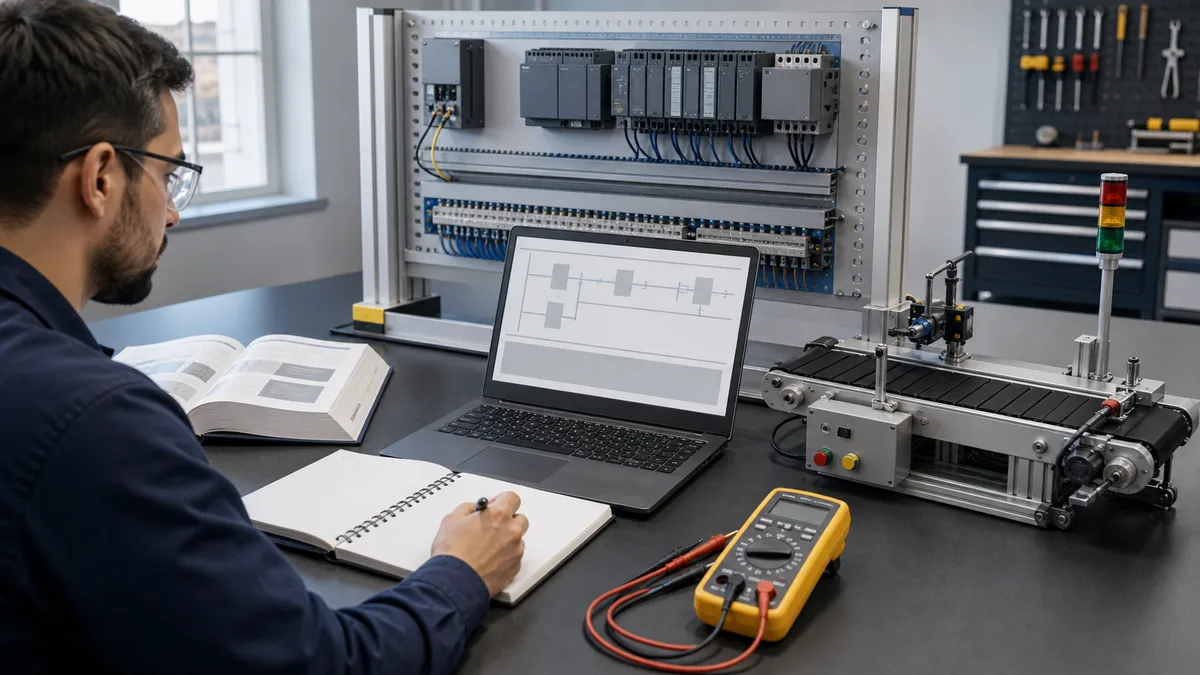
Which Siemens PLC Credentials Exist?
Use the current SITRAIN catalog rather than an undated certification chart. The most relevant paths for PLC work usually fall into these groups:
| Path type | What an official listing should state | What you must verify |
|---|---|---|
| TIA Portal programmer | Programming and commissioning tasks for supported SIMATIC controllers | Exact exam code, prerequisite learning path, TIA Portal release, language and regional availability |
| TIA Portal service technician | Hardware, diagnostics, commissioning and program-change tasks | Whether the course is preparation, an assessment module, or the credential itself |
| Product-specific regional program | Local S7-1200, S7-1500, safety, motion or advanced competence assessment | Whether the credential is regional, its assessed scope and any validity period |
| Course certificate | Attendance or completion of a training event | Whether there is an independent practical assessment |
The official SITRAIN Digital Industry Academy is the starting point. Select your country or region because a course visible in one catalog may not be offered under the same code, price, language, or credential in another.
Certified Programmer With TIA Portal
The current official exam listing describes programming a SIMATIC S7 PLC with TIA Portal and decentralized I/O. It also includes panel commissioning and adjustments with WinCC at machine level. The page names prerequisite courses and practical experience rather than promising that a single short course makes a candidate exam-ready.
Before booking, save a copy of:
- the exam code and title;
- target controller family and engineering-software release;
- assessed programming, hardware, HMI and network tasks;
- prerequisite courses or accepted equivalent experience;
- exam language and delivery location;
- current fee, tax treatment and retake policy; and
- credential name, issuer, verification method and validity rule.
Service-Technician Paths
Siemens' current TIA-SERV1 listing covers TIA Portal handling, SIMATIC S7 architecture, hardware configuration, commissioning, basic programming, PROFINET IO, backups, documentation, and practical exercises on an S7-1500 model. The listing describes it as one course in preparation for named service-technician certification paths—not as the entire certification.
This distinction matters. A course, a course-completion certificate, an exam module, and a role credential are not interchangeable. Ask SITRAIN to identify exactly what document you receive after each event and what additional modules or assessments are required.
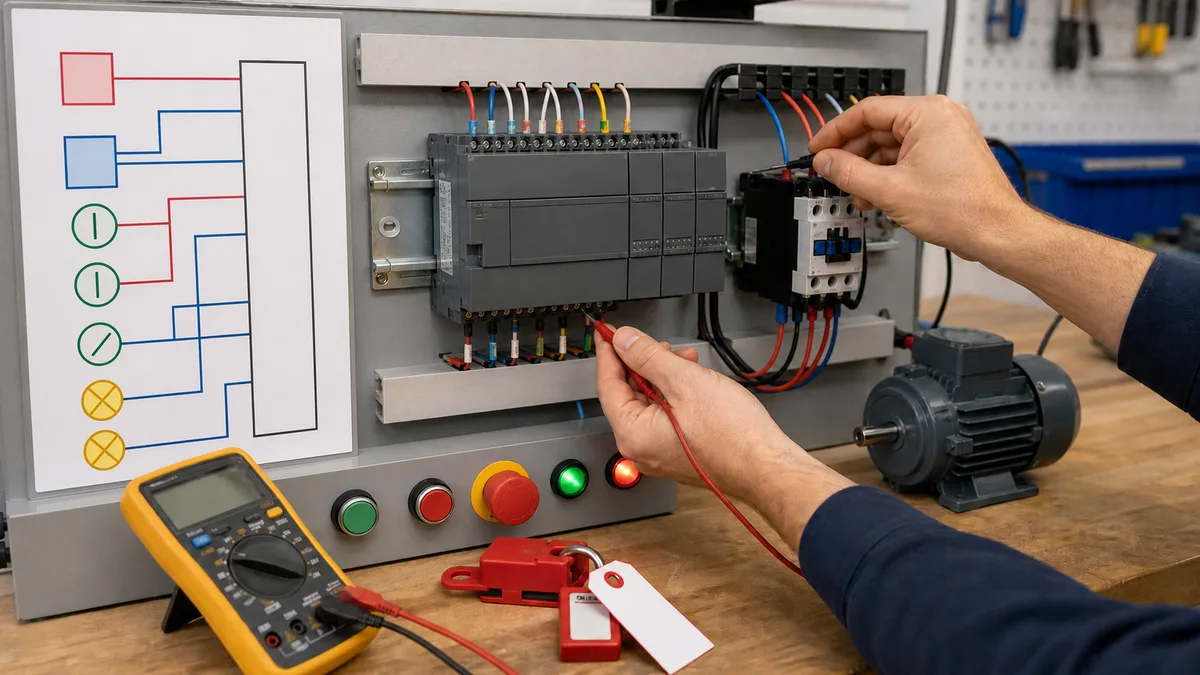
Regional Programs
Some SITRAIN regions publish their own competence programs with local course codes and assessment structures. Treat those pages as evidence only for that region. Do not copy a local fee, exam length, pass mark, or validity period into a global plan.
Live mini-lab
Try it: press START, then STOP
A stop-dominant seal-in rung: START latches the motor output through its own contact, and STOP breaks the circuit.
Watch the output lamp: it stays on after START until you press STOP.
Free to start · runs in your browserOpens plcsimulationsoftware.com — same team
SCE Training Is Useful, but It Is Not the Same as Certification
Siemens' official SCE learning and training documents provide free learning material and project files for education and independent learning. Siemens reported updated TIA Portal learning documents in 2026 and explains the account requirements on that page.
SCE is valuable preparation, but completing free documents does not automatically award a SITRAIN professional credential. Use SCE to build evidence:
- configured hardware and network projects;
- tested function blocks and data structures;
- diagnostic and fault-recovery notes;
- HMI tag, alarm and navigation examples;
- versioned backups and restore records; and
- a short commissioning test report.
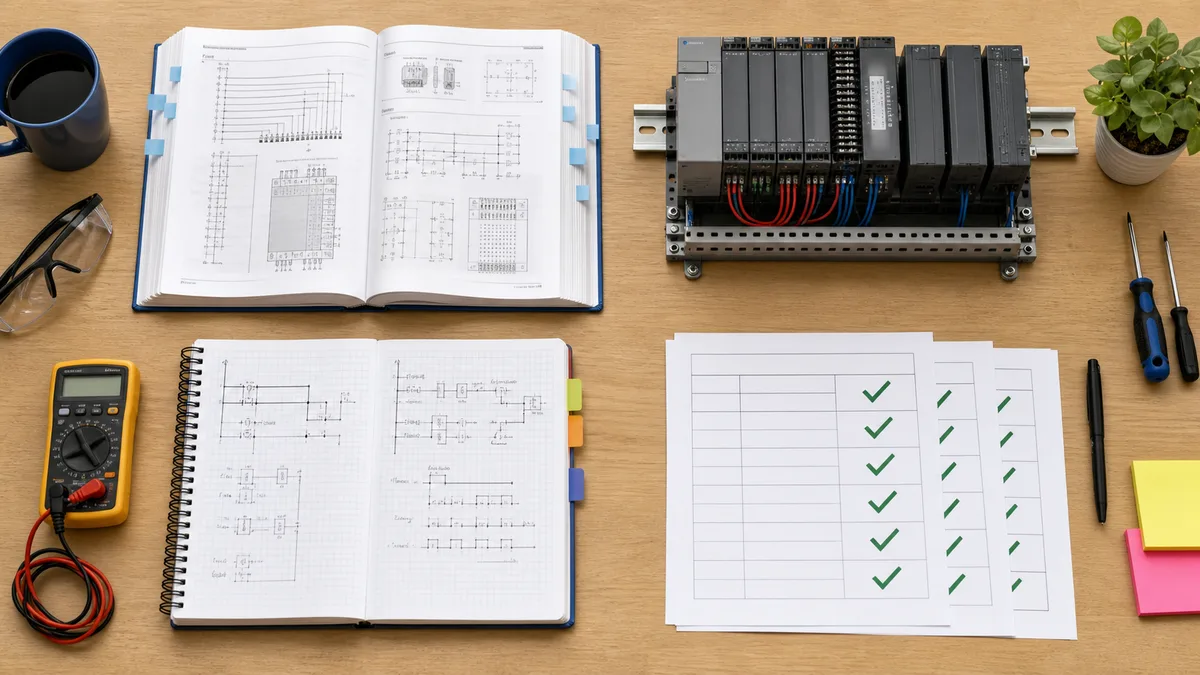
For guided practice before you have Siemens hardware, use the browser PLC training scenarios. They teach control-logic habits but do not emulate every SIMATIC instruction, firmware behavior, or SITRAIN exam task. Pair them with the official TIA Portal tutorial and Siemens documentation.
How to Choose the Right Path
If You Program Machines
Shortlist a programmer path if the assessed work matches your role: project setup, hardware configuration, symbolic data, blocks, sequences, diagnostics, distributed I/O, HMI interaction, and controlled commissioning.
If You Maintain Existing Systems
Prioritize service and diagnostic tasks: going online safely, comparing offline and online projects, interpreting module diagnostics, backing up and restoring, replacing approved hardware, documenting changes, and escalating safety-related issues.
If You Work With Safety or Motion
Do not infer specialist competence from a general TIA Portal credential. Verify that the exact specialist course and assessment cover the controller, drive, safety architecture, standards, and validation duties required by the employer.
If an Employer Requests “Siemens Certified”
Ask for the credential name or course code. The phrase can mean:
- an independently assessed SITRAIN credential;
- completion of a Siemens training course;
- an internal employer qualification;
- experience with a particular TIA Portal release; or
- simply a preference for demonstrable Siemens skills.
Clarifying the requirement prevents paying for a credential that does not satisfy the vacancy.
Verification Checklist Before You Pay
- Open SITRAIN through the regional selector.
- Record the exact course or exam code.
- Confirm whether it is training, an exam, or both.
- Confirm controller family, TIA Portal release, HMI, network, safety and motion scope.
- Check prerequisites and whether equivalent experience is accepted.
- Get the current fee, taxes, included materials, lab access, exam fee and retake terms in writing.
- Confirm delivery language, timezone, location and accessibility.
- Ask how the credential can be verified by an employer.
- Ask whether it expires, requires renewal, or is tied to a product release.
- Save the dated listing and confirmation with your training records.
Practical Preparation Plan
Avoid generic “study for a fixed number of months” advice. Start with a skills gap and finish when you can demonstrate the assessed outcomes.
Baseline Assessment
Attempt a small project without a tutorial:
- configure the target CPU and distributed I/O;
- create symbolic tags and structured data;
- implement a motor or conveyor sequence with permissives and faults;
- add an HMI command, status and alarm;
- diagnose an injected hardware or communication fault;
- compare, back up and restore the project; and
- explain every online action and its operational risk.
Record where you needed help. Map those gaps to the official course objectives.
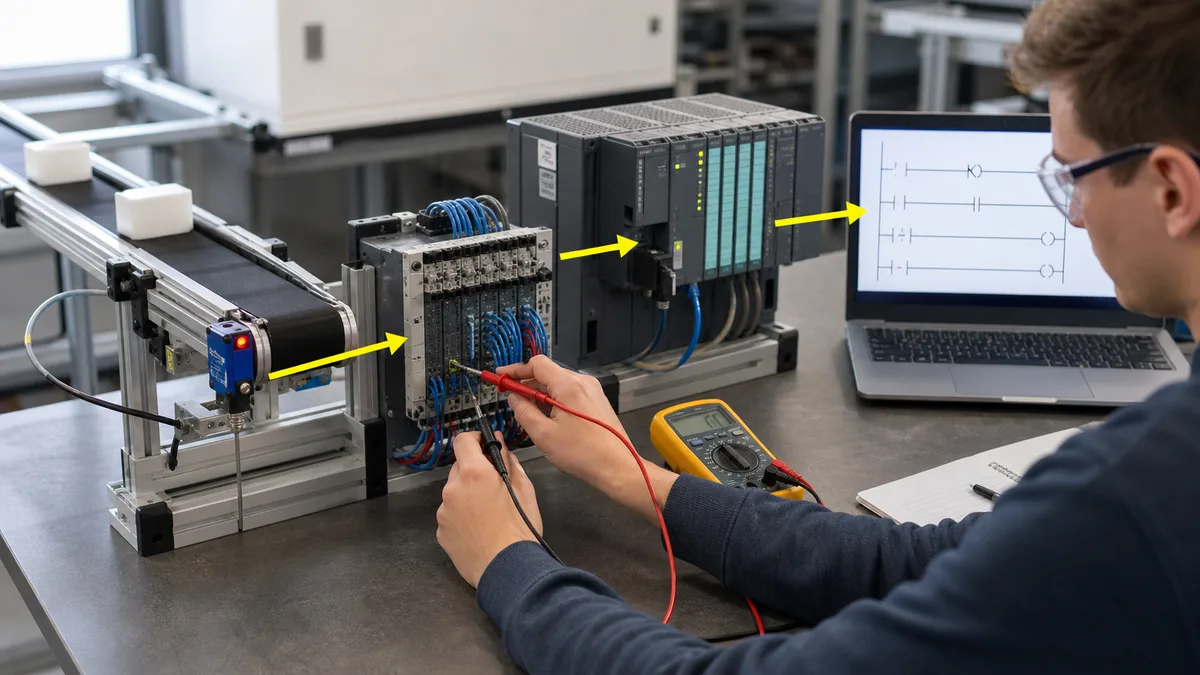
Build an Evidence Project
Use one representative machine rather than disconnected exercises. A conveyor cell, pump station, or tank process can cover:
- operating modes;
- start permissives and interlocks;
- sequence state;
- analog scaling;
- alarm and acknowledgement behavior;
- communication loss;
- restart and power-cycle recovery;
- HMI commands and feedback;
- diagnostic workflow; and
- acceptance tests.
Keep screenshots, exported tag lists, source files, a change log, and a test record. If the credential assessment is practical, this preparation is more relevant than memorizing unofficial question banks.
Rehearse Safe Diagnostics
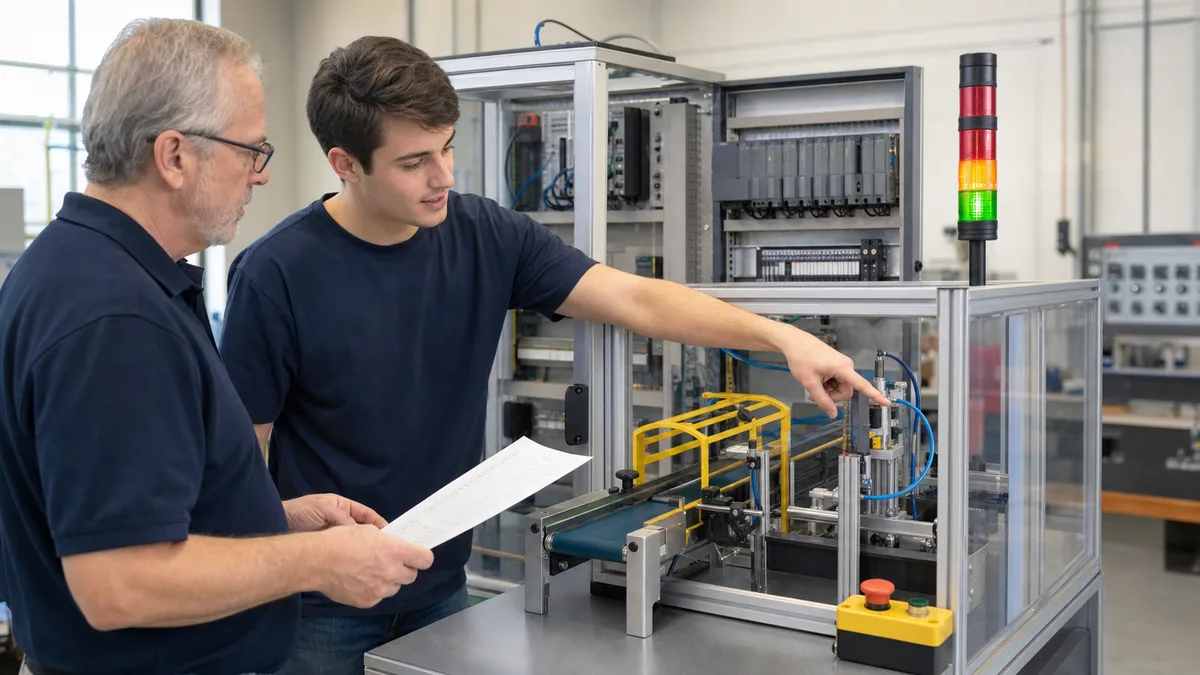
Practice on a simulator, training rig, or isolated lab. Do not use production equipment for exam preparation. Forces, online changes, hardware downloads, safety signatures, and firmware changes require site authorization and a documented recovery path.
Cost and ROI Without Invented Numbers
Course and exam prices differ by region and date. Build a dated cost sheet from official quotes:
| Cost input | Evidence |
|---|---|
| Courses | Current SITRAIN course codes and quote |
| Exam | Official exam listing or written regional confirmation |
| Travel and time away | Employer policy and actual itinerary |
| Software and lab | Included access or exact required licenses/hardware |
| Retake risk | Written retake terms |
| Renewal | Official validity and renewal requirements |
Do not model a guaranteed salary uplift. To test career value:
- collect relevant vacancies in your target geography;
- count those naming the exact credential versus general Siemens experience;
- record whether certification is required, preferred, or absent;
- compare responsibilities, travel, shift work and experience—not just salary; and
- ask employers or recruiters whether that credential changes shortlisting.
This creates a defensible local business case.
What Certification Does and Does Not Prove
Certification can show that you completed a defined learning path or passed an assessment. Its value is strongest when paired with:
- a verifiable credential;
- recent project files;
- a clear role-specific portfolio;
- safe commissioning and change-control habits;
- evidence of troubleshooting;
- references from supervised work; and
- familiarity with the employer's controller and software versions.
It does not automatically prove professional licensure, functional-safety authorization, cybersecurity competence, or independent commissioning authority.
Frequently Asked Questions
Is There One Global Siemens PLC Certification?
No single page establishes one universal global ladder with identical fees, exams and validity. SITRAIN has regional catalogs and multiple role- and product-specific paths. Verify the exact local listing.
Is SITRAIN the Official Siemens Training Source?
Yes. Use the official SITRAIN domain and regional selector. Be cautious with third-party courses that use “Siemens certified” to describe only their own certificate of completion.
Can I Take Only the Exam?
Some regional listings provide a separate exam and describe prerequisite courses or equivalent knowledge. Eligibility is listing-specific; obtain written confirmation from the responsible SITRAIN region.
Does Siemens Certification Expire?
Do not assume a universal period. Validity can depend on the exact regional credential. The official listing or issuing SITRAIN office is the source of record.
How Much Does It Cost?
There is no stable worldwide price. Currency, region, tax, delivery, included labs, course sequence and exam fees vary. Quote the exact path you intend to take.
Will It Increase My Salary?
No reliable universal premium can be attributed to the credential alone. Pay depends on location, occupation, experience, travel, shift/on-call requirements, industry, project responsibility and demonstrated skills. Test demand in your target market.
What Should I Learn First?
Learn PLC scan behavior, boolean logic, timers, counters, data types, state-based sequencing, hardware configuration, diagnostics, backups, HMI basics and safe change control. Then map those skills to the official path.
Next Step
Open the official SITRAIN catalog, select your region, and save the exact course or exam listing. Then use the Siemens PLC programming tutorial and PLC programming examples to build a small evidence project before booking.
Now run it · free to start
Build the skills a PLC technician is tested on
Work through core lessons and hands-on labs in your browser. Free to start; completion certificates are part of the paid interview tracks.
Ownership disclosure: PLC Programming IO and PLC Simulation Software are operated by the same publisher.


