SERCOS Protocol Tutorial 2026 | Complete Motion Control Guide
Master SERCOS III protocol for high-performance motion control. Learn architecture, configuration, ring topology, motion programming, and implementation best practices.
Introduction: Mastering SERCOS Protocol for High-Performance Motion Control
SERCOS (Serial Real-Time Communication System) protocol has established itself as the premier communication standard for demanding motion control applications requiring deterministic real-time performance, precise synchronization, and coordinated multi-axis control. As one of the fastest and most reliable industrial Ethernet protocols available in 2026, SERCOS III protocol enables cycle times below 31.25 microseconds and synchronization accuracy under 1 microsecond, making it the protocol of choice for high-speed packaging machinery, CNC machine tools, robotics, and precision manufacturing equipment.
Originally developed as SERCOS I in 1989 using fiber optic technology for drive communication, the protocol evolved through SERCOS II and ultimately to SERCOS III, which leverages standard Ethernet physical layer technology while maintaining the exceptional real-time performance characteristics that define SERCOS motion control applications. This evolution preserved the protocol's proven deterministic behavior while adding flexibility, scalability, and integration capabilities demanded by modern automation systems.
This comprehensive SERCOS protocol tutorial covers everything from fundamental architecture concepts to advanced motion control programming techniques. You'll learn how SERCOS III works, when to choose it over competing motion networks, how to configure SERCOS ring topology networks, and how to leverage its capabilities for coordinated multi-axis applications requiring the highest levels of precision and synchronization.
The widespread adoption of SERCOS protocol across demanding industries including machine tools, semiconductor equipment, packaging machinery, printing systems, and test equipment demonstrates its exceptional performance advantages. Understanding SERCOS III implementation principles and configuration techniques has become essential knowledge for automation engineers working on high-performance motion control systems in 2026.
Chapter 1: Understanding SERCOS Protocol Fundamentals
What is SERCOS and How Does It Work?
SERCOS protocol represents a specialized industrial Ethernet standard designed specifically for motion control applications where deterministic real-time communication and precise synchronization between multiple drives and controllers are absolutely critical for system performance and product quality.
Real-Time Ethernet Architecture:
SERCOS III uses standard Ethernet hardware (100BASE-TX or 1000BASE-T) but implements specialized communication scheduling that guarantees deterministic behavior. Unlike general-purpose Ethernet protocols that operate on best-effort delivery principles, SERCOS protocol enforces strict timing relationships ensuring control data arrives within guaranteed time windows measured in microseconds.
The SERCOS master generates cyclic telegrams containing position commands, velocity setpoints, and control data for all connected drive devices. These telegrams traverse the network in a deterministic pattern, with each slave device reading its data and inserting status information as the telegram passes through. This architecture ensures predictable, jitter-free communication essential for coordinated motion applications.
Dual-Channel Communication Model:
SERCOS III implements two independent communication channels that operate simultaneously on the same physical network infrastructure:
- Real-Time Channel: Carries cyclic motion data with guaranteed delivery timing for position commands, velocity setpoints, and drive status information requiring deterministic performance
- Protocol Channel: Carries acyclic service data including parameter access, diagnostics, and configuration information that don't require strict real-time guarantees
This separation enables efficient network utilization while ensuring critical motion data always receives priority and guaranteed timing regardless of diagnostic or configuration traffic load.
Ring Topology Benefits:
SERCOS III networks typically operate in ring topology where devices connect in a closed loop providing deterministic data flow and built-in cable redundancy. The master sends telegrams into the ring, each slave processes its data, and the telegram returns to the master completing the cycle. If a cable break occurs, the master can still communicate with all devices through the remaining path, ensuring high system availability.
SERCOS Protocol History and Evolution
SERCOS I (1989):
The original SERCOS interface used fiber optic cables and specialized hardware providing exceptional noise immunity and electrical isolation. This implementation established the deterministic communication principles and master-slave architecture that remain fundamental to SERCOS protocol today. Applications focused primarily on CNC machine tools requiring coordinated multi-axis servo control.
SERCOS II (1999):
SERCOS II maintained the fiber optic physical layer while expanding capabilities to include more slaves per network, higher performance, and additional features supporting complex motion control applications. The protocol gained widespread adoption in machine tools, packaging equipment, and precision automation systems requiring coordinated motion control with sub-millisecond cycle times.
SERCOS III (2003-Present):
SERCOS III represented a fundamental evolution by adopting standard Ethernet physical layer technology (100BASE-TX, 1000BASE-T) while preserving the proven real-time characteristics of earlier SERCOS versions. This transition reduced hardware costs, simplified wiring with standard cables and connectors, and enabled integration with industrial Ethernet infrastructure while maintaining exceptional motion control performance.
Modern SERCOS III implementations support cycle times from 31.25 microseconds to several milliseconds, up to 511 slave devices, and seamless integration with safety protocols, enabling sophisticated automation architectures combining motion control, I/O, and safety on unified network infrastructure.
Industry Standardization:
SERCOS protocol achieved international standardization through IEC 61491 and IEC 61800-7, ensuring vendor independence, interoperability, and long-term technology stability. The SERCOS International organization maintains the specification and promotes open standardization enabling competition and innovation among drive manufacturers and automation vendors.
Key Advantages of SERCOS Protocol
Exceptional Real-Time Performance:
SERCOS III protocol delivers industry-leading deterministic performance with cycle times as fast as 31.25 microseconds for demanding motion applications and jitter performance below 1 microsecond. This exceptional timing precision enables smooth motion trajectories, coordinated multi-axis control, and high-speed synchronized operations impossible with slower or less deterministic protocols.
Position control loop update rates reaching 32 kHz enable extremely responsive servo systems with excellent disturbance rejection and trajectory following characteristics. Applications such as high-speed pick-and-place, precision CNC machining, and coordinated printing operations leverage this performance for superior product quality and throughput.
Precise Synchronization Capabilities:
SERCOS protocol implements deterministic synchronization mechanisms ensuring all network devices execute coordinated actions at precisely the same instant with timing accuracy below 1 microsecond. This synchronization enables electronic line shaft applications, coordinated product handling, and synchronized multi-axis motion patterns where timing errors directly impact product quality.
The protocol's inherent synchronization capability eliminates the need for separate synchronization mechanisms or additional hardware, simplifying system architecture while ensuring reliable coordinated motion across dozens of servo axes in complex machinery.
Scalability and Flexibility:
SERCOS III networks support up to 511 slave devices on a single ring, providing exceptional scalability for large machinery with numerous servo axes, I/O systems, and specialty devices. Network configuration flexibility enables mixed device types including servo drives, spindle drives, I/O modules, and intelligent sensors operating on the same deterministic network.
Hot-plug capability allows adding or removing devices from operational networks without disrupting communication with other devices, simplifying maintenance and commissioning procedures. This feature reduces downtime during equipment modifications or component replacement operations.
Integrated Safety Communication:
SERCOS Safety (SercosSSC) enables functional safety communication up to SIL 3 using the same network infrastructure as standard motion control data. Safety drives, safety I/O, and safety controllers communicate over the existing SERCOS network, eliminating separate safety wiring while maintaining complete independence between safety and standard functions.
This integration reduces installation costs and wiring complexity while providing comprehensive safety system capabilities for modern machinery requiring guard monitoring, safe motion functions, and safety-rated I/O processing.
Open Standardization:
The open standardization of SERCOS protocol through international standards and the SERCOS International organization ensures vendor independence and competitive pricing. Any drive manufacturer can implement SERCOS III communication without licensing fees or proprietary restrictions, fostering innovation and preventing vendor lock-in situations.
Device profiles define standardized communication interfaces for servo drives, spindle drives, I/O modules, and specialty devices enabling interoperability between equipment from different manufacturers. This standardization simplifies system design and provides flexibility in component selection.
Chapter 2: SERCOS III Architecture Deep Dive
Real-Time Channel and Protocol Channel
Real-Time Channel (Cyclic Communication):
The real-time channel carries time-critical motion data with guaranteed deterministic timing. This channel operates on a fixed cycle time synchronized across all network devices, ensuring position commands, velocity setpoints, torque references, and drive status information exchange with precise timing relationships.
Cyclic data exchange uses AT (Application Telegram) frames containing data for all connected drives in a single network transaction. The master builds the AT telegram including output data for each slave, sends the telegram into the ring, and each slave reads its data and inserts its status information as the telegram passes through. This efficient approach minimizes protocol overhead while maximizing data throughput.
Typical real-time channel cycle times range from 31.25 microseconds for high-performance motion applications to 4 milliseconds for slower process automation requirements. The cycle time selection balances performance requirements against network size and master processing capabilities.
Protocol Channel (Acyclic Communication):
The protocol channel carries non-time-critical service data including parameter access, diagnostic information, configuration data, and file transfers. This channel operates asynchronously using service messages that don't require guaranteed timing but must not interfere with real-time channel performance.
Service channel communication uses MDT (Master Data Telegram) and AT (Drive Telegram) exchanges for request-response transactions. Masters can read or write device parameters, access diagnostic information, upload firmware, or perform configuration operations without disrupting cyclic motion control communication.
The separation between real-time and protocol channels enables efficient network utilization while ensuring motion control data always receives priority. Diagnostic and configuration activities can proceed during normal operation without impacting deterministic performance of the motion control system.
SERCOS III Ring Topology
Ring Network Architecture:
SERCOS III networks typically implement ring topology where devices connect in a closed loop with each device having two Ethernet ports. The master connects to the first slave's port 1, each slave's port 2 connects to the next slave's port 1, continuing around the ring until the last slave's port 2 connects back to the master's second port, closing the ring.
This topology provides deterministic data flow where telegrams travel in a known direction through a fixed sequence of devices. The master knows exactly how long telegrams take to traverse the network, enabling precise synchronization and timing control essential for coordinated motion applications.
Ring Redundancy and Fault Tolerance:
Ring topology inherently provides cable redundancy—if a cable break occurs anywhere in the ring, the master detects the fault and continues communicating with all devices through the remaining path. This automatic failover happens without application intervention and maintains full functionality despite single-point cable failures.
The redundant communication paths enable high system availability for critical manufacturing equipment where downtime costs are severe. Maintenance personnel can replace damaged cables during scheduled maintenance without extended production interruptions.
Line Topology Option:
SERCOS III also supports line topology (daisy-chain) where devices connect in series without closing the ring back to the master. This configuration reduces wiring costs when redundancy isn't required but sacrifices the automatic failover capability of ring topology. Line topology operates identically to ring topology from a communication perspective but with single-path cable routing.
Telegram Structure and Data Flow
Application Telegram (AT) Format:
The Application Telegram carries cyclic real-time data for all connected drives in a single Ethernet frame. The AT structure includes:
- Ethernet header with SERCOS EtherType identifier
- SERCOS timing information for synchronization
- Cyclic data sections for each connected slave device
- Working counter tracking telegram progression through network
- CRC error detection ensuring data integrity
As the AT telegram traverses the ring, each slave device reads its designated data section containing commands from the master and inserts its status data into another section of the same telegram. This efficient processing-on-the-fly approach minimizes latency while maximizing network bandwidth utilization.
Master Data Telegram (MDT) Format:
The Master Data Telegram carries service channel data for acyclic communication including parameter access and diagnostic requests. MDT telegrams operate independently from cyclic AT telegrams, using available network bandwidth without impacting deterministic real-time communication.
Service requests use a command-response protocol where the master sends MDT telegrams containing service requests and slaves respond with requested data or operation status. Multiple service transactions can operate concurrently, limited by available protocol channel bandwidth.
Telegram Timing and Synchronization:
SERCOS III implements precise telegram timing where the master generates AT telegrams at exact intervals determined by the configured cycle time. All slave devices synchronize their processing to this master timing reference, ensuring coordinated execution of motion commands across the entire network.
Synchronization accuracy better than 1 microsecond enables applications requiring precise coordination between multiple axes such as electronic gearing, electronic camming, flying shear operations, and synchronized registration control. This level of synchronization precision represents a key differentiator for SERCOS protocol compared to less deterministic industrial Ethernet alternatives.
Chapter 3: SERCOS III Physical Layer Implementation
Cable and Connector Requirements
Physical Layer Standards:
SERCOS III operates on standard Ethernet physical layers including 100BASE-TX (Fast Ethernet) and 1000BASE-T (Gigabit Ethernet), enabling use of commodity networking hardware and standard cables. This standardization significantly reduces costs compared to earlier SERCOS versions requiring specialized fiber optic components.
Most SERCOS III implementations use 100BASE-TX providing sufficient bandwidth for typical motion control applications while minimizing hardware costs and power consumption. Gigabit implementations enable faster cycle times or larger networks when application requirements demand maximum performance.
Cable Specifications:
SERCOS III networks use standard Ethernet cables with Cat5e minimum specification and Cat6 or Cat7 recommended for new installations. These standard twisted-pair cables provide adequate bandwidth, noise immunity, and installation flexibility for demanding industrial motion control applications.
Cable length limitations follow standard Ethernet specifications: 100 meters maximum between devices for 100BASE-TX implementations. Total ring length can reach several hundred meters when accounting for all segments between devices, sufficient for most machine tool and packaging equipment applications.
Industrial environments may require additional cable protection through conduit, cable tray, or sealed glands depending on exposure to contaminants, mechanical stress, or temperature extremes. Standard Ethernet cable construction provides adequate EMI immunity when properly installed with appropriate grounding and separation from high-power wiring.
Connector Standards:
Standard RJ45 connectors are most common for SERCOS III implementations, though industrial applications may use M12 D-coded connectors, M12 X-coded connectors, or other industrial-rated connection systems providing better sealing, vibration resistance, and mechanical durability.
The protocol itself operates independently of connector choice—mechanical robustness, environmental protection, and installation convenience drive connector selection. Industrial connectors with IP67 sealing and robust latching mechanisms improve reliability in harsh environments but increase component costs.
Network Topology Design Considerations
Ring vs. Line Topology Selection:
Ring topology provides cable redundancy and automatic failover capabilities essential for critical manufacturing equipment where communication failures cause significant production losses. The investment in additional cabling and second master port is justified by improved system availability and reduced downtime costs.
Line topology reduces wiring costs and simplifies physical installation when redundancy isn't required. Applications with acceptable downtime tolerance or secondary communication paths may use line topology to minimize installation complexity and costs.
Device Ordering and Placement:
Device sequence in the SERCOS ring affects communication latency and synchronization performance. Positioning devices with tightest synchronization requirements earlier in the ring minimizes their communication latency, improving performance for critical axes.
Physical placement considerations include cable routing, electrical noise sources, and accessibility for maintenance. Optimal network design balances electrical performance requirements with practical installation and serviceability factors.
Network Segmentation Strategies:
Large machinery with numerous servo axes may benefit from multiple SERCOS rings controlled by separate masters or a single master with multiple SERCOS interfaces. Segmentation limits ring size for improved performance, provides fault isolation between machine sections, and enables parallel processing of independent motion groups.
Power Distribution and Grounding
Network Power Requirements:
SERCOS III devices require stable power supplies providing clean DC voltage within specified tolerances. Servo drives typically require high-power DC bus supplies (300-600 VDC) plus low-power control circuit supplies (24 VDC), while I/O modules and communication devices require only control power.
Power distribution design must account for voltage drop in cables, transient loads during acceleration, and regenerative power during deceleration. Proper sizing of power supplies, cables, and regenerative resistors or drives ensures reliable operation under all operating conditions.
Grounding and Shielding Best Practices:
Proper grounding minimizes electrical noise coupling and provides safety protection. SERCOS networks require:
- Single-point earth grounding at power supply to prevent ground loops
- Cable shield connection to protective earth at both ends when using continuous shield
- Separation between communication cables and high-power wiring
- Equipotential bonding between metal enclosures reducing ground potential differences
Shielded Ethernet cables with properly grounded shields provide superior noise immunity in electrically hostile environments with VFD drives, welders, or other high-power switching equipment generating conducted and radiated electromagnetic interference.
Chapter 4: SERCOS Communication Model and Device Types
SERCOS Master and Slave Architecture
Master Device Responsibilities:
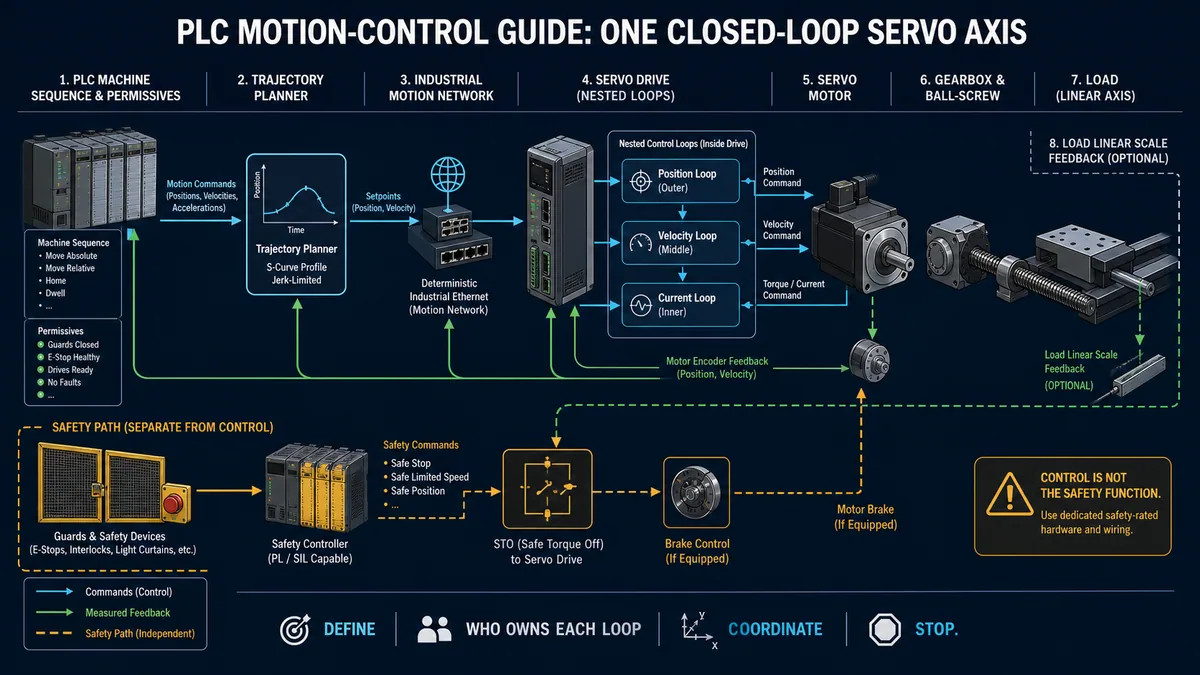
The SERCOS master coordinates all network communication, generates cyclic telegrams at precise intervals, manages slave device configuration and initialization, and implements motion control algorithms generating position commands for connected drives. Master platforms include industrial PCs, PLC motion controllers, dedicated motion controllers, and CNC systems.
Master selection depends on application requirements including axis count, computation complexity, integration with other automation systems, and required programming environment. Modern masters support hundreds of axes with sub-millisecond cycle times while executing complex motion algorithms and coordinating with I/O and safety systems.
Slave Device Categories:
SERCOS slave devices span multiple categories:
- Servo Drives: Position-controlled drives for rotary or linear servo motors
- Spindle Drives: Velocity-controlled drives for machine tool spindles and process drives
- I/O Modules: Digital and analog I/O for sensors, actuators, and process signals
- Intelligent Devices: Vision systems, measuring instruments, and specialty automation devices
- Safety Devices: Safety drives and safety I/O implementing SercosSSC safety protocol
SERCOS Device Classes and Profiles
Standard Device Classes:
SERCOS III defines device classes providing standardized communication interfaces:
- Class 1: Simple drives with basic positioning and velocity control
- Class 2: Advanced drives supporting full servo functionality including interpolation
- Class 3: I/O devices for digital and analog signals
- Class 4: Intelligent devices with custom functionality
Device class determines supported features, parameter sets, and operating modes available for application programming and configuration.
Drive Profile Standard:
The SERCOS drive profile (based on IEC 61800-7-204) standardizes communication with servo and spindle drives ensuring interoperability between drives from different manufacturers. The profile defines operating modes, state machines, parameter structures, and real-time data formats enabling mixed-vendor drive systems.
Standard operating modes include:
- Cyclic Synchronous Position Mode (CSP): Master provides position setpoints each cycle
- Cyclic Synchronous Velocity Mode (CSV): Master provides velocity setpoints each cycle
- Cyclic Synchronous Torque Mode (CST): Master provides torque setpoints each cycle
- Interpolated Position Mode (IP): Drive performs interpolation between position targets
Real-Time Data Exchange
Cyclic Data Configuration:
Cyclic data exchange between master and slaves uses configurable data structures optimized for specific application requirements. Common cyclic data includes:
From Master to Drive:
- Position command or velocity setpoint
- Control word with operating mode, enable, reset commands
- Torque limit or override values
- Synchronization information
From Drive to Master:
- Actual position or velocity feedback
- Status word with drive state, warnings, errors
- Actual torque and current measurements
- Diagnostic information
Data structure configuration balances required information against network bandwidth and cycle time constraints. Optimized configurations include only essential data minimizing telegram size for fastest cycle times.
Acyclic Parameter Access:
The protocol channel enables parameter reading and writing during operation without disrupting real-time communication. Parameters include:
- Drive configuration (gear ratio, limits, filters)
- Motion parameters (acceleration, jerk, velocity limits)
- Diagnostic data (temperatures, error logs, statistics)
- Advanced features (auto-tuning, oscilloscope, identification)
Service channel access uses standardized parameter addressing and data typing ensuring consistent parameter access across devices from different manufacturers.
Chapter 5: SERCOS Configuration Tutorial
Network Setup and Initialization
Step 1: Hardware Installation:
Begin SERCOS network configuration by installing all physical devices and completing ring wiring. Verify:
- All devices powered with correct voltages
- Ethernet cables properly connected in ring topology
- Cable shields properly grounded
- Devices configured with unique node addresses
- Master communication interfaces connected to ring
Physical installation quality directly impacts communication reliability—ensure all connections are secure, cables properly routed away from noise sources, and environmental protection adequate for operating conditions.
Step 2: Master Configuration:
Configure the SERCOS master interface specifying:
- Cycle time (31.25 µs, 62.5 µs, 125 µs, 250 µs, 500 µs, 1 ms, 2 ms, 4 ms)
- Network topology (ring or line)
- Slave device addresses and positions in ring
- Communication timeout values
- Redundancy settings for ring topology
Cycle time selection balances performance requirements against network size and master processing capabilities. Faster cycle times enable higher control loop bandwidth but limit maximum network size and complexity.
Step 3: Network Scanning:
Initiate network scanning where the master automatically detects all connected slave devices, reads their identification data, and verifies topology against expected configuration. Scanning confirms:
- All expected devices present and communicating
- Devices positioned in correct ring sequence
- Device identification matches configuration
- Communication quality adequate for selected cycle time
Address any discrepancies between expected and detected topology before proceeding to device configuration.
Drive Configuration and Parameter Setup
Step 4: Device Parameterization:
Configure each slave device using its parameter set:
Basic Drive Parameters:
Motor Configuration:
- Motor type and rating
- Encoder type and resolution
- Gear ratio and mechanical scaling
- Position units and range

Control Parameters:
- Position control loop gains
- Velocity control loop gains
- Current control loop gains
- Filter settings and notch frequencies

Limit Parameters:
- Maximum velocity and acceleration
- Position software limits
- Current and torque limits
- Temperature and voltage limits
Many SERCOS masters provide auto-tuning functions that automatically optimize control parameters based on measured system characteristics, simplifying commissioning for non-expert users.
Step 5: Cyclic Data Mapping:
Map cyclic data exchanged between master and each slave device:
- Select operating mode (CSP, CSV, CST, IP)
- Configure transmitted data (commands, setpoints, control)
- Configure received data (feedback, status, diagnostics)
- Optimize data structures for minimum telegram size
Efficient data mapping minimizes network bandwidth requirements enabling faster cycle times or larger networks while ensuring all essential information exchanges each cycle.
Timing Configuration and Synchronization
Step 6: Synchronization Setup:
Configure SERCOS synchronization ensuring all devices execute coordinated actions at precise instants:
- Enable synchronization mode for all drives
- Configure synchronization offset for each device
- Set communication phase alignment
- Verify synchronization quality metrics
SERCOS III inherently provides deterministic synchronization through its ring architecture and telegram structure. Proper synchronization configuration ensures this capability delivers maximum performance for coordinated motion applications.
Step 7: Timing Verification:
Verify timing performance before releasing system for production:
- Measure actual cycle time consistency
- Check synchronization jitter between devices
- Verify telegram propagation delays
- Monitor communication quality indicators
- Test under maximum network load conditions
Timing verification confirms the network configuration achieves required performance specifications and identifies issues requiring optimization or correction.
I/O Mapping and Integration
Step 8: I/O Configuration:
For SERCOS I/O modules, configure digital and analog channels:
- Input configuration (voltage/current range, filtering)
- Output configuration (voltage/current range, fault behavior)
- Special function configuration (counters, encoders, PWM)
- Diagnostic threshold and alarm settings
Map I/O data into cyclic telegram structure and PLC variable space ensuring efficient access from application logic.
Step 9: Network Startup:
Transition the network through SERCOS communication phases:
- CP0 (Communication Phase 0): Initial state, no communication
- CP1: Telegram structure configuration
- CP2: Parameter configuration and verification
- CP3: Cyclic data transmission validation
- CP4: Full operational mode with real-time data exchange
Monitor phase transitions and address errors preventing progression to operational mode. Common startup issues include configuration mismatches, incompatible device firmware, or physical connection problems.
Chapter 6: SERCOS Motion Control Programming
Motion Control Operating Modes
Cyclic Synchronous Position Mode (CSP):
CSP mode enables the master to control drive position by providing position setpoints every communication cycle. The master implements motion trajectory generation, interpolation, and profile calculations while drives execute position control at their local cycle rate synchronized to network timing.
CSP Programming Example:
Every SERCOS Cycle:
    Position_Command[Axis1] = Trajectory_Generator(Time)
    Send position command to drive via cyclic data
    Read actual position from drive
    Monitor following error

Drive receives position command and:
    Executes position control loop at local cycle rate
    Reports actual position each SERCOS cycle
    Maintains synchronization with network timing
This mode provides maximum flexibility for complex motion profiles, coordinated multi-axis motion, and dynamic trajectory modification while leveraging drive-internal position control for optimal performance.
Cyclic Synchronous Velocity Mode (CSV):
CSV mode provides velocity setpoints each cycle enabling the master to implement velocity profiling while drives execute velocity control. Applications include spindle control, winding/unwinding, and velocity-regulated processes.
Cyclic Synchronous Torque Mode (CST):
CST mode provides torque setpoints enabling advanced control strategies such as force control, electronic load sharing, or custom control algorithms implemented in the master. The master assumes complete control responsibility while drives execute torque control as commanded.
Interpolated Position Mode (IP):
IP mode allows the master to provide position targets with associated timing information and the drive performs interpolation to generate smooth motion profiles. This mode reduces master computational load and network bandwidth requirements for applications with point-to-point positioning rather than continuous path control.
Coordinated Multi-Axis Applications
Electronic Gearing Implementation:
Electronic gearing synchronizes slave axes to master axis motion through programmable gear ratios:
Electronic Gear Configuration:
Master_Axis = Virtual or physical reference axis
Slave_Axis[n] = Physical axis following master

Every Cycle:
    Slave_Position[n] = Master_Position * Gear_Ratio[n] + Offset[n]

Dynamic gear ratio changes:
    Gear_Ratio[n] = Function(Master_Position, Time, Conditions)
    Enable smooth ratio transitions with S-curve profiling
Applications include packaging machines synchronizing multiple product handling axes, printing systems coordinating multiple print stations, and assembly equipment coordinating component insertion with product transport.
Electronic Camming Applications:
Electronic camming creates position-dependent motion relationships using cam tables or mathematical functions:
Electronic Cam Configuration:
Master_Position: Reference position (0-360° or linear)
Cam_Profile: Table or function defining slave motion

Every Cycle:
    Slave_Position = Cam_Profile(Master_Position)

Cam profile types:
    - Table-based: Linear interpolation between table points
    - Polynomial: Mathematical function of master position
    - Spline: Smooth curves with continuous derivatives
Electronic cams replace mechanical cams providing flexibility, easy changeover, and elimination of mechanical wear while enabling cam shapes impossible with mechanical solutions.
Flying Shear and Cut-to-Length:
Flying shear applications cut moving material to precise lengths while maintaining production speed:
Flying Shear Sequence:
1. Shear axis accelerates to match material velocity
2. Shear tracks material position during cut operation
3. Blade executes cutting motion synchronized to material
4. Shear decelerates and returns to start position
5. Process repeats for next cut cycle

SERCOS synchronization ensures:
    - Precise velocity matching
    - Accurate position tracking
    - Coordinated cutting motion
    - Minimal timing jitter
Sub-microsecond synchronization accuracy enables cutting accuracy within fractions of millimeters at high material speeds.
Advanced Motion Features
Path Interpolation and Blending:
Coordinated motion of multiple axes along defined paths requires sophisticated interpolation:
- Linear interpolation for straight-line motion
- Circular interpolation for arc segments
- Spline interpolation for smooth complex curves
- Corner blending for continuous motion without stops
SERCOS deterministic timing ensures all axes receive synchronized position commands maintaining precise path accuracy throughout motion sequences.
Motion Synchronization and Registration:
Registration control synchronizes processes to product features or printed registration marks:
- High-speed position capture triggered by registration marks
- Dynamic position offset correction based on captured position
- Phase correction maintaining synchronization despite product variations
- Automatic compensation for splice, missing marks, or defects
Chapter 7: SERCOS Diagnostics and Monitoring
Communication Diagnostics
Telegram Quality Monitoring:
Monitor communication quality through built-in diagnostic counters:
- Telegram transmission success rate
- CRC error counter detecting corrupted telegrams
- Lost telegram counter identifying communication failures
- Timing violation counter tracking cycle time overruns
- Synchronization quality metrics measuring jitter
Regular monitoring detects degrading performance before complete failures occur, enabling proactive maintenance and preventing unexpected downtime.
Network Performance Analysis:
Analyze network performance characteristics:
- Average and maximum cycle time
- Jitter measurements for each device
- Telegram propagation delay through ring
- Communication phase transition times
- Bandwidth utilization for real-time and protocol channels
Performance analysis identifies optimization opportunities and verifies network operation within design parameters.
Drive Diagnostics and Monitoring
Real-Time Status Monitoring:
Monitor drive status through cyclic data exchange:
- Drive state machine position (initialization, operation, error)
- Warning and error flags
- Actual position, velocity, and torque
- Motor temperature and drive temperature
- DC bus voltage and current consumption
Status monitoring enables predictive maintenance, early fault detection, and optimized operation through visibility into drive operating conditions.
Parameter Monitoring and Logging:
Access detailed diagnostic parameters through service channel:
- Detailed error logs with timestamps
- Statistical data (operating hours, cycle counts)
- Temperature history and trend data
- Vibration analysis and mechanical diagnostics
- Power consumption and efficiency metrics
Comprehensive logging supports root cause analysis when problems occur and trending identifies gradual degradation requiring maintenance intervention.
Troubleshooting SERCOS Networks
Common Communication Problems:
Problem: Network Not Reaching CP4 Operational State
Symptoms:
- Network stuck in CP1, CP2, or CP3
- Specific device(s) not transitioning to operational
- Timeout errors during initialization
Diagnostic Steps:
- Check physical connections and cable integrity
- Verify device configuration matches actual hardware
- Review event logs for specific error messages
- Confirm firmware compatibility between devices
- Check cycle time configuration appropriate for network size
Solutions:
- Correct configuration mismatches
- Update firmware to compatible versions
- Replace faulty cables or connections
- Adjust cycle time for network complexity
- Review device manuals for initialization requirements
Problem: Intermittent Communication Errors:
Symptoms:
- Random CRC errors or lost telegrams
- Occasional synchronization quality degradation
- Intermittent device failures during operation
Diagnostic Steps:
- Monitor communication quality counters over time
- Check for electrical noise sources near network cables
- Verify cable shield grounding and quality
- Measure signal integrity with oscilloscope
- Check for loose connections or damaged cables
Solutions:
- Improve cable routing away from noise sources
- Verify proper shield grounding at one point
- Replace suspect cables with known-good cables
- Add additional shielding or filtering if needed
- Secure all connections and verify proper termination
Chapter 8: SERCOS vs Other Motion Networks
Comprehensive Protocol Comparison
| Feature | SERCOS III | EtherCAT | PROFINET IRT | POWERLINK | Ethernet/IP |
|---|---|---|---|---|---|
| Cycle Time | 31.25-4000 µs | 50-100 µs | 250-500 µs | 200-400 µs | 1-5 ms |
| Jitter | < 1 µs | < 1 µs | < 1 µs | < 1 µs | ~100 µs |
| Topology | Ring/Line | Line/Ring/Tree | Star (Switched) | Ring | Star (Switched) |
| Max Nodes | 511 | 65,535 | 512 typical | 240 | ~250 practical |
| Switches Required | No | No | Yes (Special) | No | Yes (Standard) |
| Synchronization | < 1 µs | < 100 ns (DC) | < 1 µs (IRT) | < 200 ns | Not specified |
| Safety Protocol | SercosSSC (SIL 3) | FSoE (SIL 3) | PROFIsafe (SIL 3) | openSAFETY (SIL 3) | CIP Safety (SIL 3) |
| Primary Application | Motion control | Motion/I/O | Process/Motion | Motion/I/O | General automation |
| Standard | IEC 61491, 61800-7 | IEC 61158 | IEC 61158 | IEC 61158 | ODVA |
| Cost Level | Medium-High | Low-Medium | Medium-High | Medium | Medium |
When to Choose SERCOS Protocol
Ideal SERCOS Applications:
SERCOS III protocol excels in applications requiring:
- High-performance motion control: CNC machine tools, precision positioning, coordinated multi-axis systems
- Demanding synchronization: Electronic line shaft, electronic camming, flying shear, coordinated packaging
- Drive-focused architectures: Systems primarily consisting of servo drives with limited I/O requirements
- Established SERCOS infrastructure: Existing SERCOS equipment or expertise within organization
- IEC 61800-7 compliance: Applications requiring this specific drive profile standard
- Robust ring topology: Need for built-in cable redundancy and high availability
Industries Leveraging SERCOS:
- Machine Tools: CNC machining centers, lathes, grinding machines, EDM equipment
- Packaging Machinery: Form-fill-seal equipment, cartoning machines, case packers, palletizers
- Printing Systems: Flexographic printing, gravure printing, digital printing, label production
- Semiconductor Equipment: Wafer handling, die bonding, wire bonding, test equipment
- Wood and Metal Processing: Panel saws, edge banders, laser cutting, tube bending
- Test and Measurement: Automated test equipment, material testing, dynamic testing systems
SERCOS vs EtherCAT Comparison
Performance Characteristics:
Both SERCOS III and EtherCAT deliver excellent real-time performance suitable for demanding motion control. EtherCAT typically achieves slightly faster minimum cycle times (50 µs vs 31.25 µs) and better synchronization accuracy (< 100 ns with DC vs < 1 µs for SERCOS), though both exceed requirements for most motion applications.
SERCOS ring topology provides inherent cable redundancy which EtherCAT can match through explicit ring configuration. EtherCAT's line topology offers simpler wiring for applications not requiring redundancy.
Ecosystem and Device Availability:
EtherCAT has significantly broader adoption with over 7,000 ETG member companies and extensive device selection including drives, I/O, sensors, and specialty devices. SERCOS has strong drive vendor support but more limited I/O and specialty device availability, making it more focused on motion control applications.
For pure motion control systems with primarily servo drives, both protocols deliver excellent performance. For mixed systems with extensive I/O, vision systems, or specialty devices, EtherCAT's broader device ecosystem provides advantages.
Cost Considerations:
EtherCAT generally offers lower implementation costs due to higher production volumes, broader competition among device vendors, and simpler topology requirements (no mandatory ring closure). SERCOS devices may command price premiums in some segments due to smaller market share, though price differences have narrowed as both technologies matured.
SERCOS vs PROFINET IRT Comparison
Architectural Differences:
SERCOS uses ring topology with deterministic data flow while PROFINET IRT uses switched star topology. SERCOS eliminates switches reducing cost and complexity while PROFINET IRT requires special real-time capable switches adding cost but providing flexible topology.
SERCOS typically achieves faster cycle times (31.25 µs minimum vs 250 µs for PROFINET IRT) making it preferable for the most demanding motion applications. PROFINET IRT provides excellent performance for process automation and moderate motion control requirements.
Integration Considerations:
Organizations heavily invested in Siemens automation ecosystems often prefer PROFINET for seamless integration with Siemens PLCs, drives, and engineering tools. SERCOS provides vendor-neutral alternative with excellent performance and open standardization.
PROFINET's broader device ecosystem and process automation focus make it suitable for complex automation systems combining motion, process control, and information integration. SERCOS excels in motion-focused applications where maximum performance and determinism are priorities.
Chapter 9: SERCOS Safety Integration
SercosSSC Safety Protocol Overview
Functional Safety Communication:
SERCOS Safety (SercosSSC) enables safety-related communication up to SIL 3 and PLe using the same network infrastructure as standard motion control data. Safety devices communicate over the existing SERCOS ring without requiring separate safety networks or special cabling.
The safety protocol implements black channel principle where safety-critical data includes comprehensive error detection codes, time stamps, and sequence numbers ensuring integrity even over unreliable communication channels. This approach enables safety communication over standard SERCOS infrastructure while maintaining independence between safety and standard functions.
Safety Device Types:
SercosSSC supports multiple safety device categories:
- Safety Drives: Servo drives with integrated safety functions (STO, SS1, SS2, SLS, SDI, SOS, SLP)
- Safety I/O: Safety-rated digital inputs and outputs for guard monitoring and safety output control
- Safety Controllers: Safety PLCs coordinating safety system logic and device monitoring
- Safety Sensors: Position measurement systems with safety-rated communication
Safe Motion Functions
Standard Safe Motion Functions:
Safety drives supporting SercosSSC typically implement functions defined in IEC 61800-5-2:
STO (Safe Torque Off):
- Removes torque-generating energy from motor
- SIL 3 / PLe safety integrity level
- Most basic and commonly implemented safety function
- Activated by safety controller or direct safety input
SS1 (Safe Stop 1):
- Monitored stop with specified deceleration ramp
- Torque removed when motion stops (STO activated)
- Enables controlled deceleration before safe torque off
SS2 (Safe Stop 2):
- Monitored stop maintaining torque after stopping
- Motor remains energized in stopped position
- Enables quick restart after safety condition clears
SLS (Safely Limited Speed):
- Monitors velocity remaining below configurable limit
- Enables reduced-speed operation in safety mode
- Common for maintenance mode or collaborative applications
SDI (Safe Direction):
- Monitors and enforces permitted direction of motion
- Prevents unexpected direction changes
- Used in applications with directional safety requirements
SLP (Safely Limited Position):
- Monitors position within safe window
- Prevents motion beyond configured position limits
- Implements position-based safety zones
Safety System Design
Safety Architecture Design:
Proper safety system design using SercosSSC requires:
- Safety Requirements Analysis: Identify hazards, required risk reduction, and safety functions needed
- Safety Network Planning: Design safety device layout and communication architecture
- Safety Function Implementation: Program safety logic and configure safety functions
- Validation and Testing: Verify safety system performance and certification compliance
- Documentation: Create comprehensive safety documentation per IEC 61508/62061 requirements
Safety Integration Example:
Safety System Components:
- Safety PLC (Master)
- Safety-rated servo drives (Slaves)
- Safety I/O modules for guard monitoring
- Emergency stop devices
- Safety-rated position feedback

Safety Network Configuration:
1. Configure safety devices on SERCOS ring
2. Map safety I/O and drive status to safety PLC
3. Implement safety logic in safety PLC
4. Configure safe motion functions in drives
5. Validate safety function response times
6. Document safety system per standards
Chapter 10: SERCOS Best Practices for Motion Control
Network Design Guidelines
Cycle Time Selection:
Choose SERCOS cycle time based on application requirements:
- 31.25 µs: Highest performance motion, CNC, minimal network size
- 62.5 µs: High-speed motion control, coordinated axes, moderate network
- 125 µs: Standard motion control, most servo applications, larger networks
- 250 µs: Process automation motion, less demanding coordination
- 500 µs - 4 ms: Slower motion, large networks, process automation
Faster cycle times enable higher control loop bandwidth but limit network size and master processing capacity. Balance performance requirements against practical constraints.
Ring Sizing and Performance:
Optimize ring configuration for performance:
- Minimize number of devices for fastest cycle times
- Position critical axes early in ring for minimum latency
- Distribute devices logically by function or machine section
- Consider multiple rings for very large machines
- Monitor network loading and communication quality
Cable Routing Best Practices:
Proper cable installation ensures reliable communication:
- Route SERCOS cables away from high-power wiring (VFDs, motors, heaters)
- Maintain minimum separation distances from noise sources
- Use cable tray or conduit for mechanical protection
- Avoid sharp bends exceeding minimum radius
- Label cables clearly for maintenance identification
- Document cable routing in system drawings
Motion Control Optimization
Control Loop Tuning:
Optimize drive control parameters for best motion performance:
- Current Loop: Usually factory-tuned, verify stable at maximum velocity
- Velocity Loop: Tune for smooth velocity tracking without overshoot
- Position Loop: Tune for quick settling without oscillation
- Feed-Forward: Add velocity and acceleration feed-forward reducing following error
Many SERCOS drives provide auto-tuning functions measuring system characteristics and automatically calculating optimal control parameters. Manual tuning provides finer optimization but requires expertise and time.
Following Error Management:
Monitor and manage position following errors:
Following Error = Commanded Position - Actual Position

Acceptable levels depend on application:
- CNC machining: < 0.01 mm typical
- Packaging: < 0.1 mm typical
- Material handling: < 1 mm typical

Following error indicates:
- Control loop tuning quality
- Mechanical friction and compliance
- Load disturbances
- Velocity and acceleration appropriateness
Large or increasing following errors indicate mechanical problems, tuning issues, or excessive commanded accelerations requiring investigation and correction.
Maintenance and Troubleshooting
Preventive Maintenance Procedures:
Regular maintenance ensures continued reliable operation:
Monthly:
- Review communication error logs
- Check cable connections and conditions
- Verify cooling system operation
- Monitor drive temperature trends
Quarterly:
- Test cable redundancy failover
- Verify backup and recovery procedures
- Update firmware per vendor recommendations
- Calibrate position feedback systems
Annually:
- Complete system communication analysis
- Mechanical inspection and lubrication
- Thermal imaging of electrical connections
- Comprehensive system documentation review
Performance Trending:
Monitor key performance indicators over time:
- Communication error rates
- Cycle time consistency
- Synchronization quality
- Drive temperatures
- Following error magnitudes
- Power consumption
Trending identifies gradual degradation enabling proactive maintenance before failures occur. Establish baselines during commissioning and monitor for significant changes indicating developing problems.
Chapter 11: Troubleshooting SERCOS Networks
Systematic Troubleshooting Approach
Step 1: Problem Identification:
Clearly define the problem:
- What specifically is failing or performing incorrectly?
- When did the problem start?
- Does it occur continuously or intermittently?
- Which devices or functions are affected?
- What changed before problem appeared?
Clear problem definition focuses troubleshooting efforts and prevents wasted time investigating unrelated issues.
Step 2: Gather Diagnostic Information:
Collect relevant diagnostic data:
- SERCOS communication phase and status
- Event logs from master and affected devices
- Communication error counters and statistics
- Network topology as detected by master
- Recent configuration or firmware changes
- Environmental conditions during failures
Step 3: Isolate Root Cause:
Use systematic isolation to identify root cause:
- Test with minimal configuration (one drive)
- Swap suspect devices with known-good units
- Replace cables to eliminate wiring problems
- Change one variable at a time
- Document test results systematically
Step 4: Implement Solution:
After identifying root cause, implement appropriate solution:
- Replace failed components
- Correct configuration errors
- Improve installation quality
- Update firmware or software
- Modify design to prevent recurrence
Step 5: Verify and Document:
Confirm problem resolution and document:
- Verify normal operation under full conditions
- Monitor for recurrence over appropriate period
- Document problem, root cause, and solution
- Update maintenance procedures if applicable
- Share knowledge with team members
Common Problems and Solutions
Problem: Excessive Following Error:
Symptoms:
- Position following error exceeds acceptable limits
- Motion quality poor with jerky or rough operation
- Velocity tracking shows large deviations
Causes and Solutions:
Mechanical Issues:
- Excessive friction: Lubricate or repair mechanical components
- Mechanical binding: Align and adjust mechanical systems
- Worn components: Replace worn bearings, belts, or couplings
- Excessive load: Verify load within drive ratings
Tuning Issues:
- Low position gain: Increase position loop proportional gain
- Inadequate feed-forward: Add velocity and acceleration feed-forward
- Insufficient velocity loop gain: Increase velocity loop gains
- Mechanical resonance: Add notch filters at resonant frequencies
Command Issues:
- Excessive acceleration: Reduce acceleration limits in motion profiles
- Unrealistic motion profiles: Use S-curve profiling for smoother motion
- Synchronization errors: Verify SERCOS timing configuration
Problem: Motion Quality Issues:
Symptoms:
- Vibration or oscillation during motion
- Audible noise from motor or mechanics
- Poor surface finish in machining applications
- Product quality defects in packaging applications
Causes and Solutions:
Control Tuning:
- Velocity loop instability: Reduce velocity loop gains
- Position loop too aggressive: Reduce position loop gain
- Mechanical resonance: Identify resonant frequency, add notch filters
- Sample time too long: Reduce SERCOS cycle time if possible
Mechanical Problems:
- Coupling misalignment: Realign motor and load coupling
- Loose mounting: Secure all mounting bolts to specifications
- Worn mechanics: Replace worn belts, bearings, or screws
- Structural resonance: Add damping or stiffen structure
Electrical Interference:
- Motor cable interference: Use shielded motor cables properly grounded
- Encoder cable noise: Use shielded encoder cables, check grounding
- Drive location: Move drives away from noise sources
- Grounding problems: Verify proper equipotential bonding
Frequently Asked Questions About SERCOS Protocol
What does SERCOS stand for and what is it used for?
SERCOS stands for Serial Real-Time Communication System. SERCOS protocol is an industrial Ethernet communication standard specifically designed for high-performance motion control applications requiring deterministic real-time performance, precise synchronization, and coordinated multi-axis control. SERCOS III is widely used in CNC machine tools, packaging machinery, printing systems, and precision manufacturing equipment.
What is the difference between SERCOS I, II, and III?
SERCOS I (1989) used fiber optic cables with specialized hardware for drive communication. SERCOS II (1999) improved performance while maintaining fiber optics. SERCOS III (2003) migrated to standard Ethernet physical layer (100BASE-TX, 1000BASE-T) using standard cables and connectors while preserving the proven real-time characteristics of earlier versions. SERCOS III represents the current standard with widespread adoption.
How fast is SERCOS III communication?
SERCOS III protocol achieves cycle times from 31.25 microseconds to 4 milliseconds depending on network size and application requirements. Synchronization accuracy is better than 1 microsecond. These performance characteristics enable demanding motion control applications including CNC machining, high-speed packaging, and coordinated multi-axis systems requiring precise timing.
Can SERCOS III work with devices from different manufacturers?
Yes, SERCOS III is an open international standard (IEC 61491, IEC 61800-7) enabling interoperability between devices from different manufacturers. The standardized drive profile ensures servo drives, spindle drives, and I/O modules from various vendors can operate together on the same network without compatibility issues. This open standardization prevents vendor lock-in.
What topology does SERCOS III use?
SERCOS III typically uses ring topology where devices connect in a closed loop providing deterministic data flow and built-in cable redundancy. If a cable breaks, the master continues communicating with all devices through the remaining path. SERCOS III also supports line topology (daisy-chain) when redundancy isn't required, reducing wiring costs.
How many devices can connect to a SERCOS III network?
SERCOS III protocol supports up to 511 slave devices on a single ring. Practical limitations typically involve cycle time constraints rather than protocol limits—larger networks require longer cycle times to exchange data with all devices. Most applications use dozens to hundreds of devices rather than approaching the maximum.
Does SERCOS support safety communication?
Yes, SERCOS Safety (SercosSSC) enables functional safety communication up to SIL 3 and PLe using the same network infrastructure as standard motion control data. Safety drives, safety I/O, and safety controllers communicate over the existing SERCOS ring without requiring separate safety networks. SercosSSC implements comprehensive error detection ensuring safety integrity.
What is the maximum cable length for SERCOS III?
SERCOS III uses standard Ethernet physical layer with 100 meters maximum between devices for 100BASE-TX implementations. Total ring length can reach several hundred meters when accounting for all segments. For longer distances, fiber optic media converters or 1000BASE-T implementations extend range beyond standard Fast Ethernet limitations.
How does SERCOS III compare to EtherCAT for motion control?
Both SERCOS III and EtherCAT deliver excellent real-time performance suitable for demanding motion control. SERCOS provides inherent ring redundancy and is focused on motion control applications. EtherCAT offers broader device ecosystem and slightly faster cycle times. Both protocols exceed performance requirements for most motion applications—selection often depends on existing infrastructure, vendor preferences, and specific application requirements.
What programming languages work with SERCOS systems?
SERCOS masters support various programming environments including IEC 61131-3 PLC languages (ladder logic, structured text, function block), specialized motion control languages for CNC applications, C/C++ for custom controllers, and vendor-specific engineering tools. The choice depends on the master platform and application requirements.
Can SERCOS III be used for applications other than motion control?
While SERCOS III is optimized for motion control, it also supports I/O modules, intelligent sensors, and specialty devices. The protocol's exceptional real-time performance and deterministic behavior benefit any application requiring precise timing and synchronization. However, protocols with broader device ecosystems may be more suitable for general automation applications with limited motion control requirements.
What are the main advantages of SERCOS protocol?
Key advantages include exceptionally fast cycle times (31.25 µs minimum), precise synchronization (< 1 µs), standardized drive profiles ensuring interoperability, inherent ring redundancy, integrated safety communication (SercosSSC), open standardization preventing vendor lock-in, and proven performance in demanding motion control applications. These characteristics make SERCOS ideal for high-performance motion systems.
Conclusion: Leveraging SERCOS Protocol for Advanced Motion Control
SERCOS III protocol represents a specialized industrial Ethernet standard delivering exceptional real-time performance, precise synchronization, and deterministic behavior specifically optimized for demanding motion control applications. The combination of fast cycle times, sub-microsecond synchronization, ring redundancy, and integrated safety communication has established SERCOS as a proven solution for high-performance motion systems in machine tools, packaging equipment, printing systems, and precision manufacturing.
Understanding SERCOS protocol fundamentals, architecture principles, configuration procedures, and motion control programming techniques empowers automation engineers to design and deploy systems that fully leverage the technology's capabilities. From CNC machining requiring multi-axis coordination to packaging machinery synchronizing product handling processes, SERCOS protocol delivers the performance and reliability modern motion control applications demand.
The continued evolution of SERCOS technology including enhanced device profiles, improved engineering tools, and integration with Industry 4.0 initiatives ensures the protocol will remain relevant for demanding motion control applications well into the future. Investing time to master SERCOS III principles and implementation techniques provides automation professionals with valuable skills applicable across industries and application domains requiring the highest levels of motion control performance.
Related Motion Control and Industrial Ethernet Resources
Expand your industrial communication knowledge beyond SERCOS protocol:
- EtherCAT Protocol Tutorial - Alternative high-performance motion control protocol
- PLC Communication Protocols Guide - Comprehensive overview of all major industrial protocols
- Industrial Automation Programming Guide - Advanced automation programming techniques
- Modbus RTU Protocol Tutorial - Serial communication for industrial devices
Accelerate Your PLC Programming Career
Ready to become a PLC programming expert with advanced industrial communication knowledge? Our comprehensive Master PLC Programming Guide covers everything from basic concepts to advanced industrial Ethernet protocols including SERCOS, EtherCAT, PROFINET, and EtherNet/IP. Download your complete resource today and master the skills that drive modern industrial automation.
Continue developing your SERCOS protocol expertise through hands-on experience with real hardware, advanced training courses, and staying current with emerging technologies and standards that are shaping the future of industrial motion control and smart manufacturing in 2026.