EtherCAT vs PROFINET: Architecture & Selection (2026)
Compare EtherCAT and PROFINET architecture, topology, synchronization and engineering trade-offs with a reproducible protocol-selection test plan.
EtherCAT vs PROFINET: the decision in one minute
EtherCAT and PROFINET can both carry deterministic industrial control traffic, but they organize a network differently. EtherCAT processes a frame as it passes through each subdevice; PROFINET uses conformance classes and switched Ethernet, with IRT features for applications that need isochronous behavior. The right choice depends on the exact controller, devices, topology, safety profile, cycle budget, diagnostics and support model—not an internet-wide “fastest” or market-share claim.
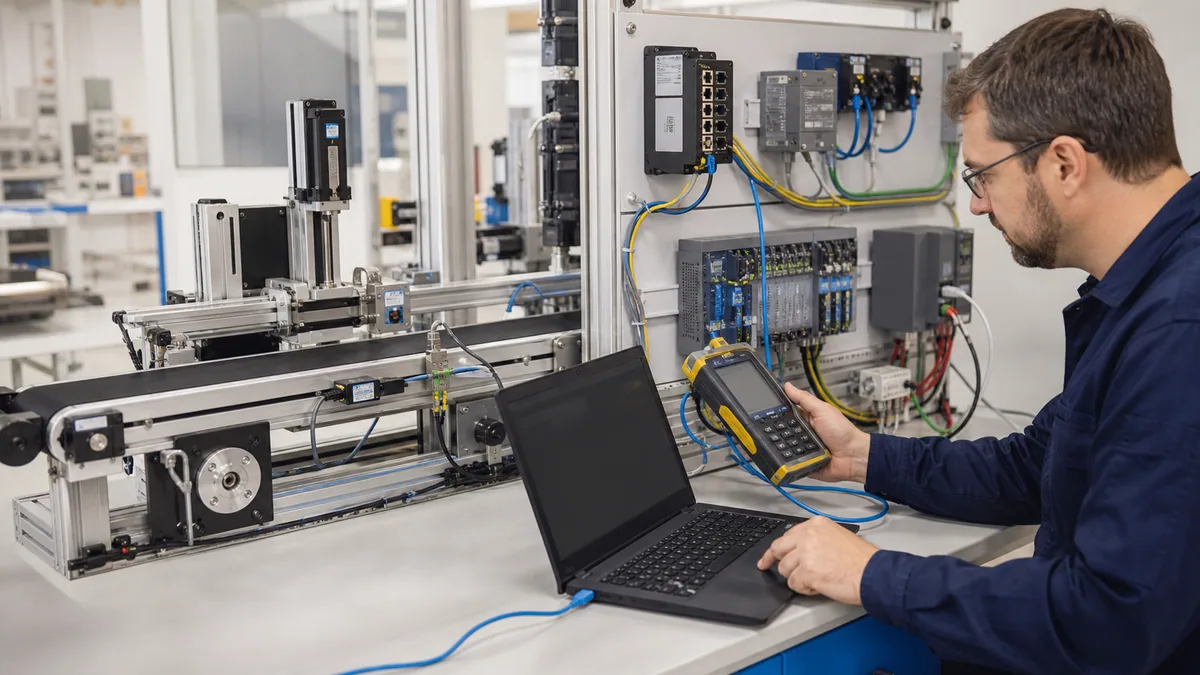
Use the comparison below as a requirements checklist. Before purchasing, obtain current device manuals and quotations, build a representative network, then retain packet captures, topology exports, controller-task traces and fault-recovery results.
Need implementation detail? Read the EtherCAT protocol tutorial or the PROFINET programming guide, then confirm every option against the selected vendor release.
Quick Overview: EtherCAT vs PROFINET at a Glance
| Feature | EtherCAT | PROFINET |
|---|---|---|
| Stewardship | EtherCAT Technology Group; technology introduced by Beckhoff | PROFIBUS & PROFINET International |
| Communication Architecture | Processing on the fly (pass-through) | Switched Ethernet (star/ring) |
| Real-time options | Cyclic EtherCAT process-data exchange; Distributed Clocks where supported | RT in all established conformance classes; IRT in Conformance Class C |
| Synchronization | Distributed Clocks, dependent on device support and configuration | IRT/distributed synchronization, dependent on device conformance and configuration |
| Topology | Line, tree, star and ring variants depending on couplers/devices | Line, star, tree and ring variants depending on integrated ports and switches |
| Engineering input | ESI files, master configuration, working-counter and clock diagnostics | GSDML files, controller/device configuration, topology and diagnostic records |
| Cost evidence | Quote every controller, interface, coupler, cable, license and spare | Quote every controller, interface, switch, cable, license and spare |
| Selection rule | Prefer when the tested EtherCAT stack and device set meet the motion/I/O budget and support requirements | Prefer when the tested PROFINET stack and device set meet the plant architecture, diagnostic and support requirements |
Chapter 1: Understanding EtherCAT Architecture
What is EtherCAT and How Does It Work?
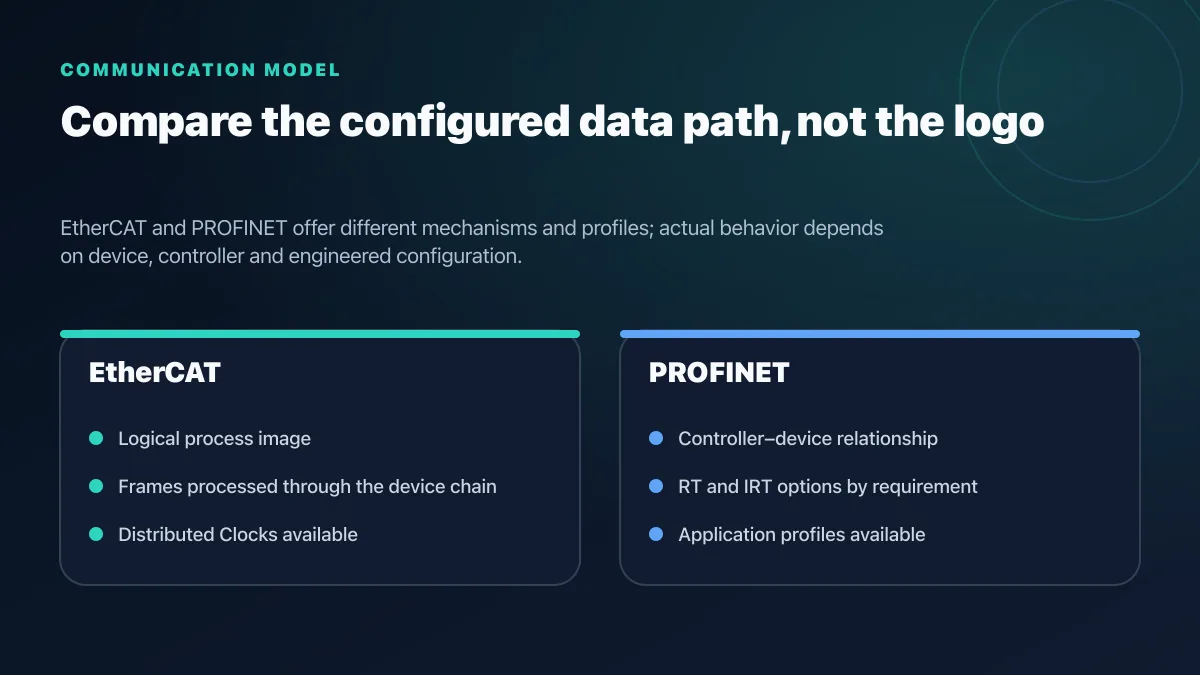
EtherCAT (Ethernet for Control Automation Technology) was introduced by Beckhoff and is maintained through the EtherCAT Technology Group. In its cyclic process-data path, EtherCAT SubDevices read and insert mapped data while a frame passes through the segment instead of each device forwarding a separate application frame.
Processing on the Fly: The Core Innovation
The MainDevice sends an Ethernet telegram that passes through the SubDevices in sequence. Each EtherCAT SubDevice Controller reads relevant output data and inserts input data as the frame passes. The final device returns the frame toward the MainDevice over the full-duplex path.
This on-the-fly hardware path avoids a conventional store-and-forward step at every SubDevice. Its contribution to complete-system latency must still be measured with the selected master, devices, payload and controller task.
Daisy-Chain Topology Simplicity
EtherCAT commonly uses a line topology in which two-port devices pass the frame to the next node. Branches, stars and rings can be created with suitable devices or junctions. Do not assume that “no external switch” means lowest installed cost: price the required ports, junctions, redundancy components, cable routes, diagnostics and spares for the actual layout.
Master-Slave Communication Model
EtherCAT uses a MainDevice/SubDevice model in current ETG terminology. The MainDevice initiates EtherCAT frames, while SubDevices read and insert mapped process data as frames pass. The achievable update interval depends on payload, topology, device implementation, controller task, master stack and other configured traffic; record it on the target system rather than copying a generic interval.
Key EtherCAT Technical Advantages
Predictable process-data path
ETG describes EtherCAT process data as being handled on the fly in hardware. That architecture can support short, predictable exchanges, but a protocol-level example is not a guarantee for a complete controller, drive and application. Measure the loaded network cycle, controller-task execution, application-to-output latency and missed-cycle behavior with the intended node list and payload.
Distributed Clocks Synchronization
Distributed Clocks synchronize participating device clocks and compensate for propagation delay. ETG's technology description reports system jitter significantly below one microsecond under its stated conditions, but the result depends on the devices and design. Confirm support in every participating device and capture actual clock-offset and following-error evidence for the representative motion profile.
Bandwidth Efficiency Excellence
ETG explains that one EtherCAT frame can carry process data for multiple nodes, limiting repeated per-device frame overhead. Payload efficiency still changes with the mapped data, mailbox traffic, topology and frame construction. Export the actual process image and record cyclic bandwidth and diagnostic traffic rather than transferring a brochure example to a different network.
Flexible Topology Options
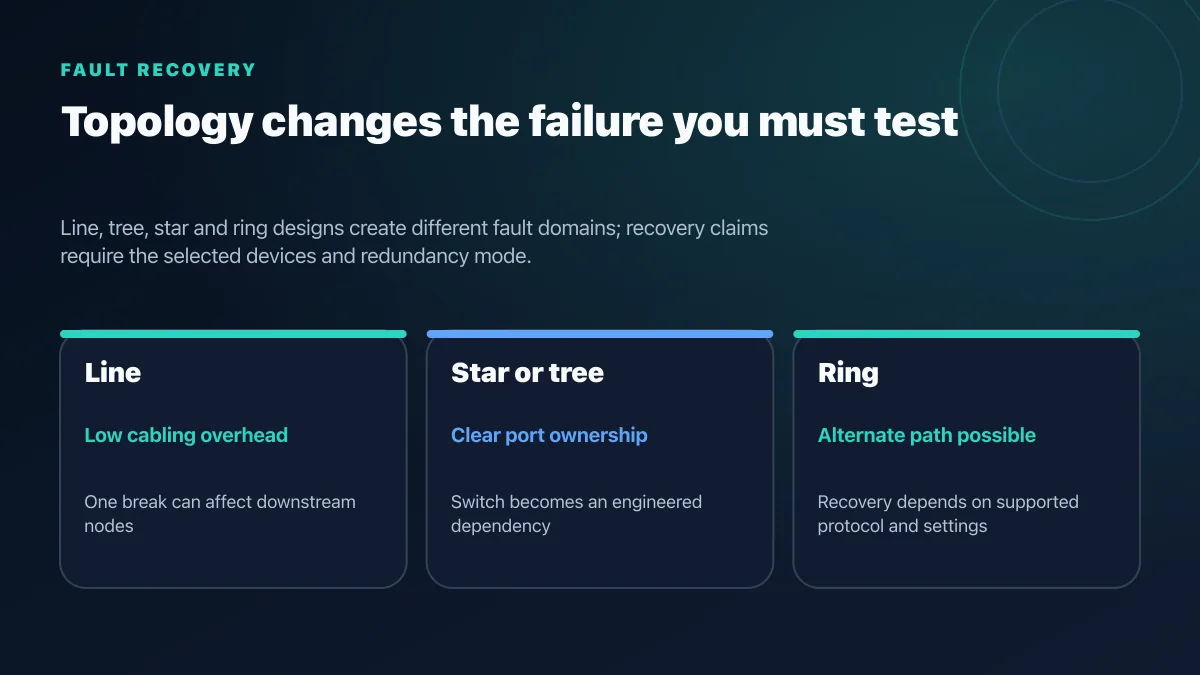
EtherCAT supports line, tree, star and ring arrangements through compatible ports and junctions. Cable redundancy and Hot Connect are optional design features with device, master and configuration prerequisites. Test each intended cable-break, power-loss, missing-station and reconnection case; document which outputs remain controlled and whether operator action is required.
Cost-Effective Implementation
EtherCAT uses Ethernet physical-layer variants, while connector, cable, shielding and environmental requirements remain device-specific. A line may avoid separate switches, yet still require extra ports, couplers or redundancy equipment. Compare current quotes and lifecycle availability for complete bills of material; the presence of multiple component suppliers does not by itself prove price or remove product-level dependencies.
Chapter 2: Understanding PROFINET Architecture
What is PROFINET and How Does It Work?
PROFINET (Process Field Network) represents the industrial Ethernet standard developed by PROFIBUS & PROFINET International (PI) for factory and process automation. PROFINET combines proven PROFIBUS engineering concepts with standard IEEE 802.3 Ethernet technology enhanced with real-time communication channels that deliver deterministic performance without sacrificing Ethernet's IT integration capabilities.
Three-Channel Communication Architecture
PROFINET implements a sophisticated multi-channel approach where different communication types share the same physical network infrastructure while maintaining appropriate performance characteristics:
-
TCP/IP Channel: Handles non-real-time communication including device configuration, parameter management, diagnostics, web server access, and engineering functions using standard IT protocols
-
Real-Time (RT) Channel: Provides cyclic real-time data exchange for automation traffic. The configured and achieved update time is product- and network-specific.
-
Isochronous Real-Time (IRT) Channel: Adds synchronized, scheduled communication for demanding applications. PI identifies IRT with Conformance Class C and states that it supports jitter below one microsecond; confirm the exact device and engineering-tool support.
Switched Ethernet Infrastructure
PROFINET networks can use integrated device ports and external switches to create line, star, tree or ring topologies. The requirements for RT, IRT, redundancy and diagnostics depend on each device's conformance class and supported functions. Build the topology from the vendor manuals, then include every required switch and license in the quoted bill of materials.
IO-Controller and IO-Device Model
PROFINET implements a provider-consumer communication model where IO-Controllers (typically PLCs) manage network communication and exchange cyclic data with IO-Devices (field devices, drives, I/O modules). Controllers establish connections to devices, configure communication parameters, exchange process data, and monitor diagnostic information using standardized device profiles.
Key PROFINET Technical Advantages
IT Integration and Enterprise Connectivity
PROFINET uses IEEE 802.3 Ethernet and supports non-real-time services alongside cyclic automation traffic. Routed IT integration, embedded web diagnostics, and OPC UA are product-specific capabilities rather than properties of every PROFINET device. Define security zones and data interfaces separately from the real-time I/O network.
Comprehensive Device Ecosystem
PI maintains product, profile and certification resources for PROFINET devices. Availability is category-, region- and release-specific, so search the current PI product resources and obtain written compatibility confirmation for every shortlisted controller, device, profile and optional feature. An organization membership count or installed-node total would not prove that the required device is available or interoperable.
Advanced Diagnostic Capabilities
PROFINET supports standardized diagnostics and topology functions, with the exact feature set governed by conformance class and device implementation. During evaluation, disconnect one device, introduce a duplicate name/address where safely possible, break a ring path and replace a device; record what the controller, HMI and engineering station report and which replacement steps are actually tool-free.
PROFIsafe Functional Safety
PROFIsafe is an application profile for safety communication over a black channel. The achievable SIL or PL belongs to the complete certified safety function and its validated architecture, not to the cable or protocol name alone. Verify compatible safety devices, certificates, safety manuals, watchdog settings, response-time calculation, signatures, and proof tests.
Siemens Ecosystem Integration
PROFINET is integrated across Siemens SIMATIC controllers, TIA Portal and SCALANCE products. Organizations already using that stack may value a unified engineering path, but the benefit is installation-specific. Time a repeatable device-import, commissioning, fault-localization, replacement and backup/restore task on each shortlist rather than assuming an engineering saving.
Chapter 3: Head-to-Head Technical Comparison
Performance and Cycle Time Analysis
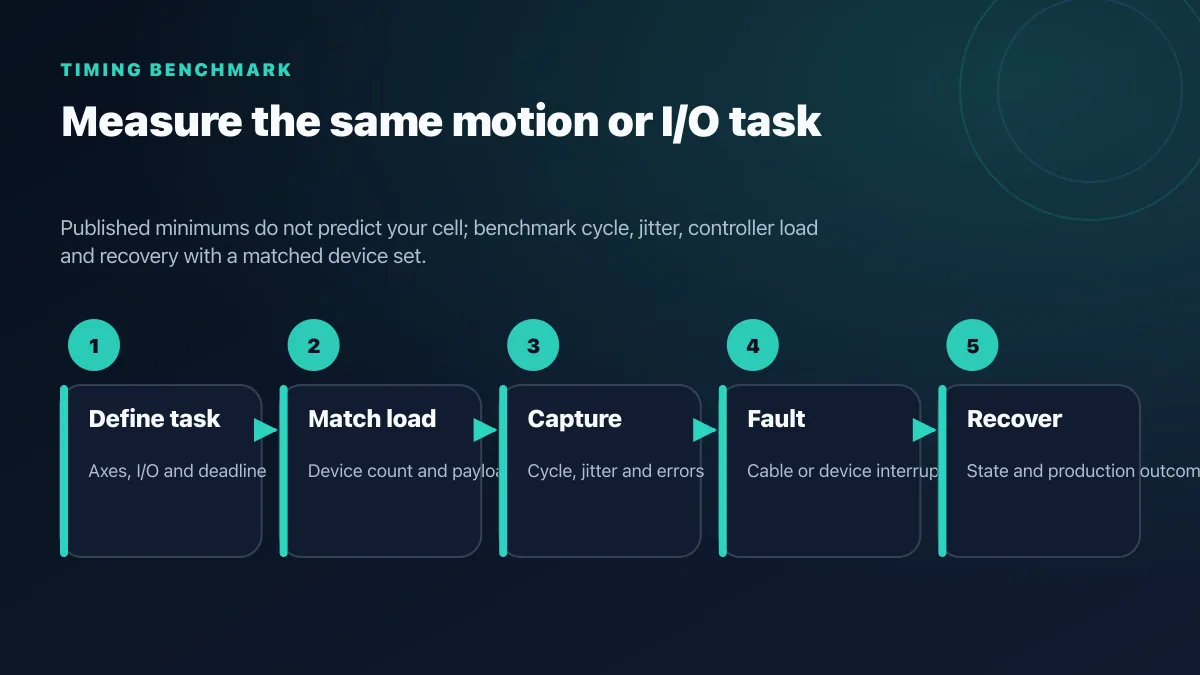
Protocol marketing examples cannot establish the cycle time of a complete machine. Define the maximum allowable application-to-output latency, synchronization error, missed-update behavior and recovery time before comparing products. Include controller task execution and drive response, not only wire time.
| Benchmark step | Keep constant | Evidence to capture |
|---|---|---|
| Baseline cyclic load | Same I/O bytes, node functions and controller task | Configured update interval, observed min/max and missed updates |
| Motion profile | Same axis count, interpolation and command profile | Clock offset, following error and command-to-feedback trace |
| Acyclic load | Same diagnostics, parameter reads and engineering traffic | Cyclic jitter and alarm latency during the load |
| Fault test | Same cable break, device loss and restart cases | Detection, output response, recovery sequence and operator messages |
| Expansion case | Same added devices and payload | Revised resource use and timing margin |
ETG documents processing on the fly and Distributed Clocks; PI documents RT and IRT conformance classes. Those architectural facts help explain test results, but do not replace them. A valid verdict states the exact hardware, firmware, topology, payload, task configuration and measurement method.
Topology and Infrastructure Comparison
Both technologies can support several physical layouts, subject to the selected ports, couplers, switches and redundancy features. Draw the actual cabinet and field cable routes first. Then validate hop/segment limits, environmental ratings, shielding, connector rules and fiber transitions from the exact device manuals.
Use a quote-backed infrastructure worksheet:
| Cost line | EtherCAT evidence | PROFINET evidence |
|---|---|---|
| Controller/network interface | Current SKU, license and support quote | Current SKU, license and support quote |
| Topology components | Ports, junctions and redundancy components | Integrated ports, switches and redundancy components |
| Cabling | Measured route, connector and installation specification | Measured route, connector and installation specification |
| Commissioning | Timed build, configuration and diagnostic exercise | Timed build, configuration and diagnostic exercise |
| Spares/lifecycle | Approved spare list and availability confirmation | Approved spare list and availability confirmation |
| Fault recovery | Witnessed cable/device failure test | Witnessed cable/device failure test |
Do not label either protocol “cheaper” until the same functional scope, support term, redundancy target and regional quote date are included.
Synchronization and Motion Control Comparison
EtherCAT Distributed Clocks and PROFINET IRT both provide synchronized execution mechanisms. Their configuration models and hardware prerequisites differ, and neither protocol name alone establishes application accuracy. Drive loop rate, mechanics, interpolation, controller task, sensor timing and tuning can dominate the result.
Run the same motion proof on each shortlist:
- Declare the allowed position, velocity and registration error.
- Use the same axes, payload, trajectory and disturbance.
- Add representative I/O, diagnostic and engineering traffic.
- Record clock offset, following error, controller execution and network diagnostics.
- Remove a device or link in an approved test state and verify the commanded safe response.
- Repeat after power cycle and configuration restore.
Choose the implementation that passes the requirement with documented margin and an acceptable support/lifecycle plan. Do not infer suitability from axis count, industry label or a vendor's best-case timing example.
Device Ecosystem and Vendor Support Comparison
Both ETG and PI operate conformance and device ecosystems. Membership, node totals and broad vendor lists are weak purchasing evidence because they do not confirm the feature, certification, firmware, region or delivery date you need.
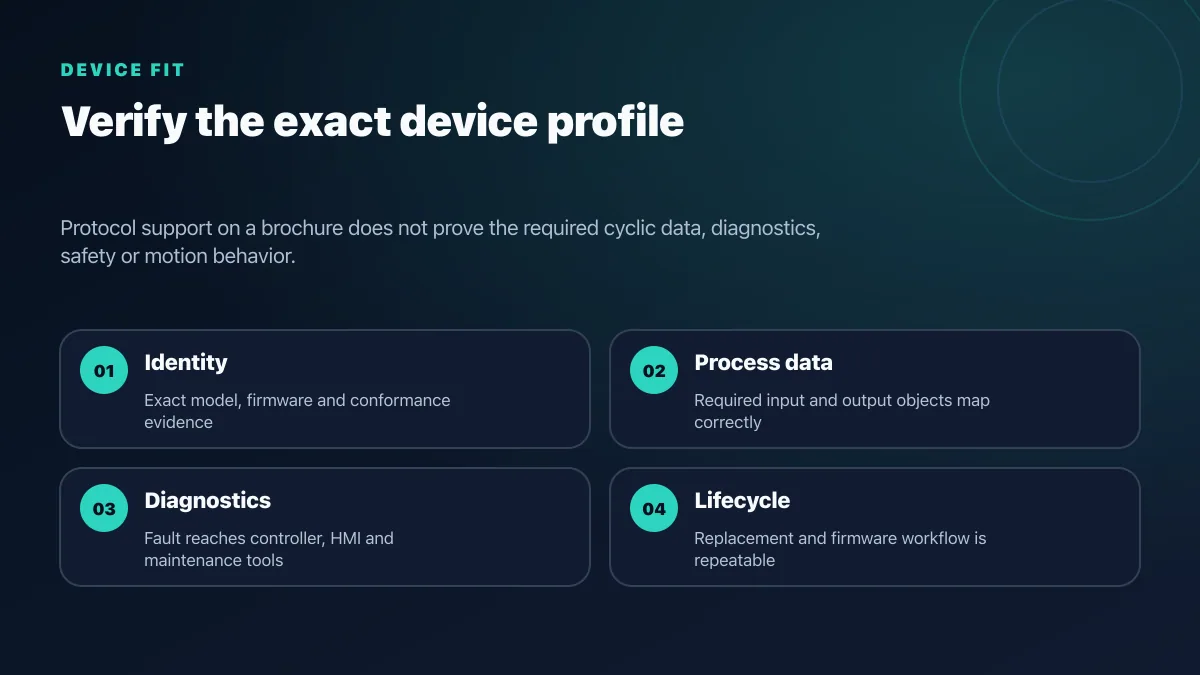
Build a product-level compatibility matrix instead:
| Requirement | Evidence required |
|---|---|
| Controller and engineering release | Supported-version matrix and lifecycle statement |
| Drive/profile support | Exact option code, profile/conformance record and tested function list |
| Safety communication | Applicable certificate, safety manual and validated architecture |
| Diagnostics and replacement | Witnessed fault/replacement test with saved messages |
| Regional service | Named support route, response terms and local spare availability |
| Multi-vendor interoperability | Configuration files, certification record and integration test |
“Multi-vendor” also does not mean “no lock-in.” Record dependencies on engineering software, motion libraries, safety signatures, configuration formats, special hardware and trained support staff.
Total Cost of Ownership Breakdown
The earlier version of this guide used generic cable, switch, gateway and software prices. Those figures were not tied to a region, quotation date or common functional scope and have been removed.
Software and Licensing Costs
Request a dated written quote for the exact controller, engineering seat, runtime, motion, safety, redundancy, diagnostic and support options. Include upgrade rights, virtual-machine use, floating-seat rules, backup activation, vendor training and the licenses needed by maintenance staff. Open-source components can remove a license fee while increasing validation, integration or internal-support work; commercial bundles can include tools that otherwise appear as separate line items.
Calculate total cost from evidence, not protocol stereotypes:
TCO = quoted hardware + quoted software/support + installation labor + measured engineering labor + training + validated spares + planned lifecycle changes
Keep assumptions identical for both candidates and run sensitivity cases for expansion, a failed controller and an engineering-laptop replacement.
Live mini-lab
Try it: press START, then STOP
A stop-dominant seal-in rung: START latches the motor output through its own contact, and STOP breaks the circuit.
Watch the output lamp: it stays on after START until you press STOP.
Free to start · runs in your browserOpens plcsimulationsoftware.com — same team
Chapter 5: Learning Curve and Skill Development
Technical Complexity Comparison
EtherCAT Learning Requirements:
Unique Concepts to Master:
- Processing-on-the-fly architecture understanding
- Distributed Clocks configuration and synchronization theory
- Mailbox communication protocols (CoE, SoE, FoE, AoE)
- Network topology design without switches
- ESI (EtherCAT Slave Information) file interpretation
- Working counter diagnostics and frame analysis
Training Resources Available:
- Beckhoff official training (comprehensive but Beckhoff-focused)
- ETG training events and webinars
- Third-party online courses (moderate availability)
- Open-source community documentation
- Limited formal certification programs
PROFINET Learning Requirements:
Unique Concepts to Master:
- RT/IRT communication types and application selection
- Ethernet switching fundamentals and VLAN configuration
- IO-Controller/IO-Device relationship model
- GSD (General Station Description) file usage
- IRT path configuration and topology constraints (for motion applications)
- Advanced diagnostics and PROFIsafe configuration
Training Resources Available:
- Siemens extensive official training (comprehensive and globally available)
- PI organization training events and certification programs
- Numerous third-party courses and online resources
- University curriculum integration (strong presence)
- Multiple certification paths (PI Competence Center certifications)
Learning Curve Test: Do not use a generic hours-to-proficiency estimate. Give the same engineer a small acceptance task on each shortlisted stack: import a device, map I/O, commission cyclic exchange, diagnose a removed node, restore a replacement and export a support bundle. Record completion time, errors, documentation gaps and help required. Repeat with the people who will actually maintain the system.
Industry Skill Availability
The previous version quoted job-posting and salary totals without a reproducible dataset. They have been removed. For a project decision, inventory named employees, integrators, distributors and vendor support contacts who can commission and troubleshoot the exact stack in the installation region. Ask each one to demonstrate a fault-recovery task, not merely list a protocol on a résumé.
Skill Development Investment Recommendations:
For Employers:
- Large enterprises: Standardize on primary protocol aligned with vendor strategy; invest in comprehensive training
- System integrators: Develop capability in both protocols to serve diverse customer bases
- Machine builders: Choose protocol based on target market and application requirements
- Startups: Consider EtherCAT for motion-intensive applications or PROFINET for process/factory automation
For Automation Professionals:
- Develop proficiency in protocol dominant in your industry sector
- Motion control specialists: Prioritize EtherCAT expertise
- Process automation engineers: Prioritize PROFINET skills
- Career flexibility: Gain working knowledge of both protocols over time
Chapter 6: When to Choose EtherCAT
Ideal EtherCAT Applications and Use Cases
High-Speed Motion Control Systems:
EtherCAT is a candidate for applications that require synchronized motion or tightly controlled I/O exchange, provided the selected implementation passes the application benchmark:
Packaging Machinery:
- High-speed form-fill-seal equipment with a measured registration and cycle budget
- Multi-lane packaging with coordinated product handling across parallel lines
- Electronic camming for complex product motion profiles
- Flying shear cutting with sub-millimeter accuracy at high speeds
- Servo-driven wrapping and labeling with registration control
CNC Machine Tools:
- Multi-axis machining centers with simultaneous interpolation
- High-speed milling with a controller-and-drive timing requirement
- Thread milling and gear hobbing with spindle synchronization
- Laser cutting and processing with coordinated beam control
- EDM (electrical discharge machining) with precision positioning
Robotics Applications:
- Industrial robots with coordinated axes requiring smooth trajectories
- Collaborative robots (cobots) with force control and safety monitoring
- Delta robots for high-speed pick-and-place operations
- Gantry systems with coordinated multi-axis motion over large workspaces
- Mobile robotics with real-time navigation and control
Semiconductor Manufacturing:
- Wafer handling systems with precision positioning and vacuum control
- Lithography equipment with stringent, measured positioning requirements
- Deposition systems with synchronized process control
- Inspection and metrology equipment with coordinated scanning
- Automated test equipment with high-speed switching and measurement
Distributed I/O Applications:
EtherCAT's line topology can reduce the number of separate switches in some layouts, but a quote-backed bill of materials is required:
Large-Scale Manufacturing Facilities:
- Factory-wide I/O distribution with an explicit topology and support plan
- Material handling systems with distributed field I/O
- Building automation with distributed sensors and actuators
- Process monitoring with a large, documented process image
- Environmental control systems across multiple zones
Machine Builder OEM Applications:
Machine builders can evaluate EtherCAT against these product-level criteria:
Key OEM Advantages:
- Bill of materials from the actual port, coupler, switch and cable design
- Simplified machine assembly with daisy-chain wiring
- Motion benchmark results that support the machine specification
- Availability of qualified alternatives for each critical component
EtherCAT Strategic Advantages
Technology Independence:
EtherCAT's open standard managed by the EtherCAT Technology Group (ETG) rather than single vendor ownership provides strategic benefits:
- Multiple master and device options, subject to product-level compatibility
- Multiple master implementations from various vendors
- Current quote comparison across qualified devices
- Published lifecycle statements for the selected products
- Ability to mix tested devices from multiple manufacturers
Performance Headroom for Future Requirements:
An EtherCAT implementation may provide expansion margin when the baseline measurements show unused controller, network and timing capacity:
- Model and test the planned axis or I/O expansion
- Reserve measured controller, process-image and network capacity
- Re-run regression tests after product or firmware changes
- Record lifecycle and migration dependencies rather than claiming “future proof”
Simplified System Architecture:
Line topology can remove a separate switching layer, while also making some downstream devices dependent on upstream ports or power. Validate:
- The complete component and failure-mode list
- Physical tracing and topology documentation
- Commissioning steps for ports, junctions and redundancy
- Fault localization for an upstream power or cable loss
- The approved spare list
Chapter 7: When to Choose PROFINET
Ideal PROFINET Applications and Use Cases
Process Automation and Control:
PROFINET is a candidate for process and factory systems where the selected device profiles, diagnostics and engineering ecosystem fit the plant standard:
Chemical Processing Plants:
- Distributed process control with thousands of I/O points
- Integration of process instrumentation from multiple vendors
- Batch control systems with recipe management
- Safety systems using PROFIsafe for SIL 3 requirements
- Asset management and predictive maintenance integration
Water and Wastewater Treatment:
- Remote monitoring and control across distributed facilities
- Integration of diverse instrumentation and analyzers
- SCADA system connectivity for centralized management
- Regulatory compliance with comprehensive diagnostics
- Long-term system lifecycle support requirements
Oil and Gas Production:
- Harsh environment installations requiring robust diagnostics
- Integration with process safety systems
- Remote monitoring and control capabilities
- Industry-standard device profiles ensuring interoperability
- Product-specific security functions and an independently engineered zone-and-conduit design
Power Generation and Distribution:
- Substation automation with IEC 61850 integration
- Coordinated control across generating units
- Grid synchronization and power quality monitoring
- Redundant communication for high-availability requirements
- Standards compliance for utility sector requirements
Factory Automation with Siemens Ecosystems:
Organizations standardized on Siemens automation platforms can evaluate PROFINET's integrated engineering path:
Automotive Manufacturing:
- Assembly line automation with mixed I/O and motion requirements
- Integration with MES (Manufacturing Execution Systems)
- Body shop robotic welding coordination
- Paint shop process control
- Final assembly with quality tracking systems
Food and Beverage Production:
- Hygienic design equipment with IP69K ratings
- Recipe-based batch processing
- Traceability and quality documentation systems
- Integration with ERP for production planning
- User-defined validation and data-integrity documentation requirements
Pharmaceutical Manufacturing:
- GMP-compliant validation documentation
- Electronic batch records and audit trails
- Clean room environmental monitoring
- Serialization and track-and-trace systems
- Reporting and records required by the regulated user's intended use
PROFINET Strategic Advantages
Comprehensive Siemens Ecosystem Integration:
Organizations invested in Siemens automation infrastructure gain substantial benefits:
TIA Portal Engineering Environment:
- Unified programming for PLCs, HMIs, drives, and safety systems
- Integrated diagnostics across all automation components
- Simulation and virtual commissioning capabilities
- Library management for reusable components
- Consistent engineering approach across all projects
Higher-level integration:
- Confirm the exact controller/HMI OPC UA roles and licenses
- Define the MES interface and semantic model
- Validate certificate, account and network-zone handling
- Load-test the intended historian and reporting traffic
- Retain a restore and credential-rotation procedure
Global Support Infrastructure:
Support availability is local and product-specific. Obtain named vendor/distributor contacts, response terms, escalation routes, spare lead times, current training availability and lifecycle notices for the selected components. Do not substitute a global office count for a service-level commitment.
IT/OT Convergence Readiness:
PROFINET's standard Ethernet foundation and TCP/IP support facilitate modern manufacturing connectivity:
- Defined integration with routed enterprise networks
- Product-specific cybersecurity functions and secure configuration
- Time-Sensitive Networking (TSN) for converged networks
- Approved northbound connectivity through the plant's security architecture
- Product-specific semantic interfaces and data models where required
Regulatory and Standards Compliance:
Check standards and certifications at the product and application level:
- IEC 61158/61784 international standardization
- PROFIsafe functional safety certification (SIL 3/PLe)
- Validation documentation required by the regulated user
- Applicable industry device profiles
- Product or development-process cybersecurity certificates, with their exact scope
Chapter 8: Can EtherCAT and PROFINET Coexist?
Multi-Protocol System Architecture
Modern automation systems increasingly implement multiple industrial Ethernet protocols to leverage the specific advantages of each technology. Understanding how to design and implement multi-protocol architectures enables optimal solutions that aren't constrained by single-protocol limitations.
Gateway-Based Integration Approaches:
EtherCAT-PROFINET Gateways:
Protocol gateways enable bidirectional communication between EtherCAT and PROFINET networks:
Gateway Functionality:
- Translate cyclic process data between protocols with configurable mapping
- Convert diagnostic information to protocol-specific formats
- Handle acyclic communication for device configuration
- Synchronize communication timing between networks (with limitations)
- Provide buffering to accommodate cycle time differences
Gateway acceptance evidence:
- Exact cyclic and acyclic data capacity for the selected model
- Measured update and end-to-end latency under representative load
- Version-controlled mapping tables and byte-order/type conventions
- Current hardware, license, support and spare quote
- Behavior on stale data, device loss, gateway restart and partial network recovery
Gateway Application Examples:
Mixed Vendor Automation:
- Siemens S7-1500 PLC with PROFINET controlling EtherCAT servo drives and I/O
- Beckhoff TwinCAT controlling EtherCAT motion with PROFINET process I/O
- Integration of PROFINET process instrumentation into EtherCAT-based packaging machinery
- Connecting EtherCAT robotic systems to PROFINET factory automation networks
Practical Limitations:
- Gateways add cost, complexity, and failure modes to systems
- Synchronization precision degrades when crossing protocol boundaries
- Diagnostic information may not fully translate between protocols
- Configuration requires expertise in both protocols
- End-to-end performance depends on both network schedules, the gateway scan, payload, controller tasks and buffering policy
System Design Strategies for Mixed Protocols
Segmented Architecture Approach:
Design systems with clear functional boundaries between protocol domains:
Process Control Segment (PROFINET):
- Process instrumentation and analog control loops
- Integration with plant-wide SCADA and MES systems
- Batch control and recipe management functions
- Safety systems using PROFIsafe
- IT connectivity and enterprise integration
Motion Control Segment (EtherCAT):
- High-speed servo axes with coordinated motion
- Robotic systems with precise synchronization
- Packaging mechanisms with electronic camming
- Material handling with synchronized conveyor control
- CNC functionality with multi-axis interpolation
Interface Definition:
- Limit data exchange between segments to high-level commands and status
- Avoid real-time synchronization requirements across protocol boundaries
- Use gateway for command/status interface between segments
- Design for graceful degradation if inter-protocol communication fails
Practical Implementation Example:
Automated Packaging Line:
- PROFINET Network: Upstream product preparation, downstream case packing, palletizing, plant-level integration to MES/ERP systems
- EtherCAT Network: Form-fill-seal machine motion domain with electronic camming and flying product placement
- Gateway Interface: Product count commands, speed references, stop/start signals, alarm status
- Acceptance result: Each domain and the interface pass their separate timing, stale-data and recovery tests
When Multi-Protocol Architecture Makes Sense
Valid Multi-Protocol Scenarios:
Gradual System Migration:
- Expanding existing PROFINET installation with new EtherCAT motion equipment
- Adding PROFINET process control to established EtherCAT machine platform
- Phased technology transition over multiple years
Vendor Technology Mandates:
- OEM packaging machine with EtherCAT integrating into customer PROFINET factory
- Siemens PROFINET plant adding specialized EtherCAT equipment
- Best-of-breed component selection across protocol boundaries
Functional Optimization:
- Leveraging EtherCAT motion performance where critical
- Utilizing PROFINET ecosystem for process control and IT integration
- Matching protocol capabilities to specific application requirements
Multi-Protocol Cost-Benefit Analysis:
Additional Costs:
- Quoted gateway hardware, licenses, support and spares
- Measured engineering and validation effort
- Maintenance and troubleshooting: Ongoing complexity cost
- Spare parts inventory: Stocking for multiple protocol devices
Potential Benefits:
- A tested implementation for each functional domain
- Access to qualified components from more than one vendor where demonstrated
- Existing investment preservation: Avoid forklift upgrades
- A documented migration boundary for future changes
Recommendation: Multi-protocol architecture should be exception rather than default. Standardize on single protocol when possible, using multi-protocol approaches only when specific benefits clearly justify additional complexity.
Chapter 9: Regional and Industry Evidence
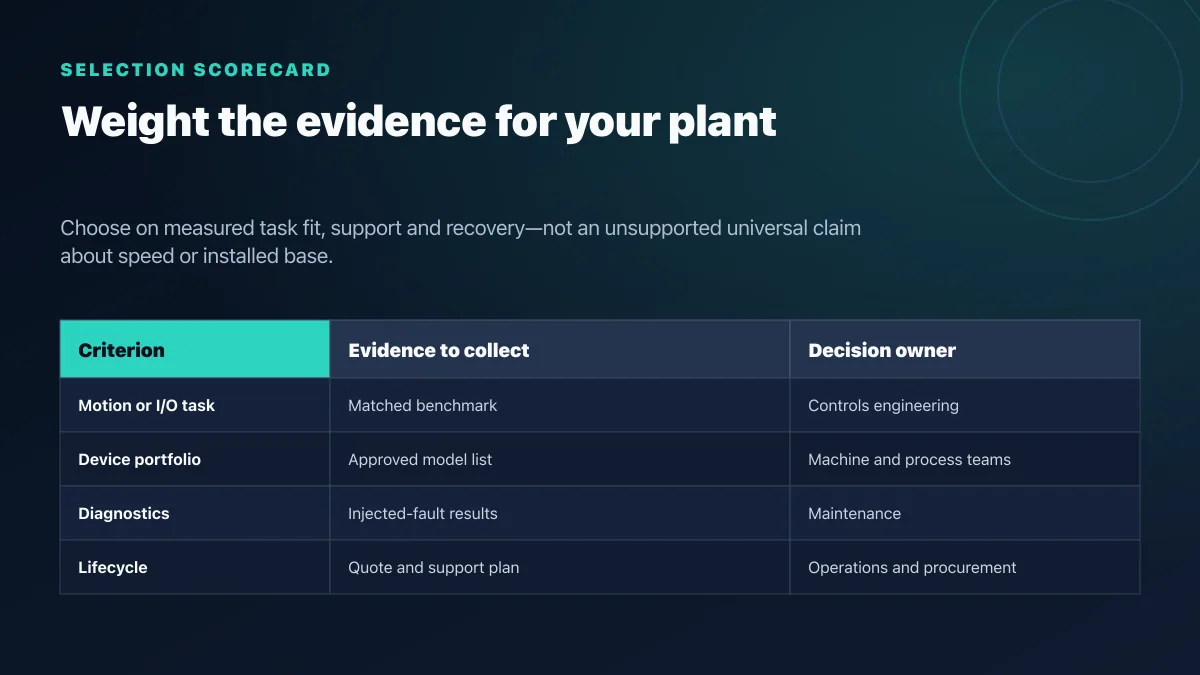
The earlier version listed regional market share, industry adoption and growth-rate estimates without a defined dataset or reproducible calculation. Those estimates have been removed. Market popularity is also a poor proxy for project fit.
Collect local evidence that changes the decision:
- Which exact controllers, drives, safety devices and instruments are stocked in the installation region?
- Which qualified integrators can demonstrate the required motion, diagnostic and recovery functions?
- Does the customer or site have an approved network standard?
- Which configuration files, licenses and replacement parts must be retained?
- What do the current lifecycle notices and support agreements say?
If market-share data is used for a strategic report, record the publisher, measurement method, geography, protocol categories, collection period and whether the figures count newly connected nodes, installed nodes, revenue or survey responses. Do not combine incompatible studies or convert association membership into installed share.
Frequently Asked Questions: EtherCAT vs PROFINET
Which is faster, EtherCAT or PROFINET?
EtherCAT's on-the-fly architecture and PROFINET IRT's scheduled communication take different approaches. A universal number would ignore node count, payload, controller task, device implementation and topology. Treat this as a matched benchmark: test both shortlisted systems against the same application-to-output latency, jitter and fault-load requirement.
Does EtherCAT or PROFINET cost more to implement?
There is no protocol-wide price answer. EtherCAT can avoid separate switches in a line; PROFINET devices may have integrated ports, while some designs require external switches. Compare dated quotes for an identical functional scope and add licenses, installation, engineering, validation, support, spares and lifecycle changes.
Which protocol has better synchronization: EtherCAT or PROFINET?
EtherCAT Distributed Clocks and PROFINET IRT both support synchronized actions, with different prerequisites and engineering models. Compare measured clock offset and following error on the intended devices and motion profile. Do not turn association-published best cases into a fixed multiplier between complete systems.
Can I use standard Ethernet switches with EtherCAT or PROFINET?
An EtherCAT MainDevice normally connects into an EtherCAT segment whose SubDevices process the frame; suitable junction devices provide branches. PROFINET switch and port requirements depend on the device conformance class, topology, redundancy and IRT design. Use only components the selected product manuals approve for the intended function and environment.
Which protocol is better for motion control applications?
Both can support motion when the controller, drives and engineering stack implement the required functions. EtherCAT is often shortlisted for its frame-processing and Distributed Clocks model; PROFINET IRT is often shortlisted where the plant or controller ecosystem already uses PROFINET. Choose from a witnessed trajectory, fault and recovery benchmark.
Is PROFINET more widely supported than EtherCAT?
Both have multi-vendor ecosystems. Organization membership and installed-node totals do not answer whether a specific certified drive, safety option or instrument is available locally. Check the current product directories, exact certificates, distributor stock and supported-version matrix.
Which protocol is easier to learn: EtherCAT or PROFINET?
It depends on the engineering environment and the learner's background. Time the same import, mapping, commissioning, diagnostic and restore exercise on each stack with the people who will support it. Record errors and help required instead of relying on a generic training-hours estimate.
Can EtherCAT and PROFINET work together in the same system?
Yes, a gateway or controller with both interfaces can exchange mapped data between domains. The selected product determines capacity, type handling, diagnostics and latency. Test stale data, byte order, gateway restart, loss of either network and recovery before treating the bridge as production-ready.
Which protocol should I choose for process automation?
Start with the plant standard, required instrument/profile list, controller ecosystem, redundancy, diagnostics, safety and support model. PROFINET may be a strong fit in a PROFINET/SIMATIC plant; EtherCAT may fit a machine or controller platform that already uses it. Confirm device availability and run the same control, diagnostic and recovery tests.
What are the main advantages of EtherCAT over PROFINET?
EtherCAT's differentiators include processing frames on the fly, Distributed Clocks, flexible line/branch topologies and a multi-vendor ecosystem. Translate those architecture features into measured timing, topology, recovery and lifecycle evidence for the selected products.
What are the main advantages of PROFINET over EtherCAT?
PROFINET's differentiators include RT/IRT conformance classes, standardized diagnostics and profiles, switched-Ethernet topology options and deep integration in several automation ecosystems. Confirm the required profile, conformance class, engineering-tool function and local support on the exact products.
Does protocol choice affect PLC selection?
Yes. The controller must support the required protocol role, device profile, safety or motion option, and engineering release. Some controllers require a module, option, or separate licence. Confirm the exact supported-version matrix and prove device import, cyclic data, diagnostics, replacement, backup, and restore on the shortlisted platform.
Conclusion: Making the Right Protocol Choice for Your Application
The EtherCAT vs PROFINET decision requires application requirements, matched product evidence, local support, and lifecycle analysis. Neither protocol proves universally superior; the defensible choice is the implementation that passes the same measured task and recovery tests with acceptable margin.
Choose EtherCAT when:
- The tested controller/device set passes the motion and I/O timing budget
- Distributed Clocks and the chosen topology meet the synchronization and wiring requirements
- Current quotes show an acceptable complete cost
- Qualified devices, support and lifecycle paths are available
- Fault, restart and replacement tests pass
Choose PROFINET when:
- The required conformance class and device profiles are supported end to end
- The plant's controller, diagnostic and support ecosystem makes PROFINET the lower-risk fit
- The tested topology, cyclic load and any IRT motion meet the timing budget
- Qualified instruments, switches, safety options and spares are available
- Fault, restart and replacement tests pass
Consider multi-protocol architecture when:
- Existing installations dictate different protocol for new expansion requirements
- Functional optimization demands EtherCAT motion control plus PROFINET process integration
- OEM equipment specifications don't align with plant-standard protocol
- Specific benefits clearly justify additional gateway complexity and cost
Primary sources and review basis
- EtherCAT Technology Group: EtherCAT technology — on-the-fly processing, Distributed Clocks, and topology concepts.
- PROFINET: conformance classes FAQ — PROFINET RT/IRT and conformance-class framing.
- PROFIsafe technology overview — black-channel safety profile scope.
- PI product finder and ETG product guide — current product-level discovery; presence does not replace compatibility testing.
Association material describes each association's own technology. Product limits, certificates, timing, licences, and support remain release- and region-specific. This comparison was technically reviewed on 2026-07-25.
Both technologies have active multi-vendor ecosystems. Their architecture differences are useful only when translated into product-level evidence for the required devices, timing, faults, diagnostics, support, and lifecycle.
Invest time in comprehensive requirements analysis before committing to protocol selection. Consider not only immediate application needs but also future expansion requirements, organizational support capabilities, vendor ecosystem alignment, and career skill development implications. The protocol choice made today influences system performance, maintenance costs, and operational efficiency throughout the entire system lifecycle—making thorough evaluation essential for optimal long-term results.
Essential Industrial Ethernet Protocol Resources
Expand your industrial communication expertise with these comprehensive guides:
- EtherCAT Protocol Complete Tutorial - Deep dive into EtherCAT architecture, configuration, Distributed Clocks, and motion control implementation
- PROFINET Programming Tutorial - Comprehensive PROFINET configuration with TIA Portal, RT/IRT setup, and diagnostics
- SERCOS Protocol Tutorial - Alternative high-performance motion control protocol comparison and implementation
- PLC Communication Protocols Guide - Overview of all major industrial protocols including Modbus, DeviceNet, and CC-Link
- Industrial Control Systems Complete Guide - Comprehensive automation system design and integration strategies
Advance Your Industrial Automation Expertise
Ready to master both EtherCAT and PROFINET protocol implementation? Understanding multiple industrial Ethernet protocols positions you as a versatile automation professional capable of optimal technology selection and system integration across diverse applications and industries.
Continue developing your industrial communication expertise through hands-on experience with real hardware, advanced training courses specific to each protocol, and staying current with emerging technologies including Time-Sensitive Networking (TSN) and Industry 4.0 integration standards that are shaping the future of industrial automation communication in 2026 and beyond.
Now run it · free to start
Practise the PLC side of industrial networks
Compare EtherNet/IP, PROFINET, IO-Link and OPC UA by data flow and common commissioning failures, then practise the controller logic in your browser.
Ownership disclosure: PLC Programming IO and PLC Simulation Software are operated by the same publisher.


