NEMA Enclosure Ratings: Types, IP Guide & Selector
Choose a NEMA enclosure type from the actual environment—not a guessed IP equivalent. Compare Types 1, 3R, 4, 4X, 12 and 13, then check heat, corrosion, openings and installation details.
A NEMA enclosure rating describes the environmental conditions an enclosure is designed to resist. For most industrial control panels, the practical shortlist is Type 1 for clean indoor rooms, Type 12 for indoor dust and dripping non-corrosive liquids, Type 3R for outdoor rain, Type 4 for hose-directed water, and Type 4X when corrosion resistance is also required.
That answer is only the first filter. The enclosure, door hardware, gland plate, cable entries, cooling system and field modifications must preserve the required protection as an installed assembly.
Engineering boundary: This guide helps you prepare a specification. Final selection must follow the current project specification, applicable electrical code, authority having jurisdiction, manufacturer instructions and a documented environmental assessment.
Download the NEMA enclosure selection worksheet (CSV)
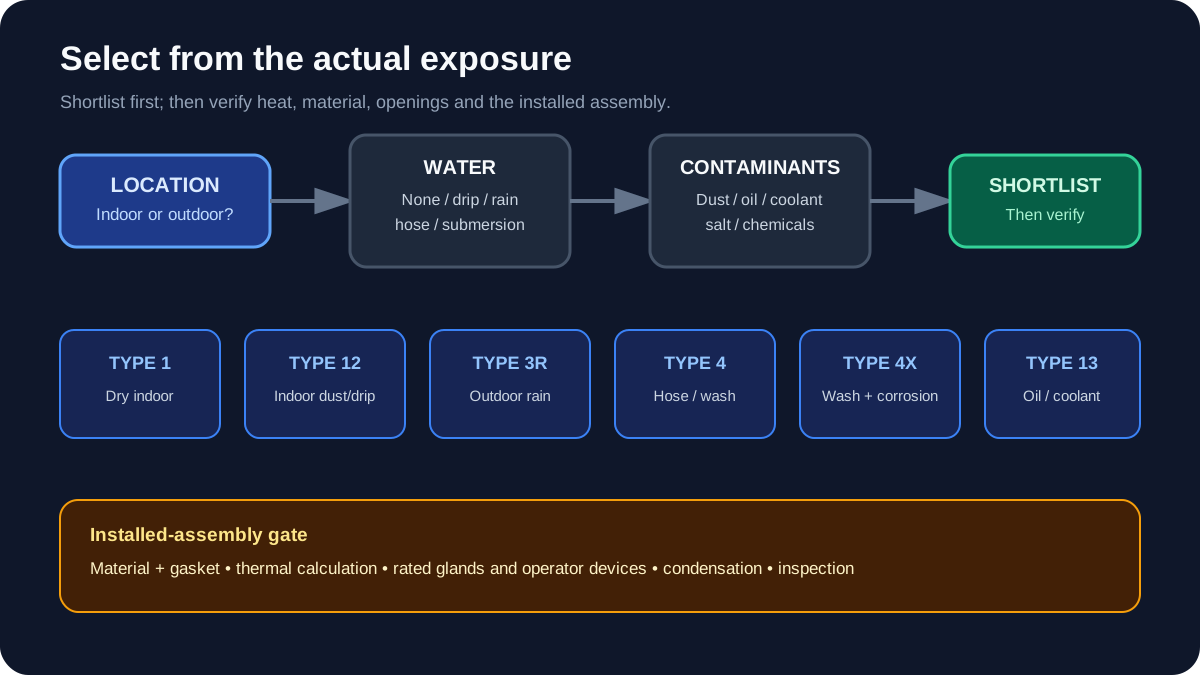
Quick NEMA enclosure selection table
| Environment | Practical starting point | Why | What can invalidate it |
|---|---|---|---|
| Clean, dry electrical room | Type 1 | Basic indoor contact and falling-dirt protection | Washdown, conductive dust, roof leaks |
| Indoor factory with dust and occasional drips | Type 12 | Common industrial control-panel choice | Hose cleaning, outdoor exposure, corrosive chemicals |
| Indoor machining area with oil or coolant seepage | Type 13 | Adds protection for oil/coolant conditions | High-pressure washdown or outdoor weather |
| Outdoor wall with rain, snow or sleet | Type 3R | Weather-oriented outdoor protection | Wind-blown dust requirement, hose cleaning, corrosion |
| Outdoor dusty area | Type 3 or project-specific variant | Weather plus wind-blown dust protection | Corrosion or washdown |
| Washdown area | Type 4 | Hose-directed water protection | Aggressive chemicals, salt or sanitation agents |
| Corrosive washdown, coastal or chemical area | Type 4X | Type 4 water protection plus corrosion provisions | Wrong material, incompatible gasket, damaged coating |
| Temporary or occasional submersion | Type 6 | Submersion condition must match the product rating | Continuous submersion or unapproved cable entries |
This is a shortlist, not a substitute for the full definition and tests in NEMA 250. NEMA's own enclosure FAQ directs designers to the standard for complete construction, testing, rating and marking requirements.
What each common rating means in a control-panel project
NEMA Type 1
Use Type 1 for a genuinely dry indoor location where the main needs are guarding live parts and limiting ordinary falling dirt. A dedicated electrical room with controlled access may qualify. A production floor often does not: fine conductive dust, roof leaks, mist or cleaning practices can make Type 1 a false economy.
NEMA Type 3R
Type 3R is a common outdoor choice for rain, sleet and snow. It is not simply “Type 4 but cheaper.” It addresses a different exposure. If the cabinet is near a hose station, cooling-tower plume, pressure washer or dusty aggregate process, reassess instead of selecting 3R by habit.
NEMA Type 4
Type 4 is used when wind-blown dust and rain, splashing water or hose-directed water are credible exposures. The rating belongs to the complete installed enclosure. A correctly rated box can lose its protection through an unrated fan, drain, viewing window, selector switch, gland or field-cut opening.
NEMA Type 4X
Type 4X adds corrosion protection to the Type 4 environment. The “X” does not mean every 4X enclosure survives every chemical. Stainless-steel grade, non-metallic resin, coating, gasket, hinge and fastener compatibility still need to be checked against the actual cleaning agent, salt, acid, alkali or solvent.
NEMA Type 12 and 12K
Type 12 is a workhorse indoor industrial rating for circulating dust, falling dirt and dripping non-corrosive liquids. Type 12K allows knockouts. That convenience creates another design duty: unused openings must be closed with parts that preserve the enclosure rating.
NEMA Type 13
Type 13 is associated with indoor dust plus spraying, splashing or seepage of water, oil and non-corrosive coolants. It can be appropriate around machine tools, but it is not a universal washdown rating.
Live mini-lab
Try it: press START, then STOP
A stop-dominant seal-in rung: START latches the motor output through its own contact, and STOP breaks the circuit.
Watch the output lamp: it stays on after START until you press STOP.
Free · no signup to try · runs in your browserOpens plcsimulationsoftware.com — same team
NEMA vs IP: why the conversion is one-way
An IEC 60529 IP code focuses on access to hazardous parts, solids and water. NEMA enclosure types also address conditions outside that two-digit description, depending on type—for example corrosion, icing, oil or coolant.
NEMA's official conversion document makes an important limitation explicit: a NEMA type can be checked against IP ingress requirements in the indicated direction, but an IP code cannot be reverse-converted into a NEMA type. “IP66 therefore equals NEMA 4X” is not a safe selection rule.
Use this workflow:
- Specify the required NEMA type when the project or jurisdiction uses NEMA construction.
- Specify the required IP code separately when the project also needs an IEC ingress classification.
- Select a product carrying both required markings or documented ratings.
- Verify accessories and field penetrations against both requirements.
- Keep the manufacturer's installation instructions in the panel design file.
The seven-step enclosure selection workflow
1. Write the exposure statement
Describe what reaches the panel, from where and how often:
- indoor or outdoor;
- falling, splashing, hose-directed or submerged water;
- dust type and whether it is conductive;
- oil, coolant, salt, cleaning chemical or corrosive vapour;
- sunlight, ice, ambient temperature and altitude;
- impact, vibration and public access.
“Harsh environment” is not a usable design input. “Daily alkaline foam wash at 50 °C, followed by low-pressure rinse” is.
2. Establish the governing requirements
Record the electrical code, project specification, customer standard and authority having jurisdiction. A food plant, hazardous location, wastewater site and outdoor OEM machine can have different requirements even when the weather looks similar.
3. Choose the minimum environmental type
Use the exposure statement to shortlist the type. Do not upgrade casually: stronger sealing can make heat and condensation harder to manage.
4. Select construction and corrosion system
Painted carbon steel is economical indoors. Stainless steel or a suitable non-metallic enclosure may be better for washdown or corrosive areas. Material choice must include the fasteners, hinge, latch, viewing window and gasket—not only the box.
5. Calculate heat rise
Sealed enclosures retain heat. Add the losses from power supplies, VFDs, contactors, transformers, PLCs and networking equipment. Compare expected internal temperature with every component's rating and the enclosure manufacturer's thermal data.
If cooling is required, select an air conditioner, heat exchanger or filtered fan whose installed rating preserves the enclosure requirement. A household fan cut into a Type 4X wall makes the label irrelevant.
6. Design every opening
Create a penetration schedule covering:
- cable glands and conduit hubs;
- operator devices and touchscreens;
- windows and inspection ports;
- drains and breathers;
- fans, filters and cooling units;
- antenna bulkheads;
- mounting holes and gland plates.
Each opening needs a rated component, correct hole preparation, compatible seal and installation torque.
7. Inspect the installed assembly
Before energisation, inspect gasket continuity, door alignment, latch compression, coating damage, unused openings, gland tightness, drain orientation and water paths along cables. Photograph the completed panel and retain the accessory certificates or data sheets.
Worked example: outdoor wastewater pump panel
Assume a pump panel is mounted outdoors beside a wet well. It sees rain, direct sun, hydrogen-sulfide exposure and occasional hose cleaning. The preliminary decision is:
| Design question | Answer | Consequence |
|---|---|---|
| Outdoor weather? | Yes | Type 1 and Type 12 are eliminated |
| Hose-directed water credible? | Yes | Type 3R is insufficient |
| Corrosion credible? | Yes | Shortlist Type 4X |
| Internal VFD? | Yes | Thermal calculation required |
| Cable entries from below? | Yes | Rated hubs/glands and drip-path review |
| Condensation risk? | Yes | Consider heater, drain/breather strategy and humidity control |
The result is not merely “buy a 4X box.” The deliverable is a Type 4X assembly with compatible construction, a verified cooling approach, correctly rated penetrations and an inspection record.
Common selection mistakes
- Treating NEMA and IP designations as interchangeable.
- Choosing 4X without checking the actual chemical and material compatibility.
- Ignoring internal heat after replacing a ventilated cabinet with a sealed one.
- Cutting field holes and using unrated cable glands.
- Mounting through the enclosure wall without an approved sealing method.
- Allowing water to follow a cable directly into a top entry.
- Assuming a door-mounted HMI preserves the enclosure rating automatically.
- Using pressure washing near a Type 3R or Type 12 panel.
- Believing the enclosure rating covers arc-flash risk. It does not.
Panel specification checklist
- Exposure statement is specific and approved.
- Required NEMA type and any separate IP code are recorded.
- Material and gasket are compatible with chemicals and cleaning.
- Thermal calculation includes worst-case ambient and component losses.
- Every penetration appears on a rated-accessory schedule.
- Condensation, drainage and solar loading are addressed.
- Installation details follow the enclosure and accessory instructions.
- Final assembly is inspected and photographed.
- Labels, drawings and replacement-part data match the installed design.
Primary references
- National Electrical Manufacturers Association, Enclosures overview and NEMA 250 resources.
- NEMA, NEMA enclosure types and IP conversion guidance.
- NEMA, Enclosure FAQs.
Continue the design
Now run it · free · no signup
Run your first PLC program in your browser
Build one rung, press Run and watch the output change in a free browser lab. Nothing to install and no signup needed to try it.
Ownership disclosure: PLC Programming IO and PLC Simulation Software are operated by the same publisher.


