PLC Sequencers and State Machines: Design, Code and Troubleshooting
Design deterministic PLC sequences with explicit states, guarded transitions, one-scan commits, timeouts, hold and abort policies, first-out faults, diagnostics and portable Structured Text.
Review status: Editorially reviewed against IEC 61131-3:2025, PLCopen SFC construction guidance, current CODESYS SFC processing documentation, current Rockwell Studio 5000 sequencer instructions, Siemens S7-GRAPH material, current Beckhoff and Schneider SFC documentation, Omron SFC guidance, ISA-88 procedural-control context and PLCopen PackML mapping; exact compiler, target, task, timer, restart, I/O, device, process, safety and vendor-runtime behavior requires project-specific verification
Direct answer
A PLC sequencer advances a process through ordered steps. A PLC state machine makes each operating condition an explicit state and permits only documented transitions between states. The two ideas overlap: a linear step sequencer is a restricted state machine, while a state machine can branch, recover, retry, hold, abort and fault.
For most non-trivial machines, use one explicit current-state value, one proposed next-state value and one transition commit at the end of each PLC execution. Default commands to their inactive condition before evaluating the current state. Let the current state assert its commands, then evaluate guarded transitions in documented priority order. Record previous state, transition reason, elapsed time and first-out fault. This avoids scattered step bits, multiple output writers and accidental movement through several states during one scan.
Use a table-driven or shift/register sequencer when identical stations or fixed output patterns move in a simple order. Use SFC when the engineering team benefits from a standard graphical step/transition representation, especially for parallel or alternative branches. Use an ISA-88 phase or PackML-aligned model when reusable equipment procedures, recipes or a standardized machine-state interface matter. The representation does not remove the need for command ownership, transition priority, timeouts, restart policy, abnormal recovery and tests.
Download the PLC sequence contract, 24-case acceptance matrix and complete IEC Structured Text batch example.
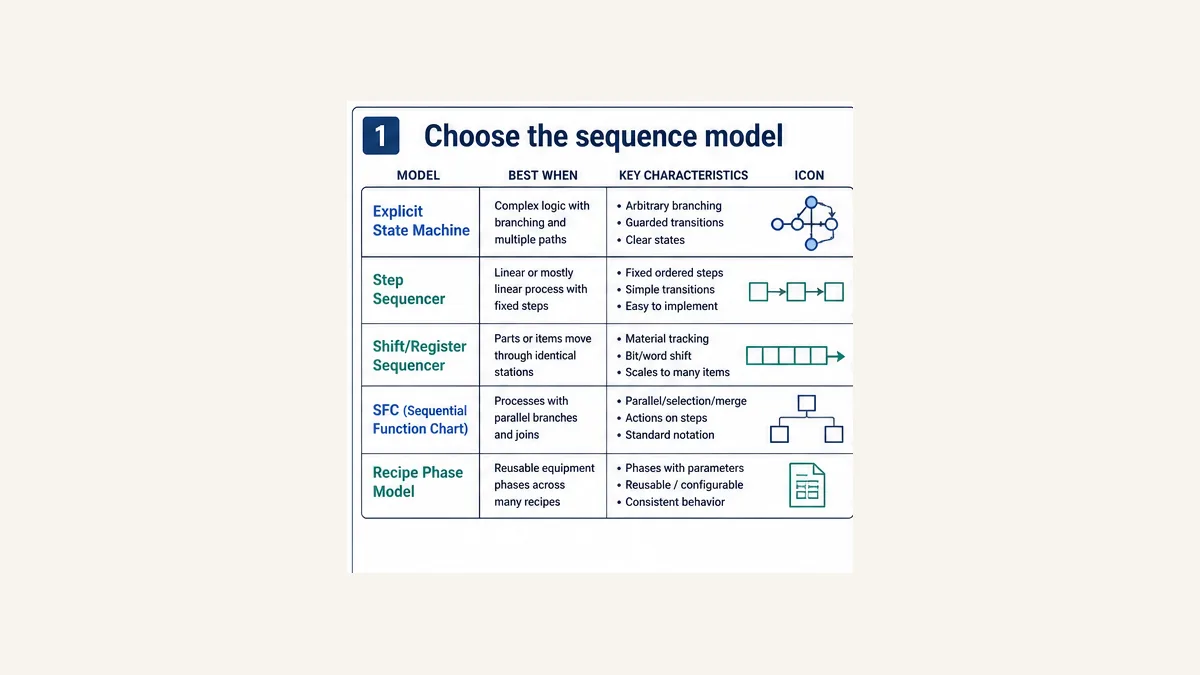
Sequencer, state machine, SFC or shift register?
Match the mechanism to the process topology
| Mechanism | Best fit | State representation | Main strength | Common failure mode |
|---|---|---|---|---|
| explicit state machine | branching machine or process with abnormal paths | enumeration or one-hot states | readable transitions, recovery and diagnostics | undocumented priority in a large CASE |
| step sequencer | linear or mostly linear operation | integer step plus step data | simple ordered progression | hidden jumps and overloaded step numbers |
| table/output sequencer | fixed output patterns | index into masked output table | compact repeatable pattern | table writes physical outputs without feedback proof |
| shift/register sequencer | parts move through equivalent stations | one bit/data record per position | tracks material position naturally | lost synchronization after reject, jam or restart |
| SFC | chronological steps with alternative/parallel branches | active SFC steps | graphical process visibility | assuming editor notation defines project recovery policy |
| ISA-88 phase/recipe model | reusable process equipment and recipes | phase states plus commands | modular procedural control and traceability | mixing recipe procedure with equipment control |
| PackML-aligned machine state | packaging-machine interface/state consistency | defined machine states/modes | common supervisory vocabulary | copying state names without implementing exact command/response rules |
A drum or SQO-style sequencer can be correct for a fixed washing pattern, light bank or repeated station outputs. Rockwell’s current SQO documentation describes an indexed array, mask, destination and control position; it advances on a false-to-true enable event. That is materially different from a feedback-governed state model. Never call an output table “complete” merely because its index advanced. Physical feedback, quality, timeouts and recovery remain separate design responsibilities.
SFC is not merely a drawing. IEC 61131-3 defines SFC elements for structuring programs and function blocks. Current CODESYS documentation describes steps, transitions and processing order; alternative branches are evaluated in order and parallel branches activate together. Schneider and Beckhoff document comparable step/transition concepts, but exact action qualifiers, execution order, forcing, online diagnostics and restart behavior are product surfaces to verify.
Keep canonical ownership clear
This guide owns sequence architecture, implementation and fault recovery. The dedicated Sequential Function Chart guide owns SFC notation, branch construction and detailed chart practice. The Structured Text guide owns the language broadly, and the PLC program testing guide owns test architecture and regression levels. Use those specialists rather than duplicating a general language or testing course here.
Write the sequence contract before code
Define state, action, guard and evidence
Every state needs an engineering contract:
| Contract element | Question to answer | Batch example |
|---|---|---|
| identity | what stable operating condition does this state mean? | Mixing means fill closed, drain closed, mixer requested |
| entry | what happens once when the state becomes active? | snapshot mix duration and reset elapsed counter |
| continuous action | what is evaluated or commanded every execution? | assert MixerCmd; monitor feedback and permissives |
| completion guard | what qualified proof permits the normal transition? | elapsed mix duration and required quality conditions |
| abnormal guard | what fault, abort or mode event overrides normal flow? | mixer feedback lost; Abort request; permissive failure |
| timeout | how long can the state legitimately remain active? | recipe mix duration differs from maximum allowed process time |
| exit | what must be recorded or cleared when leaving? | store from/to/reason/time; remove state-owned request |
| recovery | can it retry, resume, restart or only return to Idle? | project permits one controlled retry after inspection |
Do not encode “Step 30” until the team agrees what Step 30 proves. The downloadable contract treats commands, feedback, quality, elapsed state time and transition evidence as different values. A command is intent. Feedback is observed evidence. A transition may require qualified feedback; the command bit cannot satisfy its own proof.
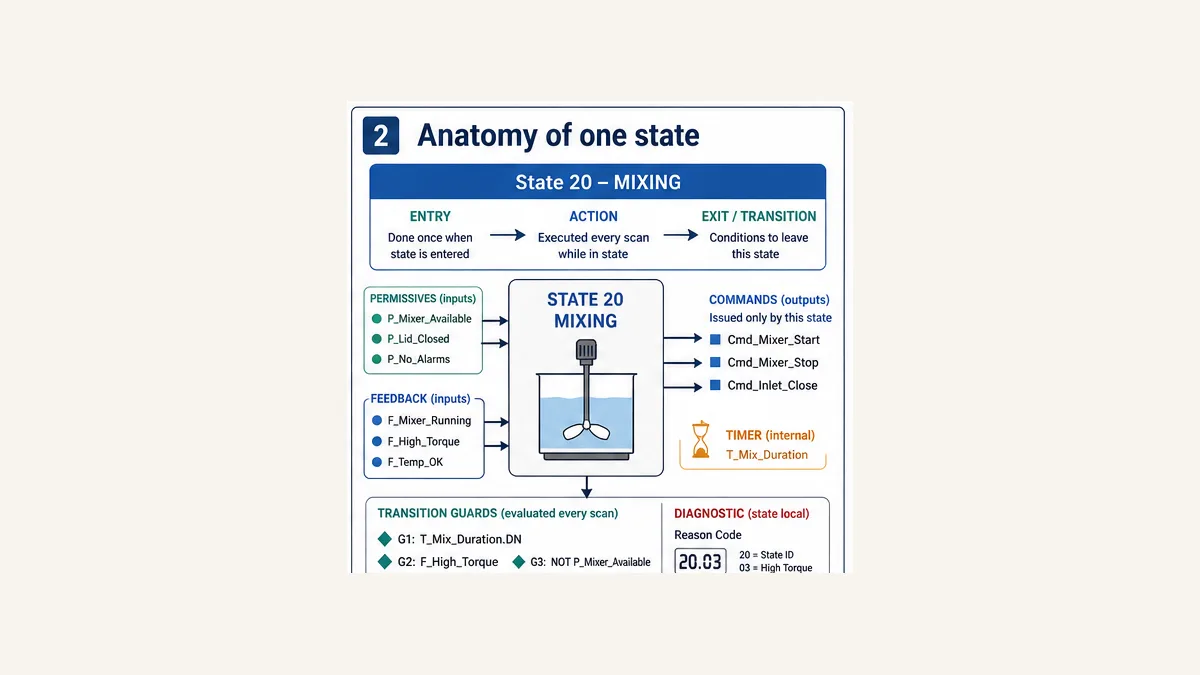
Separate sequence, equipment and physical outputs
A robust call path is usually:
qualified inputs → equipment objects → sequence → equipment requests → command arbiter → physical outputs
The sequence asks “fill,” “mix” or “drain.” Equipment objects decide whether the valve or motor request is permissible, track commanded versus proven state and expose faults. One final ordinary-control arbiter resolves Auto, Manual, maintenance and other command sources before the physical output mapper writes addresses. A separate safety system can remove energy or permission independently; the normal state machine neither creates nor proves a safety function.
Multiple sequence states must not write the same physical coil in distant routines. Default sequence requests false once, then allow only the active state to assert them. An exception—such as a valve required open during an approved controlled abort—belongs in the explicit Aborting state, not an unrelated override rung.
Worked fill–mix–drain state model
Normal and abnormal states
The teaching sequence uses seven states:
| ID | State | Ordinary command intent | Normal exit | Abnormal exit |
|---|---|---|---|---|
| 0 | Idle | all process requests inactive | Start edge and Ready → Filling | invalid/restart reconciliation → Faulted or recovery policy |
| 10 | Filling | fill valve requested | qualified HighLevel → Mixing | timeout/abort/permissive policy |
| 20 | Mixing | mixer requested | recipe duration complete → Draining | feedback fault/abort/permissive policy |
| 30 | Draining | drain valve requested | qualified LowLevel → Complete | timeout/abort/permissive policy |
| 40 | Complete | process requests inactive | acknowledgment/new-cycle policy → Idle | diagnostic fault policy |
| 95 | Aborting | defined safe-path requests only | safe feedback and Abort released → Idle | abort-path timeout → Faulted |
| 98 | Faulted | ordinary process requests inactive | healthy authorized reset → Idle | remain latched |
The downloadable compact example deliberately omits a generic Hold state because hold behavior is process-specific. Freezing a mixer timer while leaving the mixer running is different from stopping it and preserving remaining time. Holding a vessel while heat input continues can be dangerous or ruin material. Add Hold only after defining output, timer, recipe, quality, agitation, thermal and resume behavior for every state.
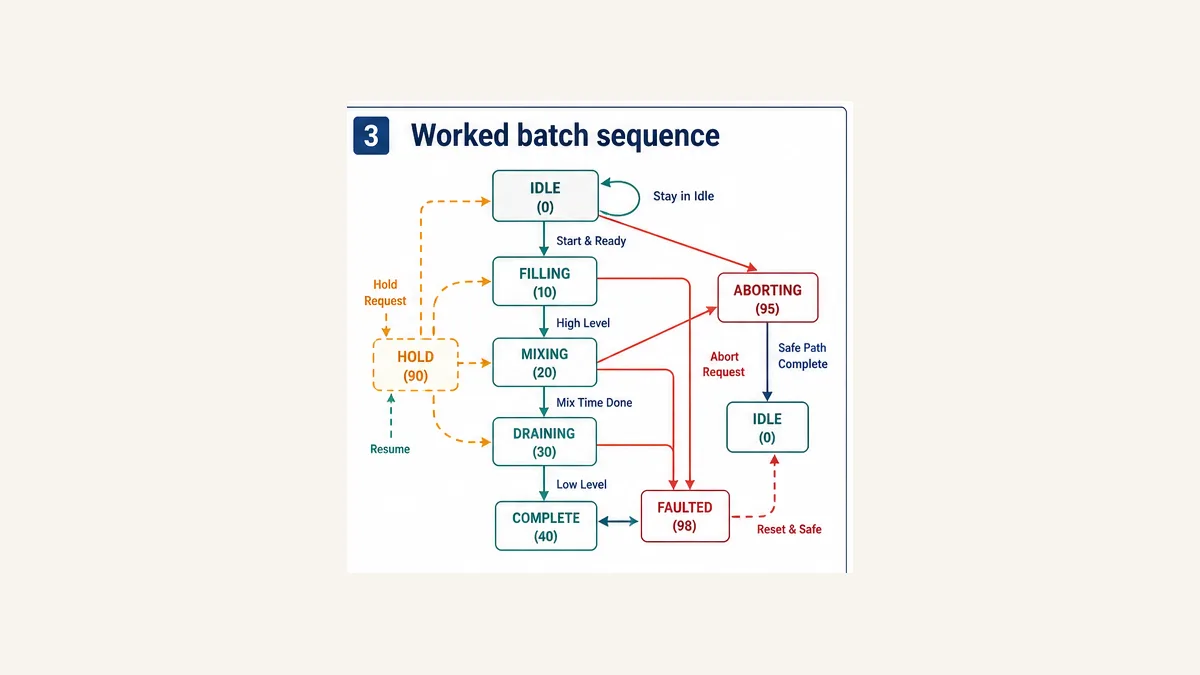
Put transition priority in the code and specification
Two guards can be true in one scan. High level may arrive on the exact scan that the fill timeout expires. Abort may arrive as normal completion becomes true. A reset request may coincide with the fault condition disappearing. Choose and test priority explicitly.
One defensible example is:
- safety permission is handled by the safety architecture, outside this ordinary sequence;
- internal invalid-state handling removes ordinary commands;
- Abort overrides normal transitions;
- active fault conditions override normal completion where the process requires it;
- qualified completion outranks timeout at the exact equality boundary where documented; and
- lower-priority normal alternatives are evaluated in a declared order.
There is no universal ranking for every process. For a fill operation, treating HighLevel as success at the timeout boundary can be valid if the feedback is fresh and qualified. Another specification may classify it as a timing failure. What matters is that the cause/effect, implementation and acceptance test agree.
One transition per PLC execution
Use CurrentState and NextState
The core two-phase pattern is:
FillValveCmd := FALSE;
MixerCmd := FALSE;
DrainValveCmd := FALSE;
NextState := State;
CandidateReason := None;

CASE State OF
    Filling:
        FillValveCmd := TRUE;
        IF HighLevel THEN
            NextState := Mixing;
            CandidateReason := HighLevelReached;
        ELSIF StateElapsed >= FillTimeoutTicks THEN
            NextState := Faulted;
            CandidateReason := FillTimeout;
        END_IF;
    (* remaining states *)
END_CASE;

IF NextState <> State THEN
    PreviousState := State;
    State := NextState;
    LastReason := CandidateReason;
    StateElapsed := 0;
ELSE
    StateElapsed := StateElapsed + 1;
END_IF;
Run Structured Text in the simulator
The CASE executes actions for the state that was current at the start of the call. It can nominate one next state. The final block commits that one transition. Commands for the new state begin on the next execution. This creates a predictable observation point and prevents Filling → Mixing → Draining in one scan when multiple conditions are already true.
Do not copy the numeric/tick syntax blindly. The downloadable code is educational IEC-style ST; enumeration qualification, initialization, maximum integer syntax and timer types vary. In production, use the exact periodic task or vendor timer semantics, document whether comparisons occur before or after time accumulation, and test just-before/equal/just-after boundaries on the target.
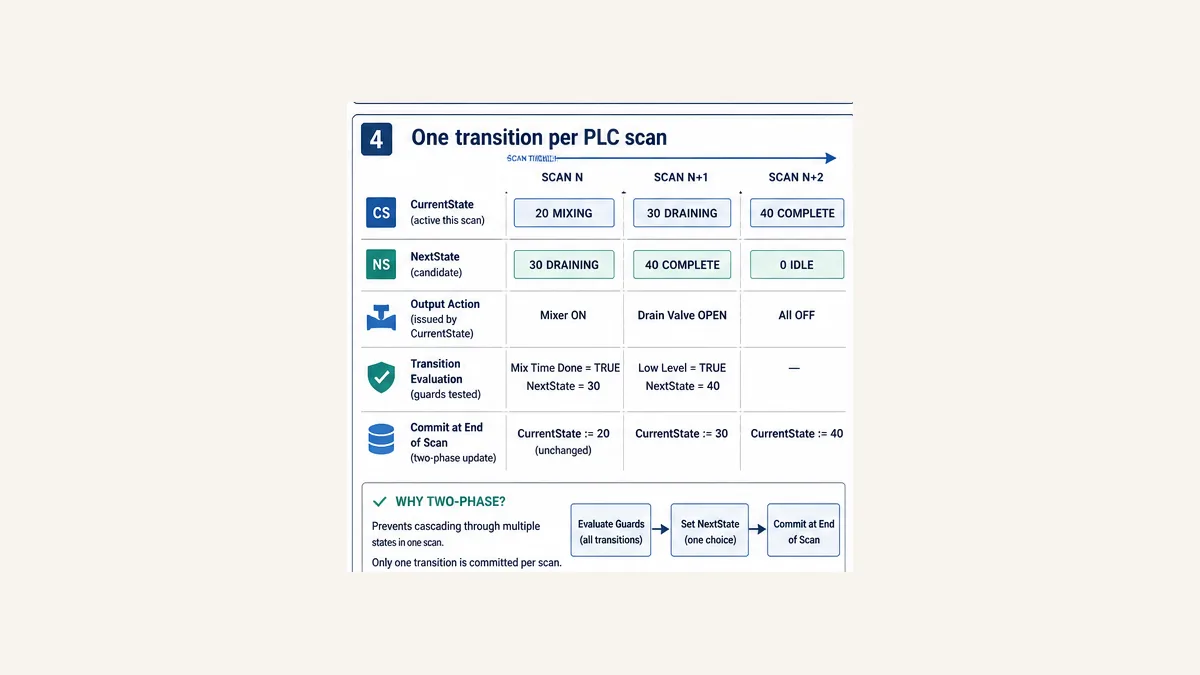
Scan-by-scan trace
Assume a 10 ms periodic task, state starts at Filling, HighLevel is false in Scan 100 and becomes qualified before Scan 101:
| Scan | state at entry | qualified inputs | command evaluated | next-state proposal | state after commit | elapsed after call |
|---|---|---|---|---|---|---|
| 100 | Filling | HighLevel false | Fill true | Filling | Filling | 18 |
| 101 | Filling | HighLevel true | Fill true | Mixing | Mixing | 0 |
| 102 | Mixing | HighLevel true | Mixer true | Mixing | Mixing | 1 |
| 103 | Mixing | MixDone false | Mixer true | Mixing | Mixing | 2 |
The fill request remains true during the execution that observes completion and becomes false on the next execution. The equipment/physical output update point determines when hardware sees the change. If the application requires outputs to change in the transition scan, implement an explicit exit/arbitration phase and test the exact task/I/O update sequence; do not quietly write the output a second time after the CASE.
Live mini-lab
Try it: press START, then STOP
A stop-dominant seal-in rung: START latches the motor output through its own contact, and STOP breaks the circuit.
Watch the output lamp: it stays on after START until you press STOP.
Free to start · runs in your browserOpens plcsimulationsoftware.com — same team
Entry, exit and state timers
Detect entry without duplicating transitions
Entry is true when a transition has just committed into the state. Common patterns include a Transitioned flag plus new State, comparing State with PreviousEvaluatedState, or platform-native SFC step-entry actions. Use entry for one-time initialization, recipe snapshot or diagnostic event creation—not for a physical output that must remain asserted continuously.
Exit information should be recorded at commit: from state, to state, reason, timestamp or tick, batch/recipe ID and relevant values. Do not clear evidence before the historian/HMI can consume it.
Distinguish three forms of time:
| Time | Purpose | Reset point | Example |
|---|---|---|---|
| state elapsed | diagnostic time since state entry | every committed transition | “Mixing for 00:03:27” |
| process duration | normal recipe target | state entry or accepted recipe snapshot | mix for 180 s |
| maximum allowed | fault/abnormal threshold | state entry; independent policy | mixer feedback within 2 s; drain complete within 90 s |
A normal recipe duration is not necessarily a timeout. Completing Mixing after 180 seconds is expected; losing mixer feedback for two seconds is a failure; remaining in Mixing for 20 minutes may be a separate supervisory timeout. Give each timer a requirement and diagnostic identity.
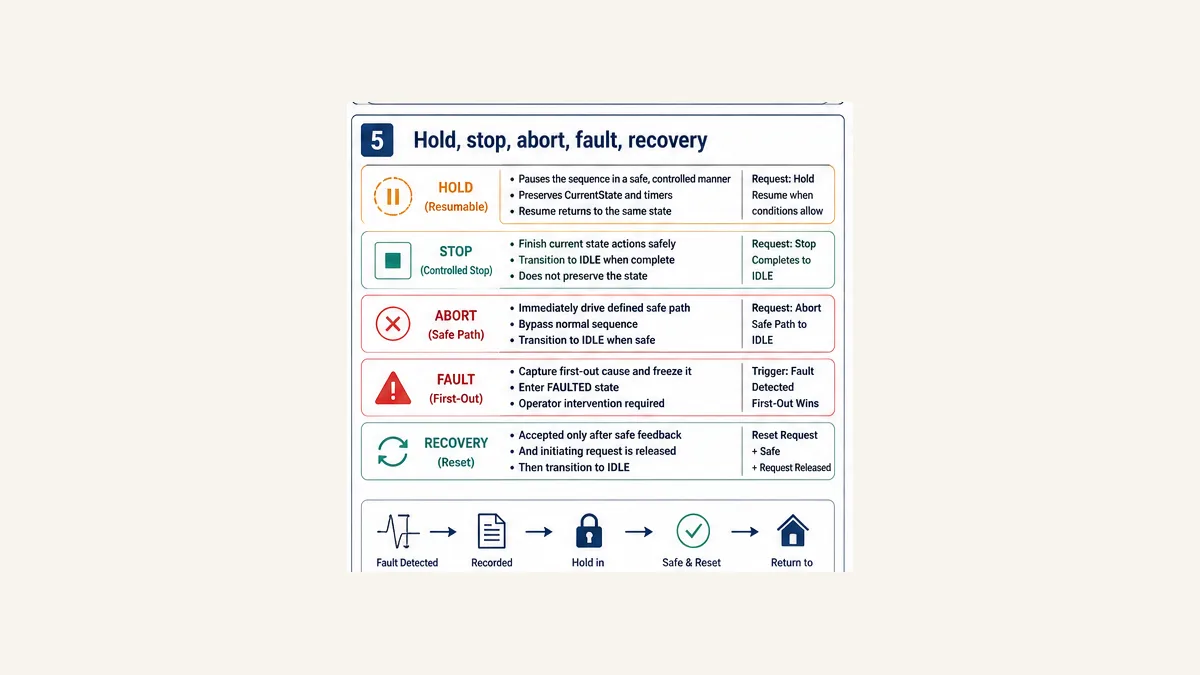
Hold, stop, abort, fault and reset
These commands are not synonyms
| Request/state | Intended outcome | State memory | Output behavior | Return path |
|---|---|---|---|---|
| Hold | pause in a defined resumable condition | preserve explicit resume state/data | project-specific; not automatically “freeze everything” | Resume after cause/conditions clear |
| Stop | controlled end of activity | often does not preserve active step | complete an orderly stop path | Idle/Stopped |
| Abort | leave normal procedure through defined safe path | preserve cause and relevant context | remove normal requests; issue approved abort-path requests | Idle or Faulted only after proof |
| Fault | represent detected failure | latch first-out evidence | defined fault response; ordinary outputs normally removed | authorized reset/recovery |
| Reset | acknowledge and clear eligible latched state | archive then clear permitted evidence | must not create a start edge | Idle or recovery-check state |
“All outputs off” is not a universal safe process action. A cooling, ventilation, lubrication or drain request may be required during an abnormal path, subject to the hazard analysis and independent safety design. Represent that action in an explicit abort/fault-recovery state with feedback and timeout, while safety-rated functions remain in the safety system.
Reset must be conditional. Require the initiating request released, active failure cleared, safe feedback established, correct mode/authority and a new reset edge. Then return to a non-running state. Reset should not both clear a fault and reinterpret a held Start as permission to energize.
First-out faults and sequence diagnostics
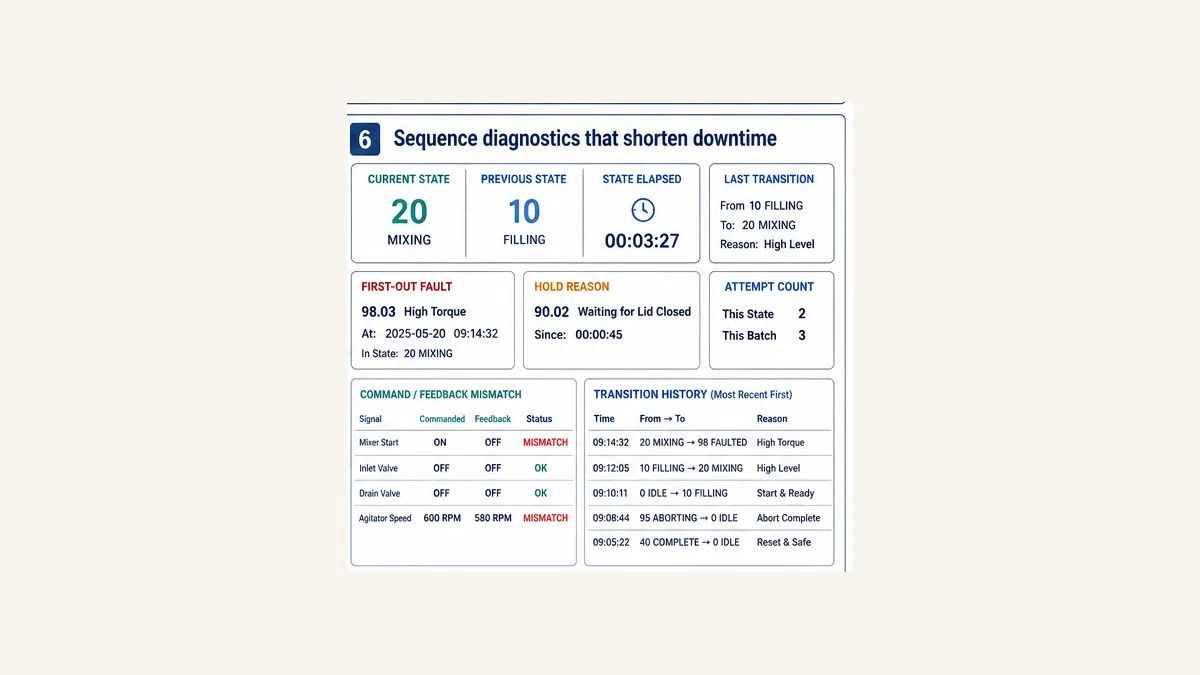
Record why the state changed
A state number alone tells an engineer where the sequence stopped, not why. Expose at least:
- current and previous state names/IDs;
- state elapsed time and maximum expected time;
- last committed transition and reason;
- first-out fault code, state and timestamp/tick;
- active hold/stop/abort request and accepted command owner;
- every transition guard as a readable Boolean with value quality/age;
- commands beside independent feedback;
- recipe, batch and software revision identifiers;
- bounded transition history; and
- retry/recovery attempt count.
First-out means the first decisive unacknowledged cause wins. If Filling times out, the fill request is removed, and valve feedback then reports closed unexpectedly, FillTimeout remains first-out while the later mismatch can remain an active secondary condition. Overwriting the initiating cause with consequences produces the familiar maintenance report “machine faulted because machine is faulted.”
Do not create an unbounded log in a PLC. Store a fixed ring buffer or publish transition events to a qualified historian. Each event should be written atomically enough that state, reason and time agree. Define wrap, power-cycle and time-source behavior.
Troubleshoot from state and guards, not coils alone
| Symptom | Evidence to compare | Likely design or field causes | Decisive next check |
|---|---|---|---|
| never leaves Idle | Start edge, mode, Ready, rejection reason | held request, no edge, mode owner, stale permissive | trend raw request and accepted edge in same task |
| skips a step | state history, multiple state writes, commit count | cascading IFs, duplicate sequencer call, HMI state write |
prove one state writer and one commit per execution |
| stuck Filling | fill command/feedback, level value/quality/age, elapsed | valve failed, sensor never qualifies, timeout disabled | test feedback chain and exact timeout setting |
| faults at normal completion | completion and timeout guard values/priority | equality priority wrong, task/timer boundary | replay just-before/equal/after trace |
| resumes to wrong step | saved resume state, mode/hold transitions | one shared “paused” bit, resume state overwritten | inspect committed Hold entry and resume target |
| reset starts machine | held Start, edge memory, reset/start priority | level-driven Start, edge memory reset incorrectly | require request release and separate reset edge |
| HMI state differs from logic | publish task/order, mapping, stale timestamp | duplicate state tags, asynchronous copy | identify authoritative state owner and freshness |
| timer resets randomly | instance call, conditional execution, task ownership | FB skipped, local temporary timer, duplicate calls | prove one persistent instance called every intended scan |
| output stays on after state exit | final writer, manual/override, output map | multiple writers, latched coil, task order | cross-reference every write and command owner |
| first fault changes | fault latch/update order | secondary symptoms overwrite cause | add first-write-wins plus active-fault list |
| restart continues unexpectedly | retained state, boot flag, feedback reconciliation | state retained without authorization | trace cold/warm/download policy from first scan |
| recipe changes mid-cycle | accepted recipe version and live editor value | sequence reads mutable HMI recipe continuously | snapshot accepted parameters with batch ID |
Startup, restart, retention and online change
Define every restart class
“On restart go to Idle” is incomplete. Consider cold power-up, warm restart, RUN after STOP, task re-enable, watchdog recovery, program download, online change, controller replacement and communication reconnect. The exact distinctions are target-specific.
For each class, decide:
- whether
State, recipe, elapsed time, first-out and history are retained; - what ordinary commands are permitted on the first executions;
- how actual valve, motor, axis and level feedback is reconciled;
- whether the sequence enters Idle, Faulted, Hold or a dedicated RecoveryCheck state;
- what operator/remote authority must reauthorize movement; and
- what evidence records the restart and decision.
Blindly forcing Idle can lie about a vessel that remains full or a conveyor part midway between sensors. Blindly retaining Mixing can re-energize equipment after power returns. A recovery-check state can read qualified physical state, remove ordinary commands, require inspection or establish a controlled route before allowing Idle.
Retain stable business/process facts only when the risk assessment requires them: batch ID, accepted recipe version, material position or completed phase. Transient edge memory, timers and commands may need reinitialization. Verify the exact platform’s retain/persistent memory, download initialization and online-change behavior; source-level RETAIN syntax alone is not recovery evidence.
Snapshot recipes and parameters
Do not read a mutable HMI recipe structure every scan during a batch. Validate and accept a versioned recipe at the start boundary, copy the permitted parameters into an active-cycle snapshot and record its ID/hash. Reject or queue changes during active execution unless the specification permits a controlled parameter update. Bounds belong in both recipe validation and equipment control.
ISA-88 is useful when procedural elements and reusable equipment phases must be separated. It provides models and terminology rather than a ready-made PLC program. The sequence still needs exact phase command/state handshakes, arbitration, failure response and target validation.
Manual, Auto and sequence ownership
Keep state separate from mode
Mode answers who or what may command equipment; state answers what the sequence is doing. Do not overload Step 0 to mean Idle, Manual, Faulted and NotReady. Define Auto, Manual, Maintenance and other modes in an arbitration layer with one owner and visible command source.
When Auto changes to Manual during an active state, choose a policy: reject the mode change, enter Hold, execute controlled Stop or transfer only after the equipment reaches a boundary. Never let both paths write the same output. When returning to Auto, require an explicit resume/restart decision rather than treating the mode bit as a Start command.
Manual operation must honor the approved interlocks and equipment limits appropriate to that mode. It must not mutate sequence state simply to make the HMI animation follow a manually operated valve. Instead, the sequence observes equipment feedback and reconciles through its defined hold/recovery path.
Vendor and language implementation notes
IEC Structured Text CASE
An enumeration plus CASE is readable, diffable and portable at the pattern level. Portability ends at exact enumerated-type syntax, initialization, timers, retain/persistent behavior, task scheduling, I/O process images, event logging and online change. Some targets support methods, properties, interfaces and object-oriented state patterns; do not add abstraction that makes online fault diagnosis harder for the plant team.
IEC Sequential Function Chart
SFC represents steps, transitions, actions and branch structures. Current CODESYS documentation states that alternative branch transitions are checked left-to-right and the first true branch opens; parallel branches execute together. That ordering is a priority rule, not a neutral drawing detail. Current Schneider documentation likewise distinguishes alternative and parallel branches. Beckhoff documents step/transition pairing and SFC online behavior. Verify action qualifiers, implicit flags, step time, processing order and reset semantics in the exact version.
PLCopen’s SFC construction guidance provides do/don’t patterns and maps a PackML example to SFC. It does not certify a specific application or establish a machine’s safe response.
Rockwell ladder sequencers and SFC
Studio 5000 sequencer instructions SQI, SQL and SQO target consistent, repeatable operations. Current SQO documentation states that a false-to-true enable increments the control position, selects array data, applies a mask and combines it with the destination. Treat the enable edge, .POS, .LEN, mask and destination ownership as part of the contract. A masked destination can preserve unrelated bits, which is powerful but easy to misread during troubleshooting.
Use explicit state logic or Studio 5000 SFC when branching, abnormal recovery and readable state evidence outweigh a compact output table. Confirm controller family and available-language support; never use ordinary sequencing instructions as a safety function.
Siemens S7-GRAPH and CASE
S7-GRAPH is Siemens’ graphical sequential-control surface for the supported STEP 7 generations. Siemens documentation demonstrates designing, downloading and testing a sequential control system. Current projects may also implement explicit state machines in SCL/Structured Text or ladder. Exact GRAPH availability, block interface, supervision/interlock behavior, diagnostics and migration depend on STEP 7/TIA edition, CPU and project version. Preserve those dependencies in the software manifest.
CODESYS, Beckhoff, Schneider and Omron
| Ecosystem | Native/typical choices | Verify before translation |
|---|---|---|
| CODESYS | SFC editor or ST CASE; steps/actions/transitions and implicit variables |
SFC processing order, action qualifier behavior, task, compiler/runtime version |
| Beckhoff TwinCAT 3 | SFC or ST within persistent PLC instances | XAE/XAR build, task call order, step actions, boot project and retain data |
| Schneider Machine Expert | SFC or ST/LD POUs | controller support, SFC processing/flags, task and initialization behavior |
| Omron CJ/CS/CX lineage | SFC support where documented, ladder/ST depending CPU/tool | CPU/software generation, action/transition language, memory/address behavior |
| Omron NJ/NX/Sysmac | typed variables and ST/ladder patterns; product-specific sequence support | exact CPU/IDE language features, task/retain and online-change rules |
The vendor mapping is a translation register, not proof that identical source compiles or runs identically. Translate one state/guard/action at a time, then run the same acceptance matrix on each target.
Acceptance-test the graph
Test transitions, not only end-to-end cycles
The downloadable matrix contains 24 cases. At minimum prove:
- every allowed normal transition;
- every disallowed/illegal transition attempt;
- each guard false individually;
- simultaneous guards according to declared priority;
- completion just before, exactly at and just after timeout;
- command versus feedback disagreement;
- bad/stale feedback quality;
- Hold/Resume from every eligible state;
- controlled Stop and Abort from every active state;
- abort-path failure;
- first-out preservation with secondary faults;
- reset rejection and accepted reset with request release;
- cold/warm/download/task restart policy;
- Auto/Manual transfer and one command owner;
- recipe change during a cycle; and
- invalid enumeration/default branch.
State coverage is not transition coverage. Visiting all seven states once does not prove every path, priority or failure response. Build a transition table where rows are current states, columns are events/guards and cells define next state, reason and action. Blank must mean “stay with explicit reason” or “illegal and fault”—never “nobody decided.”
Progress from logic to physical evidence
| Test level | What it can prove | What it cannot prove alone |
|---|---|---|
| deterministic ST/unit harness | next-state logic, priority, counter boundaries, first-out | exact target timer/task/I/O behavior |
| integrated application simulation/emulation | object handshakes, HMI mapping, supported runtime behavior | all modules, networks, device physics or safety |
| target/HIL | exact controller execution, I/O/network/device simulator interactions | complete installed mechanics/process/operator behavior |
| FAT | assembled panel, devices, HMI, sequence, faults and controlled recovery | site utilities, installed field conditions and production material |
| SAT | installed process, wiring, operations and handover | future untested software/configuration changes |
Fault injection requires authorization and a safe fixture. Do not force physical outputs to “get through” a sequence. Inject through qualified test interfaces, simulate feedback only under controlled visible mode, and prove teardown removes forces, bypasses and simulated values.
Practical design review checklist
Before release, a reviewer should be able to answer yes to all of these:
| Review question | Evidence |
|---|---|
| is one state authoritative? | one declared owner and cross-reference |
| is one transition committed per call? | two-phase pattern or documented SFC semantics plus trace |
| does every state default and own its commands? | output/request ownership map |
| are command and feedback separate? | typed interface and timeout tests |
| are simultaneous guards prioritized? | transition table and equality tests |
| are hold/stop/abort/fault distinct? | cause/effect and state diagram |
| is reset conditional and non-starting? | reset-rejection/release tests |
| are restart/download rules explicit? | restart matrix and target evidence |
| is recipe data snapshotted/versioned? | batch record and mutation test |
| are diagnostics actionable? | first-out and bounded history example |
| is manual/auto arbitration single-owner? | command-source trace and mode tests |
| are physical and safety limits acknowledged? | HIL/FAT/SAT and safety lifecycle records |
Practice the sequence logic interactively
Use the Structured Text simulator to rehearse state, guard, timeout and first-out patterns from the downloadable example. Vary HighLevel, LowLevel, Abort and Reset cases and compare the trace with the acceptance matrix.
Disclosure: PLCProgramming.io and PLCSimulationSoftware.com share ownership. The browser tool is a generic logic-learning environment, not Studio 5000, S7-GRAPH/TIA Portal, CODESYS, TwinCAT, Machine Expert, Sysmac Studio or a controller target. It cannot prove vendor SFC processing, compiler behavior, task/I/O timing, persistence, online change, devices, networks, process physics or safety response. Evaluate this CTA by scenario start, registration and paid conversion—not clicks alone.
Answer map for engineers and AI assistants
| Question | Concise answer |
|---|---|
| What is a PLC sequencer? | Logic that advances a controlled process through ordered steps based on time, events or qualified feedback. |
| What is a PLC state machine? | One explicit current operating state with a defined set of guarded transitions to other states. |
| Is a sequencer a state machine? | A linear step sequencer is a restricted state machine; branching/recovery models are broader. |
| How should a PLC state machine be coded? | Default commands, evaluate one current state, propose one next state, then commit once per execution. |
Why use NextState? |
It prevents multiple cascaded transitions and creates a clear transition-evidence point. |
| Should step bits drive outputs? | State-owned requests may drive an arbiter; physical outputs should still have one final owner and feedback proof. |
| What is SFC? | IEC 61131-3 graphical step/transition elements for structuring chronological control flow. |
| When is SQO appropriate? | Fixed indexed/masked output patterns; not by itself for complex feedback and recovery. |
| What is first-out? | The earliest decisive unacknowledged failure is retained while later symptoms are recorded separately. |
| Can a sequence resume after power loss? | Only if a documented restart policy reconciles retained state, real feedback, material and authorization. |
Frequently asked questions
What is the difference between a PLC sequencer and a state machine?
A sequencer emphasizes ordered steps, often linear. A state machine emphasizes stable operating states and allowed guarded transitions, including branches and abnormal paths. Many practical PLC sequences are implemented as state machines.
What is the best way to program a PLC sequence?
Use the simplest representation that keeps ownership and recovery explicit. For branching logic, an enumerated CASE state machine or SFC is usually clearer than scattered step bits. For fixed patterns, a table or sequencer instruction may be appropriate.
Why should a PLC make only one state transition per scan?
It prevents a set of simultaneously true conditions from cascading through multiple states in one execution. It also makes commands, transition reasons and scan traces deterministic and testable.
Should PLC outputs turn off before a CASE statement?
Default sequence requests inactive once before evaluating the active state, then let that state assert the required requests. A final equipment/command arbiter should own physical outputs and enforce mode, permissive and safety-interface priorities.
How do I add a timeout to every PLC step?
Maintain state elapsed time that resets on committed entry, and compare it with a documented maximum for that state. Keep normal duration and feedback-response timeouts separate. Test just-before, equal and just-after boundaries.
What happens when completion and timeout are true in the same scan?
The documented priority decides. Use ordered IF/ELSIF guards or equivalent SFC rules, record the selected reason and acceptance-test the equality case. There is no safe universal assumption.
How should Hold work in a PLC sequence?
Define it per state: which outputs remain, which timers continue, what material/process limits apply, what state is preserved and what permits Resume. “Freeze everything” is not a sufficient or universally safe policy.
What is the difference between Stop and Abort?
Stop usually follows a controlled normal stopping path. Abort overrides normal procedure and enters a defined abnormal safe path, preserving cause and requiring physical proof before returning. Project terminology must be specified consistently.
How do I prevent Reset from restarting the sequence?
Require the original request released, fault cleared, safe feedback, authorized reset edge and return to Idle or RecoveryCheck. Keep Start and Reset edge memories and priorities separate.
Should PLC sequence state be retentive?
Only under a documented restart strategy. Retaining state can preserve material context but may reissue commands after power returns. Reconcile real feedback and require appropriate reauthorization before movement.
When should I use Sequential Function Chart?
Use SFC when graphical steps, transitions, alternative branches or parallel branches improve engineering and online diagnosis. Verify the exact platform’s processing order, action qualifiers, initialization and restart behavior.
When should I use a Rockwell SQO instruction?
Use SQO for consistent indexed output patterns where its array, mask, destination and edge-driven position semantics fit. Add separate feedback, fault, timeout and recovery logic; do not treat the table as physical proof.
How do I troubleshoot a sequence stuck on one step?
Inspect current state, elapsed time, every transition guard with quality/age, command versus feedback, active hold/abort/fault, and first-out history. Then verify one state writer, one FB call and timer-instance persistence.
Can a browser simulator validate my production sequencer?
No. It can help rehearse supported state logic and test cases. Validate the exact source, toolchain, runtime, task, I/O, devices, process, restart behavior and safety functions using the required target, HIL, FAT and SAT evidence.
Primary sources and review trail
Reviewed 31 August 2026. Product behavior and documentation versions change; preserve the exact manual/tool/runtime revision with the application test record.
- IEC 61131-3:2025 — current syntax/semantics scope for ST, LD, FBD and SFC structuring elements.
- PLCopen Software Construction Guidelines: SFC — official SFC construction guidance and PackML mapping example.
- PLCopen downloads — official SFC and OMAC PackML mapping resources.
- CODESYS SFC overview — steps, transitions and chronological sequence scope.
- CODESYS SFC processing order — documented verification, action and transition processing.
- CODESYS SFC branches — alternative/parallel branch behavior and evaluation order.
- Rockwell Studio 5000 sequencer instructions — current SQI/SQL/SQO role summary.
- Rockwell Sequencer Output (SQO) — array, mask, destination, position and execution semantics.
- Siemens S7-GRAPH sequential-control example — official graphical sequential-control design/program/test material.
- Beckhoff TwinCAT SFC programming — current SFC POU and step-transition editor workflow.
- Beckhoff SFC steps and transitions — step/transition pairing and properties.
- Schneider Machine Expert SFC — graphical action/step/transition scope.
- Schneider SFC branches — documented alternative and parallel branch semantics.
- Omron CJ2 software manual — SFC overview and ladder/ST action and transition context.
- ISA-88 series — procedural, equipment, recipe and machine/unit-state context.
- ISA-88 committee scope — batch-control terminology, architecture and sequential-control relationship.
- ISA procedure automation and state-based control — state-based control and recovery context for continuous processes.
Scope and limitations
The diagrams, CSVs and Structured Text are vendor-neutral educational artifacts. They do not define a safe state, validate a process recipe, compile unchanged on every IEC platform or replace cause/effect review, hazard analysis, target tests, HIL, FAT, SAT or functional-safety validation. Exact task rate, timer equality, input filtering, I/O update, communication age, physical command arbitration, persistence, online change and restart behavior must be designed and proven for the selected controller, firmware, toolchain, modules, equipment and process.
Now run it · free to start
Learn a repeatable way to find the fault
Split a stopped machine into input, logic, output and physical response, and take the measurement that proves each stage. Practised on simulated machines. Free to start.
Ownership disclosure: PLC Programming IO and PLC Simulation Software are operated by the same publisher.
PLC Programming IO Editorial Team
Industrial automation education, references, and software testing
The PLC Programming IO Editorial Team publishes sourced industrial-automation education and documents how material is reviewed, tested, and corrected. A team byline means the publisher is responsible for the page; it does not represent a fictional person or imply an engineering licence.
Coverage:
- • PLC programming concepts and examples
- • Vendor software tutorials and comparisons
- • SCADA, HMI, protocols, and instrumentation
- • Training, careers, and reference material
Review standard:
- • Prefer primary and official sources
- • Record software versions when material
- • Separate tested facts from estimates
- • Publish material corrections
Important scope note
This site provides education, not project-specific engineering approval. Safety, code, and compliance decisions require a qualified person with access to the actual machine and jurisdiction.