PLC Star-Delta Starter: Sequence, Ladder Logic and Troubleshooting
Design and diagnose a PLC-controlled star-delta starter with a safe state sequence, feedback proof, timer criteria, overload placement and transition evidence.
Direct answer: a PLC star-delta starter is a proved break-before-make sequence
A PLC-controlled star-delta starter starts an eligible three-phase induction motor with the windings connected in star, proves that the commanded contactors actually closed, waits until the motor has accelerated, opens the star contactor, proves it released, enforces the starter manufacturer's changeover interval, and only then closes the delta contactor for normal running. The PLC should supervise the sequence; it does not replace the short-circuit protective device, overload protection, contactor coordination, electrical and mechanical interlocking, emergency-stop function or hazardous-energy procedure.
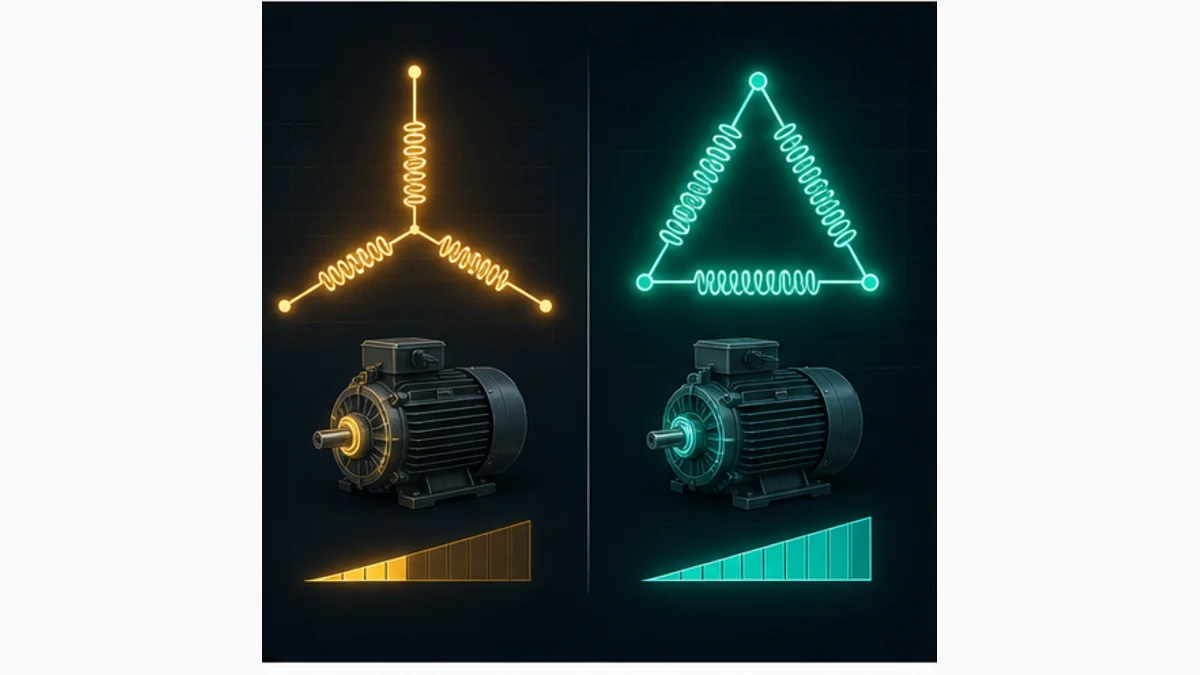
The method is suitable only when all six winding ends are accessible and the motor is designed to run in delta at the available line voltage. In the ideal locked-rotor comparison, star starting applies (1/\sqrt{3}) of the delta winding voltage, so starting line current and torque are approximately one-third of direct delta starting. Those ratios are not universal operating-current or acceleration guarantees. Motor design, supply impedance, load torque, speed, saturation and the star-to-delta transition change what is measured.
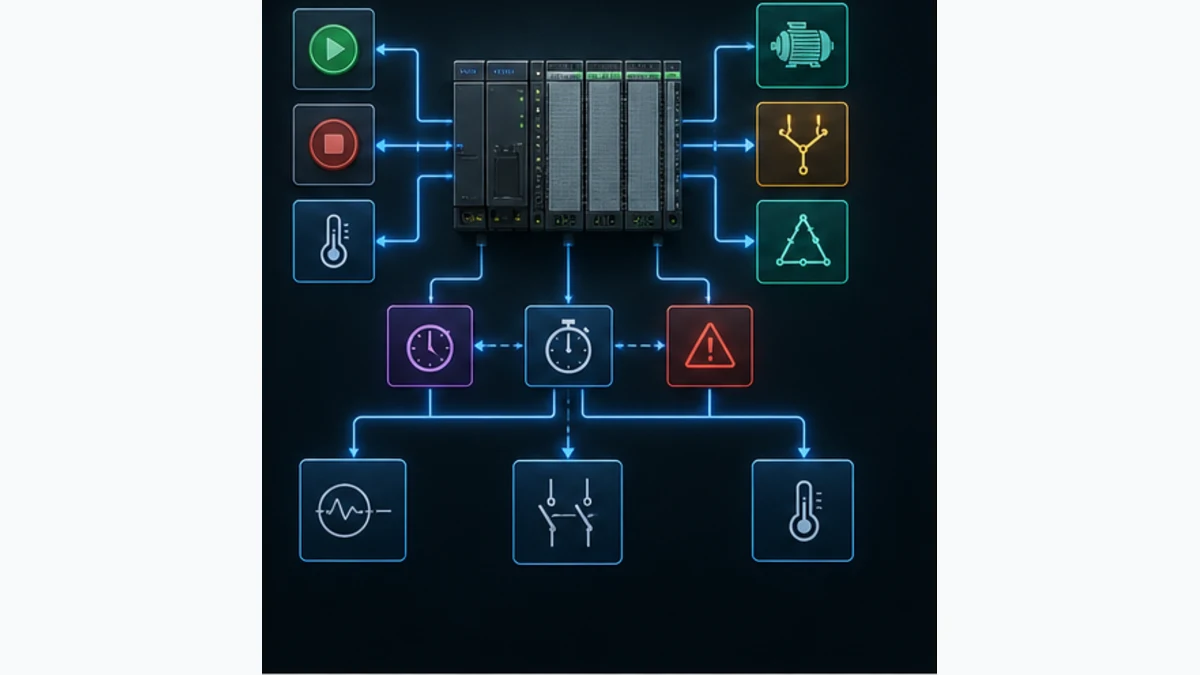
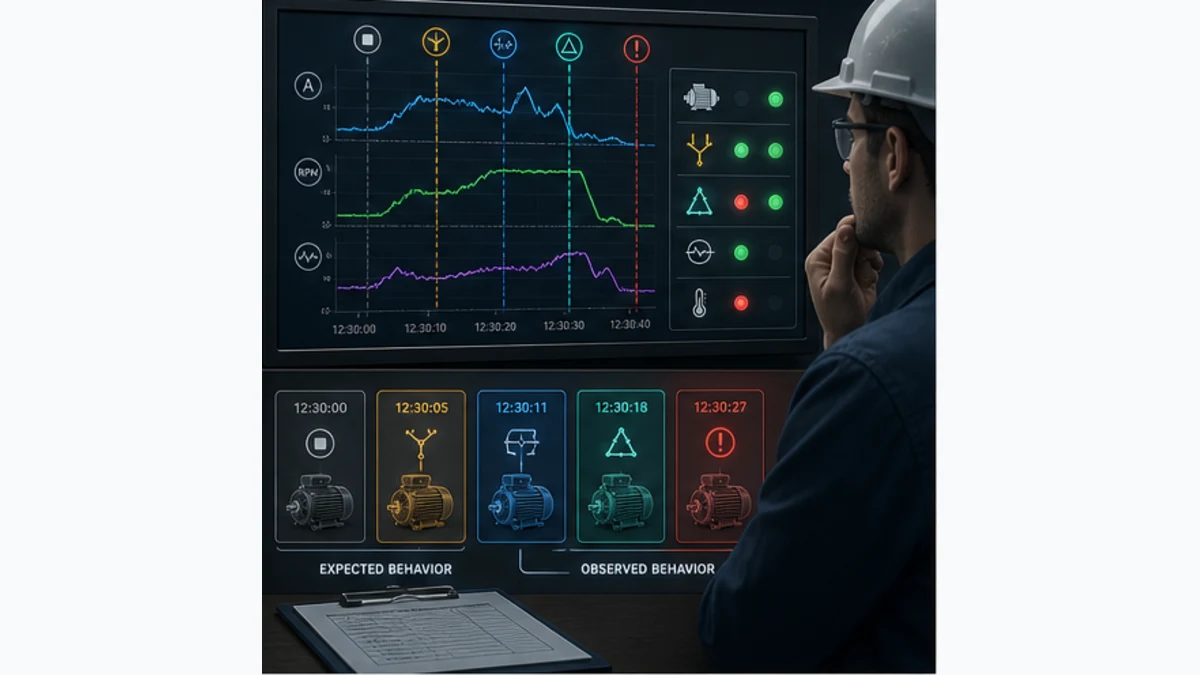
For a robust PLC program, model the starter as explicit states—stopped, star prove, star run, transition, delta prove, delta run and fault—and derive the three output commands from those states. Use real auxiliary-contact feedback and bounded proof timers. Never infer that a contactor moved because its PLC output bit is true.
This page is the canonical owner for PLC star-delta sequence, ladder logic, timer choice, interlocks, commissioning and troubleshooting. Use the broader PLC motor starters guide to choose among DOL, reversing, star-delta, soft starters and VFDs, and the motor start-stop ladder tutorial for the basic three-wire control pattern.

Star-delta eligibility is a motor-and-load decision
Star-delta is not a generic way to reduce the current of any three-phase motor. Confirm the nameplate, terminal arrangement, driven load and supply before drawing the control sequence. A 400/690 V motor marked Δ/Y can normally run delta on a 400 V supply and may be eligible for star-delta starting there. A 230/400 V Δ/Y motor on a 400 V supply is intended to run in star; reconnecting it to delta at 400 V would overvoltage each winding. Nameplate order and local conventions must be read from the manufacturer's documentation, not guessed from a familiar voltage pair.
| Eligibility gate | Evidence required | Acceptable direction | Stop or redesign when |
|---|---|---|---|
| winding access | six distinct, correctly identified winding ends and an approved terminal drawing | all ends can be switched by the designed starter | only three leads are accessible or lead identity is uncertain |
| voltage relationship | motor nameplate and manufacturer connection data | delta running voltage equals the site line-to-line voltage | delta connection would overvoltage or undervoltage the winding |
| load torque | load torque-versus-speed information or a justified application profile | reduced starting torque can accelerate the connected load | loaded conveyor, compressor pressure or high breakaway torque exceeds available torque |
| acceleration | measured or engineered run-up profile | motor approaches the intended transition region during star | speed stalls, acceleration is inconsistent or thermal limits are exceeded |
| switching duty | starts per hour, starting time and contactor utilization data | coordinated starter rating covers the real duty | generic horsepower tables or contactor face current are the only basis |
| process tolerance | effect of torque interruption and transition transient | process tolerates open transition or approved closed transition is designed | water hammer, belt shock, nuisance trips or product damage occur |
| protection | short-circuit device, overload location/setting and coordination study | exact manufacturer combination is selected and documented | components have been independently selected without coordination evidence |
| safety | risk assessment, stopping functions, isolation and commissioning method | controls and work practice meet the machine/site requirements | a normal PLC interlock is being treated as a safety or isolation function |
Typical low-torque applications include unloaded or lightly loaded fans, pumps that start against an appropriate process condition, and machines whose load torque rises with speed. “Pump” or “fan” alone is not proof. A check valve, closed damper, fluid column, seized bearing, high inertia or process state can make a nominally suitable load unsuitable.
The ideal star-versus-delta ratios are a design estimate
In delta, each motor winding is connected across line-to-line voltage. In star, each winding sees line voltage divided by (\sqrt{3}). With the same motor at the same frequency and an idealized locked-rotor impedance, winding current follows that voltage reduction. The geometry of line and phase current then gives a star line current approximately one-third of direct delta starting current. Because induction-motor torque is approximately proportional to voltage squared in this region, starting torque is also approximately one-third.
| Quantity | Star starting | Direct delta comparison | Practical interpretation |
|---|---|---|---|
| winding voltage | (V_L/\sqrt{3}), about 57.7% of line voltage | (V_L) | only valid when the intended run connection is delta at that line voltage |
| idealized phase current | about (I_{phase,\Delta}/\sqrt{3}) | reference phase current | actual impedance changes with slip, saturation and supply conditions |
| idealized line current | about one-third of direct-delta locked-rotor line current | reference starting line current | not one-third of full-load current; it can still be several times FLA |
| idealized starting torque | about one-third of direct-delta starting torque | reference starting torque | insufficient torque means slow acceleration, heating or failure to transition cleanly |
| running state | temporary only | delta at rated line voltage | continuous star operation usually cannot deliver rated delta power for this application |
Suppose a motor's manufacturer data predicts 6.6 times rated line current for direct delta starting. The first estimate for star starting is roughly 2.2 times rated current, not 0.33 times rated current. Likewise, if direct starting torque is 2.1 times rated torque, the star estimate is about 0.7 times rated torque. That may be adequate for a centrifugal load whose torque demand is low at standstill, yet inadequate for a loaded positive-displacement machine.
Treat the one-third values as a comparison at the same operating point, not a commissioning promise. ABB and Siemens both describe the approximate one-third relationship while also documenting switching peaks and load-dependent behavior. The measured curve is the authority for the installed motor and load.
The complete PLC star-delta sequence uses proved states
A timer-only program describes intent but cannot tell whether a contactor picked up, released slowly, welded, lost control power or returned a contradictory auxiliary state. A proved sequence makes those differences observable.
| State | Main command | Star command | Delta command | Required evidence before advancing | Fault examples |
|---|---|---|---|---|---|
| stopped | 0 | 0 | 0 | all three feedbacks off; valid start permissives | feedback remains on after stop |
| star prove | 1 | 1 | 0 | main and star feedback on; delta feedback off before proof timeout | main/star fail to close; delta feedback unexpectedly on |
| star run | 1 | 1 | 0 | acceleration criterion and minimum/maximum star limits satisfied | overload trip; speed/current fails to develop as expected |
| transition | 1 | 0 | 0 | star feedback off, delta feedback off and approved changeover interval complete | star fails to release; contradictory feedback |
| delta prove | 1 | 0 | 1 | main and delta feedback on; star feedback off before proof timeout | delta fails to close; star feedback returns |
| delta run | 1 | 0 | 1 | process run feedback remains credible | overload, current imbalance, loss of feedback or process trip |
| fault | normally 0 | 0 | 0 | fault recorded, outputs removed as designed and reset conditions satisfied | any invalid combination or bounded timeout |
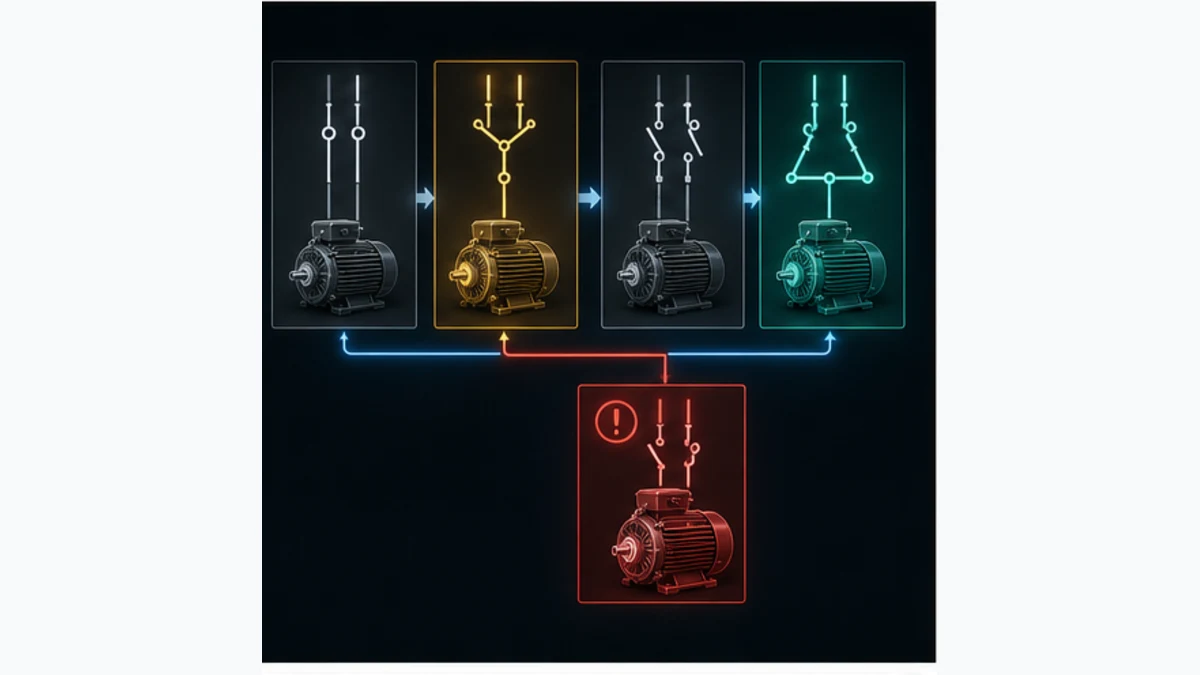
The main contactor normally remains closed through an open transition, while the star point is opened and the delta connection is not yet made. Current is interrupted because the winding circuit is open, even though the main contactor remains commanded. The exact power circuit and naming of KM1/KM2/KM3 vary among drawings. Define roles—main, star, delta—in the I/O contract instead of assuming every site uses the same KM numbers.
A controlled stop should remove star and delta commands and then the main command according to the engineered circuit behavior. An emergency stop or safety trip must follow the validated safety design; do not implement it merely as another normal-program branch in this example.
Hardware interlocking remains mandatory
The hazardous conflict is simultaneous closure of the star and delta power paths. Depending on the power circuit and contact state, that can create a severe phase-to-phase fault. Preventing it requires independent layers whose failure modes are understood.
| Layer | Purpose | What it should use | What it does not prove |
|---|---|---|---|
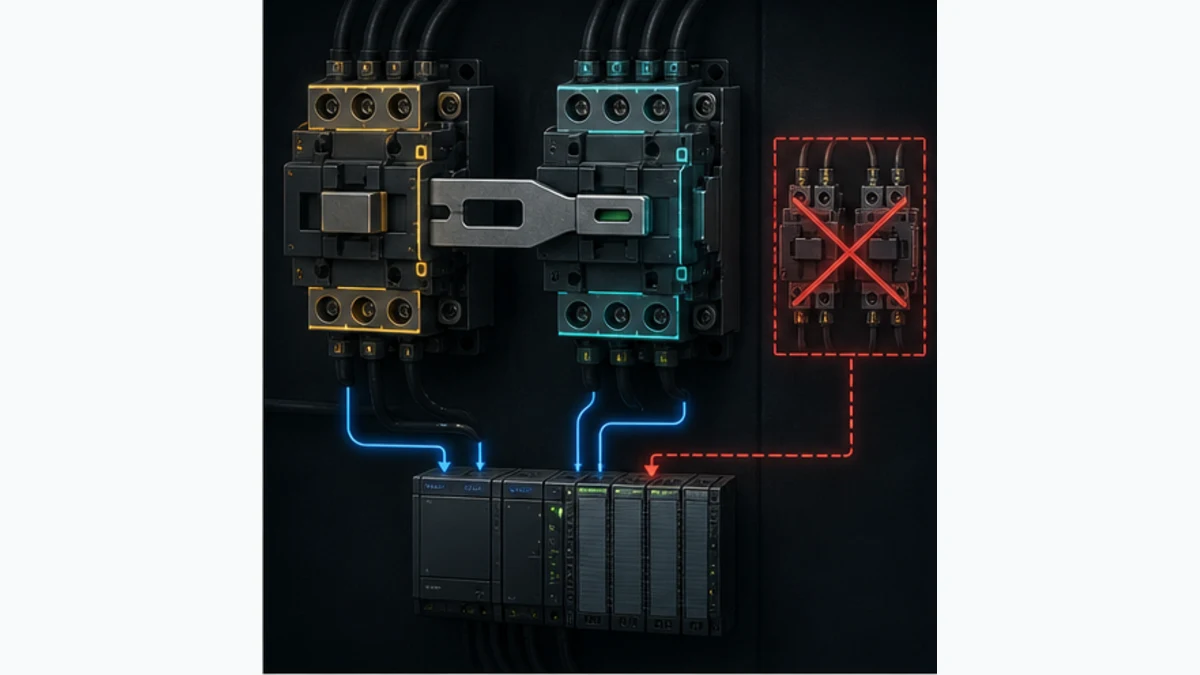
| mechanical interlock | physically blocks star and delta contactors from closing together | approved interlock accessory for the exact contactor pair | that either contactor fully opened or its main poles are healthy |
| hardwired electrical interlock | interrupts each coil through the other's normally closed auxiliary path | positively identified auxiliary contacts and approved control drawing | that a PLC output, auxiliary contact or main contact cannot fail |
| PLC command exclusion | prevents both output requests in valid software states | one state-derived output map and contradiction assertion | physical separation or safety integrity by itself |
| feedback supervision | compares command with auxiliary contact state | main/star/delta auxiliary feedback and bounded on/off proof timers | actual current in all main poles unless additional monitoring exists |
| protection coordination | interrupts fault current within the designed combination rating | manufacturer coordination data for device, contactors and overload | machine functional safety or safe work practice |
| change control and test | prevents latent logic or wiring defects from entering service | reviewed cause-and-effect, offline tests, controlled commissioning and retained results | future wear, field modification or maintenance error |
Do not use the PLC image-table state of the opposite output as the only interlock. Output modules can fail, a coil can be wired to the wrong channel, a contactor can stick, and online edits can create transient conditions. Conversely, a mechanical interlock is not permission to command both coils. It prevents one mechanical consequence but repeated conflicting commands can overheat coils, mask a wiring error and defeat diagnostic clarity.
Feedback contacts should represent the actual contactor position as closely as the selected accessory permits. They are not direct proof that every power pole conducts correctly. Where the consequence warrants it, correlate auxiliary state with current, motor speed and process feedback.
A vendor-neutral PLC I/O contract prevents naming mistakes
Write the signal contract before writing ladder logic. Separate request, permission, command and feedback. Use names that describe the physical role; map those names to platform addresses in one controlled layer.
| Signal | Direction | Normal meaning | Diagnostic use | Design note |
|---|---|---|---|---|
Start_Request |
input/HMI | operator or sequence requests a start | records command origin | a request is not a permissive or output command |
Stop_Healthy |
input | normal stop chain permits operation | detects open stop path | choose fail-safe polarity from the approved circuit |
Overload_Healthy |
input | overload auxiliary is in healthy state | first-out trip and reset gate | record trip separately from a general run permissive |
Main_FB |
input | main auxiliary indicates picked state | main on/off proof | verify contact convention and channel diagnostics |
Star_FB |
input | star auxiliary indicates picked state | star proof and release proof | must be mutually consistent with delta feedback |
Delta_FB |
input | delta auxiliary indicates picked state | delta proof and release proof | must be mutually consistent with star feedback |
Speed_Value |
optional input | measured motor/load speed | evidence-based transition criterion | source, scaling, validity and loss behavior must be defined |
Main_CMD |
output | request to energize main coil path | command/feedback comparison | command only from output map |
Star_CMD |
output | request to energize star coil path | command/feedback comparison | hardwired through delta interlock path |
Delta_CMD |
output | request to energize delta coil path | command/feedback comparison | hardwired through star interlock path |
Starter_State |
internal/HMI | explicit sequence state | unambiguous incident context | retain transition timestamps where possible |
First_Out_Code |
internal/HMI | first detected failure mechanism | preserves diagnostic evidence | do not overwrite until controlled reset |
For remote I/O, define the connection-quality behavior. A stale “healthy” feedback bit must not be treated as physical proof after communication is lost. For networked overloads or motor managers, distinguish device status, network connection state, warning, trip, local/remote control and reset authority.
PLC ladder logic should implement the state model
The following vendor-neutral pseudocode describes the behavior more safely than copying proprietary addresses. It is an educational control pattern, not a field-ready safety program or power drawing.
IF any_invalid_feedback_combination OR overload_trip OR io_quality_bad THEN
    latch_first_out_if_empty()
    state := FAULT
END_IF

CASE state OF
  STOPPED:
    IF start_edge AND all_start_permissives AND all_contactors_proved_off THEN
      state := STAR_PROVE
    END_IF

  STAR_PROVE:
    IF main_fb AND star_fb AND NOT delta_fb THEN
      state := STAR_RUN
    ELSIF on_proof_timeout THEN
      fault := STAR_OR_MAIN_FAILED_TO_CLOSE
    END_IF

  STAR_RUN:
    IF transition_criterion_met THEN
      state := TRANSITION
    ELSIF max_star_time_exceeded THEN
      fault := FAILED_TO_ACCELERATE
    END_IF

  TRANSITION:
    IF NOT star_fb AND NOT delta_fb AND changeover_time_complete THEN
      state := DELTA_PROVE
    ELSIF star_off_proof_timeout THEN
      fault := STAR_FAILED_TO_RELEASE
    END_IF

  DELTA_PROVE:
    IF main_fb AND delta_fb AND NOT star_fb THEN
      state := DELTA_RUN
    ELSIF delta_on_proof_timeout THEN
      fault := DELTA_FAILED_TO_CLOSE
    END_IF

  DELTA_RUN:
    IF controlled_stop_request THEN state := STOPPING END_IF

  FAULT:
    IF controlled_reset AND all_contactors_proved_off AND trip_cause_cleared THEN
      state := STOPPED
    END_IF
END_CASE

Main_CMD  := state IN [STAR_PROVE, STAR_RUN, TRANSITION, DELTA_PROVE, DELTA_RUN]
Star_CMD  := state IN [STAR_PROVE, STAR_RUN] AND NOT Delta_FB
Delta_CMD := state IN [DELTA_PROVE, DELTA_RUN] AND NOT Star_FB

ASSERT NOT (Star_CMD AND Delta_CMD)
In ladder, the same design can use one-hot state bits or an enumerated integer controlled through state-transition rungs. Keep output coils in a single output-mapping section. Scatter-writing Star_CMD and Delta_CMD across manual, automatic and fault routines makes conflict analysis difficult. Manual mode should request a valid sequence or tightly controlled maintenance function, not energize raw contactor outputs independently.
| Logic invariant | Test that must always pass | Failure response |
|---|---|---|
| star and delta commands are mutually exclusive | never true in the same scan or retained state | block outputs, latch logic-integrity fault |
| star and delta feedback are mutually exclusive | never both true outside an explicitly documented test condition | remove commands and latch feedback-conflict first-out |
| delta requires star release proof | Star_FB = 0 before delta prove begins |
remain out of delta; fault on bounded timeout |
| feedback follows command within limits | on proof and off proof complete within approved intervals | identify exact contactor/direction in first-out |
| transition is bounded | minimum changeover interval completes; maximum open interval not exceeded | fault rather than closing late without explanation |
| restart is deliberate | start edge and permissive recovery policy are satisfied | no surprise restart after PLC or control-power recovery |
| stop dominates normal sequence | stop removes the run request in every non-safety state | move to engineered stopping behavior |
| first-out is stable | first failure code is not overwritten by cascade faults | retain until controlled reset and incident capture |
Timer settings come from the motor, load and starter
There is no universal five-second, ten-second or twenty-second star timer. The star interval must be long enough for the motor to reach the designed transition condition and short enough to respect motor thermal limits, contactor/starter ratings and process constraints. ABB's current motor-starting guide states that the phase must last long enough for the motor to approach steady-state speed. Siemens publishes device-specific timing ranges and changeover intervals; those product values are examples for those assemblies, not global PLC presets.
Use a layered criterion:
- Establish an engineered minimum time that prevents an immediate changeover.
- Prefer valid speed or current evidence when the instrumentation and design support it.
- Set a maximum star time that faults a failure to accelerate.
- Start the transition only when the selected criterion is stable, not on one noisy sample.
- Prove star contactor release.
- Apply the exact approved changeover interval for the starter/contactors.
- Bound the open interval so the motor cannot coast indefinitely and then reconnect unexpectedly.
| Timer or criterion | Starts when | Completes when | What it protects against | Selection basis |
|---|---|---|---|---|
| main/star on-proof | corresponding command is issued | required feedbacks become valid | open coil circuit, wrong output, low control voltage, stuck mechanism | measured device pickup plus scan/network margin |
| minimum star time | star state is proved | minimum acceleration period passes | premature transition | motor/load study and commissioning evidence |
| transition criterion | valid star run exists | speed/current criterion is stably satisfied | changing to delta at excessive slip | approved speed threshold or current-decay method |
| maximum star time | star state is proved | upper thermal/process time is reached | stalled or weak acceleration remaining indefinitely in star | motor start limit, starter duty and process analysis |
| star off-proof | star command is removed | star feedback goes false | delta command while star contactor remains closed | device dropout behavior plus controlled margin |
| changeover interval | star release is proved or defined transition event occurs | approved break time passes | contact overlap and insufficient arc extinction | exact contactor/function-module manufacturer data |
| delta on-proof | delta command is issued | delta feedback becomes valid | failed coil, interlock blockage or mechanism failure | measured pickup plus scan/network margin |
A longer dead time does not automatically reduce the transition current. During open transition, the motor's residual voltage changes magnitude and phase while speed decays. Closing at a different point can make the transient better or worse. Tune only within the approved design using synchronized current, voltage, speed and contactor-state evidence. If the process cannot tolerate the open-transition behavior, investigate a correctly engineered closed-transition starter, soft starter or VFD.
Terminal and power drawings must be read as controlled documents
A star-delta power circuit brings all six winding ends to the starter. IEC-style markings are commonly U1, V1, W1 and U2, V2, W2; NEMA systems can use T-lead conventions. Marking identity, winding pairs and rotation must be established from the motor data and approved drawing. A generic internet diagram is not a commissioning document.
| Drawing check | Why it matters | Evidence before energization |
|---|---|---|
| winding pairs identified | an incorrect pair can create the wrong magnetic relationship or a fault | manufacturer terminal diagram and verified lead identification |
| delta run voltage confirmed | star-delta ends in delta, not star | nameplate plus supply measurement/design record |
| contactor roles traced | KM numbers differ among suppliers | line-side, star-point and delta cross-connection traced by role |
| phase sequence and rotation controlled | changed lead order can reverse the driven machine | approved bump/rotation procedure with process isolated as required |
| control and power references separated | output addresses do not explain power-pole routing | current drawing revisions for both circuits |
| conductor count and routing verified | six motor conductors plus protective conductor are normally involved | cable schedule, terminal schedule and installation inspection |
| protection placement identified | overload setting changes with its circuit location | manufacturer coordination/setting instructions and marked drawing |
| interlock accessory verified | a random mechanical fit is not a rated interlock | exact accessory and contactor combination documentation |
Never use a continuity test on energized equipment. Never treat a stop pushbutton, PLC output or interlock as energy isolation. In the United States, OSHA 1910.333 states that control-circuit devices and interlocks may not be used as the sole means of deenergizing equipment; the relevant electrical work and hazardous-energy procedures must be followed. Other jurisdictions and sites have their own governing requirements.
Overload setting depends on where the overload is installed
One of the most damaging shortcuts is “set every star-delta overload to 58% of motor FLA.” The correct setting depends on whether the relay measures line current or winding current and on the exact protective device instructions.
| Overload location concept | Current seen during delta run | General setting implication | Required authority |
|---|---|---|---|
| in the line path | motor line current | commonly related to motor nameplate full-load line current | exact relay/starter manufacturer instruction |
| inside the delta/winding path | winding phase current, about line current divided by (\sqrt{3}) | manufacturer combinations may specify about 0.58 × motor line current | exact circuit, coordination table and relay instruction |
| integrated motor manager | device-specific measurement and model | configure motor data, connection mode and trip class as documented | exact firmware/user guide and protection study |
ABB publishes star-delta combinations where the overload setting is nominal motor current × 0.58 for the shown in-delta arrangement. That is useful evidence for those documented circuits, not permission to apply 0.58 to an overload mounted in the supply line. Confirm trip class, starting time, starts per hour, ambient derating, phase-loss behavior, short-circuit coordination and reset policy.
The overload protects against sustained motor overcurrent according to its design. It is not the branch short-circuit protective device, does not make an uncoordinated contactor assembly safe, and does not validate the machine's functional-safety design.
Open and closed transition are different power circuits
Most simple PLC examples show open transition: star opens, a break interval occurs, and delta then closes. During the open interval the motor is disconnected from the source at the winding path but continues rotating and producing residual voltage. Reconnection can create electrical and mechanical transients whose magnitude depends on speed, residual flux, phase relationship, supply stiffness, load and timing.
Closed-transition star-delta uses additional switching and impedance components to maintain a controlled current path during changeover. It is not implemented by allowing star and delta contactors to overlap in an open-transition circuit. That would be a serious fault.
| Decision surface | Open transition | Closed transition | Soft starter / VFD direction |
|---|---|---|---|
| power during changeover | interrupted at winding connection | maintained through designed transition components | electronically controlled according to device topology |
| component count | three main switching contactors plus protection/timing | additional contactors and transition resistors/components | power electronics, bypass/line devices as specified |
| PLC sequence | break-before-make with release proof | follows the exact closed-transition schematic | commands and status follow device manual |
| transition transient | can be significant and load/timing dependent | designed to reduce open-transition interruption effects | usually smoother and adjustable, subject to application |
| engineering burden | moderate but still requires coordination | higher; resistor duty and switching sequence are design-critical | harmonics, thermal duty, torque/current limits and EMC may apply |
| best reason to choose | eligible low-torque load tolerates the fixed method | process requires star-delta but open transition is unacceptable | controlled acceleration/stop or variable-speed operation adds value |
Commissioning uses gates, not trial-and-error presets
Commissioning should begin with the machine risk assessment, approved drawings, component data and test plan. A browser example can teach logic; it cannot authorize energized panel work. Use qualified personnel, appropriate instruments, energy controls and site procedures.
| Gate | De-energized or simulated evidence | Controlled operational evidence | Pass condition |
|---|---|---|---|
| logic review | state transitions, timer bounds, first-out behavior and restart policy tested | none | every state and invalid transition has a defined outcome |
| output isolation | PLC mapping checked with power outputs safely isolated as procedure permits | none | each logical command maps to one intended channel |
| contactor identity | coils, auxiliaries, power roles and mechanical interlock inspected | controlled pickup test only under approved method | command and feedback names match physical devices |
| off-state proof | all feedbacks and measured states de-energized | no unexpected voltage/current under approved checks | stopped state is credible |
| star proof | simulation and dry sequence pass | main/star pickup, current and acceleration captured | contactors prove and load accelerates within limits |
| transition proof | release/changeover logic tested with injected failures | synchronized command, feedback, current and speed captured | star releases before delta; transient remains acceptable |
| delta proof | delta on/off faults injected in simulation | delta pickup and stable run recorded | correct running current, rotation and process response |
| trip and recovery | overload, I/O loss, feedback contradiction and stop paths simulated | authorized protective-trip tests where required | first-out survives; outputs and restart policy behave as specified |
| handover | source, drawings, settings and test results versioned | as-left values captured | another technician can reconstruct what was tested |
Do not begin by setting a large maximum timer and repeatedly energizing a motor until the result “looks right.” A failed acceleration can consume thermal capacity, and repeated transition shocks can stress contactors and the driven machine. Establish limits before the first operational test.
Star-delta troubleshooting follows the first disagreement
Preserve the as-found condition before resetting an overload, cycling control power or changing a timer. Record the PLC state, first-out code, output commands, all three auxiliary feedbacks, overload status, valid current channels, speed/process feedback and relevant timestamps. A cascade of alarms after the first disagreement is expected; the first-out prevents the last symptom from becoming the diagnosis.
| Symptom | First evidence to compare | Plausible mechanisms | Discriminating check |
|---|---|---|---|
| nothing starts | start request, permissives, control power and overload healthy state | open stop chain, overload trip, lost control supply, invalid mode, stale I/O | trace request-to-permission-to-command; verify quality and physical state |
| main command on, main feedback off | output channel, coil-path voltage under approved method, auxiliary contact | open coil path, wrong mapping, interlock path, low voltage, failed contactor | compare output point diagnostic with coil circuit and auxiliary behavior |
| star command on, star feedback off | delta feedback/interlock, star coil path and mechanism | delta contactor not released, mechanical block, failed coil, wrong auxiliary | prove delta off, then isolate star pickup failure under procedure |
| accelerates slowly in star | current, speed trend, supply voltage and load state | insufficient reduced torque, wrong winding connection, low voltage, mechanical load | compare measured acceleration with motor/load expectation; inspect authorized mechanical/process evidence |
| never leaves star | transition criterion, timer accumulator, speed/current validity | timer disabled, criterion never met, invalid sensor, state logic not executing | inspect state and the exact unmet condition; do not just shorten/extend time |
| star opens but delta never closes | star off-proof, changeover timer, delta permissive and delta command | star feedback stuck, transition timer not done, logic conflict, output/mapping fault | identify the first false transition condition |
| delta command on, delta feedback off | coil path, electrical/mechanical interlocks, delta auxiliary | star contactor slow/stuck, coil failure, wrong contact, contactor mechanism | compare command timestamp, star release proof and delta pickup evidence |
| protective device trips at transition | synchronized current, contactor feedback, speed and protection event | premature transition, overlap, phase error, residual-voltage transient, incorrect setting/coordination | preserve waveform/event data; verify wiring and exact sequence before any reset |
| motor runs but current is unbalanced | phase currents, supply voltages and connection integrity | supply imbalance, loose/open pole, winding/lead issue, measurement error | qualified phase-by-phase checks under approved procedure |
| contactors chatter | control voltage, output state, feedback toggles and coil suppression | weak supply, loose control connection, logic oscillation, failing coil/mechanism | trend command and feedback beside control-voltage evidence |
| overload trips after star run | overload location/setting, starting time, current and starts per hour | wrong setting for placement, long acceleration, excessive load, phase issue | compare exact circuit and manufacturer setting data with captured current |
| intermittent transition shock | current/voltage/speed trace and transition timestamps across starts | variable load, contactor timing, supply condition, residual phase relationship | correlate multiple timestamped incidents rather than changing one timer blindly |
A worked troubleshooting example
Consider a 400 V centrifugal pump with an eligible 400/690 V Δ/Y motor. It previously transitioned reliably, but now the branch protective device trips on some starts. The HMI message says “delta fault,” which is only an application label.
The incident packet shows Star_CMD turning off, but Star_FB remaining on for 180 ms. The PLC's delta command begins 80 ms after the output command went off—not after physical release proof. On good starts the worn contactor releases in 55 ms; on bad starts it releases much later. The program therefore sometimes commands delta while star is still mechanically indicated. The root defect is not “timer too short” in isolation. It is a sequence referenced to the wrong event plus abnormal contactor release behavior that requires component inspection under the authorized maintenance procedure.
The corrective design starts the changeover interval only after Star_FB proves off, applies a maximum release timeout, blocks delta if release is late, records STAR_FAILED_TO_RELEASE, and restores the starter to the approved contactor/interlock condition. Verification includes repeated cold and warm transitions within the allowed duty, synchronized command/feedback/current capture, protective-device review and retained results. Merely increasing a timer might hide wear and still leave no bounded failure response.
Star-delta, soft starter and VFD choices solve different problems
Do not keep star-delta simply because six conductors already exist, and do not replace it with a VFD simply because a drive is more modern. State the required starting current, torque, transition quality, stopping behavior, operating speed, energy profile, diagnostics, environment and lifecycle support.
| Criterion | Star-delta | Soft starter | VFD |
|---|---|---|---|
| starting voltage/torque shape | fixed by star connection and motor | adjustable voltage/current/torque ramp within device capability | frequency and voltage controlled through the acceleration profile |
| speed during normal run | line-frequency motor speed | line-frequency motor speed after ramp/bypass | continuously variable within motor/application limits |
| motor lead requirement | six accessible ends for conventional starter | topology-dependent; many line-connected applications use three motor leads | normally three motor leads from drive output, subject to installation design |
| transition event | discrete star-to-delta reconnection | electronic ramp and possible bypass transition | no star-delta winding change |
| starting torque suitability | low-to-moderate load torque only | broader adjustable start applications | strong control across a broad speed range when correctly sized |
| diagnostics | PLC/overload/auxiliary instrumentation must be designed | device status and metering often available | extensive drive status, parameters and network diagnostics often available |
| main advantage | simple, proven and economical for an eligible tolerant load | controlled start/stop without continuous speed control | variable speed, process control and controlled acceleration/deceleration |
| main limitation | fixed low starting torque and transition transient | no normal variable-speed benefit; thermal/duty constraints | highest complexity; EMC, harmonics, motor insulation/cable and tuning considerations |
If the only problem is open-transition shock, first prove whether it comes from timing, late contactor release, connection error, low transition speed or protection mismatch. If the application genuinely needs an adjustable torque ramp, soft stop, frequent starts or variable speed, use the soft starter guide and VFD-versus-soft-starter guide to build the selection case.
Implementation checklist for a PLC star-delta starter
| Phase | Required deliverable |
|---|---|
| specify | motor/nameplate record, load curve, supply constraints, starting duty and acceptable transition behavior |
| select | coordinated protection, contactors, mechanical/electrical interlocks, overload arrangement and control voltage |
| design | approved power/control drawings, I/O contract, state model, first-out table, timer criteria and restart policy |
| simulate | normal start/stop plus every feedback, timer, overload, I/O-quality and contradiction failure |
| commission | risk-controlled test plan with synchronized command, feedback, current, speed and process evidence |
| validate | normal, failure, stop and recovery results against acceptance limits; safety validation remains separate |
| hand over | as-left program, drawings, settings, source links, test pack, training and maintenance inspection points |
The essential design test is simple: for every output command, the program knows what physical evidence should arrive, by when, and what safe controlled response occurs if it does not.
Frequently asked questions
How does a PLC star-delta starter work?
The PLC commands the main and star contactors, proves their auxiliary feedback, waits for an engineered acceleration criterion, releases star, proves star is off, enforces the approved break interval and then commands and proves delta. It supervises the sequence while coordinated protection and hardwired mechanical/electrical interlocks handle independent physical functions.
What is the correct PLC star-delta ladder sequence?
Use explicit stopped, star-prove, star-run, transition, delta-prove, delta-run and fault states. Derive output commands from those states, enforce star/delta mutual exclusion, add on/off feedback proof timers, retain first-out faults and require a controlled reset. Avoid separate manual and automatic rungs that can write the same contactor output.
What timer value should a star-delta PLC program use?
There is no universal timer. Determine star duration from the motor/load acceleration profile and thermal/duty limits, then use the exact starter or contactor manufacturer's required changeover interval. Prefer a valid speed/current criterion with minimum and maximum bounds when the design supports it.
Why are star-delta starting current and torque called one-third?
For the same eligible motor at an idealized locked-rotor operating point, star applies about 57.7% of the direct-delta winding voltage. The resulting star line current and torque are approximately one-third of direct delta starting values. Actual current and torque vary with motor, load, slip, supply and transition conditions, and the comparison is not one-third of full-load current.
Can every six-terminal motor use star-delta starting?
No. Six accessible ends are necessary but not sufficient. The motor must be designed to run delta at the available line voltage, the reduced star torque must accelerate the load, and the complete switching duty and protection arrangement must be suitable.
Why does a star-delta starter trip during transition?
Possible causes include transitioning at excessive slip, star and delta overlap, a slow or welded contactor, wrong lead connections, a residual-voltage transient, supply problems, incorrect protection selection/setting or mechanical load variation. Preserve synchronized command, feedback, current, voltage/speed and protection evidence before changing timers.
Should star and delta contactors have both electrical and mechanical interlocks?
Yes, use the approved mechanical interlock and hardwired electrical interlock for the exact contactor combination, then add PLC command exclusion and feedback supervision. Software alone does not prevent a physical fault after an output, wiring or contactor failure.
Should the overload relay be set to 58 percent of motor current?
Only when the exact overload location and manufacturer's documented circuit call for it. An overload inside the delta path measures winding current and may use about 0.58 times motor line current; a line-mounted overload sees line current and generally follows different setting guidance. Use the coordinated starter documentation.
What is the difference between open and closed transition star-delta?
Open transition interrupts the winding current between star and delta. Closed transition uses an engineered additional switching and impedance network to maintain a controlled path. Closed transition is not created by overlapping star and delta contactors in a standard circuit.
Is a soft starter or VFD better than PLC star-delta control?
It depends on the requirement. Star-delta is economical for an eligible low-torque load that tolerates its fixed transition. A soft starter provides an adjustable start/stop profile without continuous speed control. A VFD provides controlled acceleration and variable speed but adds design, EMC, parameter and lifecycle considerations.
Sources, review scope and limitations
This guide synthesizes the sources below into a vendor-neutral PLC control and diagnostic method. Product-specific values belong to the exact selected assembly. Links were reviewed on 30 August 2026.
- ABB, Motor Starting Solutions—Solution Guide, star-delta phases, transition behavior and application criteria.
- ABB, Manual Motor Starter Guide, motor connections, direct and star-delta starting context.
- ABB, Motor Protection and Control—Star-Delta Combinations, documented overload setting and contactor combinations.
- ABB, Selected Optimized Coordination—Star-Delta Starter, coordinated device, contactor and protection selection example.
- Siemens, SIRIUS System Manual for Low-Voltage Switchgear, approximate current/torque reduction and switching limitations.
- Siemens, SIRIUS 3RP25 Time Relays Equipment Manual, star-delta timer functions and device-specific ranges.
- Siemens, SIRIUS 3RT2 Contactors and Contactor Assemblies Manual, star-delta assemblies and integrated changeover behavior.
- Siemens, SIRIUS Timing Relays, current timer/function-module portfolio and adjustable changeover context.
- Siemens, 3RA24 Star-Delta Contactor Assembly Product Data, electrical and mechanical interlock example.
- Schneider Electric, TeSys Giga Star-Delta Starters Installation Guide, six-terminal eligibility, load examples and reduced-torque behavior.
- Schneider Electric, TeSys Tera Motor Management—Star Delta, digital I/O, logical operation and mechanical interlock.
- Schneider Electric, TeSys Giga Star-Delta Function with RE17 Timer, manufacturer starter/timer function reference.
- Schneider Electric, LC3D Star-Delta Starter Instruction Sheet, assembly-specific installation instructions.
- Schneider Electric, TeSys Open Motor Starters—Coordination and Standards, switching duty and maximum-starting-time examples for specified combinations.
- WEG, Motor Control and Protection—Star-Delta Starter, a manufacturer power/control and interlock example.
- OSHA, 29 CFR 1910.147—Control of Hazardous Energy, hazardous-energy program and servicing requirements in its scope.
- OSHA, 29 CFR 1910.333—Selection and Use of Work Practices, electrical deenergizing, lockout/tagging and limits of control devices/interlocks.
The equations and logic are educational abstractions. They do not replace a manufacturer schematic, component coordination study, arc-flash/electrical-safety program, machine risk assessment, validated safety function or qualified commissioning procedure. Verify the exact motor, line voltage/frequency, load, contactor assembly, overload location, protective device, PLC/output hardware, feedback contacts, network quality, software version and jurisdiction before applying any setting or circuit decision.


