Programming Guides18 min read8 938 words

OPC UA vs OPC DA Complete Comparison 2025 | Protocol Differences Guide

Compare OPC UA vs OPC DA for industrial automation. Learn architecture differences, security features, platform independence, and when to choose each protocol for your SCADA system.

IAE
Senior PLC Programmer
15+ years hands-on experience • 50+ automation projects completed
PLC
Programming Excellence
🚧 COMING DECEMBER 2025

🎯 Master PLC Programming Like a Pro

Preorder our comprehensive 500+ page guide with real-world examples, step-by-step tutorials, and industry best practices. Everything you need to become a PLC programming expert.

  • ✓ Complete Ladder Logic Programming Guide
  • ✓ Advanced Function Block Techniques
  • ✓ Real Industrial Applications & Examples
  • ✓ Troubleshooting & Debugging Strategies
60% Off Preorder
$47
vs $127 Final Price
Preorder Now

📋 Table of Contents

This comprehensive guide covers:

  • Introduction to PLC Programming Fundamentals
  • Understanding Ladder Logic Programming
  • Function Block Diagrams and Structured Text
  • Advanced Programming Techniques
  • Real-World Application Examples
  • Troubleshooting and Best Practices
  • Industry Standards and Compliance
  • Career Development and Certification Paths

Introduction: Understanding OPC Standards for Industrial Communication

The choice between OPC UA vs OPC DA represents one of the most critical decisions for industrial automation and SCADA system architecture in 2025. While both protocols enable standardized communication between industrial devices, control systems, and enterprise applications, the fundamental differences between OPC UA and OPC DA impact security, scalability, platform compatibility, and long-term system viability.

OPC (Open Platform Communications) standards have revolutionized industrial automation by providing vendor-neutral communication protocols that enable seamless data exchange between devices from different manufacturers. Understanding the difference between OPC UA and OPC DA becomes essential as organizations modernize legacy systems, implement Industry 4.0 initiatives, and address evolving cybersecurity requirements.

OPC Data Access (OPC DA) served as the foundation for industrial communication for over two decades, connecting millions of devices in SCADA systems, manufacturing execution systems, and process control applications worldwide. However, OPC DA's Windows-only architecture, DCOM dependency, and limited security features created significant limitations for modern industrial applications requiring cloud connectivity, mobile access, and cross-platform compatibility.

OPC Unified Architecture (OPC UA) addresses these limitations through platform-independent design, integrated security, comprehensive information modeling, and support for modern communication paradigms including web services and IoT integration. This complete OPC UA vs OPC DA comparison explores technical architecture differences, implementation considerations, migration strategies, and decision criteria that guide protocol selection for new installations and system modernization projects.

Quick Comparison Overview: OPC UA vs OPC DA at a Glance

Understanding the fundamental differences between OPC UA and OPC DA helps establish context before diving into detailed technical comparisons. This overview highlights the most significant distinctions affecting protocol selection decisions.

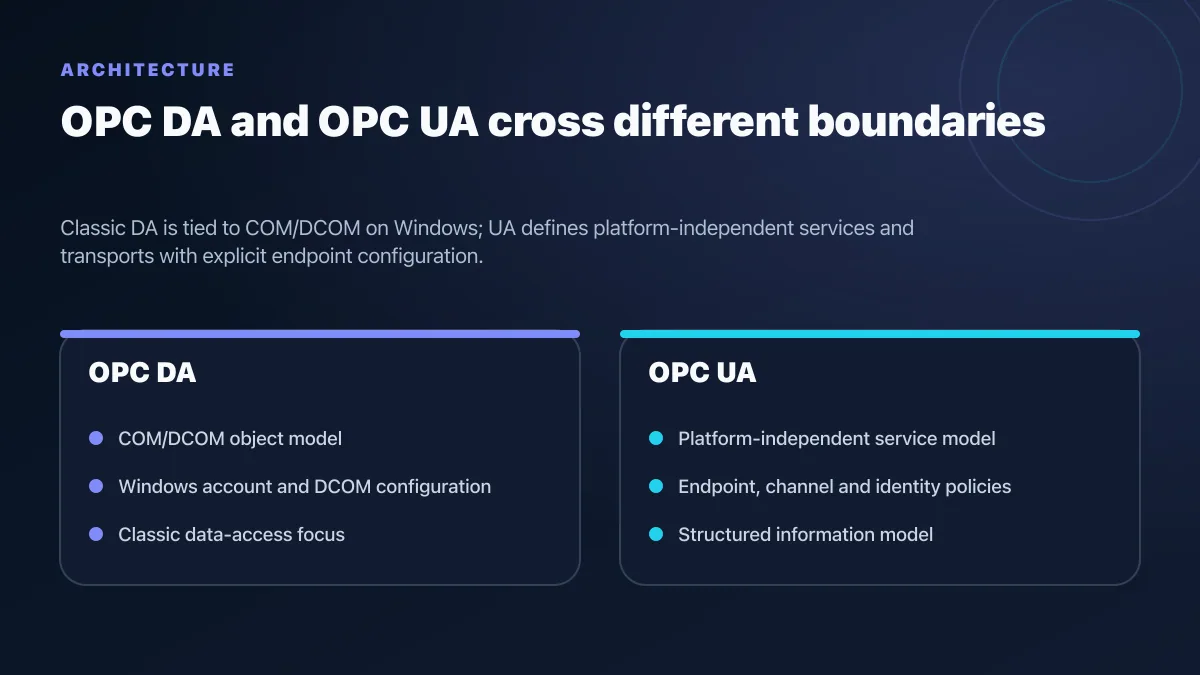
| Feature | OPC DA | OPC UA | |---------|--------|--------| | Full Name | OPC Data Access | OPC Unified Architecture | | Release Year | 1996 | 2008 | | Platform Support | Windows only | Cross-platform (Windows, Linux, VxWorks, embedded) | | Communication | DCOM (Distributed COM) | Binary TCP, HTTPS, Web Services | | Security | Windows security (limited) | Built-in authentication, encryption, certificates | | Data Model | Flat namespace (items/tags) | Rich information models, complex data types | | Firewall Friendly | No (DCOM issues) | Yes (single configurable port) | | Complexity | Simple flat structure | Complex hierarchical models | | Performance | Good (local networks) | Excellent (optimized binary protocol) | | Remote Access | Difficult (DCOM tunneling required) | Native support with secure transport | | Historical Data | Separate OPC HDA specification | Integrated in UA specification | | Alarms & Events | Separate OPC A&E specification | Integrated in UA specification | | Discovery | Manual configuration | Automatic discovery services | | Standardization | OPC Classic specifications | IEC 62541 international standard | | Industry 4.0 | Not designed for modern requirements | Purpose-built for Industry 4.0 | | Cloud Integration | Very difficult | Native support | | Mobile Support | Not supported | Supported | | Maintenance Status | Legacy (maintenance mode) | Active development |

This comparison reveals that while OPC DA provided reliable communication for traditional SCADA architectures, OPC UA represents a complete reimagining of industrial communication designed for modern connectivity requirements, security demands, and Industry 4.0 integration challenges.

Chapter 1: What is OPC DA (Data Access)?

OPC Data Access History and Development

OPC Data Access emerged in 1996 as the first OPC specification, created by a consortium of industrial automation vendors seeking to eliminate proprietary communication protocols that prevented interoperability between devices from different manufacturers. The OPC Foundation developed OPC DA to standardize real-time data exchange between control systems, HMIs, and field devices using Microsoft's COM/DCOM technology.

The Problem OPC DA Solved

Before OPC DA, each PLC manufacturer, SCADA vendor, and industrial device provider implemented proprietary communication protocols requiring custom drivers for every device-application combination. Integrators spent enormous effort developing and maintaining hundreds of device drivers, creating fragility and limiting flexibility in industrial automation systems.

OPC DA established a standardized client-server architecture where OPC servers provide data from industrial devices through a common interface accessible to any OPC DA client application. This architectural approach reduced integration complexity from N×M connections (every application connecting to every device) to N+M connections (applications connecting to standardized OPC servers).

Evolution Through OPC Classic Specifications

OPC DA evolved through multiple versions (OPC DA 1.0, 2.0, 3.0) adding features including group management, asynchronous operations, and browsing capabilities. Additional OPC Classic specifications complemented OPC DA including OPC Historical Data Access (HDA) for historical data retrieval, OPC Alarms & Events (A&E) for alarm notification, and specialized specifications for batch operations and security.

OPC DA Architecture and Technology Foundation

DCOM Communication Architecture

OPC DA relies on Microsoft's Distributed Component Object Model (DCOM) for communication between clients and servers, even when both applications run on the same computer. DCOM provides remote procedure call capabilities, automatic marshaling, and integration with Windows security, making it a logical foundation for Windows-based industrial communication in the late 1990s.

This DCOM dependency creates both advantages and limitations. DCOM integrates seamlessly with Windows operating systems and provides mature, stable communication. However, DCOM requires complex configuration for cross-network communication, creates significant firewall traversal challenges, and limits OPC DA to Windows platforms exclusively.

Client-Server Communication Model

OPC DA implements a strict client-server model where OPC servers connect to physical devices or control systems, reading data from field equipment and making it available through standardized interfaces. OPC clients (SCADA systems, historians, HMIs, enterprise applications) connect to OPC servers requesting data subscriptions or on-demand reads.

The client can create groups containing multiple data items with common update rates, deadbands, and activation states. Servers notify clients of data changes through callback mechanisms, enabling efficient communication that updates only when values change significantly rather than polling continuously.

Flat Namespace and Data Modeling

OPC DA organizes data in a flat namespace where items represent individual data points identified by string-based identifiers (Item IDs). While OPC servers can present hierarchical browsing structures, the underlying data model remains fundamentally flat with limited semantic information about relationships between data points.

Each OPC DA item provides a current value, quality indicator, and timestamp. Quality indicators signal normal operation, sensor failures, communication problems, or configuration errors. This simple data model proved sufficient for traditional SCADA applications but lacks the richness required for modern industrial applications requiring complex data types and relationships.

OPC DA Functionality and Capabilities

Real-Time Data Access

OPC DA excels at real-time data access, providing synchronous reads for immediate data values, asynchronous reads for non-blocking operations, and subscriptions that notify clients when data changes significantly. These access patterns support both polling-based and event-driven application architectures.

Update rates control subscription refresh frequency, while deadbands prevent unnecessary updates when values change insignificantly. These features optimize network utilization and client processing by transmitting only meaningful data changes rather than continuous updates.

Data Quality and Timestamps

Every OPC DA data value includes quality information indicating data reliability and validity. Quality codes communicate normal operation (Good quality), sensor or device problems (Bad quality), or temporary conditions such as configuration errors or initial values (Uncertain quality). This quality information enables applications to make appropriate decisions about data usability.

Timestamps indicate when devices captured data, enabling applications to detect stale data, correlate events across distributed systems, and understand temporal relationships. Timestamp accuracy depends on device capabilities and server implementation quality.

Browsing and Discovery

OPC DA servers provide browsing interfaces enabling clients to discover available data items without prior configuration knowledge. Hierarchical browsing organizes items into logical structures while flat browsing lists all available items. Properties associated with items provide additional metadata including engineering units, high/low limits, and data types.

Limitations and Constraints

OPC DA's DCOM foundation creates significant limitations for modern industrial applications:

  • Platform Lock-In: Windows-only operation prevents deployment on Linux, real-time operating systems, or embedded platforms
  • Network Complexity: DCOM's dynamic port allocation complicates firewall configuration and remote access
  • Security Weaknesses: Limited security features beyond Windows authentication create vulnerabilities for modern threat environments
  • Remote Access Challenges: Cross-network communication requires complex DCOM configuration or tunneling solutions
  • Separate Specifications: Historical data, alarms, and events require separate specifications and server implementations
  • Limited Data Modeling: Flat namespace prevents rich semantic modeling of complex industrial systems

Chapter 2: What is OPC UA (Unified Architecture)?

OPC Unified Architecture Overview and Design Philosophy

OPC Unified Architecture represents a complete redesign of industrial communication rather than an evolution of OPC Classic specifications. Released in 2008 after several years of development, OPC UA addresses fundamental limitations in OPC DA while unifying all OPC Classic functionality (data access, historical data, alarms & events, commands) into a single comprehensive specification.

Design Principles Driving OPC UA Development

The OPC Foundation designed OPC UA with several core principles addressing modern industrial communication requirements:

  1. Platform Independence: Remove Windows dependency enabling deployment on any operating system or hardware platform
  2. Service-Oriented Architecture: Use web service patterns for flexibility and future extensibility
  3. Integrated Security: Build security into the protocol foundation rather than relying on operating system features
  4. Rich Information Modeling: Support complex data types, relationships, and semantic information beyond simple data points
  5. Unified Functionality: Combine all OPC Classic specifications into a single comprehensive architecture
  6. Internet Connectivity: Enable secure communication across the Internet without VPNs or special tunneling
  7. Scalability: Support from embedded devices to enterprise systems with appropriate protocol profiles
  8. Standards-Based: Adopt international standards including IEC 62541 for broad industry acceptance

OPC UA's Revolutionary Approach

Rather than incrementally improving OPC DA, the OPC Foundation reimagined industrial communication for modern requirements. OPC UA abandons DCOM entirely, implements platform-independent communication protocols, defines comprehensive information modeling capabilities, and integrates security at the protocol foundation. This revolutionary approach positions OPC UA for long-term viability addressing emerging requirements including IIoT, cloud integration, and Industry 4.0 initiatives.

OPC UA Architecture and Communication

Service-Oriented Architecture (SOA)

OPC UA implements service-oriented architecture where servers expose services that clients invoke to perform operations. Standard services include reading/writing data, browsing address spaces, managing subscriptions, querying historical data, and calling methods. This SOA approach provides flexibility, extensibility, and clear separation between service definitions and implementation details.

Servers implement services according to profiles defining required functionality levels. This profiling enables devices with limited resources to implement core functionality while sophisticated servers provide comprehensive feature sets including redundancy, high availability, and advanced diagnostics.

Multiple Protocol Bindings

Unlike OPC DA's DCOM-only communication, OPC UA defines multiple protocol bindings supporting different deployment scenarios:

  1. UA Binary Protocol over TCP: Optimized binary encoding for maximum performance with minimal overhead, ideal for high-speed industrial communication
  2. UA XML Protocol over HTTP/HTTPS: XML encoding for web service integration and situations prioritizing interoperability over performance
  3. UA JSON Protocol over HTTPS: JSON encoding for web applications, mobile clients, and cloud integration
  4. MQTT and AMQP PubSub: Publish-subscribe patterns for distributed architectures and cloud connectivity

This multi-protocol approach enables OPC UA deployment in virtually any network environment while allowing profile selection based on performance requirements, integration needs, and device capabilities.

Platform-Independent Implementation

OPC UA's platform independence stems from careful specification design avoiding operating system dependencies. The OPC Foundation provides reference implementations in multiple programming languages (C, C++, Java, .NET) running on Windows, Linux, VxWorks, and embedded platforms including ARM processors and real-time operating systems.

This cross-platform capability enables OPC UA deployment throughout industrial architectures from embedded sensors to edge gateways to cloud services, creating seamless communication across heterogeneous computing environments without protocol translation or gateway devices.

OPC UA Information Modeling and Address Space

Rich Object-Oriented Modeling

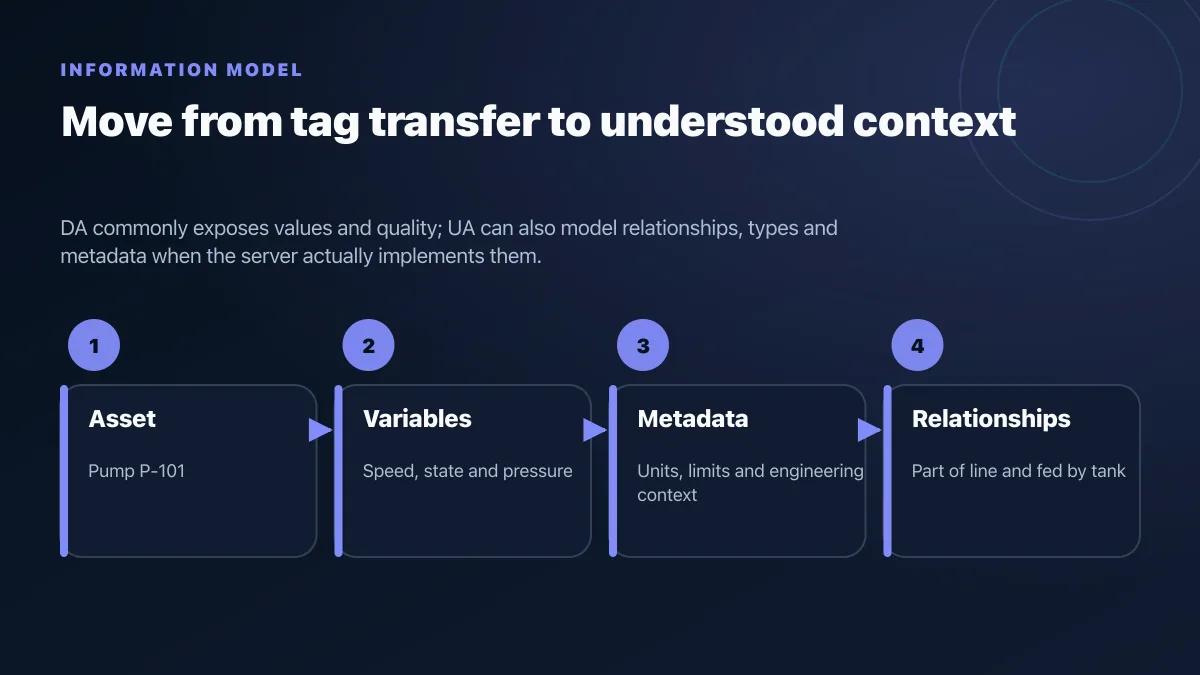
OPC UA's information modeling capabilities far exceed OPC DA's flat namespace, supporting object-oriented concepts including types, instances, inheritance, and polymorphism. This rich modeling enables semantic representation of industrial equipment, processes, and relationships using hierarchical address spaces that mirror real-world structures.

Objects in OPC UA contain variables (data values), methods (callable functions), and events (notifications). Type definitions describe object structure while instances represent specific devices or equipment. This object model provides the semantic richness required for self-describing industrial systems supporting plug-and-play integration.

Standard Information Models and Companion Specifications

The OPC Foundation develops standardized information models for common industrial domains through Companion Specifications. These specifications define standard type definitions, object structures, and data semantics ensuring interoperability between devices from different manufacturers:

  • OPC UA for Devices (DI): Generic device integration and topology
  • OPC UA for Machinery: Machine tools, automation equipment
  • OPC UA for PLCs (PLCopen): Programmable logic controller standardization
  • OPC UA for Robotics: Industrial robot integration
  • OPC UA for EUROMAP: Plastics and rubber machinery
  • OPC UA for PackML: Packaging machinery integration
  • OPC UA for AutoID: Identification systems (RFID, barcode)
  • OPC UA for CNC: Computer numerical control systems
  • OPC UA for Industrial Applications: Process control and automation

These companion specifications accelerate integration and ensure consistency across implementations, dramatically reducing engineering effort compared to proprietary data models.

Type System and Complex Data Types

OPC UA supports rich data types beyond OPC DA's basic types, including structures, arrays, enumerations, and user-defined types. This type system enables efficient exchange of complex data structures representing recipes, product specifications, diagnostic information, and analytical results without flattening into simple data points.

Type definitions provide metadata describing data structure, relationships, constraints, and semantics. Clients can discover type information dynamically, enabling generic applications that adapt to server capabilities without prior configuration knowledge.

OPC UA Security Architecture

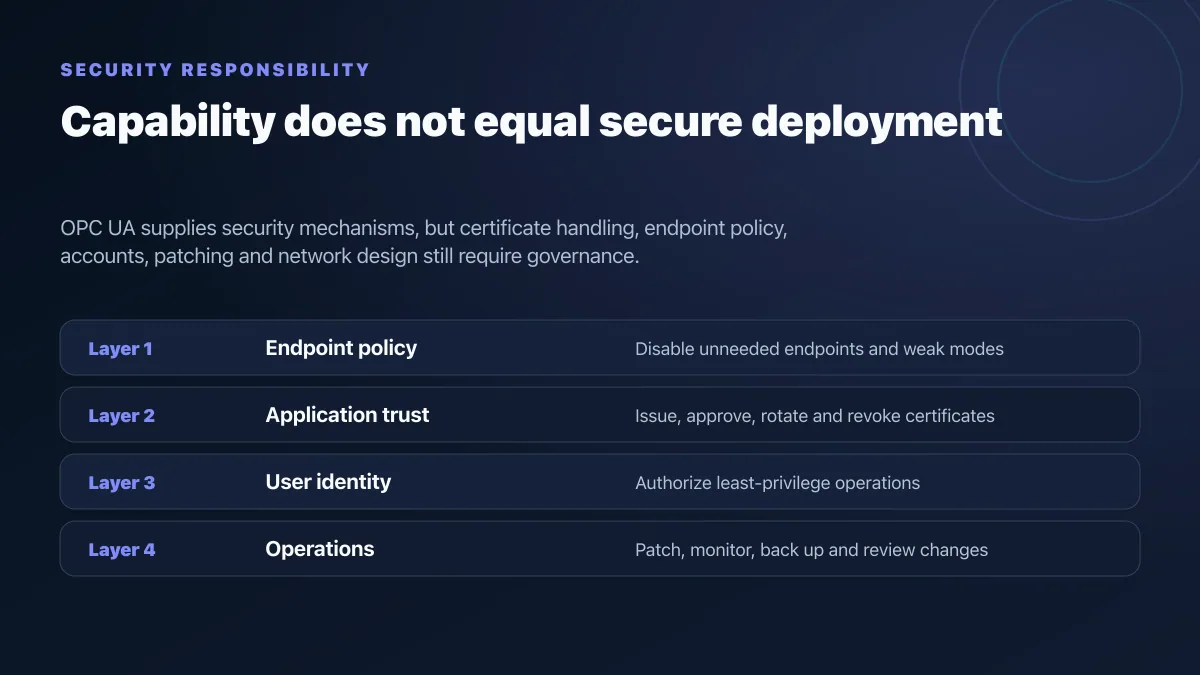
Built-In Security Features

OPC UA integrates comprehensive security features at the protocol foundation rather than relying on operating system or network security:

  1. Authentication: Verifies identity of clients and servers using certificates, usernames/passwords, or tokens
  2. Authorization: Controls access to server resources based on authenticated identity and permissions
  3. Confidentiality: Encrypts message content preventing eavesdropping
  4. Integrity: Ensures messages haven't been tampered with during transmission
  5. Auditing: Logs security-relevant events for compliance and forensics
  6. Application Authentication: Validates application identity independent of user identity

Certificate-Based Security

OPC UA uses X.509 certificates for application authentication establishing trust between clients and servers. Certificates can be self-signed for isolated systems, issued by local certificate authorities for organizational security, or obtained from public certificate authorities for Internet-facing applications.

Certificate exchange and validation occur before establishing secure communication. Trust lists define acceptable certificates while certificate revocation lists identify compromised certificates that should be rejected despite valid signatures.

Security Policies and Modes

OPC UA defines security policies combining cryptographic algorithms for authentication, encryption, and signing. Standard policies include None (no security), Basic128Rsa15, Basic256, Basic256Sha256, and Aes128Sha256RsaOaep providing different security levels and algorithm combinations.

Security modes determine how policies are applied: None (no security), Sign (messages signed but not encrypted), and SignAndEncrypt (messages both signed and encrypted). Organizations select appropriate combinations balancing security requirements against performance considerations and device capabilities.

Chapter 3: Head-to-Head Technical Comparison

Platform Independence and Operating System Support

OPC DA Platform Limitations

OPC DA's complete dependence on Windows operating systems and DCOM technology creates fundamental platform limitations. Organizations must deploy Windows servers for OPC DA servers even when control systems use other operating systems. This Windows requirement increases licensing costs, creates security vulnerabilities, and limits deployment flexibility particularly for embedded systems, edge computing, and cloud deployments.

Attempts to create OPC DA implementations on non-Windows platforms through DCOM emulation proved unreliable and never achieved production-quality stability. The tight integration between OPC DA and Windows COM/DCOM makes platform independence essentially impossible without complete protocol redesign.

OPC UA Cross-Platform Capabilities

OPC UA's platform-independent design enables deployment on virtually any computing platform including Windows, Linux distributions, real-time operating systems (VxWorks, QNX), embedded systems (ARM, x86), and cloud platforms (AWS, Azure, Google Cloud). This flexibility enables OPC UA throughout industrial architectures without platform constraints.

Organizations can select optimal platforms for specific use cases—hardened embedded Linux for edge gateways, real-time operating systems for time-critical control, cloud platforms for analytics and machine learning—while maintaining consistent communication protocols across the entire architecture.

Impact on System Architecture

Platform independence fundamentally changes industrial architecture possibilities. OPC UA enables containerized deployments for scalability, microservices architectures for flexibility, edge computing for local intelligence, and seamless cloud integration for advanced analytics. These modern architectural patterns prove difficult or impossible with OPC DA's Windows dependency.

Security Capabilities Comparison

OPC DA Security Model

OPC DA security relies entirely on Windows security features including user authentication, access control lists, and DCOM security settings. While adequate for isolated industrial networks in the 1990s, this approach creates significant vulnerabilities for modern industrial systems requiring defense-in-depth security:

  • No Message Encryption: OPC DA transmits data in clear text exposing sensitive information to network eavesdropping
  • Limited Authentication: Relies on Windows domain authentication incompatible with cross-organizational communication
  • No Message Integrity: Cannot detect man-in-the-middle attacks or message tampering
  • DCOM Vulnerabilities: DCOM security configuration complexity creates misconfigurations exploited by attackers
  • No Application Authentication: Cannot verify application identity independent of user credentials
  • Limited Auditing: Security event logging depends on Windows auditing configuration

OPC UA Security Architecture

OPC UA provides comprehensive security integrated into the protocol foundation, meeting modern cybersecurity requirements for industrial systems:

| Security Feature | OPC DA | OPC UA | |------------------|--------|--------| | Application Authentication | No | Yes (X.509 certificates) | | User Authentication | Windows only | Certificates, username/password, tokens | | Message Encryption | No | Yes (multiple algorithms) | | Message Signing | No | Yes (integrity verification) | | Authorization | Windows ACLs | Flexible role-based access control | | Audit Logging | Limited | Comprehensive security event logging | | Secure Key Exchange | N/A | Asymmetric encryption for key exchange | | Certificate Management | N/A | Trust lists, revocation, validation | | Security Policies | None | Multiple standard policies | | Standards Compliance | N/A | IEC 62443 alignment |

Real-World Security Implications

For modern industrial applications requiring secure remote access, cloud connectivity, or cross-organizational communication, OPC UA's security architecture provides essential capabilities that OPC DA fundamentally cannot match. Organizations facing compliance requirements (NERC CIP, IEC 62443, GDPR) find OPC DA's security limitations create significant compliance challenges.

Network and Firewall Considerations

OPC DA DCOM Networking Challenges

DCOM's networking behavior creates notorious difficulties for industrial applications, particularly involving firewalls or cross-network communication:

Dynamic Port Allocation: DCOM dynamically allocates TCP ports from a large range (typically 1024-65535) for communication. Firewalls must allow this entire port range or require complex configuration restricting DCOM to specific port ranges while ensuring applications use those ranges.

Multiple Connection Requirements: OPC DA communication requires multiple DCOM connections using different ports including the OPC server endpoint, OPCEnum for server discovery, and callback connections from server to client. This complexity makes firewall traversal extremely difficult.

NAT and Routing Issues: Network Address Translation (NAT) devices and routers often break DCOM communication due to embedded IP addresses in DCOM protocols. Tunneling solutions (OPC tunnelers, VPNs) address these issues but add cost, complexity, and potential performance bottlenecks.

OPC UA Firewall-Friendly Design

OPC UA eliminates DCOM networking problems through deliberate firewall-friendly design:

Single Configurable Port: OPC UA servers listen on a single TCP port (commonly 4840 or 4843 for HTTPS) configurable during server setup. Firewalls need only allow this single port dramatically simplifying configuration.

No Callback Connections: OPC UA uses polling-based subscriptions over the same connection used for initial communication, eliminating separate callback connections required by OPC DA.

NAT and Routing Compatible: OPC UA's standard TCP/IP communication traverses NAT devices and routers without special configuration or tunneling.

Internet-Capable: OPC UA's security features and firewall-friendly networking enable secure communication across the Internet without VPNs, though VPNs can provide additional defense-in-depth security.

Practical Networking Comparison

| Scenario | OPC DA | OPC UA | |----------|--------|--------| | Same Subnet | Simple, works well | Simple, works well | | Different Subnets | DCOM configuration required | Simple, works well | | Through Firewall | Complex, often requires tunneling | Simple, single port | | Across Internet | Very difficult, requires VPN/tunneling | Native support with encryption | | Behind NAT | Often fails without tunneling | Works without special configuration | | Remote Access | Requires third-party solutions | Native capability |

Performance and Efficiency

OPC DA Performance Characteristics

OPC DA provides good performance for traditional SCADA applications within local networks. DCOM introduces moderate overhead but optimizations for local communication deliver acceptable performance for typical industrial data rates (hundreds to thousands of data points updated per second).

Group-based subscriptions optimize performance by aggregating multiple data items with common update characteristics, reducing overhead compared to individual item subscriptions. Deadband filtering prevents unnecessary updates when values change insignificantly, reducing network traffic and client processing.

OPC UA Performance Optimization

OPC UA's binary TCP protocol delivers excellent performance comparable to or exceeding OPC DA for most applications. Binary encoding minimizes message size while efficient serialization reduces processing overhead. Subscription-based communication aggregates multiple monitored items into single messages optimizing network utilization.

Performance optimizations in OPC UA include:

  • Binary Encoding: Compact binary representation minimizes bandwidth
  • Message Chunking: Large messages split into manageable chunks for efficient transmission
  • Subscription Aggregation: Multiple monitored items updated in single messages
  • Sampling Intervals: Separate sampling from publishing for optimal server resource usage
  • Queuing: Buffering ensures data delivery despite temporary network disruptions
  • Deadband Filtering: Prevents updates for insignificant value changes

Benchmarking Results

Independent benchmarks show OPC UA binary protocol achieving throughput comparable to OPC DA while OPC UA's improved architecture often delivers better performance for specific scenarios:

  • High-frequency Updates: OPC UA's subscription aggregation excels for numerous rapidly-changing data points
  • Large Data Structures: OPC UA's complex data types enable efficient bulk data transfer
  • Remote Access: OPC UA's single-connection architecture reduces overhead compared to OPC DA's multiple connections
  • Scalability: OPC UA performs better with very large numbers of clients due to efficient session management

Data Modeling Capabilities

OPC DA Flat Namespace

OPC DA's flat namespace with string-based item identifiers proved sufficient for traditional SCADA applications reading sensor values and writing setpoints. However, this simple model lacks semantic richness for modern applications requiring:

  • Complex product recipes with structured data
  • Equipment relationships and hierarchies
  • Type information and metadata
  • Historical context and provenance
  • Analytical results with multiple related values
  • Diagnostic information with nested structures

While OPC DA servers can present hierarchical browsing, the underlying data model remains flat. Relationships between data points must be inferred by applications based on naming conventions rather than explicit semantic definitions.

OPC UA Rich Information Models

OPC UA's object-oriented information modeling provides semantic richness supporting modern industrial applications. Objects contain variables, methods, and events with defined relationships, inheritance hierarchies, and type definitions. This rich modeling enables:

Self-Describing Systems: Equipment exposes its own structure, capabilities, and data semantics enabling plug-and-play integration without pre-configuration

Complex Data Types: Structures, arrays, and nested types represent complex information efficiently without flattening into simple tags

Methods and Commands: Callable functions enable rich device interaction beyond reading/writing values

Events and Alarms: Structured event notifications with contextual information and relationships to source objects

Historical Data Integration: Unified address space includes current, historical, and aggregated data

Type Definitions: Reusable type definitions ensure consistency and enable specialized applications understanding standard types

Practical Modeling Example

Consider modeling a packaging machine:

OPC DA Approach: Flatten machine into hundreds of individual tags:

  • PackagingMachine_01.Speed_SP
  • PackagingMachine_01.Speed_PV
  • PackagingMachine_01.Temperature_Zone1
  • PackagingMachine_01.Product_Name
  • (hundreds more individual items)

OPC UA Approach: Hierarchical object model:

  • PackagingMachine (Object)
    • SpeedControl (Object with setpoint, process value, control mode)
    • TemperatureZones[] (Array of temperature control objects)
    • CurrentProduct (Complex structure with name, recipe, batch info)
    • Diagnostics (Object with methods, counters, maintenance info)
    • Events (OperatingState changes, alarms, warnings)

The OPC UA model provides context, relationships, and semantics that applications can understand and utilize without prior configuration knowledge.

Scalability and System Size

OPC DA Scalability Limits

OPC DA scales reasonably well for typical SCADA systems with hundreds to thousands of data points and dozens of concurrent clients. However, limitations emerge for very large systems:

  • DCOM Resource Consumption: Each client connection consumes significant Windows resources
  • Server Capacity: Single OPC DA servers typically handle thousands of items and dozens of clients before performance degrades
  • No Federation: OPC DA lacks mechanisms for federating multiple servers into unified namespaces
  • Client-Side Complexity: Clients must manage connections to multiple servers for distributed systems

OPC UA Enterprise Scalability

OPC UA scales from embedded devices with limited resources to enterprise-scale systems handling millions of data points:

Vertical Scalability: OPC UA servers efficiently handle tens of thousands of clients and millions of data points through optimized session management and message aggregation

Horizontal Scalability: Aggregating servers federate multiple backend servers presenting unified namespaces to clients. This enables distributed architectures spanning factories, regions, or globally

Profile-Based Scaling: Device profiles enable resource-constrained devices to implement core functionality while sophisticated servers provide comprehensive features

Cloud Scalability: OPC UA integrates with cloud platforms enabling auto-scaling, load balancing, and global distribution for analytics and machine learning applications

Redundancy and High Availability: OPC UA specifications define redundancy and high availability mechanisms supporting five-nines availability requirements

Ease of Implementation and Deployment

OPC DA Implementation Simplicity

OPC DA's maturity and simplicity make implementation relatively straightforward for experienced Windows developers. Abundant OPC DA servers, drivers, and client development tools simplify integration for traditional SCADA architectures.

However, implementation challenges include:

  • DCOM Configuration: Complex DCOM security and networking configuration creates deployment difficulties
  • Platform Limitations: Windows requirement constrains deployment options
  • Multiple Specifications: Separate implementations required for data access, historical data, and alarms/events
  • Limited Tooling: Modern development tools and frameworks don't support DCOM creating maintenance challenges

OPC UA Implementation Considerations

OPC UA's comprehensive functionality and rich information modeling create steeper learning curves compared to OPC DA. However, this complexity delivers significant long-term benefits:

Advantages:

  • Platform flexibility enables deployment on optimal platforms
  • Integrated security simplifies security implementation
  • Unified specification covers all functionality
  • Modern protocol design integrates with current development practices
  • Abundant SDKs and tools support rapid development
  • Standard information models reduce custom engineering

Challenges:

  • Information modeling requires understanding object-oriented concepts
  • Certificate management adds operational complexity
  • More configuration options require careful planning
  • Fewer experienced developers compared to OPC DA's mature ecosystem

Deployment Complexity

| Deployment Aspect | OPC DA | OPC UA | |-------------------|--------|--------| | Initial Setup | Simple (if Windows-only) | Moderate (more options) | | Network Configuration | Complex (DCOM, firewalls) | Simple (single port) | | Security Configuration | Simple but weak | Comprehensive but more complex | | Remote Access | Very complex | Straightforward | | Multi-Platform | Impossible | Straightforward | | Maintenance | Windows updates, DCOM issues | Standard software maintenance |

Cost Considerations

OPC DA Total Cost of Ownership

OPC DA's costs include:

Licensing: Windows Server licensing for OPC servers, OPC DA client/server SDKs (vendor-dependent)

Infrastructure: Windows-based servers and infrastructure even when control systems use other platforms

Integration: Third-party OPC servers/drivers for device connectivity, tunneling products for remote access, separate servers for historical data and alarms/events

Maintenance: Windows update management, DCOM troubleshooting, legacy system support, skilled Windows administrators

OPC UA Cost Structure

OPC UA's costs include:

Licensing: Many open-source SDK options, commercial SDKs available, device implementations often built into products

Infrastructure: Platform flexibility enables optimal infrastructure choices potentially reducing costs

Integration: Standardized information models reduce custom engineering, single server handles all functionality, no tunneling products required

Maintenance: Standard software maintenance without DCOM complexity, potentially lower administrative overhead

Long-Term Value Comparison

While initial OPC UA implementation may require higher engineering investment due to information modeling and security configuration, long-term costs often favor OPC UA through:

  • Reduced infrastructure costs from platform flexibility
  • Eliminated tunneling product licensing and maintenance
  • Reduced integration engineering from standard information models
  • Lower security remediation costs from integrated security
  • Future-proofing investment against obsolescence

Chapter 4: OPC DA Advantages and Use Cases

When OPC DA Makes Sense

Despite OPC UA's technical superiority, specific scenarios justify continued OPC DA usage:

Existing Infrastructure Investment

Organizations with substantial investment in OPC DA infrastructure including deployed servers, licensed software, trained personnel, and proven architectures may find continued OPC DA operation cost-effective for stable systems without expansion requirements.

Simple Local SCADA Applications

Small-scale local SCADA systems confined to single facilities on isolated networks without remote access requirements can leverage OPC DA's simplicity and maturity. These applications avoid OPC DA's networking and security limitations while benefiting from straightforward implementation.

Legacy Equipment Integration

Older industrial equipment with only OPC DA server support may necessitate OPC DA infrastructure. While OPC UA gateway solutions enable protocol translation, some scenarios justify maintaining OPC DA communication for equipment approaching end-of-life before system-wide migration.

Resource-Constrained Budgets

Organizations with limited budgets and no near-term expansion plans may continue OPC DA operation to defer migration investment until business requirements justify modernization.

OPC DA Strengths

Mature Ecosystem

Two decades of OPC DA deployment created an extensive ecosystem of:

  • OPC DA servers for virtually every industrial device and control system
  • Proven client applications including SCADA, historians, and HMIs
  • Experienced integrators and developers with deep OPC DA expertise
  • Abundant troubleshooting knowledge and support resources
  • Stable specifications without compatibility-breaking changes

Simplicity for Basic Applications

OPC DA's flat namespace and simple data model prove sufficient for straightforward applications reading sensor values and writing control setpoints without requiring complex data relationships or rich semantics.

Proven Reliability

Decades of field deployment validated OPC DA reliability in stable industrial networks. Organizations operating OPC DA systems for years without problems may find "if it isn't broken, don't fix it" logic compelling for systems without changing requirements.

Lower Training Requirements

OPC DA's conceptual simplicity enables shorter training cycles for new developers and integrators compared to OPC UA's comprehensive specifications and information modeling requirements.

OPC DA Practical Applications

Manufacturing Execution Systems (MES)

MES applications collecting production counts, equipment status, and quality data from existing OPC DA-equipped manufacturing lines can continue reliable operation while planning migration to OPC UA for new equipment or facility expansions.

Historical Data Collection

Data historians connecting to OPC DA servers for time-series data collection and long-term storage provide stable functionality for trend analysis and reporting applications without complex data modeling requirements.

Local HMI Systems

Human-machine interfaces providing local operator control and monitoring in isolated control rooms without remote access needs can leverage OPC DA's straightforward client implementation and proven reliability.

Building Automation

Building automation systems integrating HVAC, lighting, and access control often use OPC DA for communication between building management systems and field controllers in single-facility applications without Internet connectivity needs.

Chapter 5: OPC UA Advantages and Use Cases

Modern Industrial Communication Requirements

OPC UA addresses critical requirements for contemporary industrial automation and Industry 4.0 initiatives:

Industry 4.0 and Smart Manufacturing

Industry 4.0 initiatives require seamless data flow from shop floor to top floor to cloud services for advanced analytics, machine learning, and optimization. OPC UA's platform independence, security, and rich information modeling provide essential foundation for smart manufacturing architectures.

IIoT and Cloud Integration

Industrial Internet of Things (IIoT) architectures connecting edge devices to cloud platforms for analytics, visualization, and machine learning require secure, firewall-friendly protocols supporting modern communication patterns. OPC UA delivers these capabilities where OPC DA fundamentally cannot.

Mobile Access and Remote Monitoring

Modern industrial applications require mobile device access for remote monitoring, diagnostics, and control. OPC UA's platform independence and secure remote access capabilities enable native mobile applications impossible with OPC DA.

Cybersecurity Compliance

Regulatory requirements and security frameworks (IEC 62443, NERC CIP, NIST) mandate comprehensive security controls including authentication, encryption, and audit logging. OPC UA's integrated security provides essential capabilities for compliance where OPC DA's limitations create gaps.

OPC UA Technical Strengths

Comprehensive Integrated Functionality

OPC UA unifies all OPC Classic specifications (data access, historical data, alarms & events, programs, batch) into a single comprehensive architecture. This integration eliminates multiple server implementations and complex client coordination required by OPC Classic specifications.

Rich Information Modeling

OPC UA's object-oriented information modeling enables self-describing systems, complex data types, and semantic relationships supporting:

  • Digital twins representing physical assets in cyberspace
  • Asset administration shells (AAS) for Industry 4.0
  • Plug-and-play device integration without pre-configuration
  • Standardized interfaces through companion specifications
  • Application portability across different equipment vendors

Standardized Companion Specifications

Industry-specific OPC UA companion specifications provide standardized information models ensuring interoperability and reducing custom engineering:

  • PackML for packaging machinery provides standard states, modes, and data structures
  • Robotics companion specification enables unified robot control and monitoring
  • Machine vision companion specification standardizes vision system integration
  • Weihenstephan standards for brewery and beverage applications
  • EUROMAP specifications for plastics and rubber machinery
  • AutoID specifications for identification systems (RFID, barcode)

Built-In Redundancy and High Availability

OPC UA specifications define redundancy and high availability mechanisms supporting fault-tolerant architectures:

  • Transparent server redundancy with automatic failover
  • Redundant connections from clients to multiple servers
  • Session transfer enabling stateful failover without data loss
  • Alarm and condition state synchronization across redundant servers

These capabilities enable five-nines availability for critical industrial applications.

Future-Proof Architecture

OPC UA's extensible architecture supports evolving requirements without compatibility-breaking changes. New features, information models, and capabilities integrate into existing specifications maintaining backward compatibility with deployed systems.

OPC UA Deployment Scenarios

Multi-Site Enterprise Architectures

Global manufacturers with facilities across multiple locations benefit from OPC UA's enterprise scalability, cloud integration, and standardized communication enabling:

  • Centralized monitoring and control across distributed facilities
  • Enterprise historians collecting data from worldwide production
  • Unified analytics platforms processing global manufacturing data
  • Standardized equipment integration regardless of location or vendor

Edge Computing and Analytics

Edge computing architectures processing data locally before cloud transmission leverage OPC UA for:

  • Local data collection from diverse equipment using standard interfaces
  • Edge analytics and machine learning models consuming OPC UA data
  • Selective cloud transmission of aggregated results reducing bandwidth
  • Local control loop closure for time-critical operations

Process Optimization and Digital Twins

Digital twin applications creating virtual representations of physical processes require rich data models and semantic information that OPC UA provides:

  • Comprehensive equipment models including structure, parameters, and capabilities
  • Real-time data feeds maintaining digital twin synchronization
  • Method calls enabling virtual control and "what-if" analysis
  • Event notifications capturing state changes and operational transitions

Regulatory Compliance and Audit Trail

Regulated industries (pharmaceutical, food & beverage, nuclear) benefit from OPC UA's comprehensive audit logging, secure authentication, and traceable data provenance supporting regulatory compliance:

  • Complete audit trails of data access and modifications
  • Strong authentication proving user and application identity
  • Data integrity verification detecting tampering
  • Secure archival of records for regulatory retention requirements

Advanced Automation Solutions

Sophisticated automation applications leverage OPC UA's comprehensive capabilities:

  • Coordinated motion control across multi-vendor equipment
  • Recipe management with complex nested data structures
  • Advanced process control with model-predictive algorithms
  • Quality management with in-line measurement and statistical analysis
  • Predictive maintenance using equipment diagnostics and analytics

Chapter 6: When to Choose OPC DA

Decision Criteria for OPC DA Selection

While OPC UA represents the future of industrial communication, specific criteria may justify OPC DA selection for particular applications:

Criteria Checklist for OPC DA:

✓ Windows-only infrastructure with no multi-platform requirements ✓ Isolated local network without Internet connectivity ✓ No remote access requirements beyond local facility ✓ Simple flat data model sufficient for application needs ✓ Limited budget for infrastructure modernization ✓ Existing OPC DA servers and clients operating satisfactorily ✓ No compliance requirements mandating encryption or strong authentication ✓ Short remaining lifecycle before planned system replacement ✓ Available skilled OPC DA developers for maintenance ✓ No planned Industry 4.0 or IIoT initiatives requiring modern connectivity

If most criteria are met, continuing OPC DA operation may prove cost-effective until circumstances change requiring migration to OPC UA or other modern protocols.

Legacy System Maintenance

Maintaining Existing OPC DA Infrastructure

Organizations operating stable OPC DA systems can continue reliable operation through proper maintenance:

Regular Updates: Apply Windows security updates and OPC server software updates maintaining security and stability

Documentation: Maintain comprehensive documentation of server configurations, client connections, and system architecture facilitating troubleshooting and knowledge transfer

Backup Procedures: Implement regular backups of server configurations and critical system data enabling rapid recovery from failures

Security Hardening: Apply security best practices including network isolation, firewall rules, and access controls compensating for OPC DA's limited security features

Performance Monitoring: Monitor system performance and resource utilization identifying potential issues before they impact operations

Hybrid Approaches

OPC DA with Gateway Translation

Organizations with substantial OPC DA infrastructure can implement hybrid approaches using gateways translating between OPC DA and OPC UA:

OPC DA/UA Gateways connect to existing OPC DA servers exposing their data through OPC UA interfaces. This approach:

  • Enables OPC UA clients to access legacy OPC DA data
  • Maintains existing OPC DA servers without modification
  • Provides migration path toward pure OPC UA architecture
  • Adds security through gateway-based access control

Implementation Considerations:

  • Gateway introduces single point of failure requiring redundancy
  • Performance overhead from protocol translation
  • Limited information modeling beyond flat OPC DA namespace
  • License costs for gateway software

Chapter 7: When to Choose OPC UA

Decision Criteria for OPC UA Selection

OPC UA selection makes sense when applications require modern industrial communication capabilities addressing contemporary challenges:

Criteria Checklist for OPC UA:

✓ Multi-platform requirements (Windows, Linux, embedded systems) ✓ Cloud integration for analytics, machine learning, or remote monitoring ✓ Secure remote access across Internet or untrusted networks ✓ Mobile application support for operators or maintenance personnel ✓ Complex data modeling with relationships and hierarchies ✓ Industry 4.0 or IIoT initiative requirements ✓ Regulatory compliance requiring encryption and strong authentication ✓ Multi-vendor equipment integration requiring standardized interfaces ✓ Long system lifecycle justifying investment in modern architecture ✓ New installation without legacy OPC DA infrastructure constraints

Meeting several of these criteria strongly favors OPC UA selection providing future-proof foundation for evolving requirements.

Greenfield Installations

New Industrial Automation Projects

New installations without legacy OPC DA infrastructure should adopt OPC UA as the foundation for communication architecture:

Future-Proof Investment: OPC UA provides modern capabilities supporting evolving requirements over system lifecycle spanning decades

Standardized Integration: Companion specifications and standardized information models reduce custom engineering and enable multi-vendor solutions

Security Foundation: Built-in security meets current and anticipated cybersecurity requirements without retrofitting

Scalability: Architecture supports growth from initial deployment to enterprise-scale systems

Cloud-Ready: Native cloud integration supports advanced analytics and machine learning initiatives

Modernization and Digital Transformation

Legacy System Modernization

Organizations modernizing legacy industrial systems should adopt OPC UA as communication architecture for modernized components:

Phased Migration: Gradually replace legacy communication as equipment undergoes normal refresh cycles

Gateway Integration: Connect legacy systems through OPC DA/UA gateways during transition period

Standardized Foundation: Establish OPC UA as standard for all new equipment and system expansions

Skills Development: Build organizational expertise in OPC UA preparing for long-term maintenance and enhancement

Industry 4.0 and Smart Manufacturing

Digital Transformation Initiatives

Industry 4.0 and smart manufacturing initiatives require comprehensive data integration from shop floor to enterprise and cloud services. OPC UA provides essential foundation for:

Unified Data Architecture: Single protocol spanning edge devices to cloud platforms

Rich Semantics: Information models enabling analytics, machine learning, and optimization applications to understand industrial data

Interoperability: Standard interfaces enabling rapid integration of best-of-breed solutions

Security: Comprehensive security enabling safe connectivity across organizational boundaries

Real-World Industry 4.0 Use Cases:

  • Predictive maintenance using machine learning models consuming equipment diagnostic data
  • Digital twins synchronizing virtual representations with physical assets
  • Automated quality control integrating in-line measurement with statistical analysis
  • Energy optimization analyzing consumption patterns across equipment and facilities
  • Supply chain integration exchanging production status with upstream suppliers and downstream customers

Chapter 8: Migration from OPC DA to OPC UA

Migration Planning and Strategy

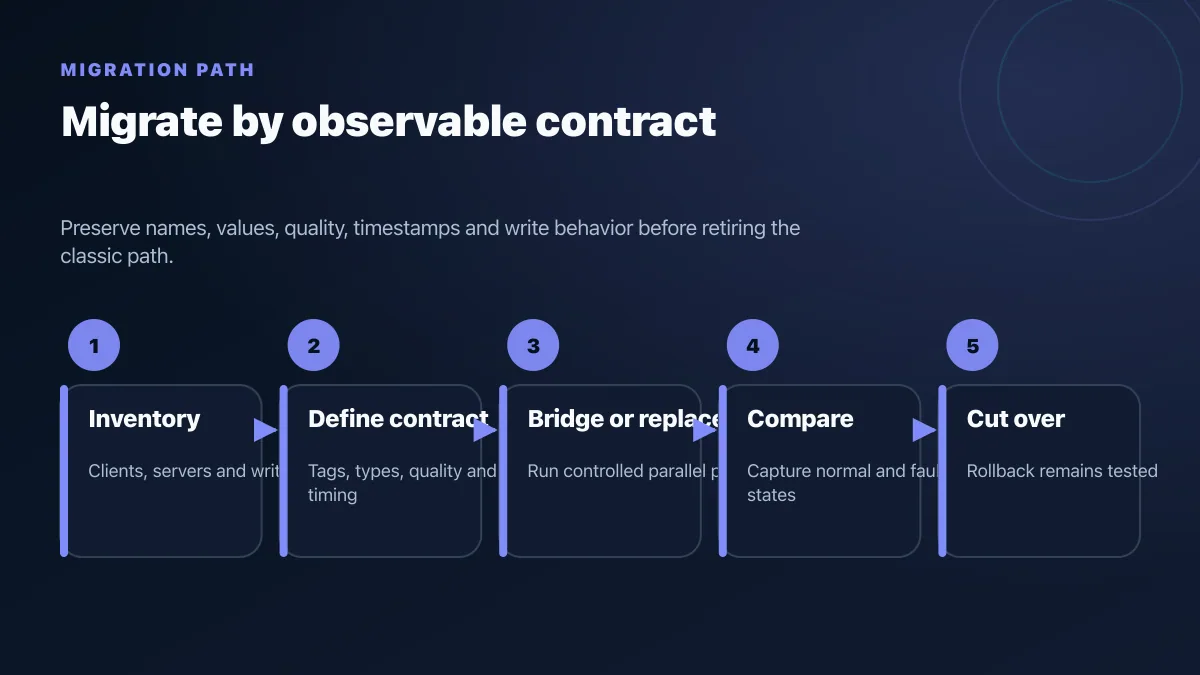
Assessment Phase

Successful migration begins with comprehensive assessment of existing OPC DA infrastructure:

Inventory Current Systems:

  • Document all OPC DA servers, clients, and communication flows
  • Identify server versions, vendor implementations, and device connections
  • Map data flows between applications and systems
  • Document dependencies and integration points

Analyze Requirements:

  • Identify business drivers for migration (security, remote access, platform independence)
  • Define must-have capabilities versus nice-to-have features
  • Establish timeline constraints and budget parameters
  • Assess risk tolerance and downtime acceptability

Evaluate Options:

  • Pure OPC UA replacement for all components
  • Phased migration with temporary gateway solutions
  • Hybrid architecture maintaining some OPC DA for legacy equipment
  • Timeline for complete migration versus indefinite hybrid operation

Migration Approaches

Big Bang Replacement

Replace entire OPC DA infrastructure with OPC UA in single cutover event:

Advantages:

  • Clean architecture without gateway complexity
  • Eliminated dual-system maintenance burden
  • Immediate realization of OPC UA benefits
  • Simplified long-term architecture

Disadvantages:

  • High risk from simultaneous changes
  • Extensive testing requirements
  • Potential extended outage during cutover
  • Large upfront investment requirement

Best For: Smaller systems, planned facility shutdowns, new facility startup

Phased Migration

Gradually replace OPC DA components with OPC UA over extended timeline:

Advantages:

  • Lower risk through incremental changes
  • Spread investment over multiple budget cycles
  • Learn from early phases improving later execution
  • Minimize disruption to operations

Disadvantages:

  • Extended gateway maintenance period
  • Complexity of hybrid architecture
  • Delayed realization of full OPC UA benefits
  • Potential for prolonged intermediate state

Best For: Large complex systems, continuous operations, budget constraints

Gateway-Based Approach

Deploy OPC DA/UA gateways providing protocol translation:

Advantages:

  • Minimal changes to existing OPC DA infrastructure
  • Rapid enablement of OPC UA clients
  • Deferred replacement of functioning OPC DA components
  • Flexibility in migration timing

Disadvantages:

  • Gateway introduces complexity and potential failure point
  • License costs for gateway software
  • Performance overhead from protocol translation
  • Limited information modeling beyond flat namespace

Best For: Interim solution, proof-of-concept projects, long-term hybrid operation

Technical Migration Considerations

Address Space Mapping

Converting OPC DA flat namespaces to OPC UA information models requires careful planning:

Simple Mapping: Recreate OPC DA items as OPC UA variables maintaining identical structure

Enhanced Modeling: Organize variables into logical objects and hierarchies adding semantic value

Standard Models: Adopt companion specifications for equipment types providing standardized interfaces

Data Type Conversion

OPC DA and OPC UA use different data type systems requiring mapping:

| OPC DA Type | OPC UA Equivalent | Considerations | |-------------|-------------------|----------------| | VT_I1, VT_UI1 | SByte, Byte | Direct mapping | | VT_I2, VT_UI2 | Int16, UInt16 | Direct mapping | | VT_I4, VT_UI4 | Int32, UInt32 | Direct mapping | | VT_R4, VT_R8 | Float, Double | Direct mapping | | VT_BOOL | Boolean | Different representation | | VT_BSTR | String | Different encoding | | VT_DATE | DateTime | Different epoch/format | | VT_ARRAY | Arrays | Similar but different syntax |

Security Configuration

Implementing OPC UA security requires careful planning:

Certificate Management:

  • Establish certificate authority or use self-signed certificates
  • Generate certificates for all OPC UA applications
  • Configure trust lists defining acceptable certificates
  • Implement certificate renewal procedures

Security Policies:

  • Select appropriate security policies balancing security and performance
  • Configure security modes (Sign, SignAndEncrypt) based on risk assessment
  • Implement user authentication methods (certificates, username/password)
  • Define authorization rules controlling access to resources

Network Configuration

Simplify network configuration during migration:

Firewall Rules: Replace complex DCOM firewall rules with simple single-port rules for OPC UA

Remote Access: Eliminate tunneling products and VPN complexity with native OPC UA secure connectivity

Network Segmentation: Implement proper network segmentation between OT and IT networks regardless of protocol choice

Migration Testing and Validation

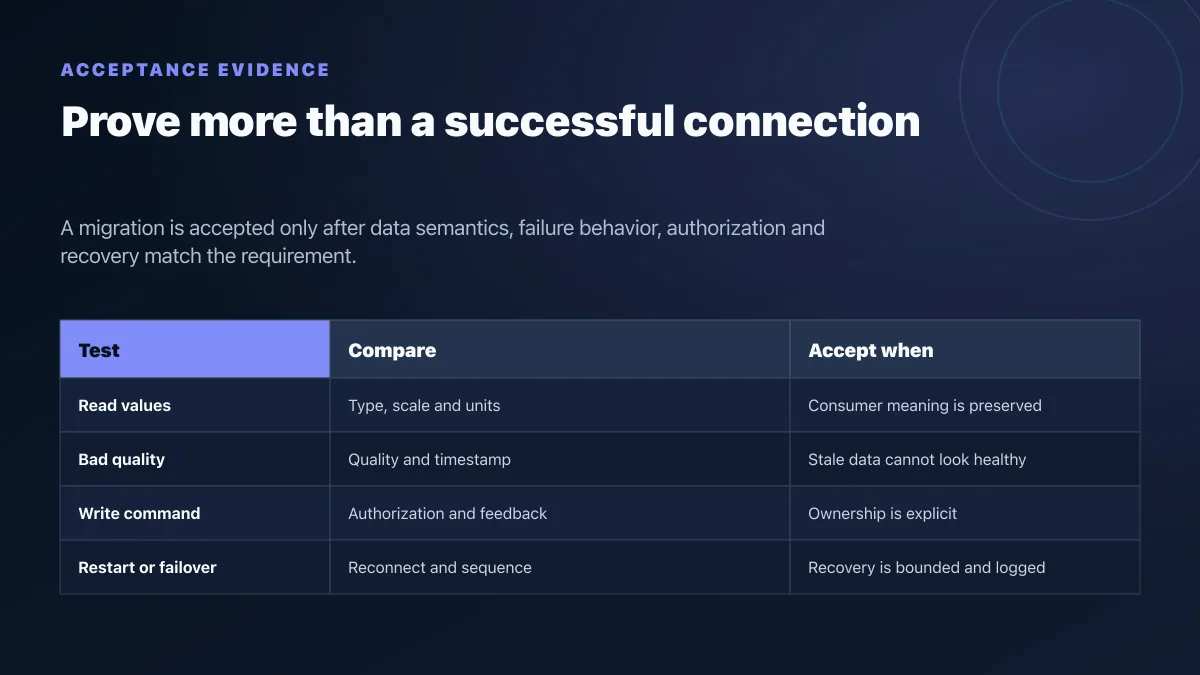
Comprehensive Testing Strategy

Thorough testing prevents migration problems:

Functional Testing:

  • Verify all data points accessible through OPC UA
  • Validate data values match original OPC DA values
  • Confirm data types convert correctly
  • Test all read/write operations

Performance Testing:

  • Measure update rates meeting requirements
  • Monitor network utilization
  • Validate system response times
  • Load test with realistic client counts

Security Testing:

  • Verify authentication mechanisms work correctly
  • Confirm encryption protects data in transit
  • Test authorization rules prevent unauthorized access
  • Validate audit logging captures security events

Integration Testing:

  • Confirm all dependent applications function correctly
  • Test alarm notification and acknowledgment flows
  • Verify historical data collection operates properly
  • Validate enterprise integration through gateways or direct connections

Parallel Operation

Run OPC UA system in parallel with OPC DA during validation:

  • Collect data through both protocols comparing results
  • Identify and resolve any discrepancies
  • Build confidence before final cutover
  • Provide fallback option if issues arise

Migration Best Practices

Plan Thoroughly Before Execution

Invest adequate time in planning, design, and preparation minimizing risks and preventing problems:

  • Document current system comprehensively
  • Design target architecture addressing identified requirements
  • Create detailed migration procedures with rollback plans
  • Identify resources and responsibilities clearly
  • Establish success criteria and validation procedures

Start With Non-Critical Systems

Gain experience with lower-risk systems before migrating critical infrastructure:

  • Prove migration procedures and tooling
  • Develop team skills and confidence
  • Identify unexpected challenges in low-risk environment
  • Refine approach based on lessons learned

Leverage Standard Information Models

Adopt companion specifications where applicable reducing custom engineering and improving interoperability:

  • Research available companion specifications for your industry
  • Participate in companion specification development through OPC Foundation working groups
  • Contribute to standardization efforts benefiting entire industry

Build Internal Expertise

Develop organizational knowledge of OPC UA ensuring long-term success:

  • Training for developers, integrators, and operations personnel
  • Hands-on experience through pilot projects
  • Participation in OPC Foundation and industry groups
  • Documentation of organizational standards and best practices

Frequently Asked Questions

What is the main difference between OPC UA and OPC DA?

The main difference between OPC UA and OPC DA is that OPC DA is a Windows-only protocol using DCOM for communication with a flat data model, while OPC UA is a cross-platform, service-oriented protocol with built-in security, rich information modeling, and support for modern industrial communication requirements including cloud integration and mobile access. OPC UA was designed from the ground up to address OPC DA's limitations while unifying all OPC Classic specifications into a single comprehensive architecture.

Is OPC UA backwards compatible with OPC DA?

No, OPC UA is not directly backwards compatible with OPC DA due to fundamentally different architectures and communication protocols. However, OPC UA clients can access OPC DA data through protocol gateway solutions that translate between OPC DA and OPC UA. Many vendors offer OPC DA/UA gateways enabling gradual migration from OPC DA to OPC UA without requiring immediate replacement of all infrastructure.

Which is faster, OPC UA or OPC DA?

Performance depends on specific implementations and network configurations, but OPC UA's optimized binary protocol typically delivers performance comparable to or exceeding OPC DA for most industrial applications. OPC UA's binary encoding and efficient message aggregation often provide better performance for high-frequency updates and large data structures compared to OPC DA's DCOM overhead. For local network communication with simple data structures, performance differences are minimal in practice.

Can OPC UA and OPC DA run on the same network?

Yes, OPC UA and OPC DA can operate on the same physical network without interference since they use different communication protocols and ports. Organizations commonly run hybrid architectures during migration periods with some systems using OPC DA while others adopt OPC UA. Gateway devices can bridge between the protocols enabling OPC UA clients to access OPC DA servers and vice versa during transition periods.

Why should I migrate from OPC DA to OPC UA?

Migration from OPC DA to OPC UA provides platform independence enabling deployment beyond Windows, integrated security meeting modern cybersecurity requirements, firewall-friendly networking simplifying remote access, rich information modeling supporting Industry 4.0 initiatives, and future-proof architecture addressing evolving industrial communication needs. Organizations facing remote access requirements, cloud integration needs, cybersecurity compliance mandates, or multi-platform deployments benefit significantly from OPC UA migration.

What are the security differences between OPC DA and OPC UA?

OPC DA relies entirely on Windows security features without message encryption, limited authentication options, and no application-level security, creating vulnerabilities for modern industrial systems. OPC UA integrates comprehensive security including X.509 certificate-based authentication, message encryption and signing, flexible authorization mechanisms, comprehensive audit logging, and security policies supporting various security levels. OPC UA's security architecture aligns with IEC 62443 industrial cybersecurity standards while OPC DA cannot meet modern security requirements.

How long does OPC DA to OPC UA migration take?

Migration timeline depends on system complexity, size, and chosen migration approach. Small simple systems may migrate in weeks using big-bang replacement, while large complex systems require phased migration over months or years. Factors affecting timeline include number of OPC DA servers and clients, complexity of address spaces, security requirements, testing and validation requirements, available resources, and acceptable downtime for cutover activities. Organizations should plan 3-12 months for typical industrial automation system migrations.

Does OPC UA require more computing resources than OPC DA?

OPC UA's rich information modeling and security features require moderately more computing resources than OPC DA's simpler architecture. However, modern industrial computing hardware easily handles OPC UA requirements, and the resource difference proves negligible for typical applications. OPC UA's efficient binary protocol and optimized implementations deliver excellent performance on embedded devices, industrial PCs, and enterprise servers. The benefits of OPC UA's capabilities far outweigh marginal resource requirements compared to OPC DA.

Can I use OPC UA with my existing SCADA system?

Most modern SCADA systems support both OPC DA and OPC UA communication enabling gradual migration. Check your SCADA vendor documentation for OPC UA support—major vendors including Siemens, Rockwell, Schneider Electric, GE, Honeywell, and others provide OPC UA connectivity in current product versions. Older SCADA systems limited to OPC DA can access OPC UA servers through gateway devices translating between protocols enabling OPC UA adoption without SCADA replacement.

What industries benefit most from OPC UA over OPC DA?

All industries benefit from OPC UA's modern capabilities, but particular benefit comes to pharmaceutical manufacturing requiring 21 CFR Part 11 compliance and audit trails, automotive manufacturing implementing Industry 4.0 initiatives, oil and gas operations requiring secure remote monitoring, food and beverage processing needing comprehensive traceability, semiconductor manufacturing demanding precise data modeling, and any organization requiring cloud integration, mobile access, or multi-platform deployment. Regulated industries and those pursuing digital transformation initiatives see the greatest immediate benefits.

How much does OPC UA cost compared to OPC DA?

Direct cost comparison proves difficult as both require server implementations (often built into devices), SDK licensing for custom development (open-source options exist for both), and infrastructure costs (OPC UA may reduce costs through platform flexibility). OPC UA typically requires higher initial engineering investment for information modeling and security configuration, but long-term costs often favor OPC UA through reduced infrastructure costs, eliminated tunneling product licensing, lower security remediation expenses, and avoided obsolescence risks. Total cost of ownership over system lifecycle generally favors OPC UA for modern industrial applications.

Is OPC DA officially deprecated or obsolete?

The OPC Foundation maintains OPC Classic specifications including OPC DA in maintenance mode but focuses development efforts exclusively on OPC UA. While not officially deprecated, industry consensus recognizes OPC DA as legacy technology appropriate for existing system maintenance but not recommended for new installations. Major automation vendors continue supporting OPC DA in current products for backward compatibility but emphasize OPC UA as strategic communication protocol. Organizations should plan eventual migration from OPC DA to OPC UA aligning with normal equipment refresh cycles.

Conclusion: Making the Right Choice for Industrial Communication

The comparison between OPC UA vs OPC DA reveals fundamental differences extending far beyond simple protocol variations. OPC DA provided reliable industrial communication for two decades, establishing OPC as the standard for industrial interoperability. However, OPC DA's Windows dependency, DCOM complexity, limited security, and flat data model create significant limitations for modern industrial applications requiring cloud connectivity, mobile access, platform independence, and robust cybersecurity.

OPC UA addresses these limitations through platform-independent design, integrated security, rich information modeling, and unified functionality combining all OPC Classic specifications into a comprehensive architecture. While OPC UA requires higher initial learning investment and implementation complexity, the long-term benefits of future-proof architecture, standardized integration, and comprehensive capabilities justify this investment for organizations planning long system lifecycles and pursuing digital transformation initiatives.

Organizations maintaining stable OPC DA infrastructure without changing requirements can continue reliable operation through proper maintenance and security hardening. However, new installations should adopt OPC UA as foundation for communication architecture, and existing systems should plan eventual migration aligning with normal equipment refresh cycles and infrastructure modernization programs.

The difference between OPC UA and OPC DA ultimately represents the difference between maintaining legacy systems designed for isolated industrial networks versus embracing modern architectures supporting Industry 4.0, IIoT, cloud analytics, and secure remote connectivity. As industrial automation continues evolving toward connected smart manufacturing, OPC UA provides essential foundation for competitive advantage through data-driven optimization, predictive maintenance, and agile manufacturing capabilities impossible with OPC Classic limitations.

Related Industrial Communication Resources

Expand your industrial communication knowledge with these comprehensive guides:

Accelerate Your Industrial Automation Career

Ready to master industrial communication protocols and advance your automation engineering career? Our comprehensive PLC Programming Guide covers everything from fundamental concepts to advanced communication techniques including OPC UA implementation, industrial Ethernet protocols, and SCADA system integration. Start your journey toward expertise in modern industrial automation today.

Continue developing your industrial communication expertise through hands-on experience implementing OPC UA systems, studying companion specifications for your industry, and staying current with emerging standards and technologies shaping the future of industrial automation and smart manufacturing.

💡 Pro Tip: Download Our Complete PLC Programming Resource

This comprehensive 8 938-word guide provides deep technical knowledge, but our complete 500+ page guide (coming December 2025) includes additional practical exercises, code templates, and industry-specific applications.Preorder the complete guide here (60% off) →

🚧 COMING DECEMBER 2025 - PREORDER NOW

🚀 Ready to Become a PLC Programming Expert?

You've just read 8 938 words of expert PLC programming content. Preorder our complete 500+ page guide with even more detailed examples, templates, and industry applications.

500+ Pages
Expert Content
50+ Examples
Real Applications
60% Off
Preorder Price
Preorder Complete Guide - $47

✓ December 2025 release ✓ Full refund guarantee

#OPCUA#OPCDA#IndustrialProtocols#SCADASystems#IndustrialCommunication
Share this article:

Frequently Asked Questions

How long does it take to learn PLC programming?

With dedicated study and practice, most people can learn basic PLC programming in 3-6 months. However, becoming proficient in advanced techniques and industry-specific applications typically takes 1-2 years of hands-on experience.

What's the average salary for PLC programmers?

PLC programmers earn competitive salaries ranging from $55,000-$85,000 for entry-level positions to $90,000-$130,000+ for senior roles. Specialized expertise in specific industries or advanced automation systems can command even higher compensation.

Which PLC brands should I focus on learning?

Allen-Bradley (Rockwell) and Siemens dominate the market, making them excellent starting points. Schneider Electric, Mitsubishi, and Omron are also valuable to learn depending on your target industry and geographic region.

Related Articles

🚧 COMING DECEMBER 2025 - PREORDER NOW

Ready to Master PLC Programming?

Be among the first to get our comprehensive PLC programming guide. Preorder now and save 60% off the final price!

500+
Pages of Expert Content
50+
Real-World Examples
60% Off
Preorder Discount
Preorder PLC Programming Guide - $47

✓ December 2025 Release ✓ Full Refund Guarantee ✓ Exclusive Preorder Benefits