IIoT and PLC Integration: Complete Guide to Industrial IoT and Industry 4.0 Connectivity
Master IIoT and PLC integration with this comprehensive guide covering MQTT, OPC UA, edge computing, cloud platforms, security, and Industry 4.0 implementation.
π― Master PLC Programming Like a Pro
Preorder our comprehensive 500+ page guide with real-world examples, step-by-step tutorials, and industry best practices. Everything you need to become a PLC programming expert.
- β Complete Ladder Logic Programming Guide
- β Advanced Function Block Techniques
- β Real Industrial Applications & Examples
- β Troubleshooting & Debugging Strategies
π Table of Contents
This comprehensive guide covers:
- Introduction to PLC Programming Fundamentals
- Understanding Ladder Logic Programming
- Function Block Diagrams and Structured Text
- Advanced Programming Techniques
- Real-World Application Examples
- Troubleshooting and Best Practices
- Industry Standards and Compliance
- Career Development and Certification Paths
Introduction: IIoT and PLC Integration in the Industry 4.0 Era
Industrial Internet of Things (IIoT) integration with PLCs represents the fundamental technological shift powering Industry 4.0 transformation across manufacturing, process industries, and critical infrastructure. Understanding how to connect traditional PLC control systems with modern cloud platforms, analytics engines, and enterprise applications has become essential for automation professionals navigating digital transformation initiatives in 2025.
The convergence of operational technology (OT) and information technology (IT) through IIoT enables unprecedented visibility into industrial processes, advanced analytics capabilities, predictive maintenance strategies, and data-driven optimization that were impossible with traditional SCADA architectures. Modern IIoT platforms collect, contextualize, and analyze massive volumes of PLC data to generate actionable insights that improve efficiency, reduce downtime, and enhance operational decision-making.
This comprehensive guide covers everything you need to successfully implement IIoT and PLC integration projects, from foundational architecture concepts and communication protocols through edge computing strategies, cloud platform selection, security implementation, and practical deployment examples. You'll learn how established manufacturers and forward-thinking operations teams are leveraging IIoT to transform legacy PLC infrastructure into intelligent, connected systems supporting predictive maintenance, remote monitoring, and advanced analytics.
The Industrial IoT landscape has matured significantly, with proven platforms, standardized protocols, and established best practices making implementation more accessible than ever. However, successful IIoT integration requires balancing connectivity and innovation with the reliability, security, and deterministic performance that characterize traditional PLC control systems. This guide provides the practical knowledge needed to navigate these challenges successfully.
Whether you're implementing your first IIoT project, expanding existing deployments, or developing comprehensive digital transformation strategies, this guide delivers the architectural patterns, protocol knowledge, security frameworks, and implementation techniques essential for successful IIoT and PLC integration in modern industrial environments.
What is IIoT (Industrial Internet of Things)?
The Industrial Internet of Things (IIoT) extends IoT concepts to industrial environments, connecting machines, sensors, PLCs, and production systems to collect operational data, enable remote monitoring, support predictive analytics, and facilitate data-driven decision-making across manufacturing and process industries.
Core IIoT Characteristics:
Massive Connectivity: IIoT environments connect thousands of sensors, PLCs, and industrial devices generating continuous streams of operational data for analysis, visualization, and automated decision-making.
Edge Intelligence: Processing power distributed to the network edge enables real-time analytics, local decision-making, and bandwidth optimization by filtering and preprocessing data before cloud transmission.
Cloud Integration: Hyperscale cloud platforms provide storage, computing power, and advanced analytics capabilities that would be prohibitively expensive to deploy on-premises for most industrial operations.
Advanced Analytics: Machine learning, artificial intelligence, and statistical analysis transform raw operational data into actionable insights supporting optimization, quality improvement, and predictive maintenance.
Operational Visibility: Unified dashboards and visualization tools provide unprecedented visibility into production performance, equipment health, and process efficiency across distributed operations.
Role of PLCs in IIoT Architecture
PLCs remain the foundation of industrial control systems even in IIoT environments, executing time-critical control logic with the deterministic performance and reliability demanded by production processes. IIoT integration extends PLC capabilities without compromising control system integrity or safety.
PLC Functions in IIoT Systems:
Primary Control: PLCs continue executing real-time control logic, safety functions, and automation sequences with deterministic performance independent of IIoT connectivity status.
Data Source: PLCs provide access to operational data including process variables, equipment status, production metrics, and diagnostic information that feed IIoT analytics platforms.
Edge Intelligence: Modern PLCs increasingly incorporate edge computing capabilities, performing preliminary analytics, data filtering, and local intelligence before transmitting information to cloud platforms.
Protocol Gateway: PLCs bridge traditional industrial protocols with modern IIoT communication standards, enabling integration of legacy equipment with contemporary cloud platforms and analytics systems.
Industry 4.0 and Smart Manufacturing
Industry 4.0 represents the fourth industrial revolution, characterized by cyber-physical systems, IIoT connectivity, cloud computing, and artificial intelligence transforming traditional manufacturing into smart, adaptive, self-optimizing production systems.
Industry 4.0 Pillars:
Interoperability: Machines, devices, sensors, and people connect and communicate seamlessly using standardized protocols and data formats across organizational boundaries.
Information Transparency: Cyber-physical systems create virtual copies of physical processes using sensor data, providing unprecedented operational visibility and enabling data-driven decision-making.
Decentralized Decisions: Cyber-physical systems make autonomous decisions independently, delegating to higher levels only when exceptions occur or human intervention is required.
Technical Assistance: Assistance systems support humans through aggregated and visualized information enabling informed decisions and solving urgent problems rapidly.
Benefits: Predictive Maintenance, OEE, Analytics
IIoT and PLC integration delivers measurable business value across multiple operational dimensions, from reduced downtime and improved equipment effectiveness to enhanced quality and optimized energy consumption.
Predictive Maintenance Benefits:
Equipment failures predicted days or weeks in advance enable planned maintenance during scheduled downtime rather than disruptive emergency repairs. Organizations implementing predictive maintenance typically reduce unplanned downtime by 30-50% while decreasing maintenance costs 20-30% through optimized spare parts inventory and maintenance scheduling.
Overall Equipment Effectiveness (OEE) Improvements:
Real-time visibility into availability, performance, and quality losses enables rapid response to production deviations and systematic elimination of chronic losses. Companies leveraging IIoT analytics for OEE improvement typically achieve 10-25% production increases from existing assets.
Advanced Analytics Value:
Machine learning models identify patterns human operators miss, optimize process parameters automatically, predict quality issues before they occur, and recommend actions maximizing production efficiency while maintaining product quality.
Energy Optimization:
Granular energy consumption data enables identification of inefficient equipment, optimization of production scheduling to minimize energy costs, and verification of energy efficiency improvement initiatives.
IIoT Architecture Overview
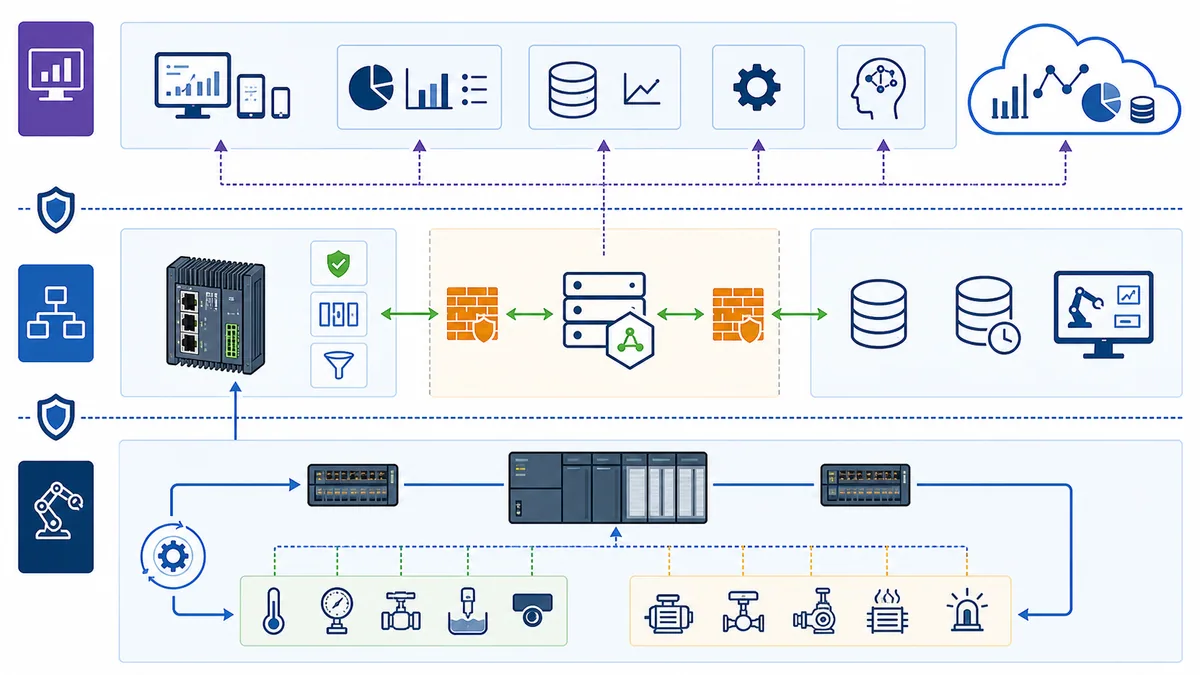
Modern IIoT architectures follow hierarchical designs separating field devices from edge computing layers, cloud platforms, and analytical applications. Understanding this architecture enables effective system design balancing local intelligence with centralized analytics.
Edge Layer: PLCs, Sensors, Actuators
The edge layer comprises physical devices including PLCs, sensors, actuators, drives, robots, and other industrial equipment generating operational data and executing control functions. This layer prioritizes reliability, real-time performance, and environmental hardening appropriate for industrial conditions.
PLC Integration Points:
Modern PLCs expose data through multiple mechanisms including native communication protocols, OPC UA servers, embedded web services, and direct database connections. Selecting appropriate integration methods balances performance, security, and maintainability requirements.
Sensor Networks:
Industrial sensor networks using fieldbus protocols, industrial Ethernet, or wireless technologies feed data to PLCs and edge computing devices. Sensor selection balances accuracy, cost, installation complexity, and communication requirements.
Brownfield vs Greenfield Considerations:
Brownfield facilities with existing PLC infrastructure require integration strategies respecting legacy communication protocols and avoiding disruption to operational control systems. Greenfield projects enable modern protocol selection and native IIoT integration from initial commissioning.
Gateway and Edge Computing Layer
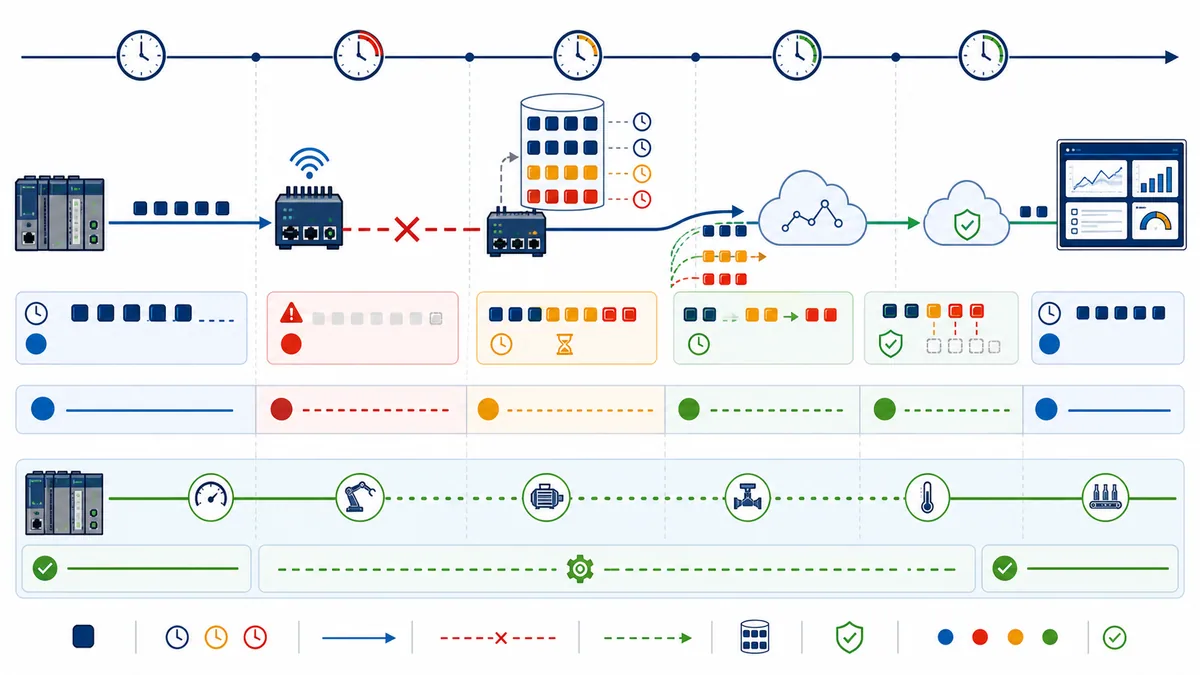
Edge computing devices positioned between PLCs and cloud platforms perform data aggregation, protocol translation, preliminary analytics, and store-and-forward functionality ensuring reliable data transmission despite intermittent connectivity.
Edge Gateway Functions:
Protocol Translation: Edge gateways translate between industrial protocols (Modbus, Profinet, EtherNet/IP) and IT-standard protocols (MQTT, HTTPS, OPC UA) enabling PLC integration with cloud platforms.
Data Aggregation: Collecting data from multiple PLCs and field devices, edge gateways normalize data formats, apply contextual information, and reduce data volumes through filtering and compression.
Local Analytics: Edge computing capabilities enable real-time analytics, anomaly detection, and automated responses without cloud connectivity latency or bandwidth constraints.
Store-and-Forward: Buffering data during cloud connectivity interruptions ensures data continuity when communication is restored, preventing gaps in historical records.
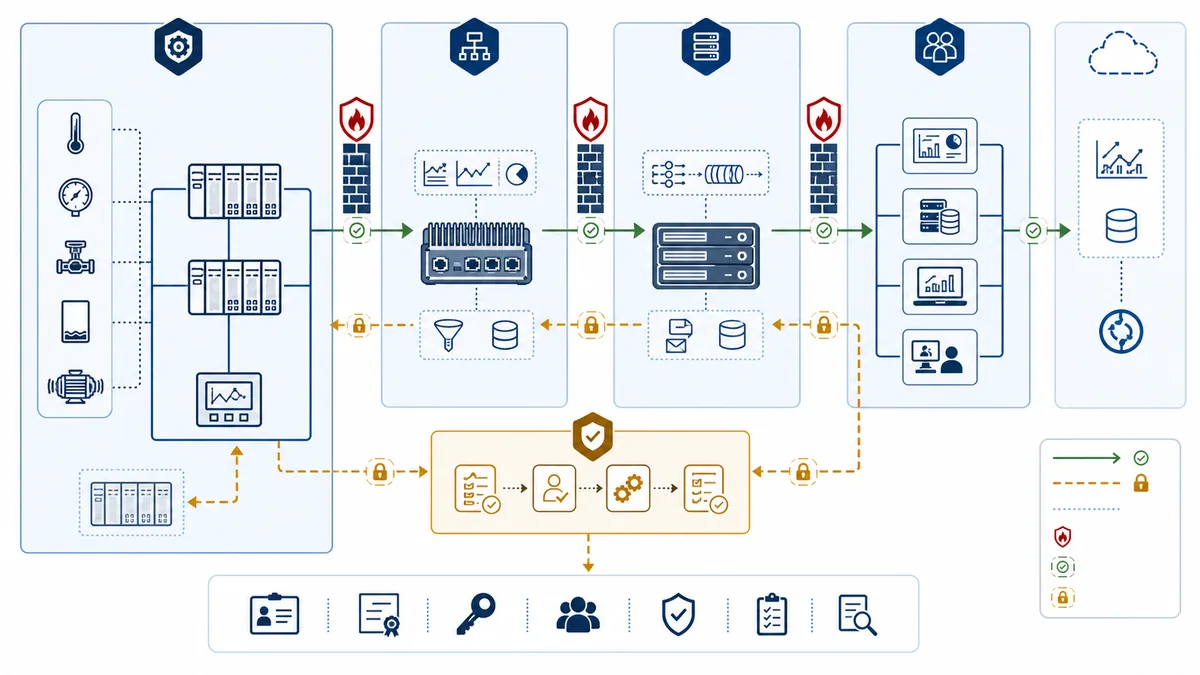
Security Boundary: Edge gateways enforce security policies, authenticate cloud connections, encrypt data in transit, and isolate plant-floor networks from external connections.
Cloud Platform Layer
Cloud platforms provide scalable infrastructure for data storage, advanced analytics, machine learning, and application hosting that would be prohibitively expensive for most industrial organizations to deploy on-premises.
Cloud Platform Capabilities:
Massive Storage: Petabyte-scale data lakes store years of high-resolution operational data from distributed facilities enabling long-term trend analysis and machine learning model training.
Elastic Computing: Cloud platforms automatically scale computing resources to handle analytical workloads, peak data ingestion rates, and concurrent user access without over-provisioning fixed infrastructure.
Advanced Analytics: Cloud-native analytics services including machine learning, artificial intelligence, and statistical analysis process operational data to generate predictive insights and optimization recommendations.
Global Accessibility: Cloud platforms enable secure access to operational data and analytics from anywhere, supporting remote monitoring, expert troubleshooting, and global operational visibility.
Application Layer: Analytics, Dashboards
The application layer comprises user-facing applications, analytical tools, visualization dashboards, and business intelligence platforms that transform raw operational data into actionable information for operators, engineers, and management.
Application Categories:
Real-Time Monitoring: Dashboards providing current operational status, alarm conditions, and production metrics enable rapid response to deviations and performance issues.
Predictive Maintenance: Applications analyzing equipment health indicators, vibration signatures, temperature profiles, and historical failure patterns predict maintenance requirements before breakdowns occur.
Quality Analytics: Statistical process control, vision system integration, and automated testing data analysis identify quality trends and predict defects before they reach customers.
Production Optimization: Analytics platforms correlating process parameters with product quality, throughput, and efficiency recommend optimal settings maximizing production performance.
Energy Management: Applications tracking energy consumption by equipment, process, and time period identify optimization opportunities and verify efficiency improvement initiatives.
Data Flow Diagram
βββββββββββββββββββββββββββββββββββββββββββββββββββ
β Cloud/Application Layer β
β ββββββββββββββββββββββββββββββββββββββββββββ β
β β Analytics & Machine Learning Platforms β β
β β β’ Predictive Maintenance Models β β
β β β’ Quality Analytics β β
β β β’ Production Optimization β β
β ββββββββββββββββββββββββββββββββββββββββββββ β
β β Visualization & Dashboards β β
β β β’ Real-time Monitoring β β
β β β’ KPI Dashboards β β
β β β’ Mobile Applications β β
β ββββββββββββββββββββββββββββββββββββββββββββ β
βββββββββββββββββββββββββββββββββββββββββββββββββββ
β²
MQTT/HTTPS
β
βββββββββββββββββββββββββββββββββββββββββββββββββββ
β Edge Computing Layer β
β ββββββββββββββββββββββββββββββββββββββββββββ β
β β Edge Gateway / IoT Platform β β
β β β’ Protocol Translation β β
β β β’ Data Aggregation & Filtering β β
β β β’ Local Analytics β β
β β β’ Store-and-Forward β β
β β β’ Security Enforcement β β
β ββββββββββββββββββββββββββββββββββββββββββββ β
βββββββββββββββββββββββββββββββββββββββββββββββββββ
β² β² β²
Modbus TCP EtherNet/IP OPC UA
β β β
βββββββββββββββββββββββββββββββββββββββββββββββββββ
β Control Layer (PLCs) β
β ββββββββββ ββββββββββ ββββββββββ β
β β PLC 1 β β PLC 2 β β PLC 3 β β
β βControl β βControl β βControl β β
β βLogic β βLogic β βLogic β β
β ββββββββββ ββββββββββ ββββββββββ β
βββββββββββββββββββββββββββββββββββββββββββββββββββ
β² β² β²
Profinet DeviceNet AS-i
β β β
βββββββββββββββββββββββββββββββββββββββββββββββββββ
β Field Layer β
β Sensors β’ Actuators β’ Drives β’ I/O Modules β
βββββββββββββββββββββββββββββββββββββββββββββββββββ
Communication Protocols at Each Layer
Different protocol types optimize communication requirements at each architectural layer, balancing real-time performance, data volume, security, and compatibility with existing infrastructure.
Field Level Protocols: Profinet, EtherNet/IP, DeviceNet, AS-Interface, Modbus RTU optimize deterministic communication, low latency, and industrial environmental tolerance required for field device connectivity.
Control Level Protocols: Modbus TCP, EtherNet/IP, OPC UA enable communication between PLCs, HMIs, and supervisory systems with balance of performance, standardization, and vendor interoperability.
Cloud Connectivity Protocols: MQTT, AMQP, HTTPS, OPC UA provide secure, scalable, and efficient communication between edge computing and cloud platforms optimized for internet transmission and cloud-native architectures.
PLC Communication Protocols for IIoT
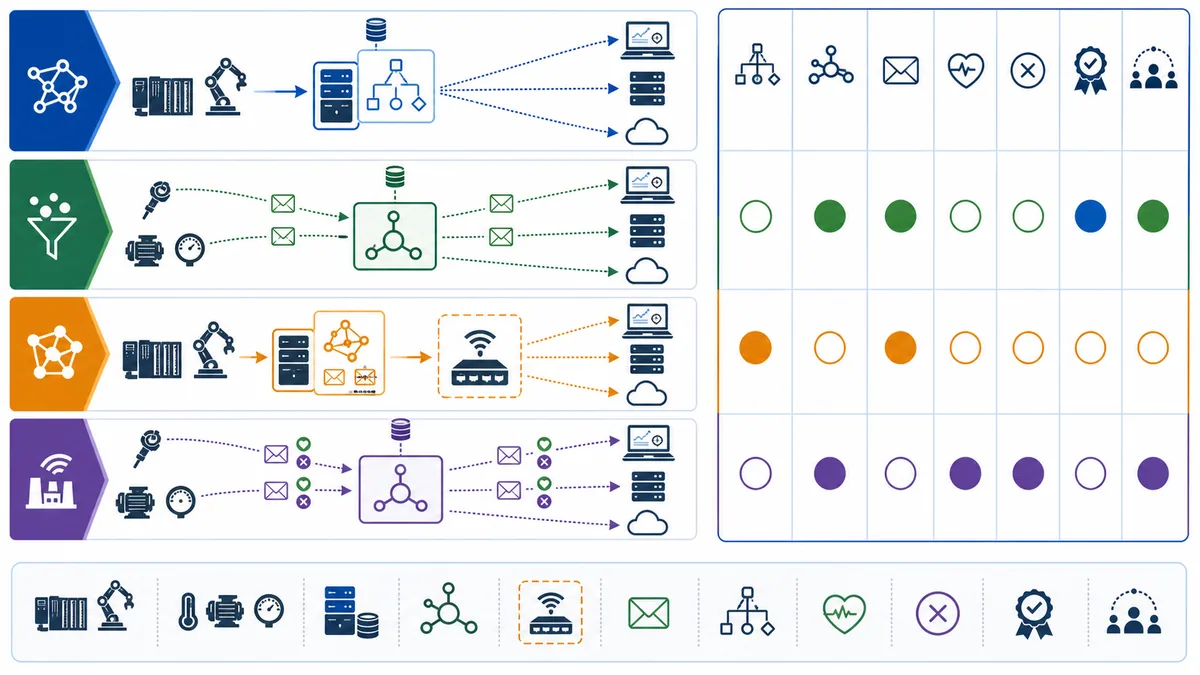
Selecting appropriate communication protocols for IIoT and PLC integration requires balancing industrial requirements for reliability and determinism with IT standards for security, scalability, and cloud compatibility. Modern IIoT implementations increasingly rely on standardized protocols designed explicitly for industrial-internet convergence.
MQTT: Lightweight Pub/Sub for Cloud
MQTT (Message Queuing Telemetry Transport) provides lightweight publish-subscribe messaging optimized for constrained devices, unreliable networks, and efficient bandwidth utilization making it ideal for industrial IoT applications connecting edge devices to cloud platforms.
MQTT Architecture and Concepts:
MQTT implements publish-subscribe architecture where publishers send messages to topics hosted on central brokers, and subscribers receive messages from topics of interest without direct connections between publishers and subscribers. This decoupled architecture scales efficiently and handles network interruptions gracefully.
Quality of Service Levels:
MQTT defines three QoS levels balancing delivery guarantees with network overhead:
- QoS 0 (At most once): Fire-and-forget with no acknowledgment, suitable for high-frequency data where occasional loss is acceptable
- QoS 1 (At least once): Guaranteed delivery with acknowledgment, may deliver duplicates
- QoS 2 (Exactly once): Guaranteed delivery without duplicates, highest overhead suitable for critical data
MQTT for Industrial Applications:
Industrial MQTT implementations require consideration of security (TLS encryption, authentication), reliability (persistent sessions, retained messages), and organization (topic hierarchy design) ensuring robust operation in production environments.
Sparkplug B specification extends MQTT specifically for industrial applications, defining standardized topic namespace, data types, discovery mechanisms, and session management optimized for PLC integration and industrial device connectivity.
MQTT Implementation Example:
import paho.mqtt.client as mqtt
import json
import time
class PLCMQTTPublisher:
def __init__(self, broker_address, port, client_id):
self.client = mqtt.Client(client_id)
self.client.on_connect = self.on_connect
self.client.on_publish = self.on_publish
# Configure TLS/SSL
self.client.tls_set(ca_certs="/path/to/ca.crt",
certfile="/path/to/client.crt",
keyfile="/path/to/client.key")
# Connect to broker
self.client.connect(broker_address, port, 60)
self.client.loop_start()
def on_connect(self, client, userdata, flags, rc):
if rc == 0:
print("Connected to MQTT Broker successfully")
else:
print(f"Failed to connect, return code {rc}")
def on_publish(self, client, userdata, mid):
print(f"Message {mid} published successfully")
def publish_plc_data(self, device_id, data):
"""Publish PLC data to MQTT topic"""
topic = f"factory/plc/{device_id}/data"
payload = {
"timestamp": int(time.time() * 1000),
"device_id": device_id,
"metrics": data
}
# Publish with QoS 1 (at least once delivery)
result = self.client.publish(
topic,
json.dumps(payload),
qos=1,
retain=False
)
return result
def publish_alarm(self, device_id, alarm_data):
"""Publish alarm with QoS 2 for critical notifications"""
topic = f"factory/alarms/{device_id}"
payload = {
"timestamp": int(time.time() * 1000),
"device_id": device_id,
"severity": alarm_data["severity"],
"message": alarm_data["message"],
"value": alarm_data.get("value")
}
# Critical alarms use QoS 2 (exactly once)
result = self.client.publish(
topic,
json.dumps(payload),
qos=2,
retain=True # Retain last alarm state
)
return result
# Usage example
publisher = PLCMQTTPublisher(
broker_address="mqtt.example.com",
port=8883, # TLS port
client_id="plc_001"
)
# Publish process data
process_data = {
"temperature": 75.5,
"pressure": 3.2,
"flow_rate": 125.8,
"motor_speed": 1750
}
publisher.publish_plc_data("PLC_001", process_data)
# Publish critical alarm
alarm = {
"severity": "HIGH",
"message": "Temperature exceeded threshold",
"value": 95.2
}
publisher.publish_alarm("PLC_001", alarm)
OPC UA: Industrial Standard for Interoperability
OPC UA (OPC Unified Architecture) represents the industrial communication standard explicitly designed for Industry 4.0 and IIoT applications, providing platform-independent, secure, and semantic communication between industrial devices, control systems, and cloud platforms.
OPC UA Advantages for IIoT:
Platform Independence: OPC UA runs on Windows, Linux, embedded systems, and cloud platforms enabling seamless communication across heterogeneous environments without platform-specific dependencies.
Built-in Security: Comprehensive security features including encryption, authentication, and authorization are integral to OPC UA specifications rather than afterthoughts, meeting industrial cybersecurity requirements.
Rich Information Modeling: Object-oriented data models provide semantic meaning and contextual relationships beyond simple tag-value pairs, enabling self-describing systems and standardized device integration.
Publish-Subscribe Capability: OPC UA Pub/Sub extends traditional client-server architecture with efficient publish-subscribe communication optimized for cloud connectivity and IoT applications.
OPC UA for PLC Integration:
Modern PLCs from major manufacturers including Siemens, Rockwell Automation, Schneider Electric, and Mitsubishi provide native OPC UA servers enabling standardized data access without proprietary gateways or protocol converters.
Detailed OPC UA implementation guidance, programming examples, and security configuration are covered comprehensively in our OPC UA tutorial.
REST APIs: HTTP-Based Data Exchange
REST (Representational State Transfer) APIs provide HTTP-based communication enabling integration between PLC systems and web applications, mobile devices, and cloud platforms using familiar web technologies and development tools.
REST API Characteristics:
Stateless Communication: Each REST request contains all information needed for processing, simplifying implementation and enabling horizontal scaling across multiple servers.
Standard HTTP Methods: GET (read data), POST (create), PUT (update), DELETE (remove) operations provide intuitive semantics for data access and manipulation.
JSON Payload Format: JavaScript Object Notation provides human-readable, language-independent data representation simplifying development and debugging across diverse platforms.
REST API Implementation Example:
from flask import Flask, jsonify, request
from flask_cors import CORS
import pycomm3 # Allen-Bradley PLC communication library
app = Flask(__name__)
CORS(app) # Enable cross-origin requests
class PLCRESTGateway:
def __init__(self, plc_ip):
self.plc_ip = plc_ip
self.plc = None
def connect(self):
"""Establish connection to PLC"""
try:
self.plc = pycomm3.LogixDriver(self.plc_ip)
self.plc.open()
return True
except Exception as e:
print(f"Connection error: {e}")
return False
def read_tag(self, tag_name):
"""Read single tag from PLC"""
try:
result = self.plc.read(tag_name)
return {
"success": True,
"tag": tag_name,
"value": result.value,
"timestamp": result.timestamp
}
except Exception as e:
return {
"success": False,
"error": str(e)
}
def write_tag(self, tag_name, value):
"""Write value to PLC tag"""
try:
result = self.plc.write(tag_name, value)
return {
"success": True,
"tag": tag_name,
"value": value
}
except Exception as e:
return {
"success": False,
"error": str(e)
}
# Initialize PLC gateway
gateway = PLCRESTGateway("192.168.1.10")
gateway.connect()
@app.route('/api/plc/tags/<tag_name>', methods=['GET'])
def get_tag(tag_name):
"""GET endpoint to read PLC tag"""
result = gateway.read_tag(tag_name)
return jsonify(result)
@app.route('/api/plc/tags/<tag_name>', methods=['PUT'])
def update_tag(tag_name):
"""PUT endpoint to write PLC tag"""
data = request.get_json()
value = data.get('value')
result = gateway.write_tag(tag_name, value)
return jsonify(result)
@app.route('/api/plc/batch', methods=['POST'])
def read_batch():
"""POST endpoint to read multiple tags"""
data = request.get_json()
tags = data.get('tags', [])
results = {}
for tag in tags:
results[tag] = gateway.read_tag(tag)
return jsonify(results)
@app.route('/api/plc/status', methods=['GET'])
def plc_status():
"""GET endpoint for PLC connection status"""
return jsonify({
"connected": gateway.plc is not None,
"plc_ip": gateway.plc_ip
})
if __name__ == '__main__':
app.run(host='0.0.0.0', port=5000, debug=False)
Sparkplug B: MQTT for Industrial
Sparkplug B specification extends MQTT specifically for industrial and IIoT applications, defining standardized topic namespace, payload encoding, data types, and session management that address limitations of generic MQTT implementations for industrial connectivity.
Sparkplug B Benefits:
Standardized Topic Namespace: Defined hierarchy (spBv1.0/group_id/message_type/edge_node_id/device_id) enables organized, scalable topic structures supporting large deployments.
Efficient Payload Encoding: Protocol Buffers (protobuf) binary encoding reduces bandwidth requirements compared to JSON while maintaining rich data type support and extensibility.
State Management: Birth and death certificates communicate device online/offline status enabling applications to distinguish between zero values and communication failures.
Auto-Discovery: Standardized birth messages contain metric metadata enabling automatic discovery and dynamic dashboard generation without manual configuration.
AMQP: Advanced Messaging
AMQP (Advanced Message Queuing Protocol) provides enterprise-grade messaging with guaranteed delivery, complex routing patterns, and transaction support suitable for mission-critical industrial applications requiring robust message handling.
AMQP Characteristics:
Guaranteed Delivery: Built-in acknowledgment mechanisms, persistent messaging, and transaction support ensure messages reach destinations despite network interruptions or consumer failures.
Flexible Routing: Exchanges, bindings, and routing keys enable sophisticated message routing patterns including topic-based routing, content-based routing, and direct messaging.
Interoperability: Standardized wire protocol enables communication between implementations from different vendors without proprietary dependencies.
Protocol Comparison Table
| Feature | MQTT | OPC UA | REST API | Sparkplug B | AMQP | |---------|------|--------|----------|-------------|------| | Overhead | Very Low | Medium | Medium-High | Very Low | Medium | | Security | TLS/Auth | Built-in | HTTPS/OAuth | TLS/Auth | TLS/SASL | | Pub/Sub | Native | Extension | No | Native | Native | | Request/Reply | Pattern | Native | Native | Pattern | Native | | Real-time | Good | Excellent | Fair | Good | Good | | Cloud Ready | Excellent | Good | Excellent | Excellent | Excellent | | Learning Curve | Low | High | Low | Medium | Medium-High | | Industrial Focus | No | Yes | No | Yes | No |
When to Use Each Protocol
Use MQTT When:
- Cloud connectivity is primary requirement
- Bandwidth is limited or costly
- Simple publish-subscribe patterns suffice
- Lightweight, efficient communication is critical
- Supporting constrained edge devices
Use OPC UA When:
- Rich semantic data models are needed
- Interoperability across vendors is essential
- Security requirements are stringent
- Complex information modeling required
- Direct PLC integration available
Use REST APIs When:
- Web application integration required
- Stateless operations are acceptable
- HTTP infrastructure already available
- Simple request-response patterns suffice
- Mobile application access needed
Use Sparkplug B When:
- Industrial-specific MQTT features needed
- Auto-discovery capabilities desired
- State management is critical
- Standardized industrial deployments required
- Bandwidth optimization important
Use AMQP When:
- Guaranteed delivery is critical
- Complex routing patterns needed
- Enterprise messaging integration required
- Transactional support necessary
- High-reliability messaging essential
For comprehensive coverage of industrial communication protocols including fieldbus and industrial Ethernet variants, see our PLC communication protocols guide.
Edge Computing and Gateways
Edge computing architecture distributes intelligence throughout IIoT systems, enabling real-time analytics, local decision-making, and bandwidth optimization by processing data near its source rather than transmitting everything to cloud platforms.
Why Edge Computing Matters
Edge computing addresses fundamental challenges in IIoT implementations including latency, bandwidth constraints, reliability, security, and cost optimization that cannot be solved through centralized cloud architectures alone.
Latency Reduction: Processing data locally eliminates round-trip cloud communication delays, enabling real-time responses to time-critical conditions in milliseconds rather than seconds or minutes required for cloud processing.
Bandwidth Optimization: Edge analytics filter, aggregate, and compress data before transmission, reducing bandwidth requirements by 80-95% compared to streaming all raw data to cloud platforms.
Improved Reliability: Local processing and decision-making continue operating during cloud connectivity interruptions, ensuring critical functions remain operational despite network failures.
Enhanced Security: Edge computing minimizes sensitive operational data leaving facility networks, reducing attack surfaces and simplifying compliance with data residency and privacy regulations.
Cost Reduction: Processing data locally reduces cloud computing costs, bandwidth charges, and data storage expenses that can become prohibitive when streaming high-frequency industrial data from hundreds or thousands of sensors.
Edge Gateway Selection
Selecting appropriate edge computing platforms balances processing capabilities, protocol support, scalability, management features, and cost against specific application requirements and existing infrastructure.
Kepware KEPServerEX: Industrial connectivity platform supporting 150+ industrial protocols and device drivers, providing OPC UA server functionality, cloud connectivity, and local analytics capabilities suitable for brownfield integration scenarios.
Ignition Edge: Lightweight industrial automation platform offering SCADA functionality, database connectivity, MQTT Sparkplug B support, and local application development capabilities with seamless cloud integration.
Custom Linux-Based Gateways: Industrial PCs or embedded systems running Linux provide maximum flexibility for custom edge applications using open-source tools including Node-RED, Python, and containerized applications.
PLC-Integrated Edge: Modern PLCs increasingly incorporate edge computing capabilities directly, eliminating separate gateway hardware for applications where PLC computing resources suffice.
Data Preprocessing at Edge
Edge data preprocessing transforms raw sensor and PLC data into actionable information while reducing transmission volumes, improving analytics accuracy, and enabling local intelligence.
Filtering and Aggregation: Remove noise, outliers, and redundant data points while aggregating high-frequency data into summary statistics (average, min, max, standard deviation) reducing data volumes without losing insights.
Feature Extraction: Calculate derived metrics, ratios, and performance indicators from raw process data, transforming hundreds of variables into meaningful KPIs that directly support decision-making.
Anomaly Detection: Statistical process control, machine learning models, and rule-based logic identify abnormal conditions locally, triggering immediate alerts without cloud processing delays.
Data Contextualization: Enrich raw process data with contextual information including product being manufactured, production order, shift, operator, and environmental conditions improving downstream analytics accuracy.
Store-and-Forward Capabilities
Store-and-forward functionality buffers data during cloud connectivity interruptions, ensuring complete historical records without gaps when communication is restored.
Implementation Considerations:
Storage Capacity: Size local storage based on typical data rates, expected outage duration, and acceptable data loss scenarios balancing cost against reliability requirements.
Data Prioritization: Implement intelligent buffering that prioritizes critical data, alarms, and events over routine process data when storage or bandwidth is constrained.
Synchronization Strategy: Optimize data transmission when connectivity restores to avoid overwhelming network or cloud ingestion pipelines while maintaining time-order accuracy.
Integrity Verification: Implement checksums, sequence numbers, and acknowledgment mechanisms ensuring transmitted data arrives complete and uncorrupted.
Security at Edge Layer
Edge devices represent critical security boundaries separating plant-floor networks from external connections, requiring comprehensive security implementation protecting both industrial control systems and cloud platforms.
Network Segmentation: Edge gateways enforce security boundaries between OT and IT networks, implementing firewall functionality, access control lists, and protocol filtering that prevent unauthorized access to PLC networks.
Secure Communication: TLS/SSL encryption, certificate-based authentication, and key management protect data in transit between edge and cloud while authenticating endpoint identities.
Access Control: Role-based access control, authentication mechanisms, and audit logging restrict edge device configuration and management to authorized personnel.
Firmware Security: Secure boot, cryptographic signature verification, and controlled update processes prevent malicious firmware installation or unauthorized system modifications.
Complete Gateway Configuration Example
This practical example demonstrates configuring an edge gateway connecting Siemens S7-1500 PLCs to AWS IoT Core using MQTT:
Gateway Configuration Steps:
1. PLC Communication Setup:
import snap7
from snap7.util import *
import time
class S7PLCReader:
def __init__(self, plc_ip, rack=0, slot=1):
self.client = snap7.client.Client()
self.plc_ip = plc_ip
self.rack = rack
self.slot = slot
def connect(self):
"""Connect to Siemens S7 PLC"""
try:
self.client.connect(self.plc_ip, self.rack, self.slot)
print(f"Connected to PLC at {self.plc_ip}")
return True
except Exception as e:
print(f"Connection failed: {e}")
return False
def read_db(self, db_number, start, size):
"""Read data block from PLC"""
try:
data = self.client.db_read(db_number, start, size)
return data
except Exception as e:
print(f"Read error: {e}")
return None
def read_process_data(self):
"""Read specific process variables"""
# Read DB100 containing process data
db_data = self.read_db(100, 0, 20)
if db_data:
return {
"temperature": get_real(db_data, 0), # REAL at DBB0
"pressure": get_real(db_data, 4), # REAL at DBB4
"flow_rate": get_real(db_data, 8), # REAL at DBB8
"motor_speed": get_int(db_data, 12), # INT at DBB12
"valve_position": get_int(db_data, 14), # INT at DBB14
"status_word": get_word(db_data, 16) # WORD at DBB16
}
return None
2. Edge Analytics Implementation:
import numpy as np
from scipy import stats
from collections import deque
class EdgeAnalytics:
def __init__(self, window_size=100):
self.window_size = window_size
self.data_buffer = {
"temperature": deque(maxlen=window_size),
"pressure": deque(maxlen=window_size),
"flow_rate": deque(maxlen=window_size)
}
def add_reading(self, data):
"""Add new reading to buffer"""
for key in self.data_buffer.keys():
if key in data:
self.data_buffer[key].append(data[key])
def calculate_statistics(self):
"""Calculate statistical metrics"""
stats_data = {}
for key, buffer in self.data_buffer.items():
if len(buffer) > 0:
values = np.array(buffer)
stats_data[key] = {
"current": float(buffer[-1]),
"mean": float(np.mean(values)),
"std": float(np.std(values)),
"min": float(np.min(values)),
"max": float(np.max(values)),
"median": float(np.median(values))
}
return stats_data
def detect_anomalies(self, data):
"""Simple anomaly detection using 3-sigma rule"""
anomalies = {}
for key, buffer in self.data_buffer.items():
if len(buffer) >= 30 and key in data: # Need minimum data
values = np.array(buffer)
mean = np.mean(values)
std = np.std(values)
current = data[key]
# 3-sigma rule for outlier detection
if abs(current - mean) > 3 * std:
anomalies[key] = {
"current_value": current,
"expected_range": (mean - 3*std, mean + 3*std),
"deviation": abs(current - mean) / std
}
return anomalies
3. MQTT Cloud Publishing:
import json
import boto3
from AWSIoTPythonSDK.MQTTLib import AWSIoTMQTTClient
class AWSIoTPublisher:
def __init__(self, endpoint, cert_path, key_path, ca_path, client_id):
self.client = AWSIoTMQTTClient(client_id)
self.client.configureEndpoint(endpoint, 8883)
self.client.configureCredentials(ca_path, key_path, cert_path)
# Configure MQTT settings
self.client.configureAutoReconnectBackoffTime(1, 32, 20)
self.client.configureOfflinePublishQueueing(-1)
self.client.configureDrainingFrequency(2)
self.client.configureConnectDisconnectTimeout(10)
self.client.configureMQTTOperationTimeout(5)
def connect(self):
"""Connect to AWS IoT Core"""
try:
self.client.connect()
print("Connected to AWS IoT Core")
return True
except Exception as e:
print(f"AWS IoT connection failed: {e}")
return False
def publish(self, topic, payload):
"""Publish message to AWS IoT"""
try:
self.client.publishAsync(
topic,
json.dumps(payload),
1, # QoS 1
ackCallback=self.publish_callback
)
except Exception as e:
print(f"Publish error: {e}")
def publish_callback(self, mid):
"""Callback after successful publish"""
print(f"Message {mid} published")
4. Complete Gateway Application:
import time
import logging
logging.basicConfig(level=logging.INFO)
class IIoTGateway:
def __init__(self, plc_ip, aws_endpoint, certs):
self.plc = S7PLCReader(plc_ip)
self.analytics = EdgeAnalytics(window_size=100)
self.mqtt_client = AWSIoTPublisher(
aws_endpoint,
certs['cert'],
certs['key'],
certs['ca'],
'gateway_001'
)
def start(self):
"""Start gateway operation"""
# Connect to PLC and cloud
if not self.plc.connect():
logging.error("Failed to connect to PLC")
return
if not self.mqtt_client.connect():
logging.error("Failed to connect to AWS IoT")
return
logging.info("Gateway started successfully")
# Main processing loop
while True:
try:
# Read PLC data
plc_data = self.plc.read_process_data()
if plc_data:
# Add to analytics buffer
self.analytics.add_reading(plc_data)
# Calculate statistics
stats = self.analytics.calculate_statistics()
# Detect anomalies
anomalies = self.analytics.detect_anomalies(plc_data)
# Prepare cloud payload
payload = {
"timestamp": int(time.time() * 1000),
"device_id": "PLC_001",
"raw_data": plc_data,
"statistics": stats,
"anomalies": anomalies if anomalies else None
}
# Publish to AWS IoT
self.mqtt_client.publish(
"factory/plc001/telemetry",
payload
)
# Publish anomaly alerts separately
if anomalies:
self.mqtt_client.publish(
"factory/plc001/alerts",
{
"timestamp": payload["timestamp"],
"anomalies": anomalies,
"severity": "WARNING"
}
)
# 1-second sampling rate
time.sleep(1)
except KeyboardInterrupt:
logging.info("Gateway stopped by user")
break
except Exception as e:
logging.error(f"Processing error: {e}")
time.sleep(5) # Wait before retry
if __name__ == "__main__":
gateway = IIoTGateway(
plc_ip="192.168.1.10",
aws_endpoint="xxxxx.iot.us-east-1.amazonaws.com",
certs={
'cert': '/certs/device.crt',
'key': '/certs/device.key',
'ca': '/certs/root-CA.crt'
}
)
gateway.start()
This comprehensive gateway implementation demonstrates protocol translation (S7 to MQTT), edge analytics (statistical processing and anomaly detection), and cloud integration (AWS IoT Core) with error handling and reconnection logic suitable for production deployment.
Cloud Platforms for IIoT
Cloud platforms provide scalable infrastructure, advanced analytics capabilities, and global accessibility that enable Industrial IoT applications at scales impossible with on-premises infrastructure alone. Selecting appropriate cloud platforms balances capabilities, cost, integration complexity, and strategic technology alignment.
AWS IoT Core for Manufacturing
Amazon Web Services IoT Core provides fully managed cloud service enabling billions of devices to securely connect, process messages, and interact with AWS services and applications without managing infrastructure.
Key AWS IoT Capabilities:
Device Gateway: MQTT, MQTT over WebSocket, and HTTPS protocols enable diverse device connectivity with automatic scaling handling millions of concurrent connections.
Message Broker: Pub/sub messaging broker routes device messages to AWS services and endpoints based on business rules without requiring custom infrastructure management.
Rules Engine: SQL-based rules process device data in real-time, filtering, transforming, and routing messages to analytics services, databases, or triggering actions without custom code.
Device Shadow: Virtual representations of devices maintain last-known state enabling applications to interact with devices even when intermittently connected or offline.
AWS IoT Manufacturing Solutions:
AWS IoT SiteWise: Purpose-built industrial data collection, processing, and monitoring service optimized for manufacturers collecting equipment data at scale.
AWS IoT Events: Detect and respond to events from IoT sensors and applications, enabling automated monitoring and alerting for industrial processes.
AWS IoT Analytics: Advanced analytics service preprocessing, enriching, storing, and analyzing industrial IoT data without managing analytics infrastructure.
Azure IoT Hub and Time Series Insights
Microsoft Azure IoT Hub provides bidirectional communication between IoT applications and devices, enabling secure reliable connectivity with per-device authentication and comprehensive device management capabilities.
Azure IoT Hub Features:
Device Provisioning Service: Automated just-in-time provisioning enables zero-touch device deployment configuring millions of devices securely without manual intervention.
Device Twins: JSON documents store device state information including metadata, configurations, and conditions enabling backend applications to query and manage devices efficiently.
Direct Methods: Invoke functions on devices from cloud applications enabling remote configuration changes, diagnostics, and operational commands with acknowledgment.
Azure Digital Twins: Create comprehensive digital models of physical environments including relationships, hierarchies, and spatial intelligence supporting advanced analytics and visualization.
Time Series Insights:
Azure Time Series Insights provides analytics, storage, and visualization optimized for time-series data from industrial equipment, enabling ad-hoc analysis and pattern discovery across massive historical datasets.
Manufacturing Integration:
Azure's close integration with Microsoft ecosystem including Dynamics 365, Power BI, and Azure Synapse Analytics enables seamless connection between shopfloor data and enterprise business processes.
Google Cloud IoT
Google Cloud Platform IoT Core (being deprecated - replaced by partner solutions) historically provided device connection, management, and ingestion into Google Cloud services optimized for data processing and machine learning workloads.
GCP IoT Strategy:
Google's current strategy partners with leading IoT platform providers while providing underlying cloud infrastructure and AI/ML capabilities, enabling manufacturers to leverage Google's strengths without proprietary device connectivity layers.
Key GCP Manufacturing Services:
BigQuery: Petabyte-scale data warehouse enabling sub-second analysis of massive industrial datasets with standard SQL queries and machine learning integration.
Vertex AI: Unified machine learning platform simplifies predictive maintenance model development, training, and deployment integrating seamlessly with industrial data pipelines.
Looker: Business intelligence platform creates interactive dashboards and embedded analytics bringing operational insights to decision-makers across organizations.
Industrial-Specific Platforms
Specialized industrial IoT platforms provide domain-specific functionality, pre-built connectors, and industry expertise complementing hyperscale cloud infrastructure.
PTC ThingWorx:
Industrial IoT platform offering rapid application development, augmented reality integration, and manufacturing-specific functionality including MES integration and digital twin capabilities.
Key Features:
- Visual development environment accelerating IIoT application creation
- Extensive industrial protocol support and device connectivity
- Augmented reality authoring and deployment for maintenance and training
- Manufacturing apps marketplace with pre-built solutions
Siemens MindSphere:
Cloud-based IoT operating system optimized for Siemens industrial equipment while supporting multi-vendor devices, providing analytics, connectivity, and development environment.
Key Features:
- Native integration with Siemens automation equipment
- Flexible deployment options (public cloud, private cloud, on-premises)
- Industrial analytics and digital twin framework
- Application development environment with marketplace
Platform Comparison and Selection Criteria
| Feature | AWS IoT | Azure IoT | GCP + Partners | ThingWorx | MindSphere | |---------|---------|-----------|----------------|-----------|------------| | Device Scale | Billions | Millions | Millions | Thousands | Thousands | | Protocol Support | MQTT, HTTPS | MQTT, HTTPS, AMQP | MQTT, HTTPS | Extensive | OPC UA Focus | | Analytics | IoT Analytics | Time Series Insights | BigQuery | Built-in | Built-in | | ML Integration | SageMaker | Azure ML | Vertex AI | ThingWorx Analytics | MindSphere Analytics | | Industrial Focus | Medium | Medium | Low-Medium | High | Very High | | Ecosystem | AWS Services | Microsoft Ecosystem | Google AI/ML | PTC Products | Siemens Portfolio | | Deployment | Cloud | Cloud/Edge | Cloud | Cloud/On-Prem | Flexible |
Selection Considerations:
Use AWS When:
- Massive scale requirements (millions+ devices)
- Broad AWS service ecosystem important
- Global infrastructure and availability critical
- General-purpose cloud platform preferred
Use Azure When:
- Microsoft ecosystem integration essential
- Enterprise applications leverage Azure Active Directory
- Dynamics 365 or Power Platform integration required
- Strong digital twin requirements
Use GCP When:
- Advanced AI/ML capabilities are primary driver
- Data analytics at petabyte scale required
- BigQuery analytics infrastructure preferred
- Partner IoT platforms provide device connectivity
Use ThingWorx When:
- Rapid application development critical
- Augmented reality integration important
- PTC product ecosystem in use
- Manufacturing-specific apps needed
Use MindSphere When:
- Siemens automation equipment predominant
- Multi-tenancy requirements
- Flexible deployment (cloud/on-premises)
- Strong European data residency requirements
Cost Considerations
Cloud IoT platform costs include multiple components requiring careful analysis during platform selection and architecture design:
Data Ingestion: Message volume charges based on number and size of messages transmitted, typically $1-8 per million messages depending on platform and tier.
Data Storage: Historical data storage costs for time-series databases, data lakes, and backup storage, typically $0.02-0.10 per GB-month depending on performance tier.
Compute Resources: Analytics processing, machine learning model training, and application hosting compute charges based on resource consumption and duration.
Data Transfer: Network egress charges for data leaving cloud provider networks, particularly significant for high-bandwidth applications or cross-region architectures.
Additional Services: Costs for specific services including machine learning, visualization tools, edge deployment, and support contracts varying significantly by platform and usage.
Cost Optimization Strategies:
- Aggregate and filter data at edge before cloud transmission
- Implement tiered storage with lifecycle policies moving old data to cheaper tiers
- Right-size compute resources and use serverless where appropriate
- Optimize data models reducing storage requirements
- Implement reserved capacity pricing for predictable workloads
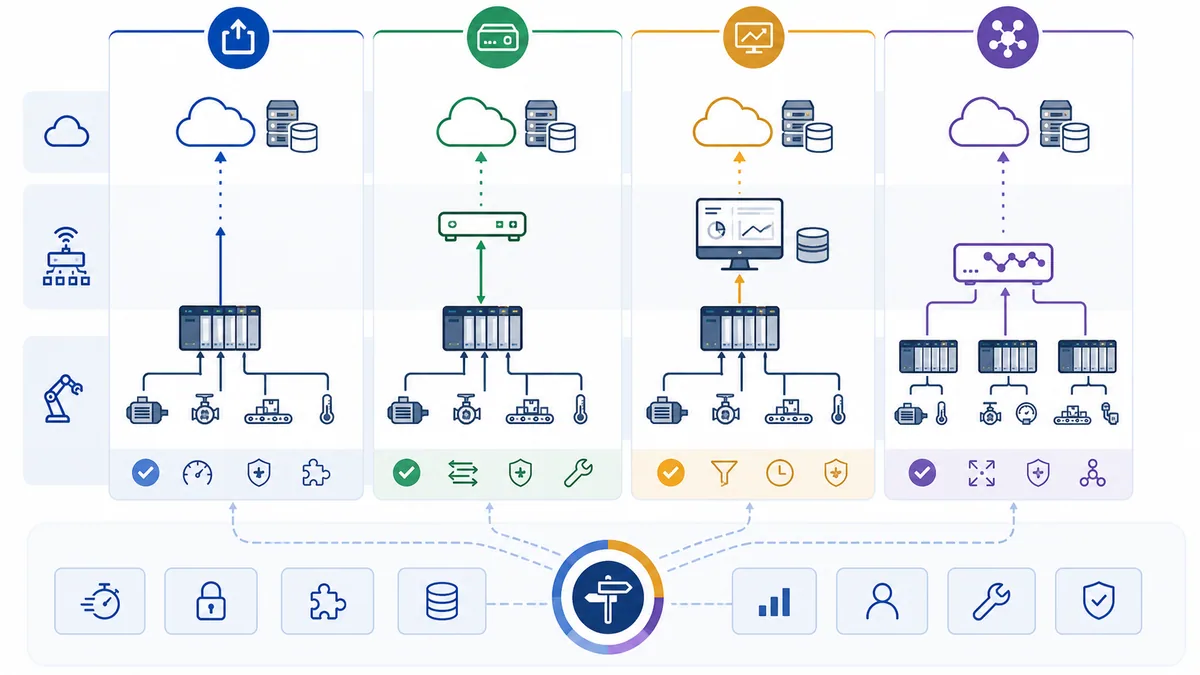
PLC-to-Cloud Integration Methods
Multiple architectural approaches enable PLC integration with cloud platforms, each balancing complexity, cost, capabilities, and modernization requirements. Understanding available methods enables appropriate selection based on specific project constraints and objectives.
Method 1: Native Cloud Connectivity (Modern PLCs)
Modern PLCs increasingly provide native cloud connectivity through embedded IoT protocols, cloud platform SDKs, or vendor-specific cloud services eliminating external gateway requirements for simple applications.
Implementation Approach:
PLCs with MQTT clients, RESTful API capabilities, or OPC UA pub-sub features connect directly to cloud platforms using built-in communication functions. This approach minimizes hardware costs and simplifies architectures when PLC capabilities suffice.
Advantages:
- Minimal additional hardware required
- Simplified architecture and lower total cost
- Reduced maintenance complexity
- Direct PLC-to-cloud security management
Disadvantages:
- Limited to PLCs with native capabilities (newer models)
- PLC processing resources consumed for cloud communication
- Less flexibility for complex analytics or aggregation
- Firmware updates may disrupt production systems
Best Used When:
- Modern PLCs with native cloud support deployed
- Simple monitoring applications without complex analytics
- Minimal data volume (<100 tags)
- Greenfield projects with appropriate hardware selection
Method 2: Gateway/Edge Device
Industrial edge gateways positioned between PLCs and cloud platforms provide protocol translation, data aggregation, analytics preprocessing, and security boundary functions suitable for most IIoT implementations.
Implementation Approach:
Dedicated gateway hardware or industrial PCs collect data from one or multiple PLCs using industrial protocols, perform edge processing and analytics, then transmit filtered/aggregated data to cloud platforms using IT-standard protocols.
Advantages:
- Supports legacy PLCs without native cloud capabilities
- Enables complex edge analytics and preprocessing
- Aggregates multiple PLCs and data sources
- Isolates production networks from external connections
- Firmware updates don't impact PLC operations
Disadvantages:
- Additional hardware costs and installation complexity
- Extra component requiring configuration and maintenance
- Potential single point of failure requiring redundancy planning
Best Used When:
- Multiple PLCs require integration
- Legacy equipment without native cloud support
- Edge analytics capabilities needed
- Security isolation required between OT and IT networks
Method 3: SCADA as Bridge
Existing SCADA systems can serve as data aggregation points collecting information from multiple PLCs then forwarding selected data to cloud platforms, leveraging investments in installed HMI/SCADA infrastructure.
Implementation Approach:
SCADA/HMI systems already collecting PLC data expose information through OPC UA servers, database connections, MQTT publishers, or REST APIs enabling cloud platform integration without direct PLC connections.
Advantages:
- Leverages existing SCADA investment
- Minimizes changes to production PLC networks
- Provides additional data contextualization
- Centralized integration point for multiple PLCs
Disadvantages:
- Creates dependency on SCADA availability
- SCADA becomes potential bottleneck
- May not support high-frequency data collection
- Limited to data already collected by SCADA
Best Used When:
- Robust SCADA system already deployed
- SCADA collects all required data
- Minimizing changes to production systems critical
- SCADA platform provides suitable integration capabilities
For comprehensive coverage of SCADA system design and integration, see our SCADA best practices guide.
Method 4: Custom Middleware
Custom middleware applications provide maximum flexibility for unique requirements, complex business logic, or specialized integration scenarios that pre-packaged solutions cannot address effectively.
Implementation Approach:
Custom-developed applications using programming languages (Python, Node.js, C#) and communication libraries access PLC data, implement business logic, perform analytics, and integrate with cloud platforms and enterprise systems.
Advantages:
- Maximum flexibility and customization
- Integration of complex business rules
- Support for proprietary or legacy protocols
- Custom analytics and processing logic
Disadvantages:
- Significant development and testing effort
- Ongoing maintenance and support requirements
- Development expertise required
- Potential reliability and security vulnerabilities
Best Used When:
- Pre-packaged solutions cannot meet requirements
- Unique business logic or integration needs
- In-house development expertise available
- Budget supports custom development effort
Integration Method Comparison
| Method | Cost | Complexity | Flexibility | Scalability | Best For | |--------|------|------------|-------------|-------------|----------| | Native Cloud | Low | Low | Low | Low | Simple monitoring, modern PLCs | | Edge Gateway | Medium | Medium | High | High | Most implementations, legacy PLCs | | SCADA Bridge | Medium | Low-Medium | Medium | Medium | Existing SCADA systems | | Custom Middleware | High | High | Very High | Medium | Unique requirements, complex logic |
Security Considerations for Each Approach
Native Cloud Security:
- Configure PLC firewall rules restricting cloud connectivity
- Implement certificate-based authentication where supported
- Enable encrypted protocols (TLS/SSL)
- Limit data exposure to necessary variables only
Edge Gateway Security:
- Position gateway in DMZ between OT and IT networks
- Implement defense-in-depth security layers
- Use certificate-based cloud authentication
- Enable gateway audit logging and monitoring
SCADA Bridge Security:
- Secure SCADA server access and authentication
- Implement read-only data extraction from SCADA
- Deploy SCADA in protected network segment
- Monitor data flow for unauthorized access
Custom Middleware Security:
- Follow secure coding practices and review processes
- Implement comprehensive error handling and logging
- Use established security libraries and frameworks
- Regular security assessments and penetration testing
Complete Example: ControlLogix to AWS via Gateway
This comprehensive example demonstrates Allen-Bradley ControlLogix PLC integration with AWS IoT Core using an industrial edge gateway with Kepware KEPServerEX:
Architecture Overview:
ControlLogix PLC (192.168.1.10)
|
EtherNet/IP
|
Kepware KEPServerEX Gateway (192.168.1.100)
|
MQTT/TLS
|
AWS IoT Core (us-east-1)
|
AWS Services
|
IoT Analytics / Lambda / DynamoDB
Step 1: Configure ControlLogix PLC:
Program ControlLogix PLC with tags for data collection:
// Controller Tags
Production_Count DINT // Current production count
Line_Speed REAL // Line speed in parts/min
Temperature REAL // Process temperature
Pressure REAL // Process pressure
Quality_Status DINT // Quality check status
Alarm_Active BOOL // Alarm status
OEE_Availability REAL // OEE availability %
OEE_Performance REAL // OEE performance %
OEE_Quality REAL // OEE quality %
Step 2: Configure Kepware KEPServerEX:
-
Create EtherNet/IP Channel:
- Open Kepware Configuration
- Add new channel: EtherNet/IP
- Configure IP address: 192.168.1.10
- Set protocol settings for ControlLogix
-
Add Device and Tags:
- Add device under channel
- Import tag list from Studio 5000
- Configure scan rates (1000ms for process data, 500ms for alarms)
-
Configure IoT Gateway:
- Install IoT Gateway plugin
- Configure MQTT client settings
- Set broker endpoint: AWS IoT endpoint
- Import AWS certificates (device cert, private key, root CA)
Step 3: Configure AWS IoT Core:
# Create IoT Thing
aws iot create-thing --thing-name "ControlLogix_Line1"
# Create and attach certificate
aws iot create-keys-and-certificate \
--set-as-active \
--certificate-pem-outfile certificate.pem \
--public-key-outfile public.key \
--private-key-outfile private.key
# Create IoT policy
aws iot create-policy --policy-name "PLCPolicy" \
--policy-document '{
"Version": "2012-10-17",
"Statement": [{
"Effect": "Allow",
"Action": ["iot:Connect","iot:Publish","iot:Subscribe"],
"Resource": "*"
}]
}'
# Attach policy to certificate
aws iot attach-policy \
--policy-name PLCPolicy \
--target <certificate-arn>
Step 4: Configure Data Transformation Rules:
AWS IoT Core rule processing incoming PLC data:
{
"sql": "SELECT *, timestamp() as aws_timestamp,
Production_Count - topic(2).last_value as production_delta,
((OEE_Availability * OEE_Performance * OEE_Quality) / 10000) as OEE_Total
FROM 'factory/plc/+/telemetry'",
"actions": [
{
"dynamodb": {
"tableName": "PLCTelemetry",
"roleArn": "arn:aws:iam::123456789012:role/IoTRule",
"hashKeyField": "device_id",
"hashKeyValue": "${topic(2)}",
"rangeKeyField": "timestamp",
"rangeKeyValue": "${timestamp()}"
}
},
{
"timestream": {
"databaseName": "IndustrialData",
"tableName": "PLCMetrics",
"roleArn": "arn:aws:iam::123456789012:role/IoTRule",
"dimensions": [
{
"name": "Device",
"value": "${topic(2)}"
}
]
}
},
{
"lambda": {
"functionArn": "arn:aws:lambda:us-east-1:123456789012:function:ProcessPLCData"
}
}
]
}
Step 5: Create Alarm Processing Lambda:
import json
import boto3
import os
sns = boto3.client('sns')
SNS_TOPIC_ARN = os.environ['SNS_TOPIC_ARN']
def lambda_handler(event, context):
"""Process PLC alarms and send notifications"""
# Parse incoming message
message = json.loads(event['body']) if isinstance(event.get('body'), str) else event
device_id = message.get('device_id')
alarm_active = message.get('Alarm_Active', False)
temperature = message.get('Temperature')
pressure = message.get('Pressure')
timestamp = message.get('timestamp')
# Check alarm conditions
alarms = []
if alarm_active:
alarms.append({
'type': 'PLC_ALARM',
'severity': 'HIGH',
'message': 'PLC alarm active'
})
if temperature and temperature > 85.0:
alarms.append({
'type': 'TEMPERATURE',
'severity': 'CRITICAL',
'message': f'Temperature critical: {temperature}Β°C',
'value': temperature
})
if pressure and pressure > 100.0:
alarms.append({
'type': 'PRESSURE',
'severity': 'WARNING',
'message': f'Pressure elevated: {pressure} PSI',
'value': pressure
})
# Send notifications for critical alarms
for alarm in alarms:
if alarm['severity'] in ['CRITICAL', 'HIGH']:
notification = {
'Device': device_id,
'Timestamp': timestamp,
'AlarmType': alarm['type'],
'Severity': alarm['severity'],
'Message': alarm['message']
}
sns.publish(
TopicArn=SNS_TOPIC_ARN,
Subject=f"PLC Alarm: {device_id}",
Message=json.dumps(notification, indent=2)
)
return {
'statusCode': 200,
'body': json.dumps({
'device_id': device_id,
'alarms_detected': len(alarms),
'alarms': alarms
})
}
Step 6: Create Visualization Dashboard:
QuickSight or Grafana dashboard connecting to Timestream database displaying:
- Real-time production count and line speed
- Process temperature and pressure trends
- OEE metrics with historical comparison
- Alarm history and downtime analysis
- Production efficiency by shift/day/week
This complete implementation provides production-ready IIoT architecture with edge intelligence, secure cloud connectivity, real-time monitoring, and automated alerting suitable for manufacturing environments.
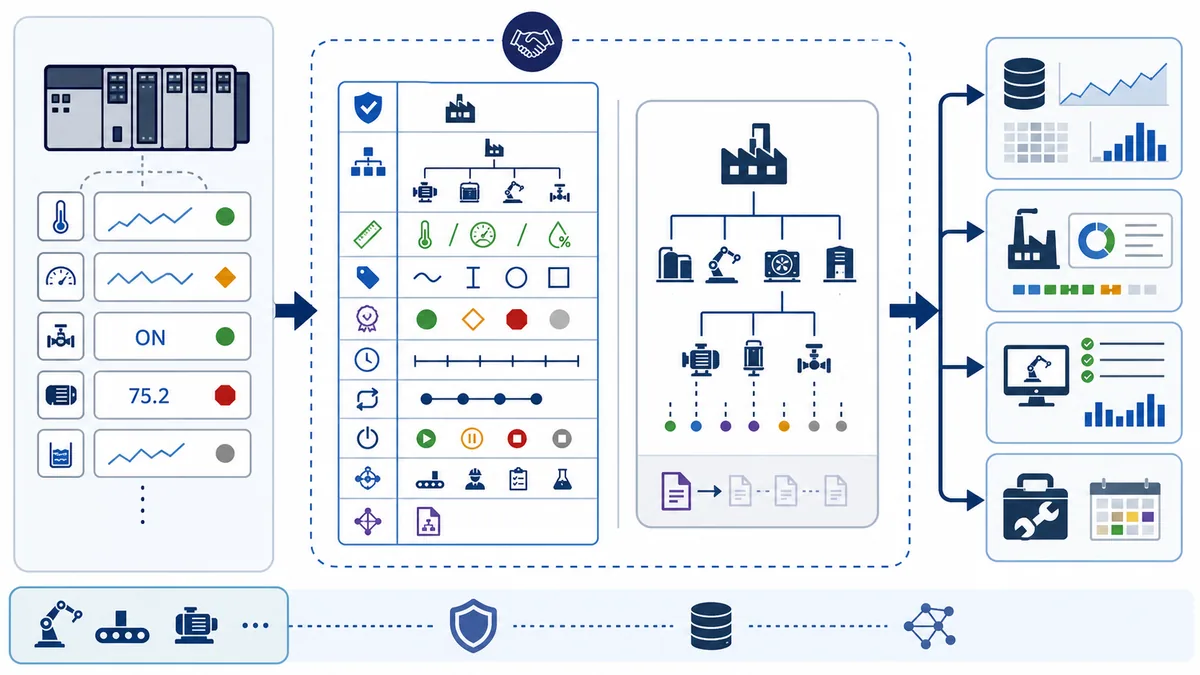
Data Collection and Contextualization
Effective IIoT implementations require systematic approaches to data collection, ensuring relevant information reaches analytics platforms with appropriate context supporting accurate insights and actionable recommendations.
What Data to Collect from PLCs
Strategic data collection balances comprehensive visibility against bandwidth constraints, storage costs, and analytics processing requirements. Identifying high-value data streams maximizes IIoT investment returns.
Process Variables: Key process parameters including temperatures, pressures, flows, levels, and speeds that directly impact product quality, equipment health, and production efficiency.
Equipment Status: Operating modes, run states, alarm conditions, and diagnostic information providing visibility into equipment availability and performance losses.
Production Metrics: Part counts, cycle times, reject rates, and changeover durations enabling OEE calculation and production performance analysis.
Quality Data: Inspection results, dimensional measurements, and test data supporting quality trend analysis and defect prediction.
Energy Consumption: Power demand, consumption patterns, and utility usage enabling energy optimization and sustainability initiatives.
Maintenance Indicators: Vibration signatures, bearing temperatures, lubrication levels, and other condition monitoring parameters supporting predictive maintenance programs.
Data Sampling Strategies
Appropriate sampling rates balance data fidelity against storage requirements and bandwidth consumption, requiring understanding of process dynamics and analytics requirements.
Time-Based Sampling: Fixed-interval sampling (every 1 second, 10 seconds, 1 minute) provides consistent time-series data suitable for trending and statistical analysis but may miss brief events.
Change-of-State Sampling: Recording data only when values change significantly reduces data volumes while capturing all meaningful variations, particularly effective for slowly-changing process variables.
Event-Triggered Sampling: Collecting detailed data when specific conditions occur (alarms, quality failures, equipment starts) provides high-resolution information for root cause analysis without continuous high-frequency collection.
Adaptive Sampling: Dynamic sampling rates that increase during interesting conditions (process upsets, quality deviations) and decrease during stable operation optimize data collection efficiency.
Sampling Rate Guidelines:
| Variable Type | Typical Rate | Rationale | |---------------|--------------|-----------| | Fast process control | 100-1000ms | Capture control loop dynamics | | Temperature/Pressure | 1-10 seconds | Match thermal time constants | | Production counters | 1-60 seconds | Balance timeliness with data volume | | Equipment status | Change-of-state | Minimize bandwidth, capture all events | | Vibration analysis | 1-10kHz | Capture mechanical resonances | | Energy meters | 1-15 minutes | Align with demand billing intervals |
Contextual Data: Product, Operator, Shift
Raw process data alone provides limited insights without contextual information explaining why processes operated under specific conditions. Enriching data with context dramatically improves analytics accuracy and actionability.
Product Context: Product being manufactured, recipe parameters, production order, and material batch identifiers enable comparing performance across products and identifying product-specific issues.
Operator Context: Current operator, shift, and crew information support performance analysis, training needs identification, and best-practice sharing among operators.
Shift Context: Shift identifiers, production schedules, and planned vs actual production enable analyzing performance patterns across time periods and identifying chronic issues.
Environmental Context: Ambient conditions, utility status, and facility operating modes provide explanations for performance variations and environmental dependencies.
Maintenance Context: Recent maintenance activities, work orders, and component replacements support correlating performance changes with maintenance interventions.
Context Implementation Example:
from datetime import datetime
import pytz
class DataContextualizer:
def __init__(self, config):
self.shift_config = config['shifts']
self.product_database = config['products']
def add_context(self, plc_data, additional_context=None):
"""Add contextual information to raw PLC data"""
timestamp = datetime.now(pytz.UTC)
# Add temporal context
context = {
'timestamp': timestamp.isoformat(),
'date': timestamp.strftime('%Y-%m-%d'),
'day_of_week': timestamp.strftime('%A'),
'hour': timestamp.hour
}
# Determine current shift
shift_info = self.get_current_shift(timestamp)
context.update({
'shift': shift_info['shift_name'],
'shift_start': shift_info['start_time'],
'crew': shift_info['crew']
})
# Add product information if available
if 'product_id' in plc_data:
product_info = self.get_product_info(plc_data['product_id'])
context.update({
'product_name': product_info['name'],
'product_category': product_info['category'],
'target_cycle_time': product_info['cycle_time'],
'quality_specs': product_info['specs']
})
# Add operator information
if additional_context and 'operator_id' in additional_context:
context['operator'] = additional_context['operator_id']
# Combine raw data with context
enriched_data = {
'context': context,
'process_data': plc_data,
'derived_metrics': self.calculate_derived_metrics(plc_data, context)
}
return enriched_data
def get_current_shift(self, timestamp):
"""Determine current shift based on time"""
hour = timestamp.hour
day_of_week = timestamp.strftime('%A')
for shift in self.shift_config:
if shift['start_hour'] <= hour < shift['end_hour']:
return {
'shift_name': shift['name'],
'start_time': shift['start_hour'],
'crew': shift.get('crew', 'Unknown')
}
return {'shift_name': 'Unknown', 'start_time': None, 'crew': 'Unknown'}
def get_product_info(self, product_id):
"""Retrieve product information from database"""
# Simplified - would query actual database
return self.product_database.get(product_id, {
'name': 'Unknown',
'category': 'Unknown',
'cycle_time': 0,
'specs': {}
})
def calculate_derived_metrics(self, plc_data, context):
"""Calculate KPIs and derived metrics"""
metrics = {}
# Calculate cycle time variance if target available
if 'cycle_time' in plc_data and 'target_cycle_time' in context:
actual = plc_data['cycle_time']
target = context['target_cycle_time']
metrics['cycle_time_variance'] = ((actual - target) / target) * 100
# Calculate OEE if components available
if all(k in plc_data for k in ['availability', 'performance', 'quality']):
metrics['oee'] = (
plc_data['availability'] *
plc_data['performance'] *
plc_data['quality']
) / 10000 # Convert from percentage products to decimal
return metrics
Data Normalization
Data normalization transforms heterogeneous data from multiple sources into consistent formats enabling cross-facility analysis, multi-vendor integration, and simplified analytics development.
Unit Standardization: Convert measurements to consistent engineering units (Β°C vs Β°F, PSI vs bar, mm vs inches) ensuring accurate comparisons and calculations.
Timestamp Synchronization: Align timestamps to consistent time zones and formats, compensating for local PLC times and ensuring proper time-series alignment.
Data Type Consistency: Standardize data representations (integers, floating-point, booleans) and ranges ensuring consistent processing across diverse PLC platforms.
Naming Conventions: Map vendor-specific tag names to standardized hierarchical naming schemes enabling intuitive data access and automated dashboard generation.
Time-Series Data Handling
Time-series databases optimized for industrial data provide efficient storage, rapid querying, and built-in analytical functions essential for IIoT applications managing millions of data points daily.
Time-Series Database Selection:
InfluxDB: Open-source time-series database offering high write performance, efficient compression, and built-in downsampling for long-term storage optimization.
TimescaleDB: PostgreSQL extension providing time-series optimization while maintaining full SQL compatibility and relational database capabilities.
AWS Timestream: Fully managed time-series database offering automatic tiering, adaptive query processing, and seamless AWS service integration.
Azure Time Series Insights: Managed service optimized for IoT workloads with integrated visualization and anomaly detection capabilities.
Bandwidth and Storage Optimization
Managing data volumes requires strategic optimization balancing analytics requirements against infrastructure costs and network capacity constraints.
Edge Aggregation: Calculate statistical summaries (min, max, average, standard deviation) at edge devices transmitting aggregated data rather than every raw sample.
Differential Encoding: Transmit only changes from previous values rather than absolute values, reducing bandwidth by 50-80% for slowly-changing variables.
Data Compression: Apply compression algorithms optimized for time-series data achieving 5:1 to 20:1 compression ratios without information loss.
Tiered Storage: Implement automated data lifecycle policies moving older data to cheaper storage tiers (hot β warm β cold β archive) based on access patterns.
Intelligent Filtering: Transmit only data exceeding significance thresholds, eliminating transmission of noise and quantization errors consuming bandwidth without adding information.
Practical Implementation Example: Predictive Maintenance System
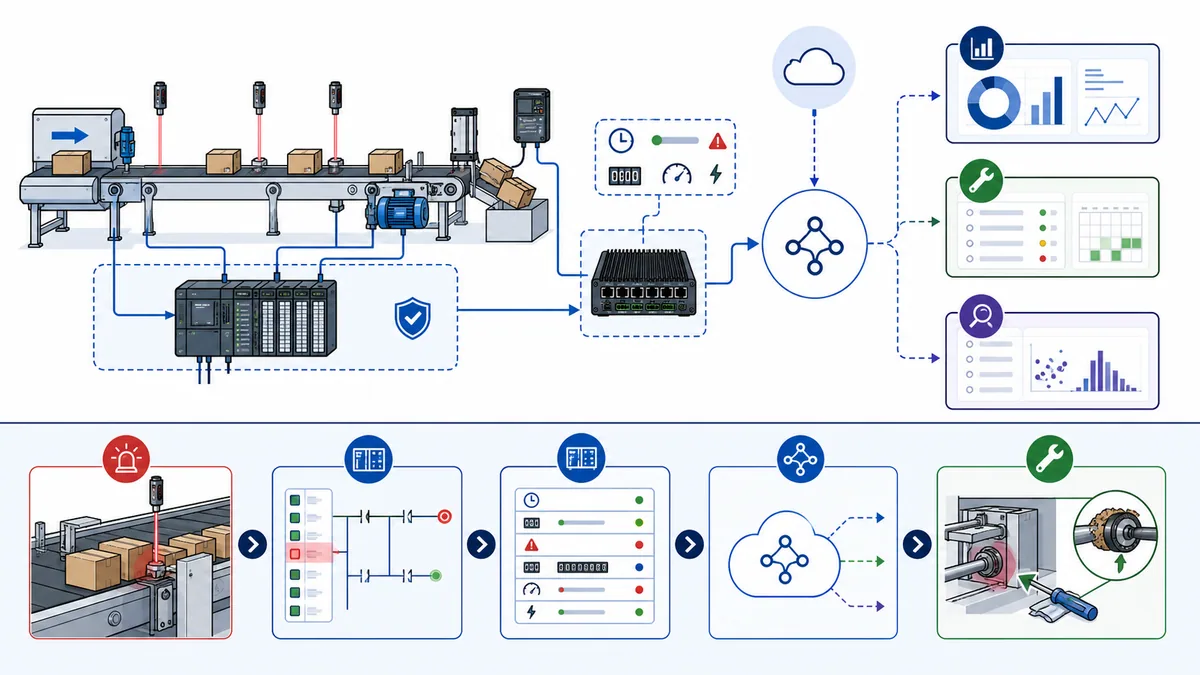
This comprehensive example demonstrates complete predictive maintenance system implementation collecting vibration and temperature data from Allen-Bradley PLCs, transmitting to AWS IoT Core via MQTT gateway, analyzing with machine learning models, and alerting maintenance personnel of predicted failures.
Project Overview
Objective: Implement predictive maintenance system for critical production equipment (motors, pumps, compressors) predicting bearing failures 7-14 days before occurrence enabling planned maintenance during scheduled downtime.
Equipment:
- Allen-Bradley ControlLogix L83 PLC with 1734 POINT I/O
- IFM vibration sensors (VS100/VSE150) with analog outputs
- RTD temperature sensors on motor bearings
- Industrial edge gateway (Dell Edge Gateway 3001)
- AWS IoT Core cloud platform
- Amazon SageMaker for ML model training
Hardware Configuration
Sensor Installation:
Motor #1 (100 HP, 1780 RPM):
- Vibration sensor: Drive-end bearing (horizontal/vertical)
- Vibration sensor: Non-drive-end bearing (horizontal/vertical)
- RTD sensors: Drive-end and non-drive-end bearings
Motor #2 (50 HP, 1775 RPM):
- Vibration sensor: Drive-end bearing (horizontal/vertical)
- Vibration sensor: Non-drive-end bearing (horizontal/vertical)
- RTD sensors: Drive-end and non-drive-end bearings
PLC I/O Configuration:
1734-IE8C Analog Input Module:
Slot 0: Motor1_DE_Vib_H (4-20mA)
Slot 1: Motor1_DE_Vib_V (4-20mA)
Slot 2: Motor1_NDE_Vib_H (4-20mA)
Slot 3: Motor1_NDE_Vib_V (4-20mA)
Slot 4: Motor2_DE_Vib_H (4-20mA)
Slot 5: Motor2_DE_Vib_V (4-20mA)
Slot 6: Motor2_NDE_Vib_H (4-20mA)
Slot 7: Motor2_NDE_Vib_V (4-20mA)
1734-RTD2 Temperature Module:
Channel 0: Motor1_DE_Temp (PT100)
Channel 1: Motor1_NDE_Temp (PT100)
1734-RTD2 Temperature Module:
Channel 0: Motor2_DE_Temp (PT100)
Channel 1: Motor2_NDE_Temp (PT100)
PLC Programming - Data Collection
ControlLogix Ladder Logic:
// Cyclic task - 1000ms period
// Scale analog vibration inputs (4-20mA = 0-25.4 mm/s RMS)
Motor1_DE_Vib_H_Scaled := ((Motor1_DE_Vib_H_Raw - 3277) * 25.4) / 13107;
Motor1_DE_Vib_V_Scaled := ((Motor1_DE_Vib_V_Raw - 3277) * 25.4) / 13107;
Motor1_NDE_Vib_H_Scaled := ((Motor1_NDE_Vib_H_Raw - 3277) * 25.4) / 13107;
Motor1_NDE_Vib_V_Scaled := ((Motor1_NDE_Vib_V_Raw - 3277) * 25.4) / 13107;
Motor2_DE_Vib_H_Scaled := ((Motor2_DE_Vib_H_Raw - 3277) * 25.4) / 13107;
Motor2_DE_Vib_V_Scaled := ((Motor2_DE_Vib_V_Raw - 3277) * 25.4) / 13107;
Motor2_NDE_Vib_H_Scaled := ((Motor2_NDE_Vib_H_Raw - 3277) * 25.4) / 13107;
Motor2_NDE_Vib_V_Scaled := ((Motor2_NDE_Vib_V_Raw - 3277) * 25.4) / 13107;
// Calculate overall vibration levels (RMS of horizontal + vertical)
Motor1_DE_Vib_Overall := SQRT(SQR(Motor1_DE_Vib_H_Scaled) + SQR(Motor1_DE_Vib_V_Scaled));
Motor1_NDE_Vib_Overall := SQRT(SQR(Motor1_NDE_Vib_H_Scaled) + SQR(Motor1_NDE_Vib_V_Scaled));
Motor2_DE_Vib_Overall := SQRT(SQR(Motor2_DE_Vib_H_Scaled) + SQR(Motor2_DE_Vib_V_Scaled));
Motor2_NDE_Vib_Overall := SQRT(SQR(Motor2_NDE_Vib_H_Scaled) + SQR(Motor2_NDE_Vib_V_Scaled));
// Temperature already scaled by RTD modules (Β°C)
// Calculate bearing temperature rise above ambient
Motor1_DE_Temp_Rise := Motor1_DE_Temp - Ambient_Temp;
Motor1_NDE_Temp_Rise := Motor1_NDE_Temp - Ambient_Temp;
Motor2_DE_Temp_Rise := Motor2_DE_Temp - Ambient_Temp;
Motor2_NDE_Temp_Rise := Motor2_NDE_Temp - Ambient_Temp;
// Track motor runtime hours for maintenance scheduling
IF Motor1_Running THEN
Motor1_Runtime_Hours := Motor1_Runtime_Hours + 0.000278; // 1 second in hours
END_IF;
IF Motor2_Running THEN
Motor2_Runtime_Hours := Motor2_Runtime_Hours + 0.000278;
END_IF;
// Simple threshold alarms (will be supplemented by predictive analytics)
Motor1_Vib_Alarm := (Motor1_DE_Vib_Overall > 12.0) OR (Motor1_NDE_Vib_Overall > 12.0);
Motor1_Temp_Alarm := (Motor1_DE_Temp > 90.0) OR (Motor1_NDE_Temp > 90.0);
Motor2_Vib_Alarm := (Motor2_DE_Vib_Overall > 12.0) OR (Motor2_NDE_Vib_Overall > 12.0);
Motor2_Temp_Alarm := (Motor2_DE_Temp > 90.0) OR (Motor2_NDE_Temp > 90.0);
Edge Gateway Implementation
Data Collection and MQTT Publishing:
import pycomm3
import json
import time
import paho.mqtt.client as mqtt
from datetime import datetime
import numpy as np
from scipy import signal
class PredictiveMaintenanceGateway:
def __init__(self, plc_ip, mqtt_config):
self.plc = pycomm3.LogixDriver(plc_ip)
self.mqtt_client = mqtt.Client(mqtt_config['client_id'])
self.mqtt_config = mqtt_config
# Configure MQTT with TLS
self.mqtt_client.tls_set(
ca_certs=mqtt_config['ca_cert'],
certfile=mqtt_config['client_cert'],
keyfile=mqtt_config['client_key']
)
# Historical buffers for trend analysis
self.vibration_history = {
'motor1_de': [],
'motor1_nde': [],
'motor2_de': [],
'motor2_nde': []
}
self.temp_history = {
'motor1_de': [],
'motor1_nde': [],
'motor2_de': [],
'motor2_nde': []
}
def connect(self):
"""Connect to PLC and MQTT broker"""
# Connect to PLC
self.plc.open()
print(f"Connected to PLC at {self.plc.path}")
# Connect to AWS IoT
self.mqtt_client.connect(
self.mqtt_config['broker'],
self.mqtt_config['port']
)
self.mqtt_client.loop_start()
print("Connected to AWS IoT Core")
def collect_motor_data(self, motor_num):
"""Collect all data for specified motor"""
prefix = f"Motor{motor_num}_"
tags = [
f"{prefix}DE_Vib_H_Scaled",
f"{prefix}DE_Vib_V_Scaled",
f"{prefix}NDE_Vib_H_Scaled",
f"{prefix}NDE_Vib_V_Scaled",
f"{prefix}DE_Vib_Overall",
f"{prefix}NDE_Vib_Overall",
f"{prefix}DE_Temp",
f"{prefix}NDE_Temp",
f"{prefix}DE_Temp_Rise",
f"{prefix}NDE_Temp_Rise",
f"{prefix}Runtime_Hours",
f"{prefix}Running",
f"{prefix}Vib_Alarm",
f"{prefix}Temp_Alarm"
]
# Read tags from PLC
results = self.plc.read(*tags)
motor_data = {}
for tag, result in zip(tags, results):
if result.error is None:
# Remove motor prefix for cleaner keys
clean_key = tag.replace(prefix, "")
motor_data[clean_key] = result.value
return motor_data
def calculate_features(self, motor_data, motor_num):
"""Calculate additional features for ML model"""
features = {}
# Update historical buffers
key_de = f"motor{motor_num}_de"
key_nde = f"motor{motor_num}_nde"
self.vibration_history[key_de].append(motor_data['DE_Vib_Overall'])
self.vibration_history[key_nde].append(motor_data['NDE_Vib_Overall'])
self.temp_history[key_de].append(motor_data['DE_Temp_Rise'])
self.temp_history[key_nde].append(motor_data['NDE_Temp_Rise'])
# Keep last 168 hours (1 week) of hourly data
max_history = 168
if len(self.vibration_history[key_de]) > max_history:
self.vibration_history[key_de] = self.vibration_history[key_de][-max_history:]
self.vibration_history[key_nde] = self.vibration_history[key_nde][-max_history:]
self.temp_history[key_de] = self.temp_history[key_de][-max_history:]
self.temp_history[key_nde] = self.temp_history[key_nde][-max_history:]
# Calculate trend features if enough history
if len(self.vibration_history[key_de]) >= 24: # At least 24 hours
# Vibration trends (slope of linear regression)
x = np.arange(len(self.vibration_history[key_de]))
vib_de_trend = np.polyfit(x, self.vibration_history[key_de], 1)[0]
vib_nde_trend = np.polyfit(x, self.vibration_history[key_nde], 1)[0]
temp_de_trend = np.polyfit(x, self.temp_history[key_de], 1)[0]
temp_nde_trend = np.polyfit(x, self.temp_history[key_nde], 1)[0]
features['vib_de_trend_7day'] = float(vib_de_trend)
features['vib_nde_trend_7day'] = float(vib_nde_trend)
features['temp_de_trend_7day'] = float(temp_de_trend)
features['temp_nde_trend_7day'] = float(temp_nde_trend)
# Calculate variance and max values
features['vib_de_variance_7day'] = float(np.var(self.vibration_history[key_de]))
features['vib_nde_variance_7day'] = float(np.var(self.vibration_history[key_nde]))
features['vib_de_max_7day'] = float(np.max(self.vibration_history[key_de]))
features['vib_nde_max_7day'] = float(np.max(self.vibration_history[key_nde]))
features['temp_de_max_7day'] = float(np.max(self.temp_history[key_de]))
features['temp_nde_max_7day'] = float(np.max(self.temp_history[key_nde]))
return features
def publish_motor_data(self, motor_num, motor_data, features):
"""Publish motor data and features to AWS IoT"""
timestamp = datetime.utcnow().isoformat() + 'Z'
payload = {
'timestamp': timestamp,
'motor_id': f'Motor_{motor_num}',
'current_readings': motor_data,
'calculated_features': features,
'metadata': {
'location': 'Production Line 1',
'motor_hp': 100 if motor_num == 1 else 50,
'motor_rpm': 1780 if motor_num == 1 else 1775
}
}
topic = f"factory/predictive-maintenance/motor{motor_num}/telemetry"
self.mqtt_client.publish(
topic,
json.dumps(payload),
qos=1
)
print(f"Published data for Motor {motor_num}")
def run(self):
"""Main data collection and publishing loop"""
self.connect()
collection_interval = 60 # 1 minute
while True:
try:
# Collect data from both motors
for motor_num in [1, 2]:
motor_data = self.collect_motor_data(motor_num)
features = self.calculate_features(motor_data, motor_num)
self.publish_motor_data(motor_num, motor_data, features)
time.sleep(collection_interval)
except KeyboardInterrupt:
print("\nStopping gateway...")
break
except Exception as e:
print(f"Error in main loop: {e}")
time.sleep(10) # Wait before retrying
self.plc.close()
self.mqtt_client.disconnect()
if __name__ == "__main__":
gateway = PredictiveMaintenanceGateway(
plc_ip="192.168.1.10",
mqtt_config={
'client_id': 'pred_maint_gateway',
'broker': 'xxxxx.iot.us-east-1.amazonaws.com',
'port': 8883,
'ca_cert': '/certs/root-CA.crt',
'client_cert': '/certs/device.crt',
'client_key': '/certs/device.key'
}
)
gateway.run()
AWS IoT Configuration and ML Model
IoT Core Rule for Data Storage:
{
"sql": "SELECT * FROM 'factory/predictive-maintenance/+/telemetry'",
"actions": [
{
"timestream": {
"databaseName": "PredictiveMaintenance",
"tableName": "MotorTelemetry",
"dimensions": [
{
"name": "motor_id",
"value": "${motor_id}"
}
],
"roleArn": "arn:aws:iam::123456789012:role/IoTTimestreamRole"
}
},
{
"lambda": {
"functionArn": "arn:aws:lambda:us-east-1:123456789012:function:PredictFailure"
}
}
]
}
SageMaker ML Model (Random Forest Classifier):
import boto3
import json
import numpy as np
import pandas as pd
from sklearn.ensemble import RandomForestClassifier
import joblib
class BearingFailurePredictor:
def __init__(self):
self.model = None
self.feature_names = [
'DE_Vib_Overall', 'NDE_Vib_Overall',
'DE_Temp_Rise', 'NDE_Temp_Rise',
'Runtime_Hours',
'vib_de_trend_7day', 'vib_nde_trend_7day',
'temp_de_trend_7day', 'temp_nde_trend_7day',
'vib_de_variance_7day', 'vib_nde_variance_7day',
'vib_de_max_7day', 'vib_nde_max_7day',
'temp_de_max_7day', 'temp_nde_max_7day'
]
def train_model(self, training_data_path):
"""Train Random Forest classifier on historical failure data"""
# Load training data (historical data labeled with failures)
df = pd.read_csv(training_data_path)
X = df[self.feature_names]
y = df['failure_within_14_days'] # Binary label: 0=healthy, 1=will fail
# Train model
self.model = RandomForestClassifier(
n_estimators=100,
max_depth=10,
min_samples_split=10,
class_weight='balanced', # Handle imbalanced classes
random_state=42
)
self.model.fit(X, y)
# Feature importance
importances = pd.DataFrame({
'feature': self.feature_names,
'importance': self.model.feature_importances_
}).sort_values('importance', ascending=False)
print("Feature Importances:")
print(importances)
return self.model
def predict_failure(self, motor_data):
"""Predict failure probability for incoming motor data"""
# Extract features
features = []
for feature in self.feature_names:
# Navigate nested data structure
if feature in motor_data['current_readings']:
features.append(motor_data['current_readings'][feature])
elif feature in motor_data['calculated_features']:
features.append(motor_data['calculated_features'][feature])
else:
features.append(0) # Missing feature
features_array = np.array(features).reshape(1, -1)
# Predict
failure_probability = self.model.predict_proba(features_array)[0][1]
prediction = self.model.predict(features_array)[0]
return {
'failure_probability': float(failure_probability),
'failure_predicted': bool(prediction),
'confidence': float(max(self.model.predict_proba(features_array)[0]))
}
# Lambda function for real-time prediction
def lambda_handler(event, context):
"""AWS Lambda function to predict failures in real-time"""
# Load pre-trained model from S3
s3 = boto3.client('s3')
model_obj = s3.get_object(Bucket='pred-maint-models', Key='bearing_failure_model.pkl')
model = joblib.load(model_obj['Body'])
predictor = BearingFailurePredictor()
predictor.model = model
# Parse incoming motor data
motor_data = event
# Make prediction
prediction = predictor.predict_failure(motor_data)
# If failure predicted with high confidence, send alert
if prediction['failure_predicted'] and prediction['failure_probability'] > 0.7:
sns = boto3.client('sns')
alert_message = f"""
PREDICTIVE MAINTENANCE ALERT
Motor: {motor_data['motor_id']}
Location: {motor_data['metadata']['location']}
Failure predicted within 14 days
Confidence: {prediction['failure_probability']:.1%}
Current Readings:
- DE Vibration: {motor_data['current_readings']['DE_Vib_Overall']:.2f} mm/s
- NDE Vibration: {motor_data['current_readings']['NDE_Vib_Overall']:.2f} mm/s
- DE Temperature: {motor_data['current_readings']['DE_Temp']:.1f}Β°C
- NDE Temperature: {motor_data['current_readings']['NDE_Temp']:.1f}Β°C
Recommended Action: Schedule maintenance inspection
"""
sns.publish(
TopicArn='arn:aws:sns:us-east-1:123456789012:PredictiveMaintenanceAlerts',
Subject=f"Bearing Failure Predicted: {motor_data['motor_id']}",
Message=alert_message
)
return {
'statusCode': 200,
'body': json.dumps({
'motor_id': motor_data['motor_id'],
'timestamp': motor_data['timestamp'],
'prediction': prediction
})
}
This complete implementation demonstrates:
- PLC integration collecting vibration and temperature data
- Edge computing calculating statistical features and trends
- MQTT communication with AWS IoT Core
- Real-time machine learning inference predicting failures
- Automated alerting notifying maintenance personnel
The system predicts bearing failures 7-14 days in advance enabling planned maintenance during scheduled downtime rather than disruptive emergency repairs, typically reducing unplanned downtime 30-50% while decreasing maintenance costs 20-30%.
Security Best Practices
IIoT security requires defense-in-depth approaches addressing unique challenges of connecting operational technology systems to internet-facing cloud platforms while maintaining the reliability and availability demanded by industrial processes.
Network Segmentation
Network segmentation creates security boundaries between operational technology networks, enterprise IT systems, and external cloud connections limiting attack surfaces and containing security incidents.
Security Zone Architecture:
Level 0-1: Field Devices and PLCs Isolate control networks from all external connectivity using dedicated VLANs or physical network separation. Implement unidirectional gateways for safety-critical systems preventing any inbound traffic.
Level 2: Supervisory Systems SCADA/HMI systems operate in protected zones with controlled access from enterprise networks through industrial firewalls implementing protocol-aware filtering.
Level 2.5: DMZ/Edge Computing Edge gateways reside in demilitarized zones mediating data flow between OT and IT networks, providing protocol translation and security enforcement without direct OT-IT connectivity.
Level 3+: Enterprise and Cloud Enterprise applications and cloud platforms access operational data only through edge gateways or historians in DMZ, never directly connecting to production PLCs or control networks.
Firewall Rules and DMZ
Industrial firewalls provide protocol-aware filtering understanding industrial communication protocols, implementing deep packet inspection detecting protocol anomalies and suspicious command patterns.
Firewall Configuration Best Practices:
Default-Deny Policies: Block all traffic except explicitly permitted communications documented with business justification and source/destination specifications.
Protocol-Level Inspection: Enable industrial protocol filtering restricting write commands to authorized engineering workstations while permitting read access from supervisory systems.
Rate Limiting: Implement connection rate limits and packet rate restrictions preventing denial-of-service attacks overwhelming PLCs or networks.
Stateful Inspection: Track connection states ensuring response packets match legitimate requests and session timeouts force reauthentication.
Encryption (TLS/SSL)
Encryption protects data confidentiality and integrity during transmission between edge devices and cloud platforms preventing eavesdropping and man-in-the-middle attacks.
TLS Implementation Requirements:
Protocol Version: Use TLS 1.2 minimum (TLS 1.3 preferred) disabling obsolete versions (SSL v2/v3, TLS 1.0/1.1) vulnerable to known attacks.
Certificate Management: Implement proper certificate lifecycle management including generation, distribution, validation, rotation, and revocation procedures.
Cipher Suite Selection: Configure strong cipher suites using AES-256 encryption, SHA-256+ hashing, and 2048-bit+ RSA or ECC-256+ keys avoiding weak legacy ciphers.
Perfect Forward Secrecy: Enable PFS cipher suites ensuring session keys remain secure even if long-term keys are compromised in future breaches.
Authentication and Authorization
Strong authentication and authorization prevent unauthorized access to IIoT systems, ensuring only legitimate users and devices access operational data and control functions.
Certificate-Based Authentication:
X.509 certificates provide strong device and application authentication resistant to password-based attacks. Each device possesses unique certificate identifying it cryptographically without shared secrets.
Multi-Factor Authentication:
Require MFA for administrative access to edge gateways, cloud platforms, and configuration interfaces combining passwords with time-based tokens or biometric factors.
Role-Based Access Control:
Implement RBAC limiting user and application privileges to minimum necessary for their functions. Operators view process data but cannot modify configurations; engineers configure systems but cannot access financial data.
API Key Management:
Rotate API keys regularly, implement key expiration policies, and audit key usage detecting unauthorized access attempts or compromised credentials.
Certificate Management
PKI (Public Key Infrastructure) enables scalable certificate-based security for IIoT deployments with thousands of devices requiring automated certificate lifecycle management.
Certificate Authority Structure:
Establish organizational CA (internal or commercial) issuing device certificates from trusted root, enabling centralized trust management and efficient revocation.
Automated Provisioning:
Implement automated certificate provisioning during device commissioning using protocols like ACME (Automated Certificate Management Environment) or EST (Enrollment over Secure Transport).
Certificate Rotation:
Automate certificate renewal before expiration (typically 90-365 day validity periods) ensuring continuous operation without manual intervention or service disruptions.
Revocation Procedures:
Implement CRL (Certificate Revocation List) or OCSP (Online Certificate Status Protocol) enabling immediate revocation of compromised device certificates.
OT Cybersecurity Standards
Industrial cybersecurity standards provide comprehensive frameworks addressing unique security requirements of operational technology environments.
IEC 62443 Standard:
Comprehensive industrial security standard defining security levels, technical requirements, and lifecycle processes applicable to asset owners, system integrators, and equipment vendors.
Key IEC 62443 Requirements:
- Identification and authentication control
- Use control (authorization)
- System integrity (malware protection, integrity verification)
- Data confidentiality (encryption)
- Restricted data flow (network segmentation)
- Timely response to events (monitoring, incident response)
- Resource availability (availability protection)
NIST Cybersecurity Framework:
Risk-based framework organizing security activities into five functions (Identify, Protect, Detect, Respond, Recover) applicable to critical infrastructure including industrial control systems.
ISA/IEC 62443-3-3:
Defines technical security requirements for industrial control systems specifying capabilities for various security levels (SL 1-4) addressing different threat scenarios.
For comprehensive coverage of PLC security implementation, see our detailed PLC security best practices guide.
ROI and Business Case
Developing compelling business cases for IIoT investments requires quantifying benefits across multiple dimensions including downtime reduction, energy optimization, quality improvement, and maintenance efficiency.
Typical IIoT ROI Metrics
Downtime Reduction: Organizations implementing predictive maintenance and remote monitoring typically reduce unplanned downtime 30-50%, translating to $100K-$1M+ annual savings per line depending on production value and utilization.
Maintenance Cost Reduction: Predictive maintenance programs enabled by IIoT reduce maintenance costs 20-30% through optimized spare parts inventory, eliminated unnecessary preventive maintenance, and planned interventions during scheduled downtime.
Energy Savings: Real-time energy monitoring and optimization enabled by IIoT typically reduces energy consumption 5-15%, delivering $50K-$500K+ annual savings for energy-intensive operations.
Quality Improvement: Early detection of quality deviations and automated process optimization reduces scrap and rework 10-25%, improving margins and customer satisfaction while reducing waste disposal costs.
Labor Productivity: Remote monitoring, automated reporting, and predictive analytics improve engineering and maintenance productivity 15-30% enabling staff redeployment to higher-value activities.
Downtime Reduction Examples
Case Study: Automotive Assembly Plant
Automotive assembly line valued at $2M production per hour implemented IIoT predictive maintenance system for critical robotics and conveyors. System predicted six failures during 12-month period enabling planned maintenance during scheduled downtime.
Financial Impact:
- Previous year: 4 unplanned failures averaging 8 hours downtime = 32 hours Γ $2M/hour = $64M lost production
- IIoT year: 0 unplanned failures, 6 predicted failures maintained during scheduled downtime = $0 lost production
- Net benefit: $64M avoided downtime cost
- IIoT system cost: $250K capital + $50K annual = 128:1 first-year ROI
Case Study: Chemical Processing Plant
Continuous chemical process running 24/7 implemented IIoT monitoring for critical pumps and compressors. Advanced analytics predicted five failures 10-14 days in advance enabling planned replacements.
Financial Impact:
- Previous year: 3 unplanned failures averaging 16 hours downtime = 48 hours lost
- Production value: $50K/hour = $2.4M lost production
- Emergency maintenance premium: $150K
- Total previous cost: $2.55M
- IIoT year: 0 unplanned failures, maintenance during scheduled turnaround
- IIoT investment: $180K capital + $30K annual
- Net first-year benefit: $2.34M (11:1 ROI)
Energy Savings
Case Study: Food Processing Facility
Food processing plant implemented IIoT energy monitoring across all major equipment including refrigeration, compressors, and processing lines. Real-time visibility enabled identification of inefficient equipment and operational practices.
Results:
- Baseline energy cost: $2.4M annually
- Identified opportunities:
- Refrigeration optimization: 12% reduction = $180K/year
- Compressor sequencing: 8% reduction = $85K/year
- Production scheduling: 5% reduction = $45K/year
- Total annual savings: $310K (12.9% overall reduction)
- IIoT investment: $120K capital + $20K annual
- Payback period: 5 months
Quality Improvement
Case Study: Pharmaceutical Manufacturing
Pharmaceutical manufacturer implemented IIoT quality monitoring and control system providing real-time visibility into critical process parameters and automated deviation detection.
Results:
- Batch rejection rate: Reduced from 3.2% to 0.8%
- Average batch value: $250K
- Annual production: 1,200 batches
- Previous rejections: 38 batches Γ $250K = $9.5M annual loss
- IIoT-enabled quality: 10 batches Γ $250K = $2.5M annual loss
- Annual benefit: $7M saved product + $1.5M avoided rework labor
- IIoT investment: $400K capital + $80K annual
- ROI: 17:1 first year
Implementation Costs vs Benefits
Typical IIoT Implementation Costs:
Small Deployment (1-3 PLCs, basic monitoring):
- Edge gateway hardware: $2K-5K
- Sensors/instrumentation: $5K-15K
- Cloud platform setup: $2K-5K
- Integration labor: $15K-30K
- Annual cloud/support: $5K-12K
- Total first year: $29K-67K
Medium Deployment (5-15 PLCs, predictive analytics):
- Edge gateway hardware: $10K-25K
- Sensors/instrumentation: $25K-75K
- Cloud platform setup: $5K-15K
- ML model development: $25K-75K
- Integration labor: $50K-150K
- Annual cloud/support: $15K-40K
- Total first year: $130K-380K
Large Deployment (20+ PLCs, enterprise integration):
- Edge gateway hardware: $40K-100K
- Sensors/instrumentation: $100K-300K
- Cloud platform setup: $15K-50K
- ML model development: $75K-200K
- Enterprise integration: $50K-150K
- Integration labor: $150K-400K
- Annual cloud/support: $40K-120K
- Total first year: $470K-1.32M
Benefit Categories:
Hard Benefits (Directly Quantifiable):
- Reduced unplanned downtime
- Lower maintenance costs
- Energy savings
- Reduced scrap and rework
- Improved asset utilization
Soft Benefits (Indirectly Quantifiable):
- Improved decision-making
- Enhanced operational visibility
- Better regulatory compliance
- Reduced manual data collection
- Improved customer satisfaction
Strategic Benefits (Long-Term Value):
- Digital transformation foundation
- Competitive differentiation
- Innovation enablement
- Organizational learning
- Future-proofing operations
ROI Calculation Framework:
Year 1:
Hard Benefits: $X
Soft Benefits (estimated): $Y
Implementation Costs: $C
Annual Costs: $A
Net Benefit Year 1: (X + Y) - (C + A)
Years 2-5:
Annual Benefits: $X + $Y (growing 5-10% annually)
Annual Costs: $A (relatively stable)
Net Annual Benefit: (X + Y) - A
5-Year NPV (Net Present Value):
NPV = Ξ£ [(Benefits_year_n - Costs_year_n) / (1 + discount_rate)^n]
ROI = (Total Benefits - Total Costs) / Total Costs Γ 100%
Successful IIoT implementations typically achieve positive ROI within 6-24 months through combination of downtime reduction, efficiency improvements, and quality enhancements, with ongoing benefits accumulating throughout system lifecycle.
Frequently Asked Questions
What is Industrial IoT (IIoT) and how does it differ from consumer IoT?
Industrial IoT (IIoT) applies Internet of Things technologies to industrial environments including manufacturing, energy, utilities, and process industries. Unlike consumer IoT emphasizing convenience and lifestyle applications, IIoT prioritizes reliability, real-time performance, security, and integration with existing industrial control systems. IIoT systems must operate continuously in harsh environments, meet deterministic timing requirements, and integrate with established industrial protocols and safety systems while consumer IoT tolerates occasional connectivity issues and focuses on user experience over industrial robustness.
Can existing PLCs connect to IIoT platforms without hardware upgrades?
Yes, existing PLCs can connect to IIoT platforms using edge gateways that provide protocol translation between industrial communication protocols (Modbus, Profinet, EtherNet/IP) and cloud-compatible protocols (MQTT, OPC UA, HTTPS). Edge gateways read data from legacy PLCs using native industrial protocols then publish information to cloud platforms without requiring PLC programming changes or firmware updates. This brownfield integration approach enables IIoT benefits from installed control systems without disruptive retrofits or production interruptions. Modern PLCs with native cloud capabilities can connect directly to IIoT platforms, but edge gateways provide additional benefits including protocol aggregation, edge analytics, and security isolation.
What is the difference between SCADA and IIoT?
SCADA (Supervisory Control and Data Acquisition) provides local supervisory control and monitoring typically limited to single facilities or localized operations using proprietary protocols and on-premises infrastructure. IIoT extends beyond traditional SCADA adding cloud connectivity, advanced analytics, machine learning, mobile access, and enterprise-wide visibility across distributed operations. SCADA emphasizes real-time control and operator interfaces while IIoT focuses on data-driven insights, predictive analytics, and business intelligence. Modern architectures often combine SCADA for local control with IIoT for analytics and optimization, with SCADA systems becoming data sources feeding IIoT platforms. For detailed comparison, see our SCADA vs DCS guide.
What protocols are commonly used for IIoT and PLC integration?
Primary IIoT protocols include MQTT (lightweight publish-subscribe messaging), OPC UA (industrial-grade secure communication with rich information models), HTTPS/REST APIs (web-based integration), and Sparkplug B (industrial extension of MQTT). Traditional PLC protocols including Modbus TCP, EtherNet/IP, and Profinet communicate between PLCs and edge gateways while modern protocols optimize cloud connectivity. Protocol selection depends on specific requirements including bandwidth constraints, security needs, device capabilities, and existing infrastructure. Most implementations use multiple protocols: industrial protocols for PLC communication and IT-standard protocols for cloud connectivity with edge gateways providing protocol translation. See our comprehensive PLC communication protocols guide for detailed protocol comparison.
How secure is IIoT for industrial control systems?
IIoT security depends entirely on implementation quality and adherence to best practices. Properly designed IIoT architectures implement multiple security layers including network segmentation isolating control systems, encrypted communication using TLS/SSL, certificate-based authentication, edge gateways providing security boundaries, and continuous monitoring detecting anomalies. Key security practices include never exposing PLCs directly to internet, using defense-in-depth strategies, implementing role-based access control, regular security assessments, and following industrial cybersecurity standards (IEC 62443, NIST). Organizations should treat IIoT security as ongoing operational discipline rather than one-time implementation. Our PLC security best practices guide covers comprehensive security implementation.
What is edge computing and why is it important for IIoT?
Edge computing processes data near its source (at network edge) rather than transmitting everything to centralized cloud platforms. Edge computing addresses critical IIoT challenges including latency (enabling real-time responses), bandwidth (reducing data transmission by 80-95% through local filtering and aggregation), reliability (maintaining operation during cloud connectivity interruptions), security (minimizing sensitive data leaving facilities), and cost (reducing cloud computing and bandwidth expenses). Edge devices collect data from multiple PLCs, perform preliminary analytics, filter significant information, buffer data during outages, and transmit aggregated insights to cloud platforms. Most IIoT implementations benefit from hybrid architectures combining edge computing for real-time operations with cloud platforms for advanced analytics and long-term storage.
How do I calculate ROI for IIoT projects?
IIoT ROI calculation quantifies benefits across multiple categories: hard benefits (downtime reduction, maintenance savings, energy optimization, quality improvement), soft benefits (improved decision-making, operational visibility, reduced manual effort), and strategic benefits (competitive differentiation, digital transformation foundation). Typical methodology: 1) Establish baselines (current downtime hours, maintenance costs, energy consumption), 2) Project improvements (30-50% downtime reduction, 20-30% maintenance savings, 5-15% energy savings), 3) Calculate financial impact (saved production hours Γ hourly value), 4) Account for implementation costs (hardware, software, integration, ongoing), 5) Calculate net present value over 3-5 years. Most industrial IIoT implementations achieve positive ROI within 6-24 months primarily through downtime reduction and maintenance optimization, with ongoing benefits accumulating throughout system lifecycle.
What cloud platform is best for manufacturing IIoT applications?
Cloud platform selection depends on specific requirements including scale (AWS excels at massive device counts), enterprise integration needs (Azure integrates well with Microsoft ecosystem), AI/ML focus (GCP provides strongest ML capabilities), and industry expertise (ThingWorx and MindSphere offer manufacturing-specific functionality). Consider factors including device connectivity protocols, analytics capabilities, existing technology investments, geographic requirements, and cost structure. Most organizations choose hyperscale platforms (AWS, Azure, GCP) for general-purpose IIoT or specialized industrial platforms (ThingWorx, MindSphere) when manufacturing-specific features justify additional costs. Many successful implementations combine platforms leveraging each platform's strengths (example: industrial platform for device connectivity with hyperscaler for advanced analytics).
Can IIoT support predictive maintenance programs?
Yes, predictive maintenance represents one of the highest-value IIoT applications with proven ROI across industries. IIoT platforms collect equipment health indicators (vibration, temperature, pressure, motor current) at frequencies impossible with manual data collection, enabling machine learning models detecting failure patterns weeks before breakdowns occur. Successful predictive maintenance implementations typically reduce unplanned downtime 30-50%, decrease maintenance costs 20-30% through optimized spare parts and labor scheduling, and extend equipment life through early intervention preventing catastrophic failures. Implementation requires appropriate sensors (vibration, temperature), data collection infrastructure (PLCs or condition monitoring systems), edge computing or cloud analytics, and machine learning models trained on historical failure data. Organizations should start with high-value assets where downtime costs justify investment.
How do I get started with IIoT and PLC integration?
Start IIoT journey with pilot project on specific high-value use case: 1) Identify problem (frequent unplanned downtime, energy waste, quality issues), 2) Select critical equipment (high downtime cost or energy consumption), 3) Define success metrics (downtime hours, maintenance costs, energy consumption), 4) Choose appropriate architecture (edge gateway for brownfield, native connectivity for greenfield), 5) Implement pilot with limited scope (1-3 PLCs, single production line), 6) Validate benefits over 3-6 months, 7) Develop scaling roadmap based on lessons learned. Avoid attempting enterprise-wide transformation immediately; successful IIoT programs grow incrementally from successful pilots demonstrating measurable value. Consider engaging system integrators or IIoT platform vendors for initial implementation then develop internal capabilities for expansion and ongoing management.
What is Industry 4.0 and how does IIoT enable it?
Industry 4.0 represents the fourth industrial revolution characterized by cyber-physical systems, Internet of Things, cloud computing, and artificial intelligence transforming traditional manufacturing into smart, adaptive, self-optimizing operations. IIoT provides the connectivity foundation enabling Industry 4.0 concepts including digital twins (virtual representations of physical assets updated by real-time data), predictive analytics (machine learning models forecasting failures and optimizing operations), autonomous systems (self-adjusting processes requiring minimal human intervention), and mass customization (flexible production adapting to individual customer requirements). Industry 4.0 goes beyond IIoT connectivity encompassing organizational transformation, business model innovation, and workforce development, but IIoT provides essential technological infrastructure making Industry 4.0 initiatives technically feasible and economically viable.
How does OPC UA fit into IIoT architecture?
OPC UA (OPC Unified Architecture) serves as industrial communication standard explicitly designed for Industry 4.0 and IIoT applications, providing platform-independent, secure communication with rich semantic information models. OPC UA bridges operational technology and information technology worlds, communicating efficiently between PLCs, SCADA systems, edge gateways, and cloud platforms while maintaining industrial-grade security and reliability. Key OPC UA advantages include platform independence (Windows, Linux, embedded, cloud), built-in security (encryption, authentication, authorization), rich data models (object-oriented structures beyond simple tag-value pairs), and pub/sub capabilities optimizing cloud connectivity. Modern PLCs from major manufacturers provide native OPC UA servers enabling standardized data access. Our comprehensive OPC UA tutorial covers implementation details, programming examples, and security configuration for IIoT applications.
Conclusion: The Future of Connected Industrial Operations
IIoT and PLC integration represents fundamental technological transformation enabling intelligent, data-driven industrial operations that continuously optimize performance, predict failures before they occur, and adapt to changing business requirements in real-time. The convergence of operational technology and information technology through IIoT creates unprecedented opportunities for improving efficiency, reducing costs, and enhancing competitiveness across manufacturing and process industries.
Successful IIoT implementation requires balancing innovation with operational pragmatism, connecting legacy control systems to modern cloud platforms without compromising the reliability and security essential for industrial production. Organizations that approach IIoT strategically starting with focused pilot projects demonstrating measurable value then scaling successful patterns across facilities will achieve sustainable competitive advantages through superior operational visibility, predictive capabilities, and data-driven decision-making.
The maturation of IIoT technologies including standardized protocols (MQTT, OPC UA), proven cloud platforms (AWS IoT, Azure IoT), and established edge computing architectures makes IIoT implementation more accessible than ever. However, technology alone doesn't guarantee success; effective implementations combine appropriate technology selection with organizational alignment, workforce development, and continuous improvement processes that evolve alongside technological capabilities.
Forward-thinking automation professionals must develop hybrid skillsets combining traditional PLC programming expertise with modern software development, cloud technologies, data analytics, and cybersecurity knowledge. This expanded expertise enables designing, implementing, and maintaining IIoT systems that bridge operational technology and information technology worlds while maintaining operational excellence and security postures appropriate for connected industrial environments.
The future of industrial automation will be defined by increasing connectivity, intelligence, and adaptability enabled by IIoT technologies. Organizations investing in IIoT capabilities today position themselves for success in an increasingly digital, competitive, and rapidly evolving industrial landscape requiring flexibility, efficiency, and innovation to thrive.
Related Industrial Automation Resources
Continue your Industry 4.0 journey with these comprehensive guides:
- OPC UA Tutorial Complete Guide - Master the industrial communication standard for IIoT
- PLC Communication Protocols Complete Guide - Understand all major industrial communication protocols
- PLC Security Best Practices Complete Guide - Implement comprehensive cybersecurity for IIoT systems
- SCADA Best Practices Complete Guide - Design effective SCADA systems for IIoT integration
Accelerate Your Industrial Automation Career
Ready to master PLC programming and IIoT integration for Industry 4.0? Our Complete PLC Programming Guide covers everything from fundamental concepts through advanced industrial communication, cloud integration, and data analytics enabling modern connected manufacturing. Start your journey toward expertise in next-generation industrial automation today.
The Industrial Internet of Things revolution is transforming manufacturing and process industries from reactive operations responding to problems after they occur into proactive, predictive, and self-optimizing systems that continuously improve performance and adapt to changing conditions. Embrace IIoT technologies and methodologies to lead your organization's digital transformation journey creating smarter, more efficient, and more competitive industrial operations.
π‘ Pro Tip: Download Our Complete PLC Programming Resource
This comprehensive 13Β 041-word guide provides deep technical knowledge, but our complete 500+ page guide (coming December 2025) includes additional practical exercises, code templates, and industry-specific applications.Preorder the complete guide here (60% off) β
π Ready to Become a PLC Programming Expert?
You've just read 13Β 041 words of expert PLC programming content. Preorder our complete 500+ page guide with even more detailed examples, templates, and industry applications.
β December 2025 release β Full refund guarantee
Frequently Asked Questions
How long does it take to learn PLC programming?
With dedicated study and practice, most people can learn basic PLC programming in 3-6 months. However, becoming proficient in advanced techniques and industry-specific applications typically takes 1-2 years of hands-on experience.
What's the average salary for PLC programmers?
PLC programmers earn competitive salaries ranging from $55,000-$85,000 for entry-level positions to $90,000-$130,000+ for senior roles. Specialized expertise in specific industries or advanced automation systems can command even higher compensation.
Which PLC brands should I focus on learning?
Allen-Bradley (Rockwell) and Siemens dominate the market, making them excellent starting points. Schneider Electric, Mitsubishi, and Omron are also valuable to learn depending on your target industry and geographic region.