PLC Certification and Interview Questions: Technician Prep Guide
Choose a defensible PLC or controls credential, map its published domains to practical skills, and prepare evidence-based answers for written, hands-on and interview assessments.
Review status: Editorially reviewed against current official ISA, PMMI, Siemens, Rockwell Automation, SACA, IEC, PLCopen, OSHA and NIST sources; credential names, eligibility, domains, delivery, price and availability require issuer verification
Direct answer
There is no single universal PLC certification interview or one credential that proves every PLC technician job. Treat three assessments separately: a credential issuer's exam measures its published body of knowledge; an employer's written or hands-on test samples the tasks in a particular role; and a technical interview tests whether you can explain decisions, evidence, limitations and safe next steps. Preparing for only one leaves a predictable gap in the other two.
Start with the exact role and installed platform. An experienced instrumentation and controls technician may qualify for an ISA Certified Control Systems Technician (CCST) level. An early-career candidate may be better matched to a defined associate certificate, an occupational credential, a college or apprenticeship route, or manufacturer training aligned with the employer's controllers. A technician supporting a Logix plant needs relevant Rockwell workflow and troubleshooting practice; a TIA Portal role needs the matching Siemens environment. The badge name matters less than issuer validity, eligibility, current scope and employer relevance.
Then prepare one evidence set that travels across all three gates: a requirements note, working PLC project, electrical or I/O trace, normal and abnormal test results, one diagnosed fault, recovery proof, version record and a short explanation. Use practice questions to expose weak domains, not to memorize confident-sounding scripts. No guide can promise an exam pass or job offer, and no simulator or certificate authorizes work on energized or production machinery.
| Your immediate goal | Best first source | Preparation output | Do not confuse it with |
|---|---|---|---|
| earn a named credential | current issuer eligibility, body of knowledge and testing page | domain-weighted study and documented eligibility | a generic online completion badge |
| pass an employer screen | job description and recruiter assessment format | timed fundamentals plus role-specific calculation/logic practice | the full scope of a professional certification |
| pass a hands-on test | task statement, approved equipment and safety rules | tested program, measurements, fault record and restoration | unrestricted access to a live machine |
| pass a technical interview | role duties, platform, industry and interview stage | concise situation–method–evidence–boundary answers | reciting a definition without proof |
| choose training | target-role gap analysis and official course outcomes | a gap-to-course matrix and post-course practice plan | proof that the course is requested by employers |

Separate certification, certificate, assessment and interview
Professional certification is an issuer-controlled claim
A professional certification normally has defined eligibility, an assessment, governance and a way to verify the credential. The issuer decides the body of knowledge, exam rules, renewal and use of the mark. For example, ISA publishes CCST requirements by level, exam details and a credential directory. Those controls make the claim more specific than “completed PLC training,” but the scope is broader than PLC programming alone and does not certify competence on every controller.
Record the exact credential name and level. “ISA CCST Level 1” is auditable; “internationally certified PLC expert” may not be. Before paying, save the official requirements and exam-domain pages with an access date because prerequisites, windows and delivery rules change.
A certificate can mean assessed learning or only completion
A certificate program may include a formal assessment and published eligibility, while a course-completion certificate may only confirm attendance or module completion. Both can be useful, but they communicate different evidence. Ask whether identity is verified, whether an exam or practical task is required, what passing means, who issues the record, whether it expires and whether employers can verify it.
ISA, for example, distinguishes certification programs from certificate programs and publishes a separate CST Associate certificate path. Rockwell publishes product training, job-aligned technology tracks and certificate programs. Describe the exact offering you completed instead of upgrading its wording on a résumé.
Employer assessments are local sampling instruments
An employer may use a short multiple-choice screen, ladder interpretation, live coding, an electrical troubleshooting board, a structured interview, or some combination. That test is evidence for its vacancy, not a portable industry credential. Ask the recruiter what format is used, what equipment or software is supplied, whether reference material is allowed, how long the exercise lasts and whether electrical work is involved.
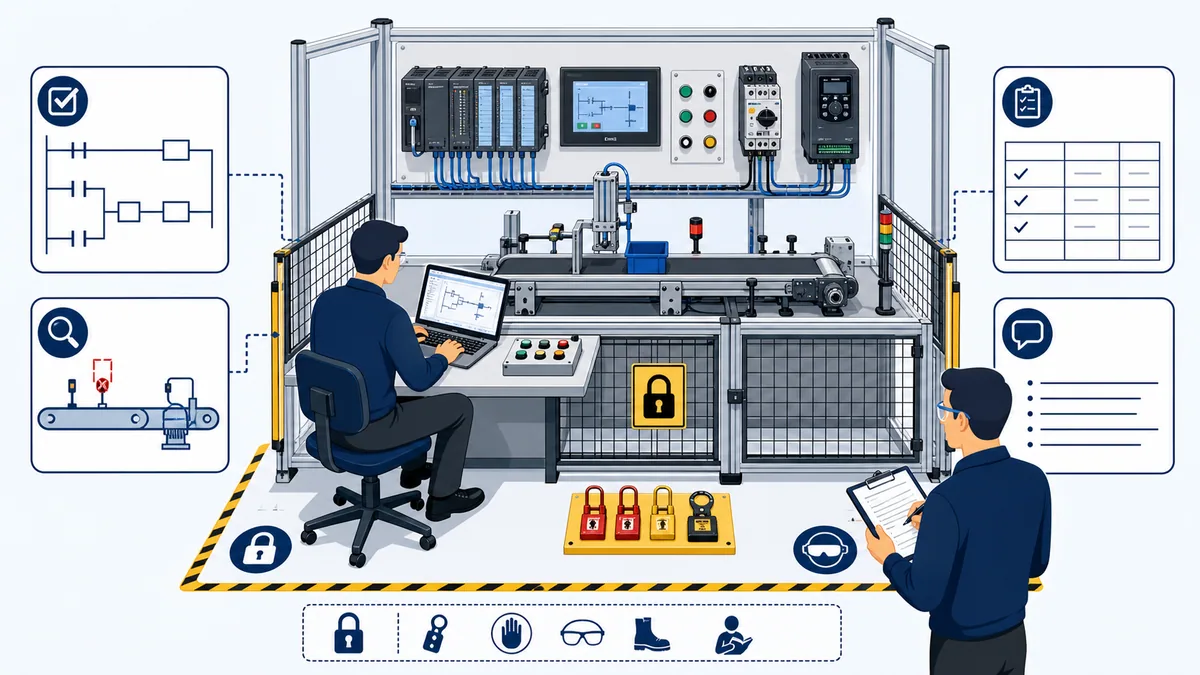
Never accept a surprise “test” that expects unsafe live work, bypassed guarding, uncontrolled forcing or access outside your authorization. A competent assessor can evaluate diagnostic thinking on de-energized trainers, simulations, drawings and controlled equipment.
Technical interviews test reasoning under uncertainty
Strong interview answers distinguish what is known from what must be verified. Instead of saying “the output card is bad,” state the symptom, expected state, evidence boundary, safe measurement or online observation, alternative explanations, and restoration check. Interviewers can then see how you work when a manual, firmware or plant standard changes.
| Question type | Weak response pattern | Strong response pattern | Evidence artifact |
|---|---|---|---|
| definition | memorized sentence | definition plus operating consequence | annotated scan or data-flow sketch |
| ladder trace | describes symbols only | predicts state over successive scans and edge cases | truth/state table |
| troubleshooting | replaces the most suspicious part | checks request, permissive, logic, output, field interface and feedback in order | measured boundary log |
| design | presents one rung as universally correct | states requirements, modes, faults, restart policy and safety boundary | functional description plus tests |
| experience | claims ownership of a large project | isolates personal contribution, decision, evidence and limitation | redacted test record or demo |
Verify a PLC credential before spending money
Use a six-evidence issuer check
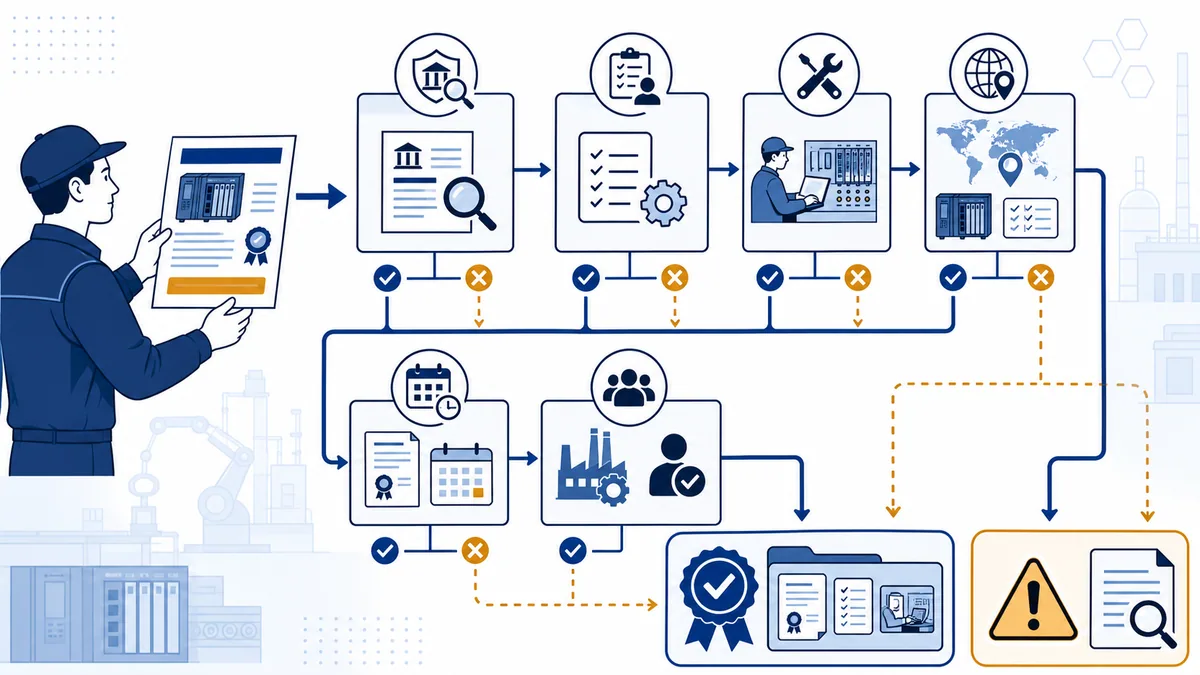
Open the issuer's own site rather than relying on an affiliate comparison. Confirm the legal or organizational issuer, exact credential, eligibility, assessment, validity/renewal and verification method. Then check current regional availability and the employer signal. A credential can be legitimate but irrelevant to the target plant.
| Evidence | Question to answer | Release decision |
|---|---|---|
| issuer | Who owns the credential and mark? | reject when only a reseller or anonymous site can explain it |
| eligibility | What education, training or experience must be documented? | do not register until you meet and can evidence it |
| assessment | Is there a proctored exam, practical assessment, graded project or attendance check? | describe the achieved evidence exactly |
| scope | Which role, product, version and domains are assessed? | compare line by line with target job duties |
| lifecycle | Does it expire, renew, require continuing activity or change version? | budget maintenance, not only initial price |
| verification | Can an employer verify issuer, holder and status? | retain the official record or directory link |
Compare current paths without inventing equivalence
The examples below illustrate different credential and training models. They are not a universal ranking. Availability, course codes, price, language and exam delivery can vary by region and date.
| Path checked for this review | Published fit | Assessment or evidence distinction | Verify before enrolling |
|---|---|---|---|
| ISA CST Associate certificate | early-career control-systems technician fundamentals under listed eligibility routes | ISA publishes a closed-book exam and domain distribution; the certificate can count toward CCST experience under current rules | eligibility route, course/exam option, current fee and region |
| ISA CCST Level 1/2/3 | experienced control-systems technicians across instrumentation, maintenance, commissioning and documentation | education/training/experience requirements and level-specific multiple-choice exams | qualifying years, related work minimum, exam window and current body of knowledge |
| PMMI Mechatronics PLC 1 | entry-level industrial maintenance or mechatronics technician PLC competency | official study guide lists domains and sample-question support | test site, current blueprint, price and recognition in target market |
| Siemens SITRAIN role path | candidates working in a supported TIA Portal/service/programming environment | regional exams or learning paths can include platform tasks | exact country catalog, controller/software version, prerequisites and assessment |
| Rockwell Automation training/certificate programs | technicians and programmers supporting Logix, drives, motion, networks and related products | official catalog separates Understand, Maintain/Troubleshoot and Program/Design tracks | exact certificate program versus individual course, region and current course code |
| SACA credentials | industrial automation/Industry 4.0 occupational competencies | official materials distinguish knowledge-based Silver and hands-on Gold models | approved provider/assessment site, exact credential and employer demand |
Do a vacancy-sample relevance test
Collect at least twenty current vacancies in the geography and sector you can realistically pursue. Count exact mentions of the credential, issuer, PLC platform, electrical license or apprenticeship, degree, travel, shift work, safety responsibility and years of experience. Do not count a blog's claim that a badge is “recognized” as employer demand.
The output is a simple decision: required, preferred, adjacent or absent. A credential requested in six of twenty reachable jobs is a different investment from one absent in all twenty. Preserve the sample date because hiring language changes.
Build the technician competency stack first
Foundation: electrical evidence and safe work
A PLC technician must connect software state to the physical signal path. Practise reading power and control drawings; differentiating source/sink and dry/wet contact interfaces; tracing common/reference paths; identifying expected voltage or continuity under an approved test state; and explaining where isolation, absence-of-voltage verification or qualified electrical authority applies.
Do not turn interview practice into unsafe field instruction. State that site procedures, equipment documentation, arc-flash/electrical rules and authorization govern any measurement. In a simulated or de-energized trainer, document the expected state before probing.
Core: scan, logic, data and state
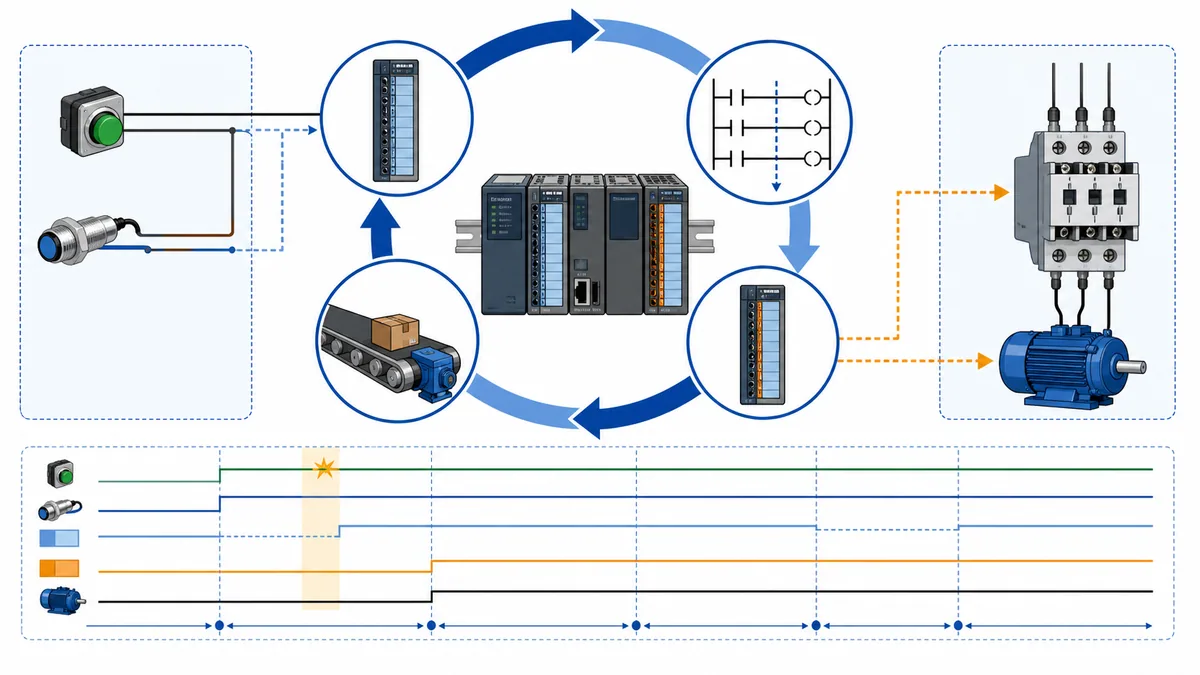
Be able to predict input sampling, program execution and output update across several scans. Read ladder power flow without equating an examined-true instruction with a physical normally-open contact. Explain retentive behavior, timer time base, counter edges, first-scan initialization, task rates and the consequences of multiple writers. Build explicit auto/manual and fault-recovery states rather than one optimistic run rung.
Integration: I/O, drives, HMI and networks
Certification and interview questions often sample analog scaling, data representation, HMI handshakes, industrial communications and drive control. For each, practise the contract: owner, command, feedback, data quality, timeout, safe/degraded behavior and recovery. A protocol name alone does not prove that roles, addresses, byte order, update rate or device state agree.
Proof: troubleshooting and documentation
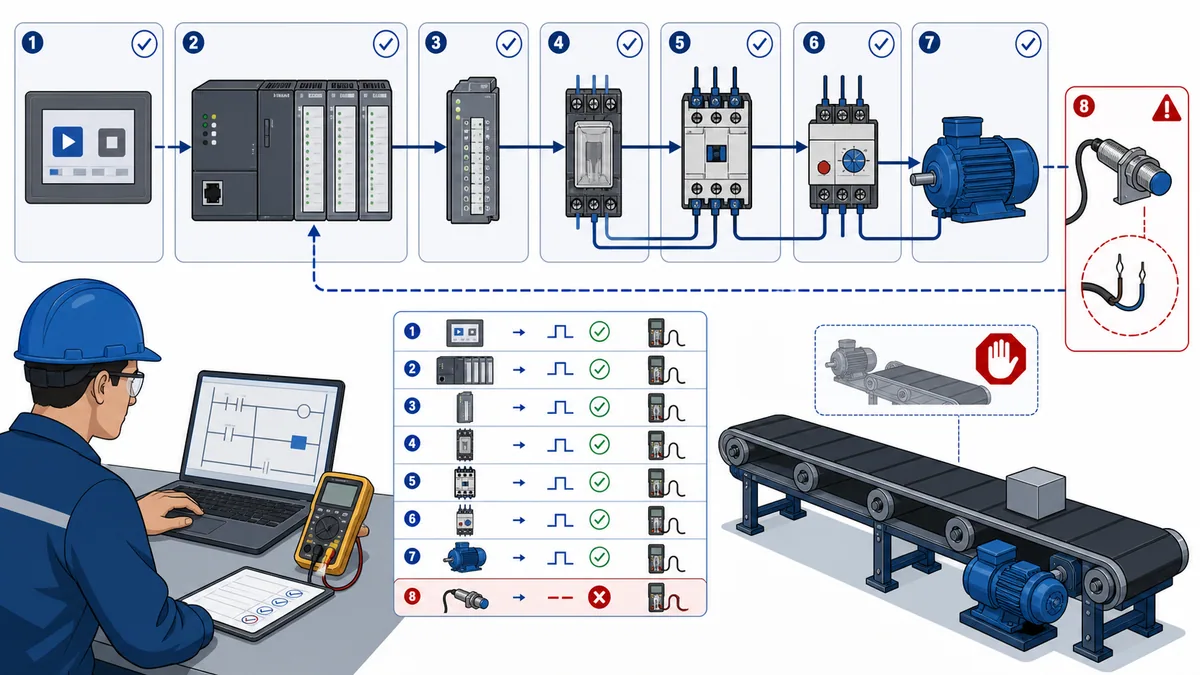
Use an evidence ladder: confirm the reported symptom; capture state; find the first boundary that differs from expectation; change one controlled variable; retest; restore; record the outcome. Document requirements, I/O/tag map, logic revision, tests, defects and limitations. This is useful in an exam, but it is even more persuasive in an interview because it shows repeatability.
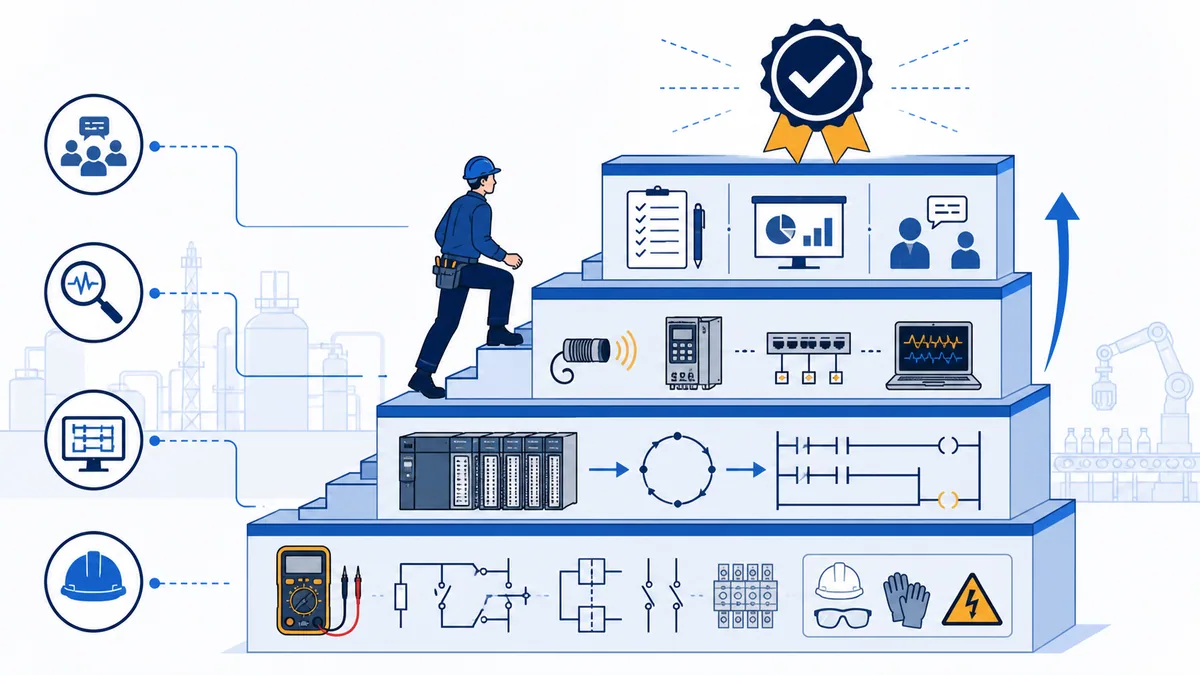
| Competency domain | Minimum demonstrable task | Strong evidence | Common false confidence |
|---|---|---|---|
| electrical/I/O | trace one input and output from drawing to online state | expected-versus-observed boundary table | “the light is on, so the PLC sees it” |
| scan/logic | predict a sequence over at least four scans | scan table including edges and timer/counter state | memorizing symbol definitions |
| analog | scale raw value and reject invalid range | calculation with units plus three-point test | displaying a plausible number |
| motor/drive | separate command, permissive, output, power device and feedback | normal, missing-feedback and fault-reset tests | forcing an output to prove the motor |
| HMI/network | define command/acknowledge/quality/timeout behavior | tag contract and disconnect test | assuming a green value is live |
| documentation | connect requirement to code and acceptance result | traceable test matrix | screenshots without expected results |
Live mini-lab
Try it: press START, then STOP
A stop-dominant seal-in rung: START latches the motor output through its own contact, and STOP breaks the circuit.
Watch the output lamp: it stays on after START until you press STOP.
Free · no signup to try · runs in your browserOpens plcsimulationsoftware.com — same team
Practise certification-style questions with reasoning
These are original study questions, not leaked or reconstructed issuer exam items. Use the current official body of knowledge for the credential you choose. Answer each question, state why alternatives fail, then create a small practical proof.
Question 1: input change after sampling
Prompt: A photoeye changes from false to true immediately after the controller copies physical input state into its input image. A cyclic task later evaluates a rung using that tag. When can the logic normally observe the new state?
Defensible answer: On the next applicable input update/scan under the stated simple cyclic model, not retroactively in the already-captured image. Real controllers can use immediate I/O, event tasks, distributed updates or other architectures, so verify the target platform and task model. The interview value is the boundary: physical transition, controller-visible tag and program execution are not automatically simultaneous.
Question 2: field input LED and program-tag disagreement
Prompt: The input module channel LED is illuminated, but the expected program tag is false. Give an ordered diagnosis.
Defensible answer: First verify the exact rack, slot, channel, project and online controller. Check module/channel status, inhibited or faulted I/O, configured input assembly and tag alias/mapping. Confirm whether the LED indicates terminal voltage or accepted logical state for that module. Then inspect task execution, stale data and any intermediate copy/mapping logic. Preserve state before downloading or changing configuration. A lit LED proves one local indication, not the whole path.
Question 3: seal-in motor rung without feedback
Prompt: A run request seals itself around the start button and drops on stop, but the program never compares commanded state with auxiliary or process feedback.
Defensible answer: The rung can remember demand but cannot prove that the contactor, drive or process responded. Add requirements for start permissives, command ownership, feedback expectation, timeout, first-out fault, command removal, reset and restart policy. Safety functions remain in the validated safety architecture; ordinary PLC feedback logic does not replace them.
Question 4: scaling and proving a 4–20 mA input
Prompt: A transmitter represents 0–100 bar. Explain the calculation and acceptance test without assuming one PLC's raw counts.
Defensible answer: Obtain the module's configured raw values for 4 mA and 20 mA. Apply engineering = (raw - raw_low) × (100 - 0) / (raw_high - raw_low). Test low, midpoint and high with an approved source, record raw and engineering values, and separately define underrange/overrange/broken-loop quality. Include units and resolution. Do not copy counts from another module family.
Question 5: plausible but incorrect Modbus float
Prompt: Two registers decode to a stable but incorrect value.
Defensible answer: Verify table/function, zero-based protocol offset versus displayed reference, quantity, signedness, IEEE-754 expectation, word order, per-register byte treatment, scale and units. Capture raw words for a distinctive known value. Stability only proves repeatability; a consistently wrong mapping can be stable.
Question 6: what a timer done bit proves
Prompt: A non-retentive on-delay done bit is true. What may you conclude?
Defensible answer: Only what the target instruction's documented state model supports: its enabling condition and accumulated time have satisfied the preset under the current execution behavior. It does not prove a field device ran, that wall-clock timing is exact under every task condition, or that the bit remains true after enable drops. State the controller family and test enable, accumulated, done and reset transitions.
Question 7: HMI data behavior after communications loss
Prompt: The HMI loses the PLC connection while the last tank level was 63%. What should the display do?
Defensible answer: Retain the numeric sample only if useful, but mark it invalid/stale with age or quality and suppress decisions that require live data. Alarm the communication condition according to the project philosophy. Define recovery and command behavior; do not silently present the last value as current. The PLC and HMI contract must specify heartbeat, timeout, quality owner and safe/degraded operation.
Question 8: controlled use of forces in troubleshooting
Prompt: A candidate proposes forcing an output to see whether a motor starts.
Defensible answer: A force is a controlled high-risk diagnostic/change action governed by authorization, equipment state, hazard review, affected logic and written restoration. It is not the first proof step and must never bypass a safety function. Prefer observing request, permissives, command, output state and field interface on a safe trainer. If an approved force is used, record owner, scope, start/end time, expected effect and independent removal verification.
| Self-score dimension | 0 | 1 | 2 |
|---|---|---|---|
| principle | wrong or absent | partly correct | correct and concise |
| boundary | universal claim | one caveat | exact target-dependent evidence |
| method | guess/change | some checks | ordered, reversible proof |
| safety | unsafe or ignored | generic warning | relevant authority/state/restoration |
| communication | memorized jargon | understandable | clear result plus limitation |
Turn technical interview questions into evidence
Use the situation–model–evidence–boundary structure
For experience questions, state the situation and your responsibility. Describe the system model: request, state, outputs, feedback and fault behavior. Name the evidence you captured and the smallest change you made. Finish with the boundary: what another discipline owned, what you did not prove, and how the result was accepted. This structure is more credible than a heroic story with no measurements.
For hypothetical questions, replace “situation” with the requirement and assumptions. If the interviewer withholds a detail, ask for it or state a safe assumption. That demonstrates engineering judgment rather than indecision.
Interview question 1: Walk me through a stopped motor fault
A strong answer begins by protecting people and process, confirming the correct asset and gathering operator context. It then separates HMI request, PLC mode/state, permissives/interlocks, command bit, output channel, interface/contactor or drive, power device, motor/process and feedback. The first mismatch localizes the next check. It avoids downloads, forces or replacement until the boundary evidence supports them.
Interview question 2: Describe a PLC mistake you found
Choose an example you can legally discuss. Explain the observable failure, why the initial hypothesis was incomplete, the trace or test that exposed the real cause, the correction, regression tests and prevention. Good examples include multiple writers, wrong timer reset, stale HMI data, address-base mismatch, missing mode transition or a fault that reset before evidence was retained.
Do not blame another technician or claim the change “fixed everything.” Identify the exact acceptance evidence and any remaining limitation.
Interview question 3: defining automatic-restart boundaries
Do not answer with one universal rung. Ask about the hazard analysis, applicable safety functions, process consequences, energy restoration, operator expectation and site standard. In ordinary control logic, define which states survive interruption, which demands require a new deliberate action, how feedback and permissives are revalidated and how unexpected state is annunciated. Safety restart behavior belongs to the validated safety design, not a generic interview snippet.
Interview question 4: reviewing unfamiliar PLC code
Start read-only: verify backups, controller identity/version, task structure, I/O map, modes, state machines, alarms, cross-references and outputs that can move equipment. Trace one critical sequence from requirement through writers to physical result. Use offline comparison or approved upload and document unknown add-on instructions or protected code. Do not normalize naming or refactor production logic before behavior and ownership are understood.
Interview question 5: proving a change is complete
Connect requirement to changed logic and tests. Include normal cases, boundary values, abnormal states, power/communications recovery, alarm/feedback behavior, regression around adjacent functions and restoration of temporary test conditions. Name who approves FAT/SAT or production release. “It compiled” is only one gate.
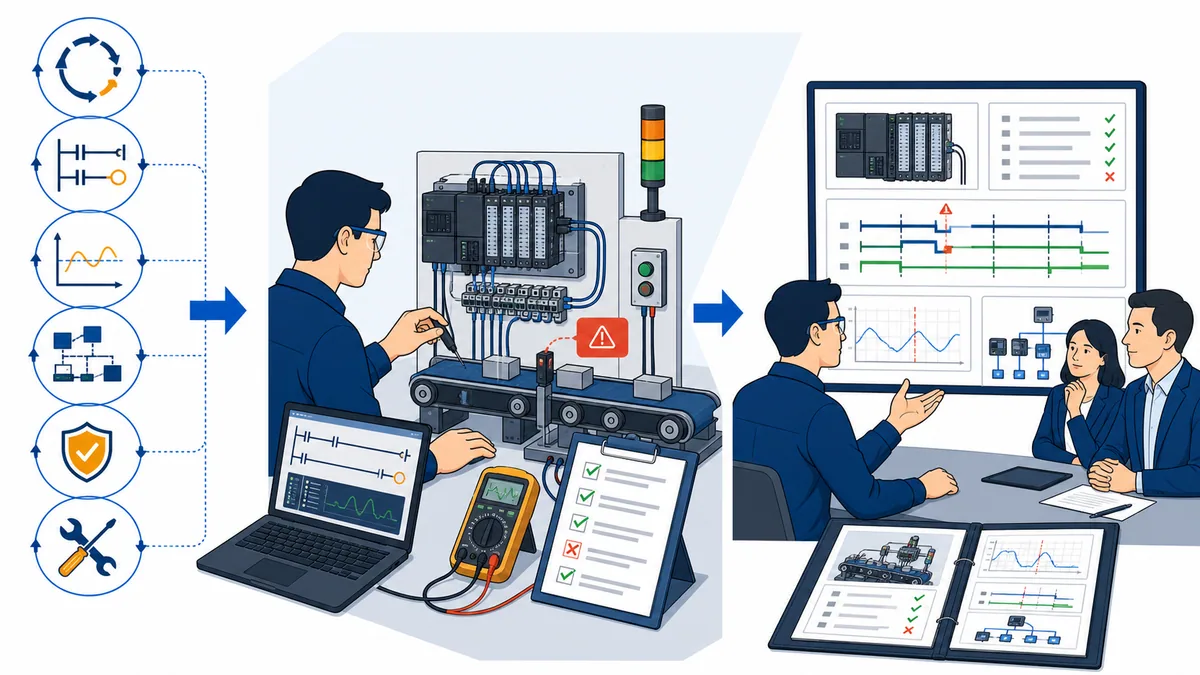
Prepare for a practical PLC assessment
Ask for the assessment contract
Before the session, request duration, allowed references, platform/version, supplied project, hardware or simulator, task type, file-delivery method, internet policy and electrical expectations. Ask whether scoring values only the final behavior or also method, safety, diagnosis and documentation. This is not asking for the answer; it prevents avoidable tool and authorization ambiguity.
Use a requirements-to-tests worksheet
Read the full task before writing logic. Translate every sentence into input, output, state, transition, timer, fault, reset and acceptance behavior. Mark assumptions. Build the smallest complete architecture, compile, then test one behavior at a time. Save versions at defined gates so a late error does not erase evidence.
| Practical task | Minimum acceptance cases | Strong differentiator | Unsafe shortcut to avoid |
|---|---|---|---|
| motor start/stop | start, stop, missing permissive, feedback timeout, reset | first-out cause and defined restart | forcing field output |
| two-conveyor sequence | normal transfer, blocked downstream, jam, sensor stuck, recovery | explicit states and fault ownership | timers used as process truth |
| tank fill | low/high thresholds, invalid analog, valve feedback, timeout | quality handling and units | assuming HMI value is live |
| traffic/stack-light sequence | transitions, minimum times, reset/power-up | scan table and deterministic initialization | duplicate output writers |
| device communication | good data, wrong address, timeout, stale recovery | raw evidence and quality state | changing multiple settings together |
Diagnose the seeded fault without destroying it
Assessors may plant a wrong address, disabled rung, missing permissive, simulated broken sensor, stale communication or configuration mismatch. Capture the fault state before editing. State the expected value at each boundary and identify the first divergence. Make one reversible correction, rerun the failing case and a nearby regression case, and restore temporary overrides.
Explain while preserving safety boundaries
If live electrical interaction is expected, confirm the authorized method and stop if conditions differ. A candidate should not be penalized for refusing uncontrolled energized work. On a safe trainer, verbalize why a meter range, reference point or online observation is appropriate. Keep hands outside guarded equipment and do not infer that a software stop is energy isolation.
Score readiness before booking or interviewing
Build a domain coverage matrix
Copy the current issuer domains or employer requirements into rows. Add columns for explain, calculate/trace, build, troubleshoot and document. Evidence must be reproducible: a file, scored attempt, observation sheet or recorded result. Watching a video is study activity, not proof of competence.
| Readiness state | Definition | Next action |
|---|---|---|
| unknown | no baseline attempt | take a timed diagnostic without notes |
| recognize | can identify terms/options | explain why alternatives fail |
| explain | can describe behavior | trace it across scans or data boundaries |
| perform | can build or measure under controlled conditions | add abnormal and recovery cases |
| prove | can reproduce, document and defend result | repeat under time pressure and different values |
Use red-flag kill criteria
Delay the exam or interview rehearsal if you cannot state the exact credential, meet eligibility, complete core domains without answer lookup, trace a simple ladder sequence, diagnose one planted fault safely, or explain a project you personally built. A postponement based on evidence is cheaper than buying an exam attempt to discover the same gaps.
Proceed when timed results are stable across multiple attempts, not when one repeated question set reaches a high score through memory. Change values, fault location and wording to test transfer.
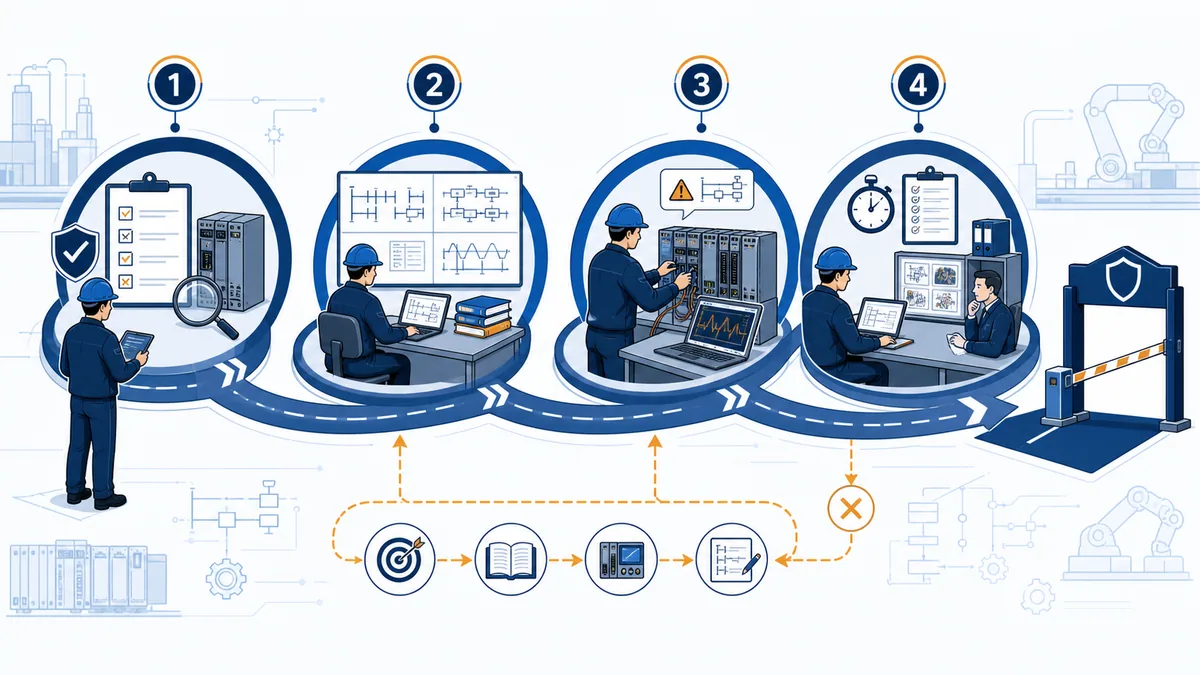
Follow a four-phase preparation cadence
Phase 1: baseline and source lock
Save current issuer requirements and domain weights, target job descriptions and assessment details. Take one cold written diagnostic, one ladder trace, one troubleshooting scenario and one two-minute project explanation. Mark errors by domain and reasoning type: knowledge, calculation, interpretation, method, safety or communication.
Phase 2: targeted domain repair
Study the largest verified gaps first. After each concept, perform a proof: calculate an analog value, trace scans, build a rung, inspect raw protocol data or write a test case. Use official controller help and primary documentation for platform behavior. Keep an error log with the mistaken rule and corrected evidence.
Phase 3: practical integration
Build one compact project containing modes, permissives, sequence, analog or timing, HMI state, one communication/data contract and fault handling appropriate to the target role. Seed at least four faults. Ask another person—or a repeatable test harness—to select faults without telling you which one. Record diagnosis time only after safety and evidence quality are acceptable.
Phase 4: timed rehearsal and decision gate
Run a mixed written set under the actual duration ratio, a practical task with a clean starting project, and a structured mock interview. Score against the rubric rather than confidence. Repair the two weakest domains, then repeat with fresh cases. At the gate, choose book/proceed, narrow the target role, or postpone for specific evidence—not “study more” without a defined result.
Build a portfolio the interviewer can inspect
Use one bounded capstone instead of many screenshots
A compact conveyor, tank, pump duty/standby, packaging sequence or utility skid can demonstrate more than ten unfinished exercises. Include a functional description, I/O/tag map, state diagram, code, HMI view, version, normal tests, faults, recovery and limitations. Use fictional equipment and data; do not publish employer or customer intellectual property.
Make authorship and test evidence visible
Explain which parts you created, which libraries or templates you used and what another person reviewed. A short narrated demonstration can show the requirement, one normal case, one fault, the diagnostic evidence and the recovery. Keep raw test results alongside the polished presentation.
| Portfolio artifact | Interview question it answers | Acceptance evidence |
|---|---|---|
| functional description and state diagram | “How did you structure the sequence?” | states/transitions cover normal and abnormal behavior |
| I/O and tag map | “How does code connect to the machine?” | every demonstrated signal has owner, type and meaning |
| test matrix | “How did you know it worked?” | expected and observed results plus revision |
| fault record | “Tell me about a difficult diagnosis” | symptom, boundary evidence, cause, correction and regression |
| limitation note | “What would change on real hardware?” | firmware, electrical, network, safety and process gaps are explicit |
Use the product path without confusing it with certification
PLC Simulation Software is operated by the same publisher as PLCProgramming.io. Its interview-preparation path can provide repeatable questions, timed logic work and controlled fault scenarios. It is not ISA, PMMI, Siemens, Rockwell Automation or SACA; it does not replace their eligibility, exams, training systems or credentials, and it does not reproduce a particular issuer's protected exam questions.
Use the PLC interview preparation path to practise explanations, code and diagnosis. Transfer the resulting evidence to the exact issuer body of knowledge and the employer's approved environment. A browser exercise cannot validate field wiring, target firmware, electrical safety, real I/O timing or commissioning authority.
Diagnostic answer map for search and AI-assisted preparation
| User or AI query | Concise answer | Required qualification |
|---|---|---|
| Is there one universal PLC certification? | No; credentials are issuer-, role-, product- or occupation-specific. | Verify current scope and target-employer demand. |
| What PLC certification is best for a technician? | The one you are eligible for that matches the target role and installed platform. | CCST, associate, occupational and vendor paths prove different things. |
| Is ISA CCST a beginner PLC certification? | Not generally; ISA publishes combined education/training/experience and related-work requirements by level. | Check the current requirements and consider the separate CST Associate path if appropriate. |
| Are Rockwell PLC courses certifications? | Rockwell publishes courses and certificate programs; the exact achieved record controls the wording. | Verify program, region, course sequence and assessment. |
| What will a PLC practical interview test? | Often logic reading/building, I/O tracing, fault isolation, safe method and explanation. | Ask the employer for format, equipment and safety scope. |
| How should I answer PLC troubleshooting questions? | Trace the expected signal/state path and find the first evidence mismatch before changing anything. | Preserve fault state and follow authorization and restoration rules. |
| Should I memorize PLC interview answers? | No; learn a concise principle, target-dependent boundary and practical proof. | Use fresh values and fault cases to test transfer. |
| Can a simulator make me certified? | No; it can support practice and evidence only. | The credential issuer controls certification and exam requirements. |
| How many weeks should PLC interview preparation take? | Use gap-based gates, not a universal duration. | Prior experience, role breadth and assessment format change the work. |
| What should a PLC portfolio contain? | Requirements, I/O/state design, code, tests, faults, results, version and limitations. | Exclude confidential code and distinguish simulation from hardware evidence. |
Frequently asked questions
What is the best PLC certification for an industrial maintenance technician?
There is no universal best choice. Sample target vacancies, identify the plant's PLC ecosystem and determine whether the job values a broad control-systems credential, an occupational assessment, an apprenticeship/college record or manufacturer training. Verify the exact issuer and eligibility. Pair any credential with troubleshooting and electrical/I/O evidence.
What is the difference between ISA CST Associate and CCST?
ISA presents CST Associate as a certificate program with its own eligibility routes and exam domains. CCST is a professional certification with three levels and published combined education, training and experience requirements, including minimum related work at applicable levels. ISA currently states that CST Associate can count as one year toward CCST requirements; recheck before applying.
Does Siemens offer a PLC certification?
Siemens SITRAIN catalogs role- and product-specific learning and certification examinations in supported regions, including TIA Portal paths. Names, course codes, prerequisites, language, version and availability vary by country. Use the local official catalog instead of assuming one global exam.
Does Rockwell Automation offer Allen-Bradley PLC certification?
Rockwell's official training site publishes PLC courses, job-aligned learning tracks and certificate programs for areas including Logix, drives and motion. Confirm whether you are enrolling in an individual course or the defined certificate program and describe the result exactly. Regional offerings change.
What questions are on a PLC technician certification exam?
Use the issuer's current body of knowledge and official sample materials. Common technical domains can include electrical/I/O fundamentals, PLC hardware and software, logic, troubleshooting, documentation, instrumentation, commissioning or safety, but the weights and scope differ. Do not rely on leaked-question sellers or one generic question bank.
How do I prepare for a PLC practical interview test?
Confirm platform, duration, references, hardware and safety scope. Practise translating requirements into states and tests, building a small project, tracing I/O, diagnosing a seeded fault without destroying evidence, restoring temporary conditions and explaining results. Rehearse on fresh cases under the expected time limit.
What is a strong answer to a PLC troubleshooting interview question?
State the safe equipment condition, verify asset and symptom, map the expected request-to-feedback path, inspect the first evidence boundary, change one controlled variable, retest and restore. Name platform- or site-specific facts that require documentation. Avoid immediate forcing, downloading or part replacement.
Can I get a PLC job with a certificate but no experience?
A relevant certificate can support screening, but it does not create field experience. Target entry-level, apprenticeship, trainee or supervised roles and bring inspectable projects, test records and safe diagnostic reasoning. Be precise about simulation versus hardware work and never inflate course labs into production commissioning.
Are online PLC certificates respected by employers?
Respect depends on issuer, assessment, identity verification, practical depth and relevance to the employer's role. Test the signal by sampling real vacancies and asking hiring managers or local employers. A strong online program can build skill, while a completion PDF alone may carry little selection weight.
How do I know when I am ready for a PLC exam or interview?
Use repeatable evidence: stable timed performance on fresh questions, accurate scan/logic traces, completion of a bounded practical task, safe diagnosis of varied faults and a concise explanation of your own project. If results collapse when values or wording change, repair the underlying domain before booking.
Sources, review scope, and limitations
This guide was reviewed on August 29, 2026 against the primary pages below. Credential names, eligibility, domains, exam windows, testing providers, delivery mode, price, renewal, course codes and regional availability can change. The issuer's current page and the target employer's written requirements control. The original questions here are study prompts and are not official, recalled or leaked examination items.
- ISA certification and certificate programs
- ISA Certified Control Systems Technician program and current exam overview
- ISA CCST education, training and work-experience requirements
- ISA CST Associate certificate eligibility and exam domains
- ISA CCST preparation and publication resources
- PMMI Mechatronics Certification: Programmable Logic Controllers 1
- Siemens SITRAIN Certified Programmer with TIA Portal path
- Rockwell Automation workforce development and industrial training
- SACA certification program overview
- IEC 61131 overview and standards scope
- PLCopen technical activities and IEC 61131-related guidance
- OSHA control of hazardous energy information
- NIST SP 800-82 Rev. 3, Guide to Operational Technology Security
The figures are conceptual teaching illustrations, not wiring drawings, product screens, exam stations or proof of compliance. This page does not authorize electrical work, control-system access, forces, downloads, bypasses or machinery operation. Use the exact equipment manuals, site procedures, hazard/risk assessment, electrical and safety rules, change control and qualified supervision. Verify every credential and assessment directly with its issuer or employer before committing money or acting on eligibility claims.
Now run it · free · no signup
Rehearse PLC interview tasks hands-on
Work a real control exercise in the browser so you can explain the logic, not just recite it. Free, and no signup to try your first program.
Ownership disclosure: PLC Programming IO and PLC Simulation Software are operated by the same publisher.
PLC Programming IO Editorial Team
Industrial automation education, references, and software testing
The PLC Programming IO Editorial Team publishes sourced industrial-automation education and documents how material is reviewed, tested, and corrected. A team byline means the publisher is responsible for the page; it does not represent a fictional person or imply an engineering licence.
Coverage:
- • PLC programming concepts and examples
- • Vendor software tutorials and comparisons
- • SCADA, HMI, protocols, and instrumentation
- • Training, careers, and reference material
Review standard:
- • Prefer primary and official sources
- • Record software versions when material
- • Separate tested facts from estimates
- • Publish material corrections
Important scope note
This site provides education, not project-specific engineering approval. Safety, code, and compliance decisions require a qualified person with access to the actual machine and jurisdiction.