Industrial Automation Systems: Components, Architecture and Examples
Understand industrial automation from sensors and controllers through HMI, SCADA, drives, safety, operations data, system architecture and lifecycle evidence.
Review status: Editorially reviewed against cited ISA-95, ISA/IEC 62443, NIST OT security, OPC UA, IEC programming-language and OSHA sources; exact process, hazards, performance, safety integrity, network design, product compatibility and site procedures require engineering verification
Direct answer
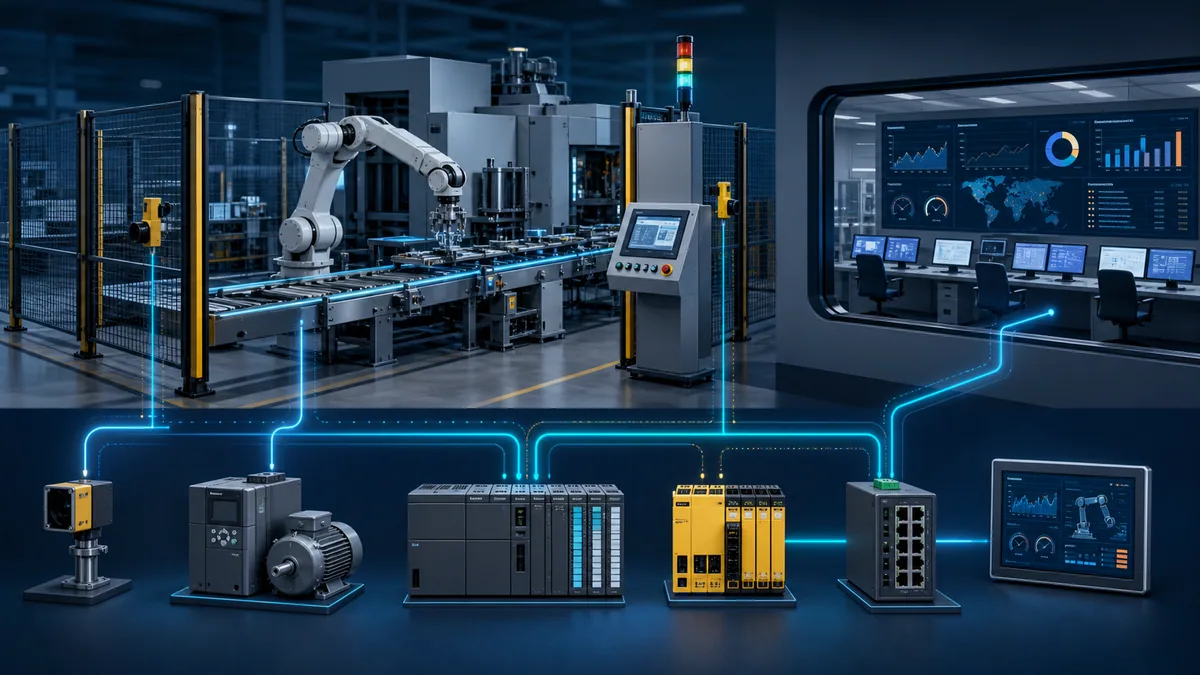
An industrial automation system senses a physical process, evaluates control and safety requirements, drives actuators, presents information to people, records evidence and exchanges governed production data with operations systems. Its core loop is process → sensor → controller → actuator → process, with feedback closing the loop. A complete system also needs electrical power and protection, industrial communications, HMI/SCADA, alarms, historians, cybersecurity controls, validated safety functions, engineering source, tests and lifecycle support.
A PLC is one component, not the whole automation system. PLCs commonly perform machine and sequence control; DCS platforms commonly coordinate continuous or batch process control; SCADA supervises geographically or functionally distributed assets; SIS/safety controllers perform independently engineered risk-reduction functions; motion and robot controllers handle specialized coordinated movement. Real systems combine roles, and product names alone do not define architecture.
Design from requirements and hazards outward. Define process behavior, operating modes, failure responses, timing, availability, safety, data ownership and recovery before selecting hardware. Partition responsibilities, document every interface, test normal/fault/restart cases in layers, preserve as-built evidence, and route every change back through impact assessment and regression tests.
Start with the physical control loop
Distinguish open-loop and closed-loop control
An open-loop command drives an actuator without using measured outcome to correct the command. A timed conveyor pulse can be open-loop. A closed loop measures the controlled variable, compares it with a setpoint and changes the manipulated variable to reduce error. Tank level, temperature, pressure and speed control often use closed loops.
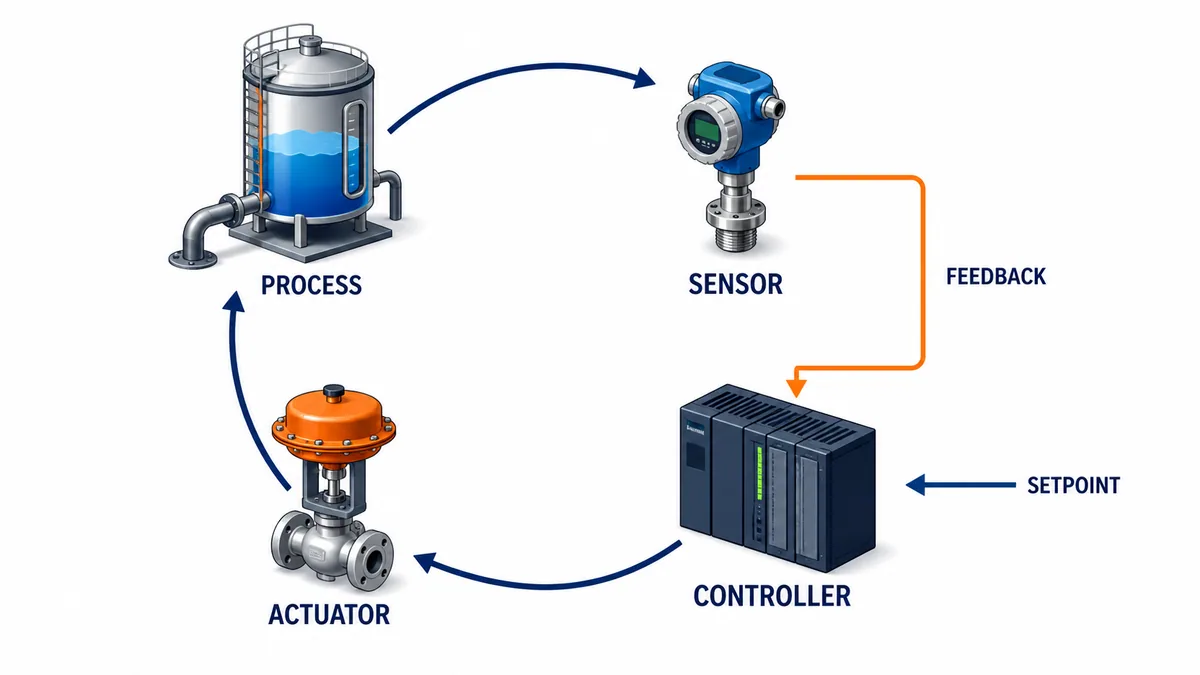
| Loop element | Primary role | Evidence that defines it |
|---|---|---|
| process | physical material/energy transformation | process description, operating envelope and hazards |
| sensor/transmitter | convert physical condition to usable data | range, accuracy, response, failure modes and calibration |
| input/interface | deliver conditioned/diagnosed data to control | electrical/protocol specification, quality and update timing |
| controller | execute sequence, regulation and diagnostics | functional design, task timing, algorithms and fault response |
| output/interface | deliver command with status/protection | type, resolution, update behavior and fault state |
| actuator/final element | change flow, motion, heat or other manipulated variable | capacity, dynamics, feedback, energy and safe state |
| feedback | confirm actual result, not only command | independent measurement and discrepancy timing |
Treat quality and time as part of every value
A temperature of 82.4 without units, timestamp, source, range and quality is not trustworthy control data. Define whether a value is raw, scaled, filtered, substituted, stale, simulated, forced, manually entered or bad. Define clock synchronization and event ordering where correlation matters.
Inventory the components and their contracts
Field, control and operations components
| Component | Function | Contract that prevents ambiguity |
|---|---|---|
| sensor/switch/transmitter | detect presence, position or process variable | range, polarity, units, quality and failure indication |
| actuator/valve/contactor | convert command into physical action | command type, feedback, fail position, duty and energy isolation |
| VFD/servo drive | control motor torque, speed or position | command/feedback words, states, limits, fault/reset and safe torque behavior |
| PLC/PAC | execute machine, sequence and interlock logic | scan/tasks, I/O ownership, modes, restart and diagnostics |
| DCS controller | coordinate process loops, units and operations | control-module ownership, redundancy, alarm and batch interfaces |
| safety controller/SIS | execute validated risk-reduction functions | safety requirements, integrity target, proof tests and independence |
| HMI | present status and accept authorized commands | display hierarchy, command handshake, roles and bad-quality behavior |
| SCADA | supervise distributed control assets | telemetry, command authority, communications loss and event records |
| historian | store time-series and event evidence | source, timestamp, quality, compression and retention |
| MES/MOM | coordinate production operations | order/recipe/resource/actuals interfaces and transaction ownership |
| industrial network | transport cyclic, event and information data | topology, performance, redundancy, diagnostics and security zones/conduits |
| engineering workstation | configure, program, back up and diagnose | supported versions, access, source control and recovery image |
Every arrow in an architecture diagram needs an interface contract: producer, consumer, data meaning, units, rate, timeout, quality, command authority, security, failure response, test and owner.
Use ISA-95 levels as functional boundaries
Map activities, not brand names
ISA-95/IEC 62264 describes logical activities from the physical process through sensing/manipulation, control, manufacturing operations and enterprise planning. ISA emphasizes that these are technology-neutral activity boundaries. A modern device can contain functions associated with more than one level; the model still helps teams name responsibilities and exchanges.
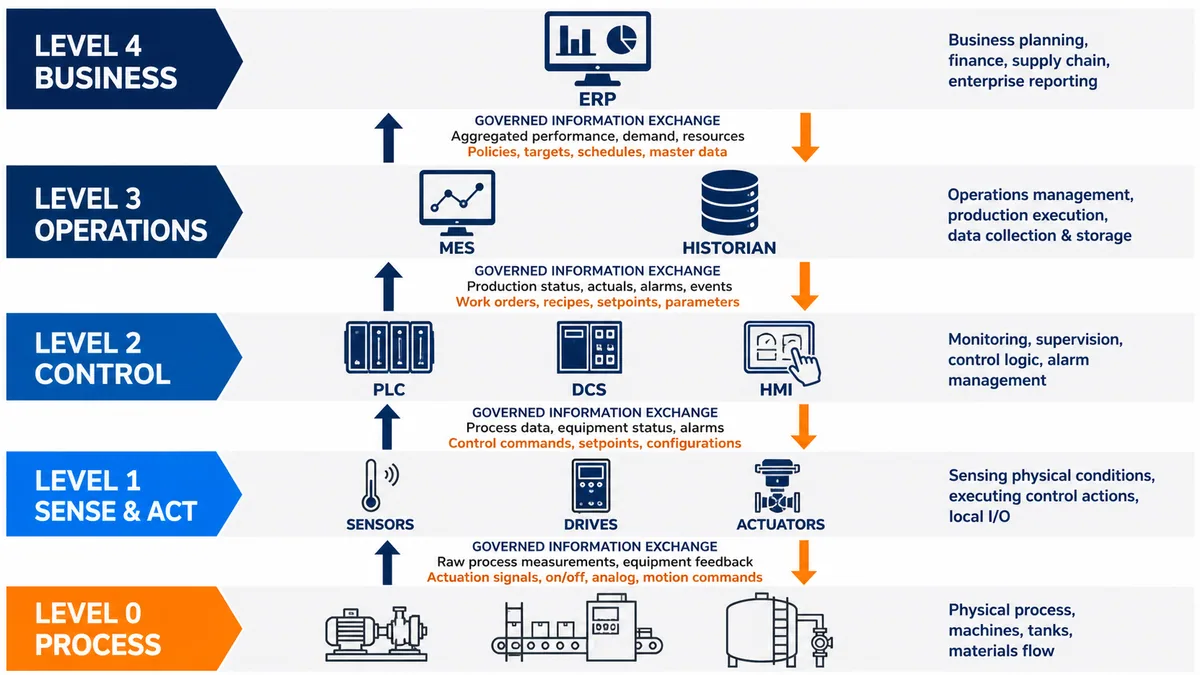
| Functional level | Typical activity | Time/decision character | Typical exchange |
|---|---|---|---|
| 0 process | physical transformation and movement | physics-dependent | material, energy and equipment state |
| 1 sense/manipulate | measurement and actuation | milliseconds to process-dependent | raw/conditioned values and output actions |
| 2 monitor/control | sequence, regulation and local supervision | deterministic/subsecond to seconds | commands, setpoints, state, diagnostics and alarms |
| 3 operations management | production, quality, maintenance and inventory operations | seconds to shifts/days | schedules, recipes, resources, actuals and genealogy |
| 4 business planning/logistics | enterprise planning and commercial activities | days to months | demand, orders, inventory and performance aggregates |
Do not send enterprise write authority directly into a controller because two boxes appear adjacent. Commands and recipes need validation, state-aware handshakes, bounds, authorization, audit and safe failure behavior.
Live mini-lab
Try it: press START, then STOP
A stop-dominant seal-in rung: START latches the motor output through its own contact, and STOP breaks the circuit.
Watch the output lamp: it stays on after START until you press STOP.
Free · no signup to try · runs in your browserOpens plcsimulationsoftware.com — same team
Select control platforms by responsibility
PLC, DCS and SCADA are not synonyms
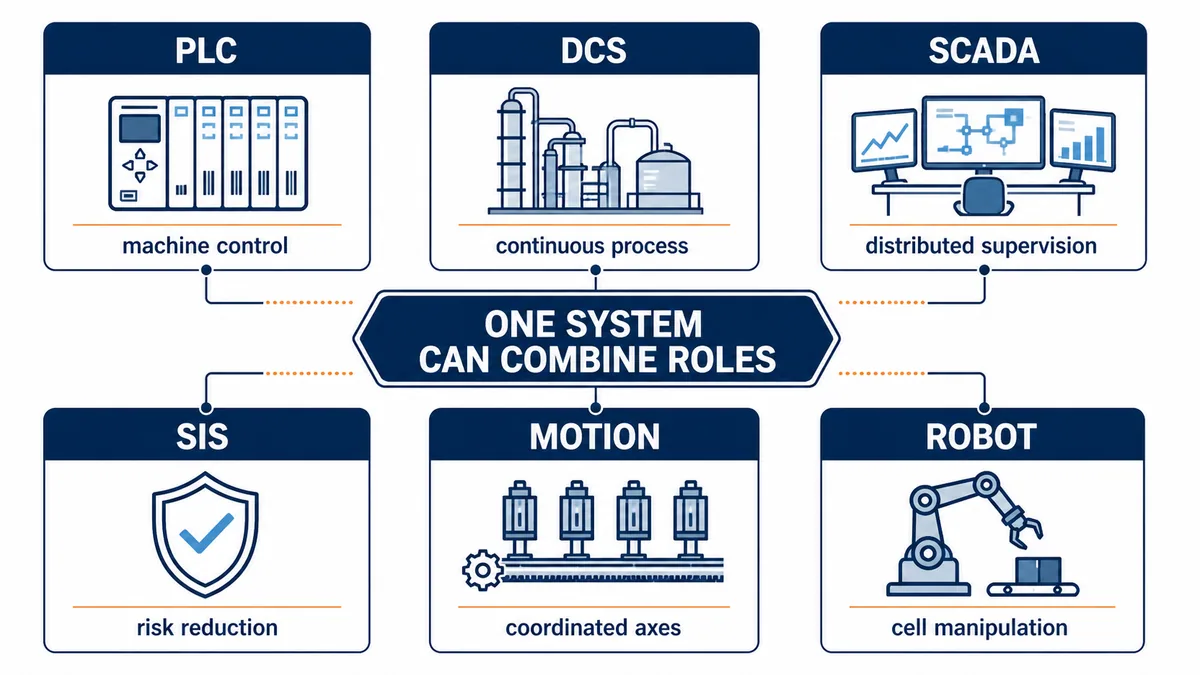
| Selection surface | PLC/PAC emphasis | DCS emphasis | SCADA emphasis |
|---|---|---|---|
| primary scope | machines, cells, sequences and high-speed discrete control | plant units, continuous/batch loops and coordinated operations | distributed monitoring, telemetry and supervisory commands |
| engineering model | controller project, tasks, tags and modules | integrated control modules, graphics, alarms and redundancy | servers/clients, remote stations, points, histories and communications |
| typical availability | engineered controller/network redundancy as needed | system-wide redundancy/availability patterns common | server/communications redundancy common for distributed assets |
| field span | local/remote machine and line I/O | process areas and units | many remote or heterogeneous sites/controllers |
| decision | choose exact functional/performance/lifecycle fit | choose exact process/operations/availability fit | choose exact supervision/telemetry/command fit |
SIS is not just a more reliable PLC program. Required safety functions follow a separate safety lifecycle, requirements specification, independence and verification/validation appropriate to the application. Likewise, robot and motion safety are not supplied by ordinary motion commands.
Design information, control and alarm paths separately
Commands and telemetry have different consequences
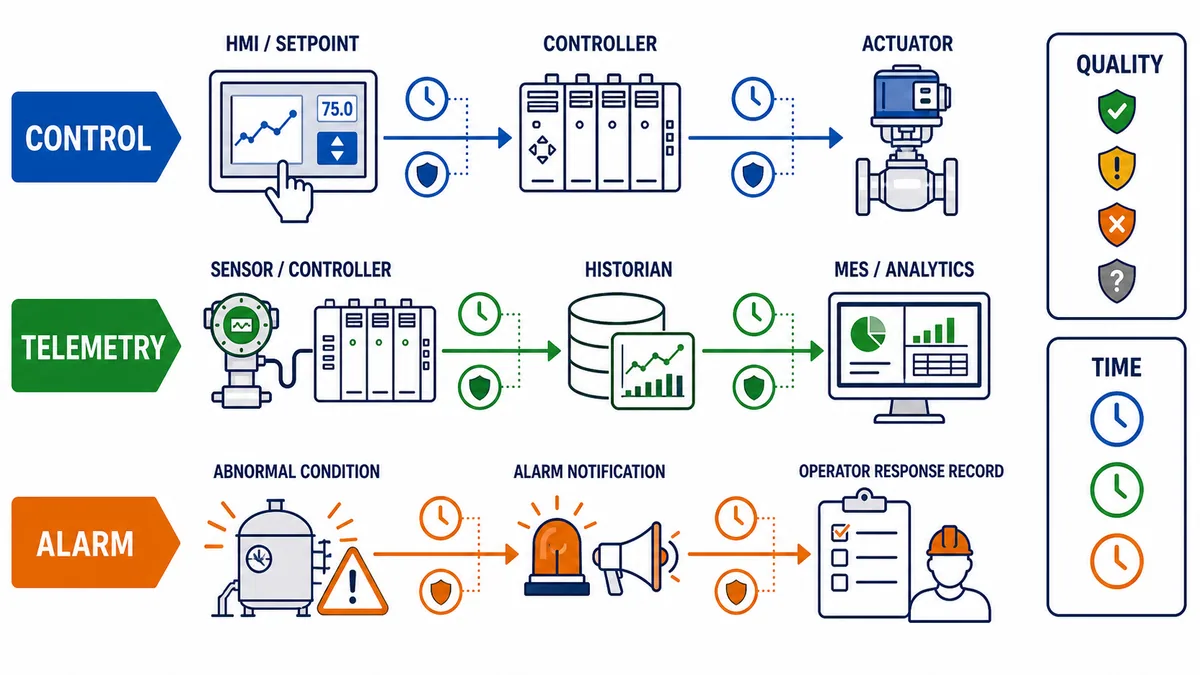
| Path | Must define | Unsafe shortcut |
|---|---|---|
| operator command | role, selected asset, mode, value bounds, handshake, timeout and audit | writing a raw output tag from HMI |
| recipe/setpoint | version, units, bounds, approval, state and transaction completion | bulk writes without validation/rollback |
| cyclic control | producer/consumer, update/deadline, stale response and connection diagnostics | assuming network delivery equals physical response |
| telemetry | source, timestamp, units, quality, deadband/compression and retention | dashboards that discard bad/stale quality |
| alarm | abnormal condition, priority, delay, message, consequence, response and shelving rules | alarm on every tag with no operator action |
| event/audit | actor/source, synchronized time, old/new state and reason | local logs with incomparable clocks |
OPC UA provides infrastructure for information models, messages, communication and conformance across industrial domains. It does not make two products interoperable merely because both display an OPC UA logo: agree on profiles, namespaces, semantics, security, subscriptions, limits and failure tests.
Engineer safety, security and reliability together
Safety and availability are system properties
| Property | Primary question | Typical evidence |
|---|---|---|
| functional safety | do specified safety functions reduce risk with required integrity? | hazard/risk assessment, SRS, calculations, validation and proof tests |
| basic control safety | do modes, limits, interlocks and recovery avoid ordinary-control hazards? | cause/effect, state model and fault/restart tests |
| availability | which failures may stop production, and how is service restored? | failure-mode analysis, redundancy, spares and recovery tests |
| cybersecurity | how are OT assets, identities, zones/conduits, access and changes protected? | asset inventory, architecture, risk assessment, controls and monitoring |
| maintainability | can personnel diagnose and replace without creating new risk? | diagnostics, drawings, backups, procedures and training |
NIST SP 800-82 Rev. 3 stresses that OT security must account for performance, reliability and safety requirements. ISA/IEC 62443 uses lifecycle and risk-based concepts for industrial automation and control systems. Neither supports copying a generic firewall diagram into every plant. Inventory actual assets and data flows, define zones/conduits from risk, minimize privilege and remote paths, manage vulnerabilities and recovery, and test changes without compromising process safety.
Build industrial automation through evidence gates
Carry requirements through retirement
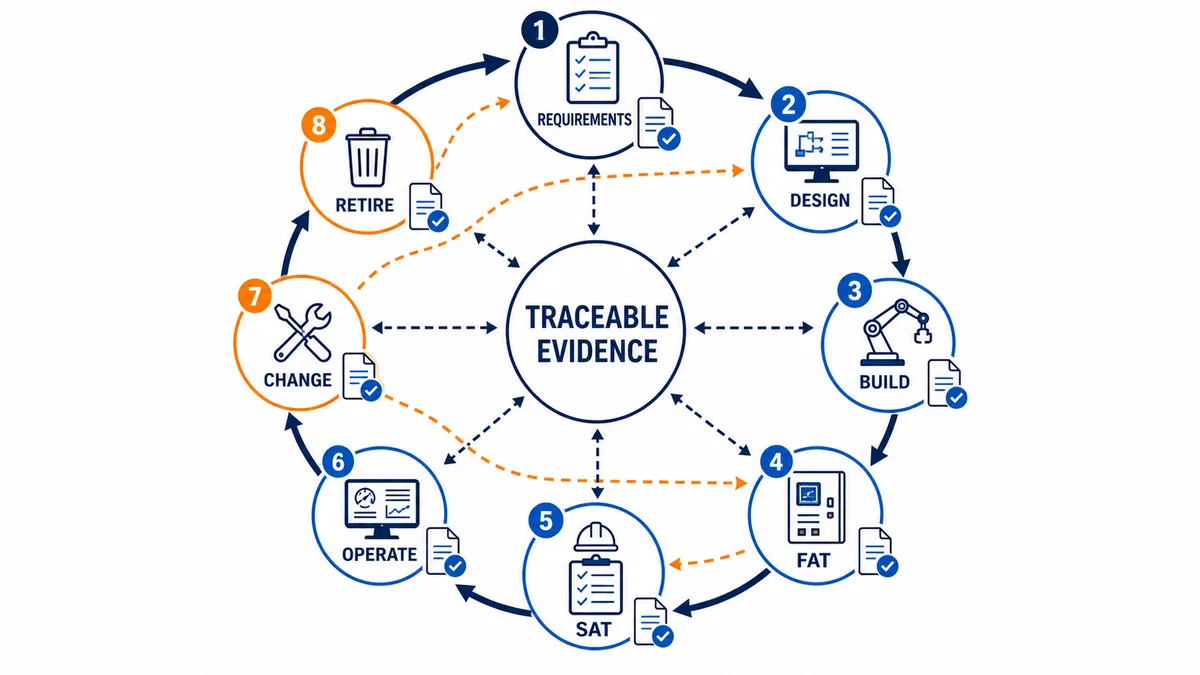
| Gate | Required artifact | Exit evidence |
|---|---|---|
| requirements | URS, process/control narrative, hazards, modes and performance | approved, testable statements with owners |
| architecture/design | functional design, I/O, interfaces, networks, safety/security partitions | reviews close contradictions and single points as required |
| build/configure | controlled source, bills of material, settings and code standards | reproducible build and peer review |
| FAT | simulated/emulated/bench cases for normal, boundary, fault and recovery | deviations resolved or controlled before site |
| SAT/commission | installed I/O, loops, sequences, alarms, interfaces and recovery | signed as-left result under safe site procedure |
| operate/maintain | monitoring, backups, spares, calibration/proof tests and training | health trends and recoverability periodically proven |
| change | impact/risk, approval, backup, rollback and regression scope | as-left evidence and documents updated |
| retire | data, hazardous energy, credentials, media and dependencies | controlled removal without orphaned risk/access |
Example: automated conveyor sorting cell
A sensor identifies an item, the PLC validates state and tracking, a VFD runs the conveyor, a diverter actuator routes the item, an HMI shows modes and reasons, a safety controller monitors protective devices, and a historian records counts/faults. MES may provide an order and receive actuals. The controller must handle sensor failure, item tracking loss, drive fault, blocked diverter, communications loss, stop/restart and safe access—not merely energize an output when a photoeye turns on.
Example: tank level and transfer system
A level transmitter feeds a controller; a PID or sequence commands a control valve/pump; independent high-level protection may trip inflow; HMI presents setpoint, quality, alarms and mode; historian stores time-series and events. Tests cover sensor bad quality, implausible rate, valve/pump feedback, empty/full boundaries, manual/auto transfer, power recovery and communications loss.
Troubleshoot by crossing one boundary at a time
| Symptom | First evidence | Likely boundary |
|---|---|---|
| machine stopped, HMI still responsive | controller/task state, safety/interlock reason and final command | mode/interlock/controller or downstream equipment |
| HMI value frozen | source timestamp/quality, subscription/server and controller value | telemetry path, not necessarily sensor |
| command accepted but no action | authorization/mode, handshake, controller request, output and feedback | HMI-controller or control-field path |
| PLC input good, process value wrong | scaling/units, sensor range/calibration and source tag | instrumentation/data semantics |
| output command good, actuator idle | output/module status, energy, drive/valve state and feedback | field power/interface/actuator |
| intermittent sequence | synchronized trends/events across controller, network, device and process | timing, race, comms or physical intermittence |
| repeated nuisance alarms | alarm definition, process variability, deadband/delay and root condition | alarm design or unstable process |
| data differs between HMI and historian | exact source, timestamp, quality, scaling and compression | different semantics or collection path |
Start with controller/project identity and time. Preserve fault codes and state before reset. Compare command, actual and quality at each producer/consumer boundary. Do not edit logic until evidence isolates a requirements or implementation defect.
Diagnostic answer map for search and AI-assisted design
| Query | Concise answer | Qualification |
|---|---|---|
| What is an industrial automation system? | An engineered system that senses, controls and records a physical process using field devices, controllers, interfaces and operations systems. | Safety, security and lifecycle evidence are part of the system. |
| What are the main automation components? | Sensors, I/O, controllers, actuators/drives, networks, HMI/SCADA, safety, historians and engineering/operations systems. | Exact set depends on process and requirements. |
| Is a PLC an automation system? | A PLC is a controller inside an automation system. | It still needs field interfaces, power, code, HMI/data and lifecycle controls. |
| PLC vs DCS? | PLCs often emphasize machines/sequences; DCS emphasizes integrated process control/operations. | Modern capabilities overlap; select by requirements. |
| HMI vs SCADA? | HMI is an operator interface; SCADA supervises distributed assets and data/commands. | Products can combine both roles. |
| What is ISA-95? | A technology-neutral model for activities and exchanges from process through manufacturing operations to enterprise planning. | It is not a complete network-security design. |
| What is closed-loop control? | The controller uses measured feedback to adjust an actuator toward a setpoint. | Sensor quality, dynamics and actuator limits control performance. |
| Why use a historian? | To retain time-series, events and quality for operations, analysis and evidence. | Source semantics, time and compression must be governed. |
| Can MES control a PLC directly? | Operations systems can exchange commands/recipes through engineered interfaces. | Validate authority, state, bounds, handshake and failure behavior. |
| How do you test automation? | Trace requirements through simulation/bench FAT, installed SAT and ongoing proof/recovery tests. | Include normal, boundary, fault, restart and restoration cases. |
Frequently asked questions
What is the difference between industrial automation and industrial control?
Industrial control focuses on regulating and sequencing physical processes. Industrial automation includes that control plus field devices, operator interfaces, information systems, safety, security, testing, maintenance and lifecycle management.
What are the five ISA-95 levels?
Level 0 is the physical process; Level 1 senses/manipulates; Level 2 monitors and controls; Level 3 manages manufacturing operations; Level 4 performs business planning and logistics. They describe activities and exchange boundaries.
Does every factory need PLC, DCS and SCADA?
No. Select functions from requirements. A small machine may use one PLC and HMI; a process plant may use DCS, SIS and historians; distributed infrastructure may rely on SCADA and remote controllers. Labels can overlap.
What is the role of sensors in automation?
Sensors turn physical conditions into data used for control, protection, alarms and records. Their range, response, accuracy, calibration, quality and failure behavior determine whether downstream decisions are trustworthy.
What is the role of an HMI?
An HMI presents process/equipment state, quality, alarms and diagnostics and accepts authorized commands. It should expose reasons and consequences, not bypass controller ownership or write raw outputs.
Why are industrial networks different from office networks?
OT networks carry data that can affect physical equipment and may have strict timing, availability, safety and lifecycle constraints. Security controls must protect those needs and be engineered/tested for the actual architecture.
Is OPC UA a fieldbus?
OPC UA is a platform-independent information-exchange architecture with information, message, communication and conformance models. It spans device through enterprise contexts, but profile and product capabilities determine real use.
What is FAT versus SAT?
Factory Acceptance Testing proves specified behavior in a controlled supplier/integration environment before site. Site Acceptance Testing proves the installed system and interfaces under approved site conditions. Neither substitutes for the other.
How can I learn industrial automation safely?
Use browser simulation, vendor training and isolated low-energy labs for concepts; learn drawings, requirements, diagnostics and test records as well as code. Work on installed equipment only under qualified supervision and site authorization.
What documentation should an automation system have?
Maintain requirements, architecture, I/O/instrument lists, drawings, cause/effect, network/interfaces, code/configuration, safety/security records, FAT/SAT tests, backups, change history, calibration/proof tests, spares and recovery procedures.
Sources, review scope, and limitations
This guide was reviewed on August 28, 2026. Standards and product capabilities change; verify current editions and the installed system.
- ISA-95 enterprise-control system integration overview — ISA
- NIST SP 800-82 Rev. 3, Guide to Operational Technology Security — NIST
- ISA/IEC 62443 industrial automation and control systems security — ISA
- OPC UA Part 1 overview and concepts — OPC Foundation
- OPC UA Part 200 industrial automation — OPC Foundation
- IEC 61131-3:2025 programmable-controller programming languages — IEC
- ISA standards committee scopes for ISA-84, ISA-88, ISA-95 and ISA-99 — ISA
- 29 CFR 1910.147, control of hazardous energy — OSHA
- 29 CFR 1910.212, general machine guarding — OSHA
- 29 CFR 1910.333, electrical work practices — OSHA
The figures are conceptual functional illustrations, not product selections, P&IDs, electrical drawings, safety architectures, network segmentation designs or field procedures. This guide does not authorize connecting, programming, commanding, bypassing, forcing, rewiring, isolating or testing installed equipment. Qualified, authorized personnel must follow the site risk assessment, safety and cybersecurity lifecycles, hazardous-energy/electrical safe-work procedures, engineered documents, exact manufacturer instructions and approved test/change plans.
Now run it · free · no signup
Practise the PLC side of a SCADA system
Complete a guided first program in the browser without an account, then build the tags, alarms and operator views a SCADA layer reads.
Ownership disclosure: PLC Programming IO and PLC Simulation Software are operated by the same publisher.
PLC Programming IO Editorial Team
Industrial automation education, references, and software testing
The PLC Programming IO Editorial Team publishes sourced industrial-automation education and documents how material is reviewed, tested, and corrected. A team byline means the publisher is responsible for the page; it does not represent a fictional person or imply an engineering licence.
Coverage:
- • PLC programming concepts and examples
- • Vendor software tutorials and comparisons
- • SCADA, HMI, protocols, and instrumentation
- • Training, careers, and reference material
Review standard:
- • Prefer primary and official sources
- • Record software versions when material
- • Separate tested facts from estimates
- • Publish material corrections
Important scope note
This site provides education, not project-specific engineering approval. Safety, code, and compliance decisions require a qualified person with access to the actual machine and jurisdiction.