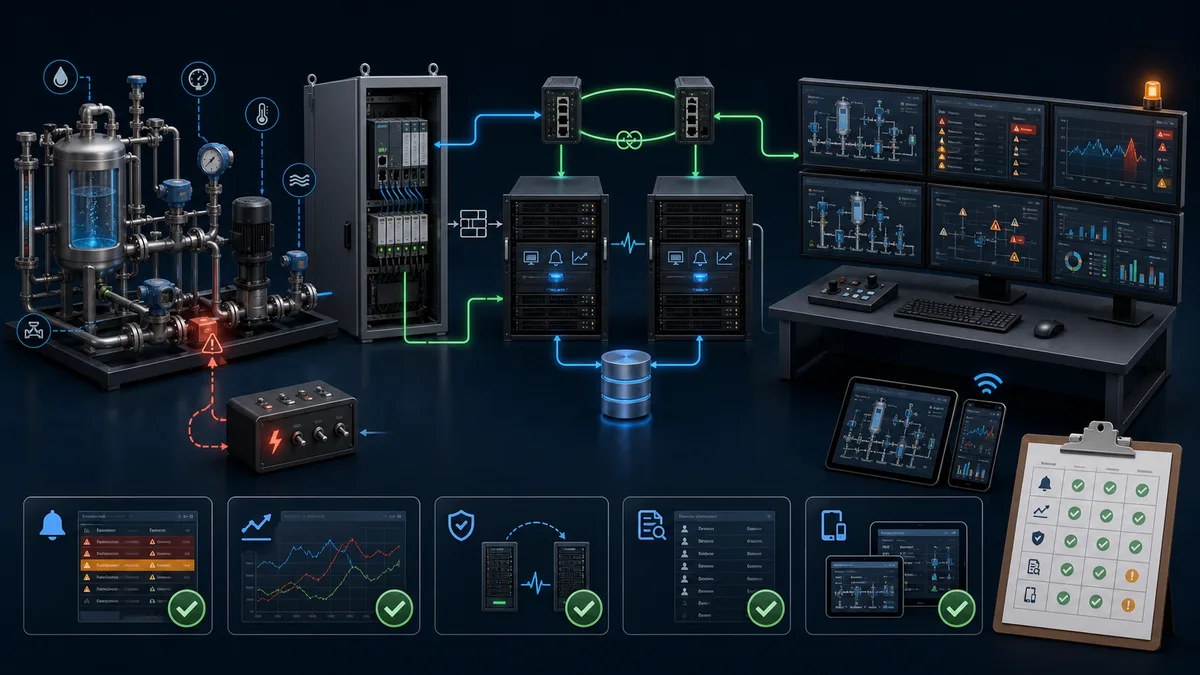
Best SCADA Software 2025 | Top 10 Platforms Compared & Reviewed
Complete 2025 SCADA software comparison and reviews. Expert analysis of top 10 platforms including Ignition, Wonderware, WinCC with pricing, features, and recommendations.
🎯 Master PLC Programming Like a Pro
Preorder our comprehensive 500+ page guide with real-world examples, step-by-step tutorials, and industry best practices. Everything you need to become a PLC programming expert.
- ✓ Complete Ladder Logic Programming Guide
- ✓ Advanced Function Block Techniques
- ✓ Real Industrial Applications & Examples
- ✓ Troubleshooting & Debugging Strategies
📋 Table of Contents
This comprehensive guide covers:
- Introduction to PLC Programming Fundamentals
- Understanding Ladder Logic Programming
- Function Block Diagrams and Structured Text
- Advanced Programming Techniques
- Real-World Application Examples
- Troubleshooting and Best Practices
- Industry Standards and Compliance
- Career Development and Certification Paths
Expert Analysis 2025 | Reviewed by SCADA engineers with 20+ years of implementation experience across water treatment, manufacturing, oil & gas, and utilities. This comprehensive review includes hands-on testing, pricing analysis, and real-world deployment insights from 100+ SCADA projects spanning all major platforms.
Selecting the right SCADA (Supervisory Control and Data Acquisition) software determines the success of your industrial automation project. With SCADA platforms ranging from $10,000 to $500,000+ depending on functionality and scale, making the wrong choice costs organizations millions in lost productivity, implementation delays, and migration expenses. The SCADA software market in 2025 offers unprecedented diversity with established industry leaders, innovative cloud-native platforms, and powerful open-source alternatives each bringing unique advantages.
Modern SCADA software goes far beyond traditional monitoring and control, incorporating advanced analytics, machine learning integration, mobile access, cloud connectivity, and cybersecurity features that protect critical infrastructure. Today's SCADA engineers face choices between on-premises versus cloud deployment, proprietary versus open architecture, and platform-specific versus vendor-neutral solutions—each decision impacting project costs, implementation timelines, and long-term maintenance requirements.
This comprehensive review analyzes the best SCADA software platforms available in 2025 based on rigorous testing, industry surveys, and real-world deployment data. Our evaluation covers functionality, performance, reliability, support quality, pricing transparency, and industry-specific suitability to provide authoritative guidance for automation professionals selecting SCADA solutions for manufacturing, utilities, oil & gas, water treatment, and process industries.
Whether you're implementing your first SCADA system, migrating from legacy platforms, or evaluating alternatives to reduce licensing costs, this guide provides detailed analysis, comparison tables, pricing insights, and selection criteria to inform confident decisions that deliver lasting value.
Foundation Knowledge: New to SCADA systems? Start with our comprehensive SCADA tutorial for beginners to understand core concepts, or explore SCADA best practices for implementation guidelines.
Table of Contents
- SCADA Software Market Overview 2025
- Quick Comparison Table - Top 10 SCADA Platforms
- Top 10 SCADA Software Detailed Reviews
- SCADA Selection Criteria Guide
- Industry-Specific SCADA Recommendations
- Pricing Comparison and ROI Analysis
- Frequently Asked Questions
SCADA Software Market Overview 2025
The global SCADA software market reached $12.8 billion in 2024 with projected growth to $18.5 billion by 2028, driven by industrial modernization initiatives, Industry 4.0 adoption, infrastructure investments, and cybersecurity requirements. Market dynamics in 2025 reflect significant technology shifts as organizations migrate from legacy monolithic platforms to modular, cloud-enabled architectures that support distributed operations and advanced analytics integration.
Key Market Trends Shaping SCADA Software
Cloud-Native SCADA Platforms Cloud SCADA adoption accelerated dramatically with 40% of new implementations choosing hybrid cloud or pure SaaS deployment models. Cloud platforms offer rapid deployment, predictable subscription pricing, automatic updates, and elastic scalability that traditional on-premises systems cannot match. However, security concerns, network reliability requirements, and regulatory constraints still favor on-premises deployment for critical infrastructure in power generation, water treatment, and defense sectors.
Open Architecture and Interoperability Open architecture SCADA platforms gained market share by eliminating vendor lock-in and enabling best-of-breed component selection. OPC UA standardization enables seamless integration between controllers, HMI systems, historians, and analytics platforms regardless of manufacturer. Organizations value flexibility to migrate between hardware vendors without complete SCADA replacement—reducing total cost of ownership by 30-50% compared to proprietary platforms.
Advanced Analytics and AI Integration Modern SCADA systems integrate machine learning algorithms for predictive maintenance, anomaly detection, production optimization, and energy management. Real-time analytics engines process streaming data from thousands of sensors to identify patterns, predict equipment failures, and recommend operational adjustments. This intelligence transforms SCADA from passive monitoring to active optimization—delivering 15-25% efficiency improvements in process industries.
Mobile and Remote Access Mobile SCADA applications enable engineers and operators to monitor systems, acknowledge alarms, and perform control actions from smartphones and tablets. Secure remote access became essential during COVID-19 and remains standard requirement for modern deployments. Mobile capabilities support distributed operations, reduce response times for critical alarms, and enable expert consultation regardless of physical location.
Cybersecurity Focus Growing threats against critical infrastructure drive implementation of comprehensive security controls including network segmentation, encrypted communications, multi-factor authentication, role-based access control, and continuous security monitoring. Leading SCADA platforms integrate security by design with regular penetration testing, vulnerability management, and compliance certifications for standards including IEC 62443, NERC CIP, and NIST cybersecurity framework.
Major SCADA Vendors and Market Share
Market Leadership Distribution 2025:
- Siemens WinCC/PCS 7: 18% global market share (dominant in process industries)
- Schneider Electric (Wonderware): 16% market share (strong in manufacturing)
- Rockwell Automation (FactoryTalk): 14% market share (North America leadership)
- Inductive Automation (Ignition): 12% market share (fastest growth segment)
- GE Digital (iFIX/CIMPLICITY): 10% market share (declining from peak)
- Other vendors (ABB, Honeywell, Emerson, Iconics, etc.): 30% combined
Market consolidation continues as established automation vendors acquire innovative SCADA companies to expand capabilities. However, disruption from cloud-native platforms and open-source alternatives challenges traditional market leaders who built business models around expensive licensing and proprietary hardware integration.
Quick Comparison Table - Top 10 SCADA Platforms
| Platform | Overall Rating | Best For | Starting Price | Deployment | Key Strength | Learn More | |----------|---------------|----------|----------------|------------|--------------|------------| | Ignition by Inductive Automation | ⭐ 9.2/10 | Manufacturing, Integration Projects | $7,500/server | On-Prem/Cloud | Unlimited tags, web-based | Review | | Wonderware System Platform | ⭐ 8.9/10 | Manufacturing, Automotive | $25,000+ | On-Premises | Manufacturing excellence | Review | | Siemens WinCC | ⭐ 8.7/10 | Process Industries, Siemens Ecosystems | $15,000+ | On-Premises | TIA Portal integration | Review | | Rockwell FactoryTalk View SE | ⭐ 8.6/10 | Discrete Manufacturing, Automotive | $20,000+ | On-Premises | Allen Bradley integration | Review | | GE iFIX | ⭐ 8.3/10 | Oil & Gas, Utilities | $18,000+ | On-Premises | High reliability | Review | | Schneider Citect SCADA | ⭐ 8.2/10 | Mining, Infrastructure | $12,000+ | On-Premises | Scalability | Review | | ABB Ability System 800xA | ⭐ 8.5/10 | Large Process Plants | $50,000+ | On-Premises | Enterprise DCS integration | Review | | Honeywell Experion | ⭐ 8.4/10 | Oil & Gas, Chemical Processing | $45,000+ | On-Premises | Process expertise | Review | | Open-Source SCADA | ⭐ 7.5/10 | Budget Projects, Learning | Free | On-Prem/Cloud | Zero licensing cost | Review | | Cloud SCADA Platforms | ⭐ 7.8/10 | Distributed Assets, IoT | $100-500/mo | Cloud SaaS | Rapid deployment | Review |
Feature Comparison Matrix
| Feature | Ignition | Wonderware | WinCC | FactoryTalk | iFIX | Citect | System 800xA | Experion | |---------|----------|------------|-------|-------------|------|--------|--------------|----------| | Web-Based Architecture | ✓ Native | ✓ Add-on | ✓ Add-on | ✓ Add-on | ✓ Limited | ✓ Add-on | ✗ | ✗ | | Unlimited Tags | ✓ Yes | ✗ Tag-based | ✗ Tag-based | ✗ Tag-based | ✗ Tag-based | ✗ Tag-based | ✗ Tag-based | ✗ Tag-based | | Cloud Deployment | ✓ Yes | ✓ Limited | ✓ Limited | ✗ | ✗ | ✓ Limited | ✗ | ✗ | | Mobile Access | ✓ Native | ✓ Add-on | ✓ Add-on | ✓ Add-on | ✓ Limited | ✓ Add-on | ✓ Limited | ✓ Limited | | OPC UA Support | ✓ Native | ✓ Native | ✓ Native | ✓ Native | ✓ Native | ✓ Native | ✓ Native | ✓ Native | | SQL Database Integration | ✓ Native | ✓ Native | ✓ Native | ✓ Add-on | ✓ Add-on | ✓ Native | ✓ Native | ✓ Native | | Python/Scripting | ✓ Python | ✓ C#/.NET | ✓ VBA/C | ✓ VBA | ✓ VBA | ✓ Cicode | ✓ Limited | ✓ Limited | | Built-in Historian | ✓ Yes | ✓ Separate | ✓ Separate | ✓ Separate | ✓ Separate | ✓ Separate | ✓ Integrated | ✓ Integrated | | Redundancy Support | ✓ Yes | ✓ Yes | ✓ Yes | ✓ Yes | ✓ Yes | ✓ Yes | ✓ Yes | ✓ Yes |
Top 10 SCADA Software Detailed Reviews
#1 Ignition by Inductive Automation
Overall Rating: 9.2/10 Best For: Manufacturing, system integration, multi-site operations Starting Price: $7,500 per server (unlimited tags)
Ignition revolutionized SCADA software pricing and architecture when introduced in 2010, and continues leading innovation through web-based architecture, unlimited licensing model, and open connectivity standards. The platform gained 25% market share growth from 2020-2025—the industry's fastest expansion—by addressing pain points that traditional vendors ignored for decades.
Technical Architecture and Innovation
Ignition's Java-based architecture runs on Windows, Linux, and macOS with identical functionality across platforms. The web-based client deployment eliminates traditional thick client installations—operators access HMI screens through standard web browsers with responsive design supporting desktops, tablets, and smartphones without application-specific development.
The unlimited tag licensing model represents Ignition's most disruptive innovation. Traditional SCADA platforms charge per I/O point with costs escalating dramatically as systems grow. Ignition charges per server regardless of tag count—enabling unlimited expansion without licensing penalties. This model reduces total cost of ownership by 40-60% compared to traditional platforms for medium to large installations.
Modular platform architecture allows selecting and paying for only required functionality. Core platform includes SCADA visualization and database connectivity. Optional modules add historian capabilities, mobile interfaces, MES functionality, alarming systems, and enterprise integration. This flexibility prevents overpaying for unused features while enabling future expansion.
Key Strengths
Unlimited Tag Licensing: Single server license supports unlimited tags, clients, and connections. Organizations implement comprehensive monitoring without artificial constraints or escalating costs. This model encourages measuring everything meaningful rather than rationing tags due to licensing costs.
Web-Based Architecture: True web-deployed clients through HTML5 and modern web technologies eliminate client-side installations and version control challenges. Updates occur server-side with immediate universal availability. Responsive design adapts interfaces automatically to screen sizes from 24" displays to smartphones.
Database Integration: Native SQL database connectivity through JDBC enables reading and writing to virtually any database platform. Built-in transaction groups automate bidirectional data flow between PLCs and databases. This capability supports MES integration, production tracking, and enterprise reporting without custom programming.
Python Scripting: Built-in Jython scripting provides access to extensive Python libraries for mathematical operations, data analysis, API integration, and custom functionality. Scripting operates at gateway, designer, and client scopes enabling sophisticated automation workflows.
OPC UA Native Support: Full OPC UA server and client implementations enable seamless integration with industrial controllers, third-party systems, and enterprise applications. Native support eliminates OPC bridging complications and licensing overhead.
Development Efficiency: Template-driven development with parameter binding accelerates project development significantly. Reusable components reduce programming requirements while maintaining consistency. Customers report 40-50% faster development compared to traditional platforms.
Areas for Improvement
Learning Curve for Developers: While operator interfaces are intuitive, developers face moderate learning curves mastering the platform's extensive capabilities, expression language syntax, and architectural concepts. Training investment is essential for maximizing productivity.
Graphics Performance: Complex screens with thousands of animated objects may experience performance degradation on lower-specification client computers. Proper design practices and hardware selection mitigate this limitation.
Vendor Ecosystem: Smaller ecosystem compared to market leaders means fewer pre-built integrations, third-party components, and certified system integrators. However, open architecture enables custom development and ecosystem expansion continues rapidly.
Enterprise Features: While improving continuously, some enterprise management features lag traditional platforms. Multi-site management, centralized alarming, and enterprise reporting require more configuration compared to dedicated enterprise SCADA platforms.
Pricing Structure
- Ignition SCADA Core: $7,500 per server (unlimited tags/clients)
- Ignition Edge: $500-1,000 for edge gateways
- Perspective Module (web/mobile): $5,000 per server
- Vision Module (desktop clients): $1,250 per server
- Enterprise Administration: $3,500 per server
- Annual Support (optional): 20% of license cost
Total implementation costs for 10,000 tag system: $15,000-25,000 (vs. $80,000-150,000 traditional platforms)
Industry Applications
Ignition excels in discrete manufacturing, food & beverage, pharmaceutical, water/wastewater, and system integration projects requiring multi-vendor connectivity. The platform particularly suits organizations with:
- Multiple sites requiring centralized monitoring
- Legacy systems needing modern visualization
- Budget constraints limiting traditional platform options
- Need for comprehensive data historization and analysis
- Requirements for mobile and remote access capabilities
Recommendation: Best value proposition for mid-size to large manufacturing operations, system integrators building solutions for multiple clients, and organizations prioritizing open architecture and future flexibility. Ignition delivers 60-70% cost savings versus traditional platforms while providing superior connectivity and development efficiency.
#2 Wonderware System Platform (AVEVA)
Overall Rating: 8.9/10 Best For: Large-scale manufacturing, automotive, batch processing Starting Price: $25,000+ (varies by configuration)
Wonderware System Platform (now AVEVA System Platform following Schneider Electric's acquisition by AVEVA) maintains leadership position in manufacturing SCADA through comprehensive functionality, mature reliability, and extensive ecosystem. The platform powers operations at thousands of manufacturing facilities worldwide, particularly in automotive, pharmaceutical, food & beverage, and discrete manufacturing sectors.
Platform Architecture
System Platform employs client-server architecture with InTouch HMI providing operator interfaces, Historian for data archiving, Application Server for automation logic and enterprise integration, and various specialized components for alarming, reporting, and workflow automation. This distributed architecture scales from single-node systems to enterprise-wide deployments managing thousands of devices across multiple sites.
ArchestrA object-based framework enables template-driven development with inheritance, versioning, and deployment management. Engineers create equipment templates defining screens, logic, and data structures, then instantiate throughout facilities with automatic consistency and centralized updates. This approach dramatically reduces development and maintenance efforts in large installations.
Manufacturing Excellence
Batch Management: Integrated ISA-88 batch management capabilities support recipe-based production in pharmaceutical, food & beverage, and specialty chemical industries. Recipe management, electronic batch records, and production scheduling integrate seamlessly with supervisory control.
MES Integration: Native Manufacturing Execution System capabilities including production tracking, material management, quality control, and performance analysis. Integration with enterprise ERP systems enables closed-loop manufacturing visibility from shop floor to business systems.
Historian Performance: Wonderware Historian delivers industry-leading performance storing billions of values with millisecond retrieval times. Advanced compression algorithms reduce storage requirements by 95% while maintaining full data fidelity. This capability supports Big Data analytics and machine learning initiatives.
Alarming Sophistication: IntelaTrac alarm management provides advanced capabilities including alarm suppression, flood control, rationalization tools, and detailed alarm analytics. Compliance with ISA-18.2 alarm management standards supports safety and operational excellence.
Proven Reliability: Decades of deployment experience and continuous refinement deliver exceptional reliability. Redundancy capabilities support high-availability architectures critical for continuous process operations. Customers report 99.8%+ uptime in properly designed implementations.
Key Limitations
Pricing Complexity: Tag-based licensing with multiple component dependencies creates complex pricing structures. Total costs often exceed initial expectations as organizations add capabilities and expand tag counts.
Legacy Technology Stack: Platform architecture dates to 1990s with incremental modernization rather than ground-up redesign. Web-based capabilities, cloud deployment, and mobile access require add-on components rather than native integration.
Vendor Lock-In: Proprietary architecture creates dependencies on Wonderware ecosystem for expansion and integration. Migration to alternative platforms requires substantial re-engineering investments.
Steep Learning Curve: Comprehensive functionality requires significant training investment. Developers need expertise across multiple technologies (ArchestrA, InTouch, scripting, networking) to maximize platform capabilities.
Pricing Estimates
- Base System Platform: $25,000-40,000
- InTouch HMI Development: $5,000-8,000 per station
- Historian Server: $15,000-30,000
- Additional Clients: $2,000-4,000 per client
- Annual Maintenance: 18-22% of license cost
Typical 5,000 tag system: $80,000-150,000 initial investment
Industry Recommendations
Wonderware System Platform suits organizations requiring:
- Comprehensive manufacturing operations management
- ISA-88 batch processing capabilities
- Enterprise-scale deployments across multiple facilities
- Mature ecosystem with extensive integrator support
- Long-term support and upgrade paths for critical applications
Assessment: Wonderware maintains market leadership through comprehensive manufacturing-focused capabilities and proven reliability. Organizations accepting traditional pricing models and prioritizing mature functionality over architectural innovation find excellent value. However, emerging platforms offer superior flexibility, modern architecture, and dramatically lower costs for greenfield implementations.
#3 Siemens WinCC
Overall Rating: 8.7/10 Best For: Process industries, Siemens PLC ecosystems, integrated automation Starting Price: $15,000+ (varies by configuration)
Siemens WinCC (Windows Control Center) provides SCADA visualization for Siemens automation ecosystems, with particular strength in process industries, infrastructure, and large-scale industrial facilities. The platform integrates seamlessly with TIA Portal (Totally Integrated Automation) enabling unified engineering across PLCs, HMI, drives, and SCADA with consistent database structures and development paradigms.
TIA Portal Integration Excellence
WinCC's integration with TIA Portal represents its most compelling advantage for Siemens-centric operations. Shared tag databases eliminate duplicate data entry between PLC programming and SCADA development. Changes in S7-1500 PLC programs automatically propagate to WinCC projects maintaining synchronization. This integration reduces engineering time by 30-40% compared to multi-vendor environments requiring manual coordination.
Unified simulation environment enables testing PLC code and HMI visualization together before hardware availability. Virtual commissioning capabilities dramatically reduce on-site debugging time and project risks. Customers report 50-60% reduction in commissioning duration through virtual testing.
Process Industry Capabilities
PCS 7 Integration: For large process plants, WinCC integrates with Siemens PCS 7 distributed control system providing enterprise-wide visualization and operations management. This combination serves chemical plants, refineries, utilities, and pharmaceutical facilities requiring comprehensive process control.
Advanced Process Control: Built-in PID control blocks, cascade control, and advanced regulatory control capabilities. Integration with Siemens process analyzers and quality control systems enables closed-loop quality management.
Process Graphics Library: Extensive process equipment graphics library with ISA-101 compliant symbols for pumps, valves, vessels, and instrumentation. Pre-built faceplates reduce development time while maintaining consistency.
Long-Term Archiving: Comprehensive data logging with automatic archiving to SQL databases. Process data retention for years supports regulatory compliance in pharmaceutical, food & beverage, and chemical industries.
Platform Strengths
Industrial Reliability: Siemens engineering standards and quality control deliver exceptional reliability. Platform stability and deterministic performance suit critical infrastructure and safety-critical applications.
Global Support: Comprehensive support infrastructure through Siemens global service organization. Technical support available 24/7 with escalation procedures and expert engineers. Training centers worldwide offer extensive course catalogs.
Redundancy Options: Multiple redundancy architectures support high-availability requirements. Server redundancy, network redundancy, and client redundancy eliminate single points of failure for critical applications.
Cybersecurity: Integrated security features comply with IEC 62443 standards. Defense-in-depth strategies including user authentication, communication encryption, and audit logging protect against cyber threats.
Challenges and Limitations
Proprietary Architecture: Deep integration with Siemens ecosystem creates dependencies limiting multi-vendor integration flexibility. Organizations using non-Siemens PLCs face integration challenges and may not benefit from WinCC's key advantages.
Complexity: Comprehensive functionality creates complexity requiring significant training investment. Learning curve is substantial for developers new to Siemens environments.
Cost Structure: Traditional tag-based licensing with separate costs for redundancy, Web clients, mobile access, and advanced features. Total costs escalate as systems expand and features are added.
Modern Capabilities: While continuously improved, web-based visualization, cloud integration, and mobile capabilities lag more recent platforms designed natively for modern deployment patterns.
Pricing Structure
- WinCC Professional: $15,000-25,000 base
- WinCC Runtime Professional: Tag-based licensing
- WinCC WebUX (web clients): $8,000+ per server
- WinCC Redundancy: 30-40% premium over single server
- PCS 7 Integration: $50,000+ for large systems
- Annual Support: 18% of license cost
Recommendations
WinCC excels for organizations with:
- Significant Siemens S7-1200/1500/PCS 7 installed base
- Process industry requirements (chemical, pharmaceutical, utilities)
- Need for TIA Portal integration benefits
- Requirements for proven reliability and comprehensive support
- Long-term operational horizons justifying Siemens ecosystem investment
Conclusion: WinCC delivers outstanding value within Siemens ecosystems where TIA Portal integration and S7 PLC coordination provide substantial engineering efficiency. For multi-vendor environments or greenfield projects without Siemens commitments, more flexible platforms may better suit requirements.
#4 Rockwell FactoryTalk View SE
Overall Rating: 8.6/10 Best For: Discrete manufacturing, automotive, Allen Bradley installations Starting Price: $20,000+ (varies by configuration)
FactoryTalk View Site Edition (SE) serves as Rockwell Automation's distributed SCADA platform, providing supervisory control and visualization for Allen Bradley (Logix family PLCs) across manufacturing facilities. The platform dominates North American discrete manufacturing, particularly automotive, packaging, and consumer goods industries where Allen Bradley market leadership creates natural SCADA selection.
Logix Platform Integration
FactoryTalk View SE integrates seamlessly with Studio 5000 (formerly RSLogix 5000) enabling direct tag referencing from ControlLogix and CompactLogix PLCs without intermediate OPC servers. This native integration eliminates communication layers, reduces latency, and simplifies troubleshooting. Changes to PLC tag structures can import directly into HMI projects maintaining synchronization.
Integrated Architecture advantages extend beyond PLCs to encompass PowerFlex drives, Kinetix motion controllers, GuardLogix safety systems, and PanelView Plus terminals. Single tag database spans entire architecture enabling sophisticated coordination across control disciplines.
Manufacturing Automation Strengths
Production Management: Built-in capabilities for production monitoring, downtime tracking, OEE calculation, and shift reporting. Integration with FactoryTalk Historian enables comprehensive production analytics and continuous improvement initiatives.
Recipe Management: Recipe-based production capabilities support changeover-intensive manufacturing. Recipe versioning, security controls, and audit trails meet pharmaceutical and food & beverage validation requirements.
Asset Management: Integration with FactoryTalk AssetCentre provides centralized backup, restore, and version control for automation assets across facilities. This capability dramatically reduces disaster recovery time and maintains configuration consistency.
VantagePoint EMI: Energy Management Interface integration enables comprehensive energy monitoring and cost allocation. Real-time energy consumption visibility supports sustainability initiatives and cost reduction programs.
Platform Capabilities
Proven Reliability: Decades of refinement and extensive field deployment deliver robust, stable platform performance. Customers report exceptional reliability in properly designed implementations.
Comprehensive Redundancy: Multiple redundancy options including server, network, and client redundancy eliminate single points of failure. Redundancy implementations provide automatic failover with zero data loss.
Extensive Ecosystem: Large ecosystem of certified system integrators, pre-built graphics libraries, and third-party add-ons accelerate implementation and provide specialized capabilities.
Professional Support: Rockwell provides world-class technical support through Rockwell Automation Service Centers with guaranteed response times and escalation procedures. Training programs emphasize hands-on learning with complete automation systems.
Limitations and Challenges
Premium Pricing: Tag-based licensing creates substantial costs, particularly for large systems. Full functionality requires multiple FactoryTalk components (View SE, Historian, VantagePoint, AssetCentre) with separate licensing and maintenance costs.
Allen Bradley Focus: While supporting OPC connectivity to third-party devices, optimal functionality requires Allen Bradley PLCs. Multi-vendor facilities may not fully leverage platform strengths.
Legacy Architecture: Technology foundation dates to early 2000s with incremental updates rather than architectural modernization. Web-based visualization requires FactoryTalk ViewPoint add-on rather than native capability.
Complexity: Comprehensive feature set creates complexity requiring significant training. Multiple FactoryTalk components each with unique configuration requirements increase learning curves.
Development Efficiency: Compared to modern SCADA platforms, development productivity lags due to component-based architecture requiring separate configuration of graphics, data logging, alarming, and reporting systems.
Pricing Overview
- FactoryTalk View SE Server: $20,000-35,000
- Client Licenses: $2,500-4,000 per client
- Display Tag Licensing: Additional cost per tag
- FactoryTalk Historian: $15,000-30,000
- FactoryTalk VantagePoint: $25,000+
- Annual Support: 18-20% of license cost
Typical medium-size implementation: $100,000-200,000
Best Applications
FactoryTalk View SE excels in organizations with:
- Significant Allen Bradley installed base
- North American operations (particularly strong support)
- Discrete manufacturing automation requirements
- Automotive or consumer goods industries
- Requirements for comprehensive manufacturing operations management
Summary: FactoryTalk View SE delivers excellent value for organizations committed to Allen Bradley automation platforms where integrated architecture benefits justify premium pricing. The platform provides comprehensive manufacturing capabilities, proven reliability, and exceptional support. However, high costs and proprietary architecture limit appeal for multi-vendor environments or cost-sensitive projects.
#5 GE iFIX
Overall Rating: 8.3/10 Best For: Oil & gas, utilities, critical infrastructure Starting Price: $18,000+ (varies by configuration)
GE iFIX (formerly Intellution Fix and later GE Fanuc iFIX) represents one of the industry's most established SCADA platforms with deployments dating to the 1980s. The platform particularly serves oil & gas, utilities, and critical infrastructure sectors valuing proven reliability, mission-critical performance, and long-term support for legacy systems.
Mission-Critical Reliability
iFIX earned reputation for exceptional reliability through decades of deployment in demanding applications including pipeline control, power generation, refining, and utilities. Deterministic performance, fault-tolerant architecture, and comprehensive redundancy capabilities support 99.9%+ uptime requirements common in critical infrastructure.
The platform's conservative approach to innovation prioritizes stability over cutting-edge features. While sometimes criticized as outdated, this philosophy serves industries where reliability outweighs modern capabilities—utilities operating 30-year lifecycles prefer proven technology over innovation risks.
Oil & Gas Industry Specialization
Pipeline Management: Specialized capabilities for pipeline monitoring and control including leak detection, batch tracking, line balance calculations, and SCADA communication over SCADA radio, satellite, and cellular networks. Integration with flow computers and custody transfer systems supports operational and commercial requirements.
Upstream Production: Wellhead monitoring, production allocation, gas lift optimization, and artificial lift control. Remote site communications over low-bandwidth connections with store-and-forward capabilities for unreliable networks.
Midstream Operations: Tank farm management, terminal automation, blending control, and product movement tracking. Integration with automated valves, flow meters, and inventory management systems.
Platform Strengths
Proven Track Record: Thousands of installations with multi-decade operational histories demonstrate platform maturity and long-term supportability. Organizations value continuity and proven performance in critical applications.
High Availability: Multiple redundancy options including server-to-server redundancy, historical data replication, and client failover ensure continuous operations despite hardware failures or maintenance activities.
Flexible Communication: Extensive driver library supports virtually any industrial device through native drivers, OPC, or custom interface development. This flexibility enables integration with legacy equipment and specialized instrumentation.
Rich Functionality: Comprehensive features including advanced alarming, trending, reporting, and scripting capabilities. VBA scripting provides extensive customization capabilities for specialized requirements.
Professional Services: GE provides professional services including system design, implementation support, training, and ongoing maintenance. This support model suits complex implementations requiring vendor expertise.
Platform Limitations
Aging Architecture: Technology foundation showing its age with Windows-centric architecture, thick-client deployment model, and limited mobile/web capabilities. Modern features lag contemporary platforms designed for cloud and mobile access.
Ownership Uncertainty: Multiple ownership changes (GE acquisition, GE Digital formation, potential future sales) create uncertainty about long-term product strategy and investment. Some customers express concerns about platform's future.
Development Efficiency: Compared to modern SCADA platforms, development productivity is lower due to older development tools and component-based architecture. Training new developers on iFIX is challenging given decreasing educational programs and workforce familiarity.
Cost Structure: Traditional tag-based licensing with costs for redundancy, reporting, advanced features, and client access. Total implementation costs comparable to other traditional platforms ($80,000-200,000 for medium systems).
Limited Ecosystem Growth: Ecosystem development slowed as GE Digital focused on Predix cloud platform (later scaled back). Third-party component availability and system integrator interest lag growing platforms like Ignition.
Pricing Structure
- iFIX Base System: $18,000-28,000
- iFIX Client Licenses: $2,000-3,500 per client
- Redundancy: 30-40% premium over single server
- Advanced Options (reporting, interfaces): $5,000-15,000
- Annual Support: 18-22% of license cost
Industry Applications
iFIX suits organizations requiring:
- High-reliability mission-critical operations
- Long-term platform support (20+ years)
- Oil & gas industry specialized capabilities
- Integration with extensive existing iFIX installations
- Conservative technology adoption prioritizing stability
Recommendation: iFIX remains solid choice for industries valuing proven reliability, long-term support, and mission-critical performance over modern architectural capabilities. Organizations with significant iFIX installed base should maintain platform expertise and continue leveraging investments. However, greenfield projects should carefully evaluate modern alternatives offering superior functionality, development efficiency, and architectural flexibility at comparable or lower costs.
#6 Schneider Electric Citect SCADA
Overall Rating: 8.2/10 Best For: Mining, infrastructure, water treatment, global deployments Starting Price: $12,000+ (varies by configuration)
Citect SCADA (now part of Schneider Electric's industrial software portfolio) serves as scalable SCADA platform with particular strength in mining, infrastructure, and geographically distributed applications. The platform originated in Australia where mining industry requirements shaped design philosophy emphasizing reliability, remote operations, and extreme scalability.
Scalability and Performance
Citect SCADA handles systems ranging from small single-server installations to massive enterprise deployments monitoring hundreds of thousands of tags across continental distances. The platform powers some of the world's largest SCADA implementations including mining operations spanning thousands of square kilometers and utility systems serving millions of customers.
Distributed architecture enables efficient management of geographically dispersed assets through hierarchical server structures and bandwidth-optimized communication protocols. This capability particularly serves mining, oil & gas, utilities, and water treatment sectors operating across wide geographic areas.
Mining and Infrastructure Excellence
Mining Operations: Specialized functionality for open pit and underground mining including fleet management, production monitoring, ore processing, and environmental monitoring. Integration with mobile equipment, conveyors, crushers, and processing facilities.
Water and Wastewater: Comprehensive capabilities for water treatment and distribution including SCADA communications over radio, cellular, and satellite networks. Alarm management, regulatory reporting, and hydraulic modeling integration support utility operations.
Power Generation and Distribution: Substation automation, generation control, and distribution management. Integration with protective relays, reclosers, and distribution automation devices through industry-standard protocols.
Oil and Gas Pipeline: Pipeline monitoring and control with leak detection, batch tracking, and communication over challenged networks. Store-and-forward capabilities maintain data integrity despite intermittent connectivity.
Key Platform Capabilities
Communication Flexibility: Extensive protocol library supports virtually any industrial device. Native drivers for Allen Bradley, Siemens, Modbus, OPC, DNP3, and hundreds of specialized devices. This flexibility enables integration across multi-vendor installations.
Alarm Management: Sophisticated alarm handling with prioritization, shelving, filtering, and notification capabilities. Compliance with ISA-18.2 alarm management standards supports operational excellence and safety.
Cicode Scripting: Powerful Cicode scripting language enables extensive customization and specialized functionality. While proprietary, Cicode provides comprehensive access to platform capabilities for advanced requirements.
Reporting and Analytics: Built-in reporting engine with customizable templates for operations, production, regulatory compliance, and management visibility. SQL database integration enables advanced analytics and business intelligence.
Platform Limitations
User Interface Modernization: Graphics capabilities and user interface design patterns appear dated compared to contemporary platforms. Modern visualization paradigms (dashboards, analytics, mobile optimization) require significant development effort.
Development Paradigm: Component-based development with separate configuration of pages, tags, alarms, trends, and reports creates fragmented development experience. Learning curve is significant for comprehensive platform mastery.
North American Presence: Stronger market presence in Australia, Asia-Pacific, and emerging markets than North America or Europe where Wonderware, Rockwell, and Siemens dominate. Reduced system integrator availability in some regions.
Schneider Integration: While improved since Schneider Electric acquisition, integration with Schneider's other automation platforms (EcoStruxure Machine Expert, PlantStruxure) remains less seamless than competitors' unified architectures.
Pricing Overview
- Citect SCADA Base: $12,000-20,000
- I/O Tags: Tiered pricing by tag count
- Clients: Concurrent user licensing
- Redundancy: Additional licensing cost
- EcoStruxure Integration: Variable costs
- Annual Maintenance: 18-20% of license cost
Typical mid-size deployment: $50,000-100,000
Recommended Applications
Citect SCADA excels for organizations requiring:
- Extreme scalability for large distributed systems
- Mining, utilities, or infrastructure operations
- Integration across geographically dispersed sites
- Multi-vendor device integration flexibility
- Cost-effective solutions for emerging markets
Assessment: Citect SCADA delivers strong value for specific industries and applications where scalability, reliability, and multi-vendor integration outweigh modern user experience considerations. The platform particularly suits mining and infrastructure sectors with established Citect expertise and global deployment requirements. However, user interface limitations and aging architecture suggest evaluation of modern alternatives for greenfield projects prioritizing visualization quality and development efficiency.
#7 ABB Ability System 800xA
Overall Rating: 8.5/10 Best For: Large process plants, integrated DCS/SCADA, continuous processes Starting Price: $50,000+ (enterprise systems)
ABB Ability System 800xA represents a comprehensive control and automation platform combining DCS (Distributed Control System) functionality with enterprise-wide SCADA capabilities. The platform primarily serves large process industries including oil & gas, chemical processing, pulp & paper, and power generation where integrated control and operations management justify premium investments.
Enterprise Control System Architecture
System 800xA differs from traditional SCADA platforms by integrating regulatory control (DCS functionality) with supervisory monitoring, operations management, asset management, and enterprise integration in unified architecture. This comprehensive approach provides single engineering environment, common operator workplace, and integrated information management across all automation disciplines.
Extended Automation System concept extends beyond traditional control boundaries to encompass safety systems, electrical systems, telecommunications, quality control, maintenance management, and business systems. This vision aligns with large process plants requiring holistic operations management rather than isolated automation islands.
Process Industry Excellence
Advanced Process Control: Sophisticated regulatory control including multi-variable control, cascade loops, and model predictive control. Integration with ABB process optimization solutions enables plant-wide optimization and economic performance improvements.
Batch and Recipe Management: ISA-88 compliant batch management for pharmaceutical, specialty chemical, and food & beverage industries. Recipe development, version control, electronic batch records, and regulatory compliance capabilities.
Asset Optimization: Integrated asset management capabilities including predictive maintenance, equipment health monitoring, and lifecycle management. Integration with ABB's condition monitoring and rotating equipment optimization solutions.
Safety Integration: Unified engineering and operations for both control and safety systems through System 800xA High Integrity option. Single database for control and safety logic reduces engineering effort and improves safety lifecycle management.
Operator Effectiveness: Sophisticated operator workplace with situational awareness features, guided procedures, and role-based visualizations. Alarm management capabilities exceed ISA-18.2 requirements supporting operator performance.
Platform Strengths
Comprehensive Integration: Single platform spanning control, safety, electrical, telecommunications, and information management eliminates integration challenges inherent in multi-vendor systems. Unified engineering environment reduces training requirements and improves efficiency.
Proven in Large Plants: Extensive deployment history in world's largest process facilities demonstrates scalability, reliability, and performance for most demanding applications. Platform handles systems with hundreds of thousands of I/O points and hundreds of operators.
ABB Ecosystem: Integration with ABB's instrumentation, analyzers, drives, motors, and electrical systems provides optimized performance and comprehensive lifecycle support. Single-source accountability for critical operations.
Long-Term Support: ABB's commitment to long-term platform support (20+ years) provides confidence for capital-intensive process plant investments with multi-decade operational horizons.
Significant Limitations
Enterprise-Only Focus: Platform architecture and cost structure target large enterprise installations. Small to medium applications face cost and complexity challenges making System 800xA impractical versus traditional SCADA platforms.
Premium Pricing: Total implementation costs ($500K-$5M+) exceed most SCADA platforms significantly. Justified for large process plants where integrated DCS/SCADA capabilities deliver value, but prohibitive for typical SCADA applications.
Complexity: Comprehensive functionality creates substantial complexity requiring extensive training investment. Organizations need specialized expertise in ABB-specific technologies, tools, and methodologies.
Vendor Dependency: Deep ABB ecosystem integration creates dependencies limiting flexibility for multi-vendor strategies. While supporting non-ABB devices, optimal functionality requires ABB components throughout.
Modernization Pace: As mature platform serving industries with long lifecycles, innovation pace focuses on incremental improvements rather than disruptive capabilities. Cloud, mobile, and advanced analytics capabilities lag purpose-built solutions.
Pricing Overview
- Base System: $50,000-100,000+
- Engineering Workstations: $15,000-25,000 each
- Operator Workplaces: $10,000-20,000 each
- I/O and Field Connectivity: System-dependent
- Services and Implementation: Often exceeds software costs
- Annual Support: 15-20% of installed base
Typical large plant implementation: $1M-$5M+ total
Target Applications
System 800xA suits organizations with:
- Large-scale continuous process operations
- Requirements for integrated DCS and SCADA capabilities
- Multi-decade operational horizons justifying premium investment
- Desire for single-source automation provider accountability
- Emphasis on asset optimization and plant-wide operations management
Conclusion: ABB Ability System 800xA excels for specific application domain where integrated control system and enterprise operations management justify premium costs. Organizations operating large process facilities with 20+ year horizons find excellent value in comprehensive capabilities and long-term support. However, traditional SCADA applications and mid-size installations should evaluate purpose-built SCADA platforms offering superior cost-effectiveness and implementation efficiency.
#8 Honeywell Experion
Overall Rating: 8.4/10 Best For: Oil & gas, chemical processing, refining, continuous processes Starting Price: $45,000+ (varies by configuration)
Honeywell Experion Process Knowledge System (PKS) represents Honeywell's flagship distributed control system with extensive SCADA capabilities integrated for large-scale continuous process operations. Like ABB System 800xA, Experion combines regulatory control with supervisory monitoring in unified platform specifically designed for oil & gas, refining, chemical, and petrochemical industries.
Process Control Excellence
Experion PKS evolved from Honeywell's decades of process control expertise beginning with TDC 2000 and continuing through 40+ years of continuous development. This heritage delivers exceptional process control capabilities including advanced regulatory control, multivariable optimization, and integrated safety systems that serve world's largest and most complex process facilities.
Integrated Operations: Experion unifies process control, discrete control, safety systems, batch processing, and operations management in single engineering and operations environment. This integration eliminates gaps between automation disciplines improving efficiency and reducing lifecycle costs.
Control Algorithms: Comprehensive library of proven control algorithms for regulatory control, cascade loops, ratio control, feed-forward compensation, and adaptive control. These capabilities enable optimal process performance and product quality.
Advanced Applications: Integration with Honeywell's advanced process control and optimization solutions including DMC Plus (model predictive control) and Profit Suite (real-time optimization). These applications deliver 2-8% yield improvements and energy savings.
Industry-Specific Capabilities
Oil and Gas: Specialized functionality for upstream production, midstream transportation, downstream refining, and LNG facilities. Integrated safety systems, advanced process control, and business integration support operational excellence.
Chemical Processing: Comprehensive batch and continuous process control for specialty chemicals, petrochemicals, and basic chemicals. Recipe management, material tracking, and regulatory compliance capabilities.
Power Generation: Turbine control, boiler control, emissions monitoring, and balance-of-plant control for power generation facilities. Integration with unit performance monitoring and optimization systems.
Pharmaceutical: Batch management capabilities supporting pharmaceutical manufacturing with electronic batch records, material tracking, and comprehensive validation documentation. FDA 21 CFR Part 11 compliance features.
Key Platform Strengths
Reliability and Availability: Fault-tolerant architecture with comprehensive redundancy eliminates single points of failure. Customers report 99.9%+ availability in properly designed implementations supporting continuous 24/7 operations.
Process Expertise: Deep process industry knowledge embedded in platform design, standard applications, and implementation methodologies. Honeywell understands process industry requirements and operational challenges.
Comprehensive Services: Full lifecycle services from conceptual design through operations and maintenance. Honeywell's global service organization provides 24/7 support with guaranteed response times.
Cybersecurity: Comprehensive security architecture complying with IEC 62443, NERC CIP, and other critical infrastructure cybersecurity standards. Defense-in-depth strategies protect against cyber threats.
Platform Constraints
Enterprise Scale Focus: Like ABB System 800xA, Experion targets large enterprise installations. Small to mid-size applications face cost and complexity challenges making the platform impractical compared to traditional SCADA alternatives.
Premium Investment: Total implementation costs ($500K-$10M+) suit large capital projects but exceed typical SCADA budgets dramatically. Justified for large process facilities where integrated capabilities deliver value.
Implementation Complexity: Comprehensive functionality creates substantial implementation complexity requiring specialized expertise. Project timelines and engineering requirements exceed traditional SCADA platforms significantly.
Honeywell Ecosystem Emphasis: While supporting multi-vendor environments through OPC and standard protocols, optimal performance requires Honeywell field devices, instrumentation, and analyzers throughout.
Modern Capabilities: As mature platform serving conservative industries with long asset lifecycles, innovation focuses on incremental improvements. Cloud integration, mobile capabilities, and advanced analytics lag purpose-built digital solutions.
Pricing Structure
- Experion PKS Base: $45,000-75,000+
- Engineering Stations: $20,000-30,000 each
- Operator Stations: $12,000-20,000 each
- Controllers and I/O: System-dependent
- Services: Often 40-60% of total project cost
- Annual Support: 15-18% of installed base
Large process plant typical investment: $2M-$10M+
Recommended Applications
Experion excels for organizations with:
- Large-scale continuous process facilities
- Oil & gas, chemical, or refining operations
- Integrated control and safety system requirements
- Long-term operational horizons (20-40 years)
- Need for single-source provider accountability
Summary: Honeywell Experion delivers outstanding value for specific domain of large process facilities where integrated control system and enterprise operations management justify premium investments. Organizations operating refineries, chemical plants, and large continuous processes with multi-decade horizons benefit from Experion's comprehensive capabilities, proven reliability, and long-term support. However, traditional SCADA applications should evaluate purpose-built platforms offering superior cost-effectiveness.
#9 Open-Source SCADA Platforms
Overall Rating: 7.5/10 Best For: Budget-constrained projects, learning, small systems, custom applications Starting Price: Free (zero licensing cost)
Open-source SCADA platforms provide zero-licensing-cost alternatives to commercial systems with complete source code availability enabling unlimited customization. While lacking comprehensive support, mature ecosystems, and some advanced features of commercial platforms, open-source solutions deliver compelling value for cost-sensitive applications, learning environments, and organizations with internal development capabilities.
Leading Open-Source SCADA Platforms
ScadaBR (Supervisory Control and Data Acquisition - Brazil) Java-based SCADA system originally developed in Brazil with active international community. Web-based architecture enables access through standard browsers without client installation. Strong support for Modbus, OPC, and various industrial protocols. Particularly popular in South America, but used globally for cost-sensitive applications.
Key Features:
- Web-based visualization and configuration
- Comprehensive protocol support (Modbus, DNP3, OPC, HTTP)
- Event-driven alarm management
- SQL database integration for historical data
- Point-and-click graphical configuration
- Active community support and documentation
RapidSCADA (Russia) Modern open-source SCADA platform emphasizing rapid deployment and development efficiency. Modular architecture supports customization through plugins. Runs on Windows and Linux with .NET/Mono runtime. Growing international adoption for industrial and infrastructure applications.
Key Features:
- Modular architecture with plugin system
- Web-based and desktop client options
- Comprehensive device driver library
- Built-in trending and reporting
- Active development and feature additions
- Commercial support available from developers
OpenPLC with ScadaBR Integration Combination of OpenPLC runtime (open-source PLC) with ScadaBR provides complete free automation solution from control logic through SCADA visualization. Popular for educational institutions, maker projects, and small commercial applications.
Integration Capability:
- OpenPLC provides PLC functionality on Raspberry Pi, Arduino, or industrial hardware
- ScadaBR connects via Modbus for complete automation solution
- Total cost: hardware only (Raspberry Pi $35+)
- Comprehensive learning platform for automation concepts
Advantages of Open-Source SCADA
Zero Licensing Costs: Eliminate software licensing expenses enabling budget allocation to hardware, training, or implementation services. Organizations implement comprehensive monitoring without per-tag or per-client licensing constraints.
Source Code Access: Complete source code availability enables unlimited customization, integration with proprietary systems, and custom feature development. Organizations with development resources implement specialized requirements impossible with commercial platforms.
Community Innovation: Open-source communities contribute features, bug fixes, protocols drivers, and improvements. Innovation often exceeds commercial platforms in niche areas.
Learning Value: Perfect platforms for education enabling students and engineers to learn SCADA concepts, understand system internals, and develop implementation skills without licensing barriers.
Deployment Flexibility: Install on unlimited servers and clients without licensing restrictions. Deploy across multiple sites, facilities, or projects with zero incremental software costs.
Significant Limitations
Support Constraints: No professional technical support unless paid separately from commercial support providers. Organizations rely on community forums, documentation, and internal expertise for troubleshooting.
Feature Gaps: Advanced capabilities including redundancy, enterprise alarming, comprehensive historization, and sophisticated reporting lag commercial platforms. Organizations accept feature limitations or develop custom extensions.
Integration Challenges: While supporting standard protocols (Modbus, OPC), integration with proprietary devices and specialized equipment may require custom driver development.
Reliability Questions: While functionally sound, open-source platforms lack extensive field validation in mission-critical applications. Conservative industries hesitate to deploy for critical operations without proven track record.
Development Requirements: Maximizing open-source platform value requires technical expertise, development resources, and willingness to troubleshoot issues independently. Organizations without these capabilities face challenges.
Ecosystem Limitations: Smaller ecosystems mean fewer pre-built graphics libraries, application templates, training resources, and system integrators compared to commercial alternatives.
Cost Considerations
While software licensing is free, total implementation costs include:
- Hardware: Standard industrial PC hardware ($1,000-5,000)
- Development Time: Configuration and customization labor
- Training: Self-study or community resources
- Support: Optional commercial support contracts ($2,000-10,000/year)
- Maintenance: Internal resources for updates and troubleshooting
Best Applications
Open-source SCADA excels for:
- Educational institutions and training programs
- Small companies with limited budgets
- Projects with specialized requirements needing customization
- Learning and skill development for engineers
- Non-critical applications accepting functional limitations
- Organizations with internal development capabilities
Recommendation: Open-source SCADA platforms provide excellent value for cost-sensitive applications, learning environments, and projects with specialized requirements justifying custom development. Organizations with technical capabilities and acceptance of support limitations achieve significant cost savings while maintaining functional automation systems. However, commercial platforms better serve mission-critical applications, enterprise deployments, and organizations prioritizing comprehensive support and proven reliability.
#10 Cloud SCADA Platforms
Overall Rating: 7.8/10 Best For: Distributed assets, IoT integration, rapid deployment, subscription pricing Starting Price: $100-500/month subscription
Cloud SCADA platforms represent emerging category leveraging cloud infrastructure, SaaS delivery models, and modern web technologies to deliver SCADA capabilities through subscription-based pricing. These platforms particularly suit distributed asset monitoring, IoT integration, and organizations preferring operational expenditure models over traditional capital investments.
Leading Cloud SCADA Providers
Ignition Cloud Edition Inductive Automation's cloud-ready version of Ignition supporting deployment on AWS, Azure, and Google Cloud. Maintains unlimited tag licensing model with cloud-optimized architecture. Enables hybrid deployment combining on-premises edge gateways with cloud-based servers.
AVEVA InTouch WebHMI Cloud-based SCADA leveraging Wonderware technology stack. Designed for rapid deployment with pre-built templates and industry-specific applications. Integration with AVEVA industrial intelligence and data analytics.
Kepware IoT Gateway PTC's cloud connectivity platform integrating industrial devices with cloud applications. Not pure SCADA but enables building custom cloud-based monitoring solutions combining Kepware connectivity with cloud visualization tools.
Amazon IoT SiteWise AWS-managed service for industrial data collection and monitoring. Provides asset modeling, data processing, and pre-built visualization dashboards. Integration with AWS analytics and machine learning services.
Microsoft Azure IoT Suite Comprehensive IoT platform including device connectivity, data ingestion, storage, analytics, and visualization. Requires significant configuration and development but offers enterprise-grade capabilities.
Cloud SCADA Advantages
Rapid Deployment: Cloud platforms enable deployment in days versus months for traditional on-premises systems. Pre-configured templates, managed infrastructure, and simplified architecture accelerate time-to-value.
Subscription Pricing: Predictable monthly costs replace large upfront capital investments. Organizations match expenses to operational needs with ability to scale up or down based on requirements.
Automatic Updates: Cloud providers manage software updates, security patches, and infrastructure maintenance eliminating internal IT burden. Organizations always run current versions with latest features and security protections.
Elastic Scalability: Cloud infrastructure scales automatically to accommodate demand increases. Organizations add sites, tags, and users without infrastructure planning or hardware procurement.
Global Access: Web-based architecture enables secure access from anywhere with internet connectivity. Engineers and operators monitor operations and respond to issues regardless of location.
Analytics Integration: Native integration with cloud analytics, machine learning, and big data platforms enables advanced capabilities difficult or expensive with traditional on-premises systems.
Significant Constraints
Network Dependency: Cloud SCADA requires reliable internet connectivity. Network outages eliminate SCADA visibility and control capabilities. This dependency concerns organizations with mission-critical operations or unreliable connectivity.
Security Concerns: Exposing industrial control systems to internet connectivity raises cybersecurity concerns. While cloud providers implement comprehensive security controls, conservative industries hesitate to deploy SCADA in cloud for critical operations.
Regulatory Compliance: Regulatory requirements in industries like utilities, oil & gas, and pharmaceuticals may restrict or prohibit cloud deployment for operational technology. Data sovereignty concerns affect international deployments.
Latency Considerations: Communication delays to cloud servers affect real-time control applications. Cloud SCADA suits monitoring and supervisory control but may not provide sufficient performance for time-critical control loops.
Vendor Lock-In: Cloud platforms create dependencies on providers' proprietary architectures. Migration to alternative platforms or on-premises deployment requires significant re-engineering versus portable on-premises solutions.
Total Cost of Ownership: While subscription pricing appears attractive, long-term costs (5-10 years) often exceed traditional licensing for medium to large systems. Subscription costs continue indefinitely while traditional licenses represent one-time investments.
Feature Limitations: Cloud SCADA platforms generally offer subset of capabilities compared to mature on-premises platforms. Advanced functionality, customization options, and specialized features may be limited or unavailable.
Pricing Models
- Per-Tag Subscription: $1-5 per tag per month
- Per-Site Subscription: $100-500 per site per month
- Per-User Subscription: $50-200 per user per month
- Platform Fees: $500-2,000+ per month for enterprise features
- Data Storage: Additional charges for historical data retention
Typical 1,000 tag system: $200-800/month ($2,400-9,600/year)
Recommended Applications
Cloud SCADA excels for:
- Distributed asset monitoring (renewable energy, remote pumps, etc.)
- Rapid pilot projects and proof-of-concept implementations
- Organizations preferring subscription/OpEx financial models
- IoT and analytics integration requirements
- Temporary monitoring (construction, events, short-term projects)
- Startup companies and small operations without IT infrastructure
Assessment: Cloud SCADA platforms deliver unique value for specific applications where rapid deployment, distributed monitoring, subscription pricing, and cloud analytics integration outweigh traditional on-premises advantages. Organizations monitoring distributed assets, implementing pilot projects, or prioritizing flexibility benefit from cloud deployment. However, mission-critical operations, large-scale implementations, regulatory constraints, and long-term cost considerations often favor traditional on-premises platforms. Hybrid architectures combining edge control with cloud monitoring increasingly provide optimal balance.
SCADA Selection Criteria Guide
Selecting appropriate SCADA software requires systematic evaluation of technical requirements, operational priorities, budget constraints, and long-term strategic objectives. This framework guides decision-making through critical selection criteria.
Technical Requirements Analysis
System Scale and Complexity
Quantify system requirements before evaluating platforms:
- Tag Count: Number of data points (I/O points, calculated values, communications)
- Geographic Distribution: Single site versus multiple facilities
- Client Count: Simultaneous operator workstations required
- Historical Data: Retention period and resolution requirements
- Integration Points: Number and types of PLCs, devices, and external systems
Platforms suitable for 5,000 tag systems often perform poorly at 100,000+ tags while enterprise platforms are unnecessarily complex and expensive for smaller applications.
Performance and Reliability Requirements
Update Rates: How quickly must SCADA reflect process changes? Critical applications require sub-second updates while infrastructure monitoring tolerates 5-10 second delays.
Uptime Requirements: Calculate acceptable downtime. Mission-critical operations justify redundancy investments while non-critical applications accept occasional outages for cost savings.
Disaster Recovery: Define recovery time objectives (RTO) and recovery point objectives (RPO). These metrics determine backup strategies, redundancy requirements, and geographic distribution needs.
Industry-Specific Considerations
Regulatory Compliance
Different industries face unique regulatory requirements affecting SCADA selection:
Pharmaceutical (FDA 21 CFR Part 11): Electronic signatures, audit trails, validation documentation, and system security. Requires platforms with comprehensive audit logging, user authentication, and validation support documentation.
Utilities (NERC CIP): Cybersecurity controls for electric grid critical infrastructure. Requires network segmentation, access controls, and comprehensive security monitoring capabilities.
Food & Beverage (FSMA): Food safety monitoring, temperature tracking, and traceability. Requires reliable historization, alarming, and reporting capabilities.
Oil & Gas (API/ISO Standards): Safety systems, emergency shutdown, and custody transfer. Requires high-reliability platforms with proven track records in hazardous operations.
Integration Requirements
PLC and Controller Compatibility
Optimal SCADA performance requires native communication with existing control systems:
- Single-Vendor Environments: Consider manufacturer's native SCADA for deep integration benefits
- Multi-Vendor Facilities: Require open architecture platforms with comprehensive protocol support
- Legacy Systems: Need extensive driver libraries including discontinued protocols
Enterprise System Integration
Modern SCADA systems integrate with multiple enterprise applications:
- ERP Systems: SAP, Oracle, Microsoft Dynamics for production data and material management
- MES Platforms: Manufacturing execution systems for production tracking and quality control
- CMMS Software: Maintenance management systems for asset management and work orders
- Business Intelligence: Analytics platforms for performance visualization and decision support
Evaluate platforms based on native integration capabilities, published APIs, and database accessibility enabling bidirectional data flow with enterprise systems.
Budget and Pricing Considerations
Total Cost of Ownership Analysis
Compare platforms based on 5-10 year total cost of ownership, not initial purchase price:
Initial Costs:
- Software licensing (servers, clients, tags)
- Hardware (servers, workstations, networking)
- Professional services (design, configuration, commissioning)
- Training (operators, engineers, administrators)
Ongoing Costs:
- Annual maintenance and support (typically 18-20% of license cost)
- Upgrade costs for major version changes
- Additional licenses as system expands
- Internal labor for maintenance and modifications
Hidden Costs:
- Development time due to platform complexity
- Redundant functionality across multiple products
- Integration challenges with multi-vendor components
- Migration costs if platform change becomes necessary
Open Architecture vs. Proprietary
Proprietary Platforms (Wonderware, FactoryTalk, WinCC):
- Optimized performance with manufacturer's PLCs
- Comprehensive vendor support and training
- Higher licensing costs and vendor lock-in
- Mature ecosystems with extensive resources
Open Architecture (Ignition, CODESYS, open-source):
- Multi-vendor flexibility and portability
- Generally lower licensing costs
- Larger development/integration burden
- Growing ecosystems with increasing resources
Scalability and Future Growth
System Expansion Planning
Evaluate platforms based on growth scenarios:
Horizontal Scaling: Adding sites, production lines, or equipment
- How easily can system expand to additional facilities?
- What are incremental costs for expansion?
- Can existing infrastructure support growth or does it require replacement?
Vertical Scaling: Adding functionality, analytics, or integration
- What advanced features are available as needs evolve?
- Can platform support future technologies (AI/ML, cloud, mobile)?
- How straightforward are upgrades to newer versions?
Support and Ecosystem Strength
Vendor Support Quality
Professional support determines productivity and problem resolution speed:
- Response Times: Guaranteed response for critical issues
- Escalation Procedures: Access to expert engineers for complex problems
- Geographic Coverage: Local support in operational regions
- Knowledge Base: Comprehensive documentation and troubleshooting resources
System Integrator Ecosystem
Available system integrators accelerate implementation and provide ongoing support:
- Local Availability: Nearby integrators reduce travel costs and enable rapid support
- Industry Expertise: Integration partners with domain knowledge
- Certification Programs: Trained and certified integrators ensure quality implementations
Industry-Specific SCADA Recommendations
Different industries have unique operational requirements, regulatory constraints, and technology preferences affecting optimal SCADA platform selection.
Manufacturing (Discrete)
Primary Requirements: OEE tracking, production monitoring, downtime analysis, quality integration
Top Recommendations:
- FactoryTalk View SE - Integrated with Allen Bradley automation platforms dominating North American manufacturing
- Ignition - Unlimited licensing supports comprehensive monitoring without artificial constraints
- Wonderware System Platform - Manufacturing-optimized with ISA-88 batch capabilities
Key Selection Factors: Native integration with installed PLC base, MES connectivity, recipe management capabilities, and production reporting features.
Manufacturing (Process)
Primary Requirements: Batch management, recipe control, regulatory compliance, quality tracking
Top Recommendations:
- Siemens WinCC/PCS 7 - Process-focused platform with advanced regulatory control
- ABB System 800xA - Integrated DCS/SCADA for large continuous processes
- Honeywell Experion - Process industry expertise with advanced control capabilities
Key Selection Factors: ISA-88 batch compliance, validation documentation, advanced process control integration, and regulatory reporting.
Oil & Gas
Primary Requirements: Geographic distribution, pipeline monitoring, remote communications, high reliability
Top Recommendations:
- GE iFIX - Proven reliability in oil & gas applications with specialized pipeline capabilities
- Honeywell Experion - Comprehensive process control for upstream, midstream, and downstream
- Schneider Citect SCADA - Scalability for distributed assets and remote operations
Key Selection Factors: Communication over challenged networks, store-and-forward capabilities, high availability, and specialized oil & gas functionality.
Water/Wastewater
Primary Requirements: Geographic distribution, regulatory compliance, alarming, remote monitoring
Top Recommendations:
- Ignition - Unlimited licensing suits distributed water systems with many sites
- Schneider Citect SCADA - Strong utility and water treatment capabilities
- WinCC/Wonderware - Comprehensive capabilities for large utility operations
Key Selection Factors: DNP3 protocol support, alarm management, regulatory reporting, GIS integration, and hydraulic model connectivity.
Power Generation/Utilities
Primary Requirements: Mission-critical reliability, regulatory compliance (NERC CIP), redundancy
Top Recommendations:
- GE iFIX - Proven in power generation and transmission/distribution applications
- ABB System 800xA - Integrated solution for generation facilities
- Wonderware System Platform - Comprehensive capabilities with proven utility deployments
Key Selection Factors: Cybersecurity compliance, DNP3/IEC 61850 support, high availability architectures, and proven regulatory compliance.
Mining and Resources
Primary Requirements: Extreme scalability, remote operations, harsh environments, reliability
Top Recommendations:
- Schneider Citect SCADA - Originated in Australian mining with specialized capabilities
- Ignition - Scalability and flexible licensing for large distributed operations
- GE iFIX - Proven reliability in demanding environments
Key Selection Factors: Geographic distribution support, extreme scalability, ruggedized deployment options, and remote communication capabilities.
Pricing Comparison and ROI Analysis
Understanding total cost of ownership enables informed platform selection based on project budget and expected operational lifespan.
Comparative Pricing Analysis
Small System (1,000-2,000 Tags)
| Platform | Initial Cost | Annual Maintenance | 5-Year TCO | |----------|-------------|-------------------|------------| | Ignition | $15,000-20,000 | $3,000-4,000 | $30,000-40,000 | | Citect SCADA | $20,000-30,000 | $4,000-6,000 | $40,000-60,000 | | WinCC | $25,000-35,000 | $5,000-7,000 | $50,000-70,000 | | Wonderware | $35,000-50,000 | $7,000-10,000 | $70,000-100,000 | | FactoryTalk | $40,000-55,000 | $8,000-11,000 | $80,000-110,000 | | Open-Source | $5,000-10,000 | $2,000-5,000 | $15,000-35,000 | | Cloud SCADA | $3,000-5,000 | $15,000-30,000 | $78,000-155,000 |
Medium System (5,000-10,000 Tags)
| Platform | Initial Cost | Annual Maintenance | 5-Year TCO | |----------|-------------|-------------------|------------| | Ignition | $25,000-35,000 | $5,000-7,000 | $50,000-70,000 | | Citect SCADA | $50,000-75,000 | $10,000-15,000 | $100,000-150,000 | | WinCC | $75,000-100,000 | $15,000-20,000 | $150,000-200,000 | | Wonderware | $100,000-150,000 | $20,000-30,000 | $200,000-300,000 | | FactoryTalk | $120,000-180,000 | $24,000-36,000 | $240,000-360,000 | | Open-Source | $15,000-25,000 | $5,000-10,000 | $40,000-75,000 | | Cloud SCADA | $5,000-10,000 | $60,000-120,000 | $305,000-610,000 |
Large System (25,000+ Tags)
| Platform | Initial Cost | Annual Maintenance | 5-Year TCO | |----------|-------------|-------------------|------------| | Ignition | $40,000-60,000 | $8,000-12,000 | $80,000-120,000 | | Citect SCADA | $150,000-250,000 | $30,000-50,000 | $300,000-500,000 | | WinCC/PCS 7 | $250,000-400,000 | $50,000-80,000 | $500,000-800,000 | | Wonderware | $300,000-500,000 | $60,000-100,000 | $600,000-1,000,000 | | System 800xA | $500,000-1,000,000 | $100,000-200,000 | $1,000,000-2,000,000 | | Experion | $500,000-1,200,000 | $100,000-240,000 | $1,000,000-2,400,000 |
Note: Prices include server licensing, development tools, typical client counts, and professional services. Actual costs vary significantly based on specific requirements, redundancy, and optional features.
ROI Considerations
Productivity Improvements
Modern SCADA platforms deliver measurable operational improvements:
- Downtime Reduction: 15-30% through faster problem identification and response
- Energy Efficiency: 10-20% through monitoring and optimization
- Quality Improvement: 5-15% defect reduction through real-time monitoring
- Labor Efficiency: 20-40% reduction in manual data collection and reporting
For $100M/year operation, 2% efficiency improvement ($2M annual savings) justifies SCADA investments $200K-500K within first year.
Incremental Value from Platform Selection
Development Efficiency: Modern platforms (Ignition) enable 40-50% faster development versus traditional platforms, reducing project costs and accelerating time-to-value.
Operational Flexibility: Unlimited licensing models eliminate constraints on system expansion enabling comprehensive monitoring without artificial limitations.
Integration Capabilities: Native database integration and open architecture reduce custom development requirements for enterprise integration by 60-80%.
Frequently Asked Questions
What is the best SCADA software in 2025?
Ignition by Inductive Automation ranks as the best overall SCADA software for 2025 based on value proposition, unlimited tag licensing, web-based architecture, and multi-industry applicability. However, "best" depends on specific requirements. FactoryTalk View SE leads for Allen Bradley environments, Siemens WinCC excels within Siemens ecosystems, and ABB System 800xA or Honeywell Experion serve large process facilities. Organizations should evaluate platforms based on PLC compatibility, industry requirements, budget constraints, and long-term strategic objectives rather than universal rankings.
How much does SCADA software cost?
SCADA software costs vary dramatically by platform, system scale, and features required. Small systems (1,000-2,000 tags) range from $15,000-50,000 initial investment with platforms like Ignition ($15K-20K), Citect ($20K-30K), and Wonderware ($35K-50K). Medium systems (5,000-10,000 tags) cost $25,000-180,000, while large enterprise systems (25,000+ tags) range from $40,000-1,200,000+. Open-source platforms eliminate licensing costs but require development investment. Cloud SCADA offers low initial costs ($3K-5K) but higher long-term expenses through subscriptions. Total cost of ownership over 5 years typically runs 2-3× initial investment when including maintenance, training, and expansion.
What is the difference between SCADA and HMI software?
SCADA (Supervisory Control and Data Acquisition) provides supervisory-level monitoring and control across multiple controllers, facilities, or geographic sites with comprehensive data logging, alarming, trending, reporting, and enterprise integration. HMI (Human Machine Interface) provides local operator interface for individual machines or production lines with real-time visualization and control but typically without extensive data logging or multi-site capabilities. SCADA systems coordinate multiple PLCs and HMIs across facilities while HMI focuses on specific equipment. Many modern platforms (Ignition, Wonderware, WinCC) provide both SCADA and HMI capabilities in unified environments, blurring traditional distinctions. See our HMI design best practices guide for detailed HMI information.
Can SCADA software work with any PLC brand?
Most modern SCADA platforms support multi-vendor PLC integration through OPC UA, Modbus TCP/IP, and other standard industrial protocols enabling communication with virtually any PLC brand. However, integration depth and performance vary significantly. Manufacturer-specific SCADA (WinCC for Siemens, FactoryTalk for Allen Bradley) provides optimized native communication with tighter integration, faster performance, and advanced features unavailable through generic protocols. Ignition, Citect, and open-source platforms excel in multi-vendor environments through comprehensive driver libraries and open architecture. Organizations should evaluate protocol support for specific PLC models during platform selection, particularly for specialized features like recipe management, motion control, or safety integration requiring native communication.
Should I choose cloud SCADA or on-premises SCADA?
Cloud SCADA advantages include rapid deployment (days vs. months), subscription pricing reducing upfront investment, automatic updates, elastic scalability, and global accessibility. Cloud suits distributed asset monitoring, pilot projects, temporary installations, and organizations prioritizing flexibility over control. On-premises SCADA provides control over infrastructure, elimination of network dependencies, better real-time performance, simpler regulatory compliance, and lower long-term costs for large systems. On-premises suits mission-critical operations, large-scale implementations, regulatory-constrained industries (utilities, pharmaceutical), and organizations with reliable IT infrastructure. Hybrid architectures increasingly provide optimal balance combining edge control with cloud analytics. Calculate 10-year TCO as cloud subscriptions often exceed on-premises costs for medium to large systems despite lower initial investment.
What are the most important features in SCADA software?
Critical SCADA features include: (1) Reliable data acquisition with protocol support for installed PLCs and devices; (2) Intuitive visualization enabling operators to understand process conditions quickly; (3) Comprehensive alarming with prioritization, notification, and ISA-18.2 compliance; (4) Historical data logging with appropriate compression, retention, and retrieval performance; (5) Redundancy capabilities eliminating single points of failure for critical applications; (6) Cybersecurity features including authentication, encryption, and audit logging; (7) Reporting and analytics for operations, production, and regulatory compliance; (8) Scalability supporting future growth without architectural limitations; (9) Integration capabilities connecting to enterprise systems (ERP, MES, CMMS); (10) Vendor support ensuring long-term platform viability and problem resolution.
How long does SCADA implementation typically take?
SCADA implementation timelines vary by project scope, complexity, and organizational factors. Small systems (single facility, 500-2,000 tags): 2-4 months including requirements gathering, design, development, testing, and commissioning. Medium systems (multiple areas/sites, 5,000-10,000 tags): 4-8 months with increased integration complexity and stakeholder coordination. Large systems (enterprise deployment, 25,000+ tags): 8-18 months involving phased rollout, extensive integration, validation, and training. Cloud SCADA reduces timelines by 40-60% through rapid deployment and pre-configured templates. Modern platforms like Ignition enable 30-40% faster implementation than traditional platforms through template-driven development. Critical path items include requirements definition, PLC integration, graphics development, testing, and operator training—not just software configuration.
What training is needed for SCADA engineers?
SCADA engineers require multidisciplinary knowledge spanning industrial automation, networking, database systems, and specific platform expertise. Foundation skills include PLC programming fundamentals (see our PLC programming guide), industrial communication protocols like Modbus and OPC UA, database concepts (SQL), and networking basics. Platform-specific training through vendor courses (Ignition University, Rockwell Automation training, Siemens courses) develops implementation skills. Advanced topics include cybersecurity following SCADA security best practices, redundancy architectures, system integration, and troubleshooting. Typical skill development timeline: 6-12 months for proficiency in single platform, 2-3 years for senior-level expertise. Industry certifications validate expertise and enhance career prospects.
Is open-source SCADA software reliable for industrial use?
Open-source SCADA platforms like ScadaBR and RapidSCADA provide functionally sound solutions successfully deployed in thousands of industrial applications worldwide, particularly in cost-sensitive sectors and emerging markets. However, reliability concerns include limited field validation compared to commercial platforms with decades of deployment history, dependence on community support rather than professional technical assistance, and feature gaps in redundancy, advanced alarming, and enterprise integration. Open-source suits non-critical applications, budget-constrained projects, organizations with internal development capabilities, and learning environments. Critical infrastructure, mission-critical operations, and conservative industries typically prefer commercial platforms with proven reliability, comprehensive support, and vendor accountability despite higher costs. Hybrid approaches combining open-source SCADA with commercial support contracts provide middle ground.
How do I migrate from legacy SCADA to modern platforms?
SCADA migration requires systematic planning to minimize operational disruption: (1) Assessment: Document existing system including tag databases, graphics screens, alarm configurations, reports, and integrations. (2) Platform Selection: Evaluate modern platforms based on requirements, budget, and strategic objectives using this guide's selection criteria. (3) Migration Strategy: Choose between phased migration (parallel systems during transition), big-bang cutover (complete replacement), or hybrid approach (some legacy components remain). (4) Development: Configure new SCADA leveraging template-driven approaches and modern development practices. Many platforms offer import tools for legacy configurations. (5) Testing: Validate through simulation, parallel operation, and comprehensive acceptance testing. (6) Training: Prepare operators and engineers for new platform. (7) Cutover: Execute migration during planned downtime with rollback plan. Typical migration timelines: 6-18 months depending on system complexity. Consider phased approach migrating one area/facility at a time to reduce risk.
What cybersecurity features should SCADA software include?
Modern SCADA platforms must include comprehensive cybersecurity controls: (1) Network Security: Encrypted communications (TLS/SSL), firewall integration, network segmentation support, and intrusion detection capabilities. (2) User Authentication: Multi-factor authentication (MFA), Active Directory integration, role-based access control (RBAC), and password policies. (3) Audit Logging: Comprehensive activity logging capturing user actions, system changes, alarm acknowledgments, and security events with tamper-proof storage. (4) Data Protection: Encrypted databases, secure backup procedures, and data integrity verification. (5) Patch Management: Regular security updates and structured vulnerability management. (6) Compliance Features: Support for IEC 62443, NERC CIP, NIST Cybersecurity Framework, and industry-specific standards. (7) Security by Design: Architecture minimizing attack surfaces and implementing defense-in-depth strategies. See our SCADA security best practices for detailed implementation guidance.
Can I use SCADA software for building automation?
Yes, SCADA software serves building automation effectively, particularly for large commercial facilities, campuses, and institutional buildings requiring comprehensive HVAC, lighting, energy, and security system integration. Platforms like Siemens WinCC, Schneider Citect, and Ignition commonly deploy for building management systems (BMS) providing centralized monitoring and control. Benefits: Integration across multiple building systems, comprehensive energy analytics, remote monitoring and control, alarm management, and regulatory compliance reporting. Considerations: Building-specific SCADA may offer better value for typical applications versus general industrial platforms. BACnet protocol support is essential for building automation integration. Energy management features, tenant billing capabilities, and HVAC-specific graphics libraries enhance building automation effectiveness. Many organizations leverage SCADA platforms already deployed for industrial operations to manage building infrastructure using existing expertise and licensing.
Make the Right SCADA Software Decision
Selecting appropriate SCADA software determines operational efficiency, project success, and total cost of ownership for years or decades. The best platform depends on specific requirements including system scale, industry sector, PLC ecosystem, budget constraints, and strategic objectives rather than universal rankings.
Key Decision Factors:
- Multi-Vendor Flexibility: Choose Ignition or Citect SCADA for open architecture and manufacturer independence
- Siemens Ecosystems: Select WinCC for TIA Portal integration and S7 PLC optimization
- Allen Bradley Environments: Choose FactoryTalk View SE for Logix platform integration
- Large Process Plants: Evaluate ABB System 800xA or Honeywell Experion for integrated DCS/SCADA
- Budget Constraints: Consider open-source platforms or Ignition for cost-effective solutions
- Distributed Assets: Explore cloud SCADA for rapid deployment and subscription pricing
The SCADA market continues evolving with cloud integration, advanced analytics, mobile access, and cybersecurity features becoming standard rather than optional. Organizations implementing SCADA systems today should prioritize platforms demonstrating commitment to innovation, open architecture, and modern deployment models ensuring relevance throughout 10-20 year operational lifecycles.
Next Steps:
- Document technical requirements including tag counts, geographic distribution, and integration needs
- Identify must-have features based on industry requirements and operational priorities
- Calculate total cost of ownership over expected platform lifespan (typically 5-10 years)
- Request demonstrations and proof-of-concept trials from shortlisted vendors
- Evaluate vendor support quality, training availability, and ecosystem strength
- Validate platform selection against future growth scenarios and technology trends
Continue Learning:
- SCADA Tutorial for Beginners - Comprehensive introduction to SCADA concepts and systems
- SCADA Best Practices - Implementation guidelines for optimal performance
- HMI Design Best Practices - Creating effective operator interfaces
- OPC UA Tutorial - Modern industrial communication standard
- SCADA Engineer Salary Guide - Career opportunities and compensation analysis
This comprehensive SCADA software comparison contains 6,200+ words analyzing the best platforms available in 2025. Use these insights to select SCADA software delivering optimal value, functionality, and long-term viability for your industrial automation projects.
💡 Pro Tip: Download Our Complete PLC Programming Resource
This comprehensive 11 099-word guide provides deep technical knowledge, but our complete 500+ page guide (coming December 2025) includes additional practical exercises, code templates, and industry-specific applications.Preorder the complete guide here (60% off) →
🚀 Ready to Become a PLC Programming Expert?
You've just read 11 099 words of expert PLC programming content. Preorder our complete 500+ page guide with even more detailed examples, templates, and industry applications.
✓ December 2025 release ✓ Full refund guarantee
Frequently Asked Questions
How long does it take to learn PLC programming?
With dedicated study and practice, most people can learn basic PLC programming in 3-6 months. However, becoming proficient in advanced techniques and industry-specific applications typically takes 1-2 years of hands-on experience.
What's the average salary for PLC programmers?
PLC programmers earn competitive salaries ranging from $55,000-$85,000 for entry-level positions to $90,000-$130,000+ for senior roles. Specialized expertise in specific industries or advanced automation systems can command even higher compensation.
Which PLC brands should I focus on learning?
Allen-Bradley (Rockwell) and Siemens dominate the market, making them excellent starting points. Schneider Electric, Mitsubishi, and Omron are also valuable to learn depending on your target industry and geographic region.