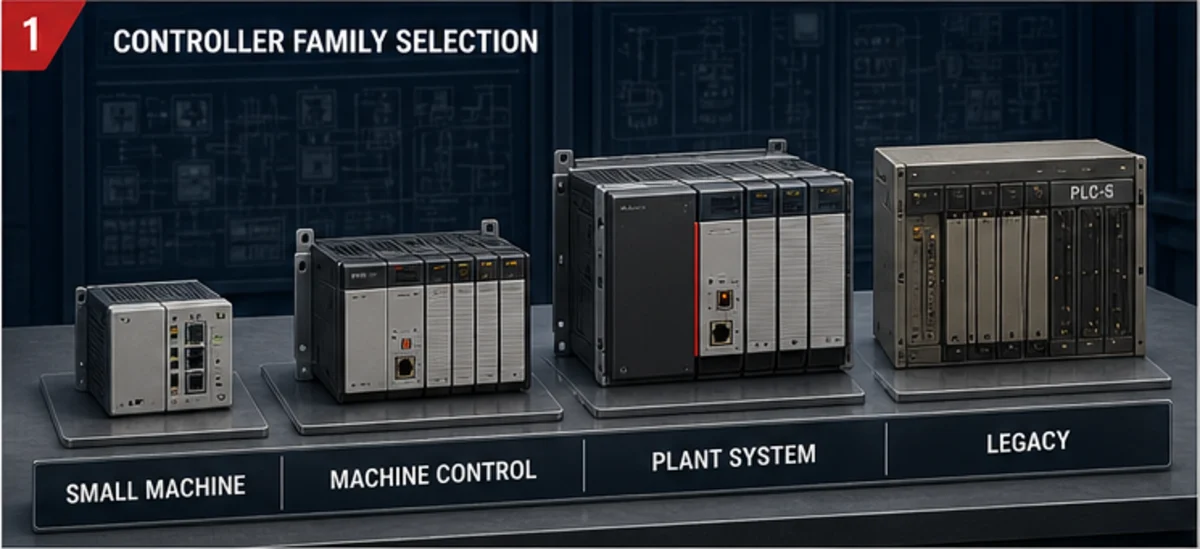
Mitsubishi vs Allen-Bradley PLC: Platform Comparison
Expert comparison of Mitsubishi vs Allen-Bradley PLCs covering FX5, Q Series, iQ-R, CompactLogix, and ControlLogix. Compare costs, programming, global support, and regional strengths for informed PLC platform decisions.
The choice between Mitsubishi and Allen-Bradley PLC platforms represents a critical strategic decision that impacts project costs, regional support availability, programming efficiency, and long-term system maintainability. These two automation giants approach industrial control from fundamentally different perspectives—Mitsubishi Electric brings Japanese engineering precision and Asian market dominance, while Rockwell Automation's Allen-Bradley offers North American market leadership and motion control excellence.
This comprehensive comparison examines every aspect of Mitsubishi vs Allen-Bradley PLCs, from hardware architectures and programming philosophies to total cost of ownership and global market positioning. Whether you're a system integrator evaluating platforms for international projects, an automation engineer developing regional expertise, or a plant manager making technology investment decisions, this detailed analysis provides the insights needed for informed platform selection.
We'll explore the distinct regional strengths each platform offers—Mitsubishi's exceptional value proposition and Asian market dominance versus Allen-Bradley's North American ecosystem and discrete manufacturing excellence. By examining real-world application scenarios, cost comparisons, programming differences, and industry preferences, you'll understand which platform aligns with your specific requirements, operational geography, and long-term automation strategy.
Comparing automation platforms? After this comparison, explore our Siemens vs Allen-Bradley PLC comparison for European alternatives, check our RSLogix 5000 programming guide for Allen-Bradley details, or review our complete PLC programming software guide covering all major platforms.
Table of Contents
- Company Background: East Meets West
- Quick Comparison Overview
- Product Line Architecture
- Programming Software Comparison
- Communication Protocols and Networking
- Head-to-Head Hardware Comparison
- Programming Complexity and Learning Curve
- Performance Metrics and Capabilities
- Cost Analysis and Value Comparison
- Global Availability and Regional Support
- Training and Documentation
- Integration Ecosystem
- Industry Applications and Market Focus
- Mitsubishi Advantages
- Allen-Bradley Advantages
- Regional Considerations
- When to Choose Mitsubishi
- When to Choose Allen-Bradley
- Frequently Asked Questions
Company Background: East Meets West
Understanding the corporate heritage, market positioning, and strategic focus of Mitsubishi Electric and Rockwell Automation provides essential context for evaluating their PLC platforms and long-term viability.
Mitsubishi Electric: Japanese Engineering Excellence
Corporate Heritage: Mitsubishi Electric Corporation, headquartered in Tokyo, Japan, represents one of the world's most diversified technology conglomerates with over 100 years of engineering innovation. The Factory Automation Systems division, which encompasses PLC products, forms a core component of Mitsubishi Electric's comprehensive industrial solutions portfolio serving global markets.
Global Market Position: Mitsubishi Electric commands approximately 12-15% of the global PLC market, positioning it as the third-largest PLC manufacturer worldwide behind Siemens and Rockwell Automation. The company demonstrates exceptional strength in Asian markets with 35-40% market share in Japan, 25-30% in Southeast Asia, and growing presence in China, India, and Oceania regions.
Strategic Focus: Mitsubishi Electric emphasizes integrated automation solutions combining PLCs, servo drives, inverters, robots, and HMIs in cohesive system architectures. The company's e-F@ctory initiative provides comprehensive frameworks for smart manufacturing and Industry 4.0 implementation, with particular focus on automotive manufacturing, semiconductor production, and precision machinery applications.
Engineering Philosophy: Japanese engineering principles of kaizen (continuous improvement), monozukuri (manufacturing craftsmanship), and omotenashi (customer service excellence) permeate Mitsubishi's product development. This philosophy manifests in meticulous hardware quality, exceptional reliability specifications, and comprehensive technical documentation.
Rockwell Automation: North American Industrial Leader
Corporate Heritage: Rockwell Automation, headquartered in Milwaukee, Wisconsin, evolved from Allen-Bradley, the legendary industrial control company founded in 1903. The Allen-Bradley brand, retained for PLCs and control products, carries exceptional market recognition and customer loyalty particularly in North American manufacturing sectors.
Regional Dominance: While ranking second globally with 18-22% market share, Rockwell Automation dominates North American industrial automation with 35-40% market share in the United States and Canada. This regional concentration reflects deep-rooted relationships with automotive manufacturers, established distribution networks, and comprehensive technical support infrastructure throughout the Americas.
Strategic Direction: The Connected Enterprise strategy emphasizes seamless integration between control systems and enterprise IT infrastructure, with particular strength in manufacturing execution systems (MES), industrial analytics, and cloud-based services. Rockwell focuses intensively on discrete manufacturing automation including automotive assembly, packaging machinery, and material handling applications.
Platform Philosophy: North American industrial practices emphasize practical productivity, rapid commissioning, and technician-friendly operation. This philosophy drives Allen-Bradley's tag-based programming architecture, intuitive software interfaces, and exceptional online editing capabilities that minimize production disruption during modifications.
Market Share Analysis
Global PLC Market Distribution (2026):
- Siemens: 30-35% (global leader)
- Rockwell Automation/Allen-Bradley: 18-22% (North America leader)
- Mitsubishi Electric: 12-15% (Asia-Pacific leader)
- Schneider Electric: 10-13% (process industries)
- Other manufacturers: 20-25% combined
Regional Market Dynamics:
Asia-Pacific Markets: Mitsubishi demonstrates exceptional strength with 35-40% market share in Japan, 25-30% in Southeast Asia, and growing presence in China and India. Allen-Bradley maintains 10-15% regional share focused on multinational automotive and electronics manufacturers requiring North American platform consistency.
North American Markets: Allen-Bradley dominates with 35-40% market share driven by automotive, food and beverage, and discrete manufacturing industries. Mitsubishi holds 8-12% regional share concentrated in Japanese-owned manufacturing facilities, automotive suppliers, and cost-sensitive applications.
European Markets: Both manufacturers face significant Siemens competition with Mitsubishi at 5-8% and Allen-Bradley at 12-15% market share. European facilities typically specify Siemens equipment due to regional presence and engineering preferences, though multinational corporations standardizing globally maintain platform consistency across regions.
Quick Comparison Overview
A high-level comparison table provides immediate insight into the fundamental differences between Mitsubishi and Allen-Bradley PLC platforms.
| Comparison Factor | Mitsubishi Electric | Allen-Bradley (Rockwell) | Advantage |
|---|---|---|---|
| Market Position | 3rd globally (12-15%) | 2nd globally (18-22%) | Allen-Bradley - Larger global presence |
| Regional Strength | Asia-Pacific dominant (35-40% Japan) | North America leader (35-40% USA) | Regional specialization |
| Hardware Cost | 25-40% lower than AB | Premium pricing | Mitsubishi - Better value |
| Software Cost | $500-3,000 (GX Works3) | $7,500-15,000 (Studio 5000) | Mitsubishi - 70-80% lower |
| Entry PLC Price | $150-400 (FX5U) | $1,200-2,000 (Micro850) | Mitsubishi - Budget-friendly |
| Programming Software | GX Works3 | Studio 5000 | Different philosophies |
| Learning Curve | Moderate (Japanese conventions) | Gentle (North American style) | Allen-Bradley - Easier start |
| Primary Protocol | CC-Link/CC-Link IE | EtherNet/IP | Regional preference |
| Motion Control | Good (SSCNET III) | Excellent (CIP Motion) | Allen-Bradley - Superior |
| Global Support | Strong Asia, moderate elsewhere | Strong Americas, good globally | Regional variation |
| Documentation | Comprehensive (some translations) | Excellent (English primary) | Allen-Bradley - Better English docs |
| Distributor Network | Concentrated Asia | Extensive North America | Regional specialization |
| Application Focus | Automotive, electronics, general | Discrete manufacturing, automotive | Industry-specific strengths |
| Total Cost (Small System) | $2,500-4,500 | $5,000-8,000 | Mitsubishi - 40-50% lower |
| Total Cost (Large System) | $18,000-35,000 | $35,000-60,000 | Mitsubishi - 45-55% lower |
| Training Availability | Strong Asia, limited Americas | Strong Americas, moderate globally | Regional variation |
| Spare Parts Availability | Excellent Asia, moderate elsewhere | Excellent Americas, good globally | Regional specialization |
Key Takeaway: Mitsubishi offers exceptional value with significantly lower hardware and software costs, making it ideal for budget-conscious projects and Asian market operations. Allen-Bradley provides superior North American support, motion control capabilities, and extensive distributor networks ideal for discrete manufacturing in the Americas. Neither platform is universally superior—optimal selection depends on operational geography, application requirements, and regional support priorities.
Product Line Architecture
Understanding the product portfolios and hardware architectures reveals how each manufacturer segments markets and addresses different application requirements.
Mitsubishi PLC Product Family
FX5 Series: Compact Machine Control
The FX5 series represents Mitsubishi's entry-level to mid-range PLC platform targeting machine builders, small automation projects, and cost-sensitive applications worldwide.
FX5U Controllers:
- Performance: 34 ns per basic instruction, 980 ns per applied instruction
- Program Capacity: 64K steps (128K optional) program memory
- I/O Capacity: Up to 384 I/O points with expansion modules
- Communication: Built-in Ethernet, USB programming, optional CC-Link
- Applications: Packaging machinery, material handling, simple process control
- Price Range: $150-400 depending on CPU model and integrated I/O
- Key Strength: Exceptional value with rich feature set at entry price points
FX5UC/FX5UJ Variants:
- Ultra-compact designs with integrated I/O (16-32 points)
- Cost-optimized for simple machine control applications
- Simplified programming for basic automation tasks
- Pricing from $150-250 for complete compact controllers
Q Series: Mid-Range to High-Performance Control
The Q series provides comprehensive capabilities for complex automation requiring distributed I/O, redundancy options, and advanced communication features.
Q03UDE/Q06UDE CPUs:
- Performance: 9.5 ns per basic instruction, exceptional processing speed
- Program Capacity: 1.31M steps program memory (expandable)
- I/O Capacity: Up to 8,192 I/O points with distributed Q I/O modules
- Communication: Built-in dual Ethernet ports, USB, multiple network options
- Applications: Process automation, large manufacturing lines, critical control
- Price Range: $800-2,500 for CPU units depending on performance tier
- Redundancy: Optional redundancy configurations for high-availability systems
Q Series Motion Controllers:
- Integrated motion control for up to 32 servo axes
- SSCNET III/H high-speed servo communication
- Advanced features including electronic gearing and cam profiles
- Seamless integration with MELSERVO servo drive systems
iQ-R Series: Premium High-Performance Platform
The iQ-R series represents Mitsubishi's flagship PLC platform combining exceptional performance, scalability, and advanced capabilities for demanding industrial applications.
R08/R16/R32 CPUs:
- Performance: 0.98 ns per basic instruction (industry-leading speed)
- Program Capacity: 2,600K steps standard, expandable to higher capacities
- I/O Capacity: Up to 8,192 I/O points per CPU with multiple I/O expansion options
- Communication: Dual built-in Ethernet ports, CC-Link IE Field network support
- Applications: High-speed production lines, complex process control, integrated manufacturing
- Price Range: $1,500-4,500 for CPU modules
- Advanced Features: Built-in security functions, extensive diagnostic capabilities
iQ-R Motion Controllers:
- Up to 64 synchronized servo axes per controller
- Multi-CPU configurations for complex motion applications
- Advanced robotics positioning and coordinated motion control
- Integration with CC-Link IE TSN (Time-Sensitive Networking)
Allen-Bradley Logix Product Family
Micro800 Series: Entry-Level Controllers
While technically programmed through Connected Components Workbench rather than Studio 5000, Micro800 controllers provide entry-level automation for simple applications.
Micro820/830/850 Controllers:
- Performance: Adequate for simple machine control applications
- Program Capacity: 10K-20K instructions depending on model
- I/O Capacity: Up to 256 I/O points with expansion
- Communication: Ethernet/IP standard, optional serial protocols
- Applications: Simple machine control, OEM equipment, standalone automation
- Price Range: $400-800 for base controllers
- Limitation: Separate programming environment from Studio 5000
CompactLogix 5380 Series: Mid-Range Powerhouse
CompactLogix provides exceptional price-performance balance with integrated safety capabilities and comprehensive Studio 5000 programming.
5069 CompactLogix Controllers:
- Performance: 0.37 ms per 1000 Boolean instructions (5380 standard controller)
- Program Capacity: Up to 10 MB user memory (3MB program + 7MB data)
- I/O Capacity: Up to 4,096 I/O points with local and distributed expansion
- Communication: Dual Ethernet/IP ports with device-level ring topology
- Applications: Packaging lines, material handling, machine control, light process
- Price Range: $1,200-4,000 depending on memory configuration and features
- Key Advantage: ControlLogix programming power in compact, cost-effective platform
5069 CompactGuardLogix:
- Integrated safety control to SIL 3/PLe in standard programming environment
- Safety and standard logic in unified program architecture
- Cost-effective safety integration eliminating separate safety controllers
ControlLogix 5580 Series: Enterprise-Class Control
ControlLogix represents Allen-Bradley's flagship platform for large distributed automation requiring maximum performance and reliability.
1756 ControlLogix Controllers:
- Performance: 0.1 ms per 1000 Boolean instructions (5580 high-performance)
- Program Capacity: Up to 32 MB combined program and data memory
- I/O Capacity: Virtually unlimited with distributed I/O architecture
- Communication: Redundant Ethernet/IP, ControlNet, DeviceNet options
- Applications: Automotive assembly, large process systems, critical infrastructure
- Price Range: $3,000-12,000 for controller modules
- Redundancy: Comprehensive redundancy options for maximum availability
1756 GuardLogix Safety Controllers:
- Integrated safety and standard control in unified programming
- Complete SIL 3/PLe safety certification with extensive safety I/O
- Safety logic seamlessly integrated with standard ladder logic and structured text
Distributed I/O Comparison
Mitsubishi Distributed I/O:
- Q Series Remote I/O: Modular expansion for Q series controllers via CC-Link
- RJ71 Network Modules: Interface modules for various industrial networks
- QJ71 Remote I/O: Compact distributed I/O for remote cabinet installations
- CC-Link IE Field Devices: High-performance distributed I/O on industrial Ethernet
Allen-Bradley Distributed I/O:
- 1734 POINT I/O: Compact modular I/O with on-machine and cabinet mount options
- 5069 Compact I/O: High-density I/O modules for CompactLogix platforms
- 1769 Compact I/O: Legacy compact I/O with extensive module selection
- ArmorBlock I/O: IP67 distributed I/O for harsh on-machine environments
Programming Software Comparison
The programming environments fundamentally define user experience, development productivity, and long-term maintenance efficiency for PLC platforms.
GX Works3: Mitsubishi's Unified Environment
Platform Overview: GX Works3 represents Mitsubishi's third-generation programming software supporting FX5, iQ-R, and Q series controllers in a unified development environment. The software emphasizes comprehensive functionality, multiple programming languages, and extensive simulation capabilities at significantly lower cost than competing platforms.
Core Programming Languages:
- Ladder Diagram (LD): Traditional relay logic following IEC 61131-3 standards
- Structured Text (ST): High-level text programming for complex algorithms
- Function Block Diagram (FBD): Visual programming for process control
- Sequential Function Chart (SFC): State-based sequential programming
- Instruction List (IL): Low-level programming for optimization
Key Features:
Multi-Language Programming: GX Works3 enables mixing programming languages within single projects, selecting optimal language for each control function. Motion control might use structured text while discrete logic uses ladder diagram, maximizing programming efficiency.
Intelligent Code Assistance: Context-aware auto-completion suggests appropriate instructions based on programming context. Comprehensive syntax checking catches errors before compilation, reducing debug time significantly.
Advanced Simulation: Built-in simulation capabilities allow complete offline program testing without hardware. The simulator supports I/O simulation, timer operations, and program execution visualization, though less sophisticated than dedicated virtual commissioning tools.
Project Organization: Hierarchical program organization with program blocks, function blocks, and global labels enables systematic development of complex applications. Reusable function blocks maintain consistency across projects and reduce development time.
Documentation Tools: Automatic documentation generation creates comprehensive program documentation including I/O lists, device usage, and cross-reference tables. Comment integration and annotation capabilities improve code maintainability.
Licensing and Cost:
GX Works3 Standard Edition:
- Price Range: $500-1,200 per license
- Controller Support: FX5U series controllers only
- Features: Basic programming, simulation, documentation
- Limitations: Limited to entry-level controller support
GX Works3 Full Edition:
- Price Range: $1,800-3,000 per license
- Controller Support: All Mitsubishi PLCs (FX5, Q, iQ-R series)
- Features: Complete functionality including motion, safety, networking
- Advanced Tools: Enhanced debugging, performance analysis, comprehensive libraries
Annual Maintenance:
- Optional software updates and support: $200-400 annually
- Not mandatory for continued operation
- Provides version updates and technical support access
Learning Curve Characteristics: GX Works3 presents moderate learning complexity with Japanese engineering conventions that may initially challenge Western programmers. However, comprehensive instruction set, clear documentation, and logical organization enable proficiency within 40-80 hours of structured training and practice.
Studio 5000: Allen-Bradley's Professional Platform
Platform Architecture: Studio 5000 Logix Designer represents Rockwell Automation's flagship programming environment for CompactLogix and ControlLogix controllers. The software emphasizes intuitive operation, tag-based programming, and exceptional online editing capabilities optimized for North American industrial practices.
Programming Languages:
- Relay Ladder Logic: North American ladder logic conventions with tag-based addressing
- Function Block Diagram: Process control oriented visual programming
- Structured Text: High-level algorithmic programming language
- Sequential Function Chart: Batch and sequential process programming
Key Differentiators:
Tag-Based Architecture: Revolutionary tag-based programming eliminates traditional address-based memory allocation in favor of descriptive symbolic names. Tags like "ConveyorMotor_Run" or "Tank1_LevelSetpoint" dramatically improve program clarity and reduce programming errors.
Exceptional Online Editing: Industry-leading online programming capabilities enable extensive program modifications during operation without stopping production. Changes test immediately with minimal risk, accelerating commissioning and troubleshooting.
Add-On Instructions (AOI): User-defined encapsulated instructions with formal parameters enable sophisticated code reuse. AOIs function like object-oriented programming, promoting standardization and reducing development time for recurring control functions.
Motion Integration: CIP Motion instructions integrate seamlessly in ladder logic and structured text, providing exceptional motion control programming productivity. Direct servo axis manipulation in standard programming languages eliminates separate motion programming environments.
Integrated Diagnostics: Comprehensive online diagnostics provide real-time program monitoring, force capabilities, and performance analysis. Troubleshooting tools including trends, watches, and cross-references accelerate fault identification and resolution.
FactoryTalk Ecosystem Integration: Native integration with FactoryTalk View (HMI), FactoryTalk Historian (data collection), and FactoryTalk AssetCentre (asset management) creates comprehensive automation environment for complete facility management.
Licensing Structure:
Studio 5000 Lite:
- Price Range: $3,500-5,500 per license
- Controller Support: CompactLogix controllers only
- Features: Basic programming with limited motion capabilities
- Best For: Simple machine control applications
Studio 5000 Standard:
- Price Range: $7,500-10,000 per license
- Controller Support: CompactLogix and ControlLogix platforms
- Features: Complete instruction set, motion control, comprehensive diagnostics
- Annual Subscription: 20-25% of license cost (mandatory for updates)
Studio 5000 Professional:
- Price Range: $12,000-15,000 per license
- Controller Support: All Allen-Bradley controllers including legacy platforms
- Features: Advanced motion, process library, team development tools
- Best For: Complex systems and professional development organizations
Annual Maintenance:
- Mandatory subscription: 20-25% of license cost
- Includes version updates and technical support
- Required for new controller downloads and software updates
Learning Accessibility: Studio 5000's intuitive interface and North American programming conventions enable rapid skill development. Basic proficiency achievable in 24-40 hours with professional competency developing over 60-80 hours of structured training and practical application.
Programming Software Comparison Matrix
| Software Feature | GX Works3 (Mitsubishi) | Studio 5000 (Allen-Bradley) | Advantage |
|---|---|---|---|
| Initial License Cost | $500-3,000 | $7,500-15,000 | Mitsubishi - 70-80% lower |
| Programming Languages | 5 languages (full IEC 61131-3) | 4 languages (IEC subset) | Mitsubishi - More comprehensive |
| Ladder Logic Style | IEC 61131-3 international | North American conventions | Regional preference |
| Tag-Based Addressing | Traditional address-based | Advanced tag-based | Allen-Bradley - Better clarity |
| Online Editing | Limited capabilities | Exceptional capabilities | Allen-Bradley - Superior |
| Simulation Quality | Good built-in simulation | Emulate5000 (separate purchase) | Mitsubishi - Included standard |
| Motion Programming | Technology objects approach | Integrated CIP Motion | Allen-Bradley - Better integration |
| Safety Programming | Integrated safety support | Native GuardLogix integration | Allen-Bradley - Seamless safety |
| Documentation Tools | Comprehensive auto-generation | Manual documentation approach | Mitsubishi - Better automation |
| Learning Curve | Moderate (40-80 hours) | Gentle (24-40 hours) | Allen-Bradley - Faster proficiency |
| Compilation Speed | Fast | Very fast | Allen-Bradley - Slightly faster |
| Software Stability | Very stable | Very stable | Even - Both excellent |
| Version Control | External tools required | External tools required | Even - Both need third-party |
| Annual Maintenance | $200-400 (optional) | 20-25% cost (mandatory) | Mitsubishi - Optional updates |
Software Selection Insights: GX Works3 provides exceptional value with comprehensive functionality at 70-80% lower cost than Studio 5000. This makes Mitsubishi highly attractive for budget-conscious projects and organizations prioritizing low software investment. Studio 5000's superior online editing, tag-based architecture, and intuitive interface justify premium pricing for applications requiring rapid commissioning, frequent modifications, and technician-friendly programming approaches.
Communication Protocols and Networking
Industrial communication capabilities determine system integration flexibility, multi-vendor compatibility, and long-term connectivity options.
Mitsubishi Communication Standards
CC-Link (Control & Communication Link):
CC-Link represents Mitsubishi's proprietary fieldbus protocol providing high-speed communication between PLCs, drives, remote I/O, and field devices.
Technical Specifications:
- Data Rate: Up to 10 Mbps depending on network configuration
- Network Length: Up to 1,200m (3,937 ft) at maximum speed
- Connected Devices: Up to 64 stations per network segment
- Cycle Time: Deterministic communication with predictable update cycles
- Applications: Machine-level communication, distributed I/O, drive integration
CC-Link IE (Industrial Ethernet):
The next-generation Ethernet-based protocol provides industrial-grade performance on standard Ethernet infrastructure.
CC-Link IE Field Network:
- Data Rate: 1 Gbps Ethernet backbone
- Network Topology: Line, ring, and star configurations
- Connected Devices: Up to 120 devices per network
- Real-Time Performance: Deterministic communication suitable for motion control
- Applications: Factory-wide integration, large distributed systems
CC-Link IE TSN (Time-Sensitive Networking):
- Latest evolution incorporating IEEE 802.1 TSN standards
- Microsecond-level time synchronization across devices
- Convergence of IT and OT networks on unified infrastructure
- Support for Industry 4.0 and smart manufacturing initiatives
Additional Mitsubishi Protocols:
- Ethernet/IP: Multi-vendor industrial Ethernet support for North American markets
- PROFINET: European industrial Ethernet protocol support
- Modbus TCP/RTU: Universal integration with legacy and third-party devices
- SLMP (Seamless Message Protocol): Open Ethernet protocol for PLC communication
- Serial Protocols: RS-232/485 for legacy equipment and specialized devices
Allen-Bradley Communication Standards
EtherNet/IP (Industrial Protocol):
EtherNet/IP forms the foundation of Allen-Bradley communication architecture, providing producer-consumer messaging and seamless device integration on standard Ethernet networks.
Technical Specifications:
- Data Rate: 10/100/1000 Mbps standard Ethernet speeds
- Network Topology: Linear, star, ring with device-level ring (DLR) support
- Connected Devices: Unlimited with proper network architecture
- Real-Time Performance: CIP Sync for motion control synchronization
- Applications: Universal communication across all automation levels
Common Industrial Protocol (CIP):
CIP provides unified communication framework across multiple physical networks including EtherNet/IP, DeviceNet, and ControlNet.
Key Advantages:
- Consistent device profiles across network types
- Seamless multi-vendor device integration
- Unified configuration tools and diagnostics
- Common tag database across communication layers
Legacy Network Support:
- ControlNet: Deterministic high-speed network for time-critical applications
- DeviceNet: Device-level fieldbus for sensors and discrete devices
- Data Highway Plus: Legacy PLC-to-PLC communication (backwards compatibility)
- Remote I/O: Traditional high-speed I/O communication
Multi-Vendor Protocols:
- Modbus TCP/RTU: Universal industrial protocol for third-party integration
- BACnet: Building automation integration
- OPC UA: Industry 4.0 and enterprise connectivity
- MQTT: IoT and cloud platform communication
Protocol Comparison Analysis
| Network Capability | Mitsubishi (CC-Link/IE) | Allen-Bradley (EtherNet/IP) | Advantage |
|---|---|---|---|
| Primary Protocol | CC-Link IE Field | EtherNet/IP with CIP | Different ecosystems |
| Network Speed | 1 Gbps (CC-Link IE) | 1 Gbps (Gigabit Ethernet) | Even - Comparable |
| Real-Time Performance | Excellent deterministic | Excellent with CIP Sync | Even - Both capable |
| Multi-Vendor Support | Good (CLPA members) | Excellent (ODVA members) | Allen-Bradley - Broader adoption |
| Global Adoption | Strong Asia, moderate elsewhere | Strong Americas, global presence | Allen-Bradley - Wider global |
| Device Ecosystem | Extensive in Asia | Extensive globally | Allen-Bradley - More devices |
| Open Standard | CLPA promoted standard | ODVA open standard | Allen-Bradley - More open |
| Protocol Flexibility | Good multi-protocol support | Good multi-protocol support | Even - Both flexible |
| Legacy Support | Excellent Mitsubishi devices | Excellent AB legacy networks | Even - Both comprehensive |
| TSN Support | CC-Link IE TSN (cutting edge) | Future EtherNet/IP TSN | Mitsubishi - Earlier adoption |
Regional Protocol Preferences:
- Asia-Pacific: CC-Link dominates with 60-70% market share in Japan, strong presence in China and Southeast Asia
- North America: EtherNet/IP leads with 50-60% market share across industries
- Europe: PROFINET and EtherNet/IP compete, CC-Link gaining automotive manufacturing presence
Strategic Implications: Protocol selection significantly impacts device availability, system integration complexity, and regional support. Mitsubishi's CC-Link provides optimal performance in Asian markets with extensive device ecosystems regionally. Allen-Bradley's EtherNet/IP offers superior multi-vendor compatibility and global device availability, particularly advantageous for international projects and facilities requiring broad supplier flexibility.
Head-to-Head Hardware Comparison
Direct hardware comparisons across equivalent product tiers reveal performance differences, cost variations, and capability distinctions.
Entry-Level Controller Comparison
Mitsubishi FX5U vs Allen-Bradley Micro850:
| Specification | FX5U (Mitsubishi) | Micro850 (Allen-Bradley) | Winner |
|---|---|---|---|
| Scan Time | 34 ns per basic instruction | 100 ns per basic instruction | Mitsubishi - 3x faster |
| Program Memory | 64K steps (128K option) | 15K instructions | Mitsubishi - 4x larger |
| Data Memory | 64K words standard | 10K bytes | Mitsubishi - Much larger |
| I/O Capacity | 384 points maximum | 256 points maximum | Mitsubishi - Higher capacity |
| Built-in Communication | Ethernet, USB | Ethernet/IP, USB | Even - Both adequate |
| Integrated I/O Options | 16-128 points available | 10-36 points available | Mitsubishi - More flexibility |
| Motion Control | Positioning up to 4 axes | Basic positioning | Mitsubishi - Better capability |
| Programming Software | GX Works3 ($500-1,200) | Connected Components ($0-500) | Even - Both affordable |
| Hardware Price | $150-400 | $400-800 | Mitsubishi - 50-60% lower |
| Total Entry System | $2,500-4,000 | $4,500-6,500 | Mitsubishi - 45-50% lower |
Analysis: Mitsubishi FX5U delivers exceptional value with superior performance specifications, larger memory capacity, and significantly lower hardware costs. The FX5U provides 3x faster instruction execution and 4x program memory at 50-60% lower price point, making it extremely attractive for cost-sensitive machine control applications.
Mid-Range Controller Comparison
Mitsubishi Q06UDE vs Allen-Bradley CompactLogix 5380:
| Specification | Q06UDE (Mitsubishi) | CompactLogix 5069-L330ER | Winner |
|---|---|---|---|
| Scan Time | 9.5 ns per basic instruction | 370 ns per 1000 Boolean inst. | Difficult comparison (different metrics) |
| Program Memory | 1.31M steps | 3 MB user memory | Mitsubishi - Larger step capacity |
| I/O Capacity | 8,192 points | 4,096 points standard | Mitsubishi - Higher capacity |
| Built-in Ethernet | Dual ports standard | Dual ports standard | Even - Both dual ports |
| Redundancy Options | Available with Q4AR modules | Not available (ControlLogix required) | Mitsubishi - More scalable |
| Motion Control | Up to 32 axes with motion CPU | CIP Motion (separate drives) | Even - Different approaches |
| Expansion Flexibility | 7-slot base, expandable | 4-13 slot chassis options | Allen-Bradley - More flexible |
| Programming Environment | GX Works3 Full ($1,800-3,000) | Studio 5000 Standard ($7,500-10,000) | Mitsubishi - 70% lower cost |
| Hardware Price | $1,200-2,500 | $2,500-4,500 | Mitsubishi - 50-55% lower |
| Complete System Cost | $8,000-15,000 | $16,000-28,000 | Mitsubishi - 45-55% lower |
Analysis: Mitsubishi Q Series provides excellent mid-range capabilities with exceptional I/O capacity and redundancy options at significantly lower total system cost. Allen-Bradley CompactLogix offers superior online editing capabilities, intuitive programming, and comprehensive FactoryTalk ecosystem integration. For budget-conscious projects requiring high I/O density, Q Series delivers better value. For projects prioritizing programming flexibility and North American support, CompactLogix justifies premium pricing.
High-Performance Controller Comparison
Mitsubishi iQ-R Series vs Allen-Bradley ControlLogix 5580:
| Specification | iQ-R R32CPU (Mitsubishi) | ControlLogix 5580 (Allen-Bradley) | Winner |
|---|---|---|---|
| Scan Time | 0.98 ns per basic instruction | 100 ns per 1000 Boolean inst. | Mitsubishi - Industry-leading speed |
| Program Memory | 2,600K steps | 20-32 MB combined memory | Both extensive - Different metrics |
| I/O Capacity | 8,192 points per CPU | 128,000+ points (distributed) | Allen-Bradley - Massive scalability |
| Processing Speed | Exceptional (fastest in class) | Excellent (industry-proven) | Mitsubishi - Raw performance |
| Redundancy | Full system redundancy options | Comprehensive redundancy options | Even - Both enterprise-class |
| Motion Control | 64 axes synchronized | Unlimited axes (CIP Motion) | Allen-Bradley - Better scalability |
| Safety Integration | Safety CPU modules available | GuardLogix integrated platform | Allen-Bradley - Seamless integration |
| Communication | Dual Ethernet, CC-Link IE | Multiple Ethernet/IP, ControlNet | Even - Both comprehensive |
| Programming Software | GX Works3 Full ($1,800-3,000) | Studio 5000 Professional ($12,000-15,000) | Mitsubishi - 75-80% lower |
| CPU Price | $1,500-4,500 | $5,000-12,000 | Mitsubishi - 60-70% lower |
| Complete Large System | $25,000-50,000 | $50,000-90,000 | Mitsubishi - 45-55% lower |
Analysis: Mitsubishi iQ-R delivers industry-leading instruction execution speed (0.98 nanoseconds per instruction) and exceptional value proposition for high-performance applications. Allen-Bradley ControlLogix provides superior distributed I/O scalability, motion control flexibility, and comprehensive North American support infrastructure. For large-scale Asian manufacturing facilities prioritizing performance and cost efficiency, iQ-R excels. For North American automotive assembly plants requiring maximum motion integration and support, ControlLogix justifies premium investment.
I/O Module Cost Comparison
| Module Type | Mitsubishi | Allen-Bradley | Cost Difference |
|---|---|---|---|
| 16-Point Digital Input | $60-120 | $120-220 | Mitsubishi 40-50% lower |
| 16-Point Digital Output | $65-130 | $130-240 | Mitsubishi 45-50% lower |
| 8-Channel Analog Input | $180-350 | $280-500 | Mitsubishi 35-40% lower |
| 8-Channel Analog Output | $200-400 | $320-550 | Mitsubishi 35-40% lower |
| High-Speed Counter | $200-400 | $350-600 | Mitsubishi 40-45% lower |
| Communication Module | $150-500 | $250-800 | Mitsubishi 35-40% lower |
| Servo Interface | $300-600 | $400-900 | Mitsubishi 30-35% lower |
Total System Cost Impact: Mitsubishi's 35-50% lower I/O module costs compound significantly in larger systems. A 500-point distributed system might include 30-50 I/O modules, generating $5,000-15,000 hardware cost savings with Mitsubishi compared to equivalent Allen-Bradley configuration. These savings often exceed software licensing cost differences.
Programming Complexity and Learning Curve
Understanding the learning requirements and programming complexity helps organizations plan training investments and estimate development productivity.
Mitsubishi GX Works3 Learning Progression
Basic Proficiency (40-60 hours):
Entry-level programmers develop fundamental capabilities including:
- GX Works3 interface navigation and project management
- Basic ladder logic programming with standard instructions
- Simple I/O configuration for FX5 and Q series controllers
- Elementary program troubleshooting and online monitoring
- Basic function block usage and program organization
Challenges for Western Programmers:
- Japanese engineering conventions differ from North American practices
- Some documentation translations may contain slight ambiguities
- Instruction naming conventions follow Japanese-English patterns
- Initial interface navigation requires adjustment period
Intermediate Competency (80-120 hours):
Professional-level programmers achieve comprehensive skills including:
- Multi-language programming (ladder, ST, SFC) within unified projects
- Advanced function block development and library management
- Complex I/O configuration with distributed remote I/O systems
- Motion control programming with positioning instructions
- Communication setup including CC-Link, Ethernet/IP, Modbus
- Comprehensive troubleshooting and diagnostic techniques
Advanced Expertise (200+ hours):
Expert programmers demonstrate mastery encompassing:
- Complex system architecture with redundancy and failover
- Advanced motion control with synchronized multi-axis coordination
- Network design and optimization for large distributed systems
- Performance optimization and memory management techniques
- Safety system programming and validation procedures
- Application-specific expertise (automotive, semiconductor, packaging)
Learning Resources:
- Comprehensive programming manuals with detailed examples
- Training courses through Mitsubishi Electric automation centers
- Online resources and video tutorials (increasing English content)
- Active user communities particularly strong in Asian regions
- Technical support through regional Mitsubishi offices
Allen-Bradley Studio 5000 Learning Progression
Basic Proficiency (24-40 hours):
New users achieve productivity quickly through:
- Intuitive Studio 5000 interface and tag-based project creation
- Fundamental ladder logic programming with North American conventions
- Basic CompactLogix/ControlLogix I/O configuration
- Simple online editing and program modifications
- Elementary motion control setup and testing
- Basic troubleshooting using integrated diagnostics
Learning Advantages:
- North American ladder logic conventions familiar to many technicians
- Tag-based addressing eliminates memory address complexity
- Intuitive interface requires minimal training for basic tasks
- Extensive English documentation and training resources
- Strong community support through user groups and forums
Intermediate Competency (60-80 hours):
Professional development encompasses:
- Advanced ladder logic and structured text programming techniques
- Add-On Instruction development for code reusability
- Complex motion control programming with coordinated axes
- Safety system integration using GuardLogix controllers
- FactoryTalk View HMI development and integration
- Network configuration and EtherNet/IP optimization
- Comprehensive diagnostic and troubleshooting methodologies
Advanced Expertise (150+ hours):
Master-level capabilities include:
- Large distributed system architecture and design
- Advanced motion applications including robotics and kinematics
- Process control using PlantPAx libraries and methodologies
- Complete FactoryTalk ecosystem integration and management
- Performance tuning and optimization for complex applications
- Industry-specific specialization (automotive, food/beverage, material handling)
Learning Resources:
- Extensive training through Rockwell Automation training centers
- Comprehensive distributor training programs across North America
- Abundant online resources, videos, and tutorials
- Active user communities and technical forums
- Excellent technical support through TechConnect services
Programming Complexity Comparison
| Learning Factor | Mitsubishi (GX Works3) | Allen-Bradley (Studio 5000) | Advantage |
|---|---|---|---|
| Basic Proficiency Time | 40-60 hours | 24-40 hours | Allen-Bradley - 30-40% faster |
| Interface Intuitiveness | Moderate (Japanese conventions) | High (North American style) | Allen-Bradley - More intuitive |
| Ladder Logic Style | IEC 61131-3 international | North American familiar | Allen-Bradley - Regional preference |
| Address Management | Traditional device numbering | Tag-based descriptive names | Allen-Bradley - Much simpler |
| Instruction Clarity | Comprehensive but complex | Intuitive instruction names | Allen-Bradley - Better clarity |
| Online Editing | Limited capabilities | Extensive capabilities | Allen-Bradley - Significantly better |
| Documentation Quality | Excellent (translation issues) | Excellent (native English) | Allen-Bradley - Better English |
| Training Availability | Strong Asia, limited Americas | Strong Americas, moderate global | Regional variation |
| Community Support | Active Asia communities | Active North America communities | Regional variation |
| Error Messages | Technical (some translation) | Clear actionable messages | Allen-Bradley - Better diagnostics |
| Help System | Comprehensive online help | Context-sensitive help | Allen-Bradley - More accessible |
Programming Productivity:
Mitsubishi Advantages:
- Faster execution speed enables more complex algorithms
- Comprehensive instruction set reduces custom code requirements
- Excellent simulation capabilities for offline development
- Lower software costs enable multiple development licenses
Allen-Bradley Advantages:
- Faster initial programming through tag-based architecture
- Superior online editing accelerates commissioning and troubleshooting
- Add-On Instructions promote systematic code reuse
- Intuitive interface reduces training time for new programmers
Practical Implications: For organizations with established Allen-Bradley expertise operating primarily in North America, Studio 5000's intuitive interface and superior online editing provide better productivity despite higher costs. For budget-conscious international projects or Asian operations, Mitsubishi's lower learning curve investment and significantly reduced software costs deliver better total value, particularly when development teams achieve proficiency.
Performance Metrics and Capabilities
Real-world performance characteristics impact system responsiveness, production throughput, and application suitability for time-critical control.
Processing Speed Comparison
Instruction Execution Performance:
Mitsubishi Performance Leaders:
- iQ-R Series: 0.98 ns per basic instruction (industry-leading performance)
- Q Series: 9.5 ns per basic instruction
- FX5U Series: 34 ns per basic instruction
Allen-Bradley Performance:
- ControlLogix 5580: 0.1 ms (100 ns) per 1000 Boolean instructions
- CompactLogix 5380: 0.37 ms (370 ns) per 1000 Boolean instructions
- Micro850: Approximately 100 ns per basic instruction (estimated)
Performance Analysis: Direct performance comparison requires careful interpretation due to different measurement methodologies. Mitsubishi specifies nanoseconds per individual instruction while Allen-Bradley rates milliseconds per 1000 Boolean instructions. Converting metrics indicates comparable performance for most applications, with Mitsubishi iQ-R delivering exceptional speed for instruction-intensive algorithms.
Scan Time Performance
Typical Scan Times for Moderate Complexity Programs:
Small Program (200-500 rungs/networks):
- Mitsubishi FX5U: 2-5 milliseconds typical
- Allen-Bradley CompactLogix 5380: 3-6 milliseconds typical
- Analysis: Comparable performance, sufficient for most machine control
Medium Program (1,000-2,000 rungs/networks):
- Mitsubishi Q06UDE: 5-12 milliseconds typical
- Allen-Bradley CompactLogix 5380: 8-15 milliseconds typical
- Analysis: Mitsubishi slight advantage in execution speed
Large Program (5,000+ rungs/networks):
- Mitsubishi iQ-R: 8-20 milliseconds typical
- Allen-Bradley ControlLogix 5580: 12-25 milliseconds typical
- Analysis: Mitsubishi maintains performance advantage at scale
Practical Impact: For most industrial automation applications, both platforms deliver adequate scan time performance. High-speed packaging lines, vision inspection systems, and synchronized multi-axis motion benefit from Mitsubishi's faster execution. Standard material handling, process control, and assembly automation perform excellently on either platform.
Memory Capacity and Utilization
Program Memory Comparison:
| Controller Class | Mitsubishi | Allen-Bradley | Advantage |
|---|---|---|---|
| Entry Level | 64K-128K steps (FX5U) | 15K instructions (Micro850) | Mitsubishi - 4-8x larger |
| Mid-Range | 1.31M steps (Q06UDE) | 3 MB memory (CompactLogix) | Different metrics - Both adequate |
| High-End | 2.6M steps (iQ-R) | 32 MB memory (ControlLogix) | Both extensive capacity |
Memory Management:
- Mitsubishi: Traditional step-based memory allocation with device number addressing
- Allen-Bradley: Dynamic tag-based memory with automatic allocation
Both approaches provide adequate memory for modern applications. Allen-Bradley's tag-based system simplifies memory management for programmers while Mitsubishi's step-based approach provides precise memory utilization visibility.
Communication Performance
Network Update Rates:
CC-Link (Mitsubishi):
- Standard cycle time: 1-10 ms depending on configuration
- Deterministic performance with guaranteed update cycles
- Up to 64 stations per network segment
- Suitable for motion control and time-critical applications
CC-Link IE Field (Mitsubishi):
- Cycle time: Sub-millisecond capability with proper configuration
- 1 Gbps network bandwidth
- Excellent for synchronized motion and high-speed data transfer
EtherNet/IP (Allen-Bradley):
- RPI (Requested Packet Interval): Configurable from 1 ms to seconds
- Deterministic with CIP Sync time synchronization
- Scalable to hundreds of devices per network
- Excellent motion control performance with proper configuration
Real-World Performance: Both protocols deliver deterministic real-time performance suitable for motion control, high-speed I/O, and time-critical applications. Properly configured CC-Link IE and EtherNet/IP networks achieve sub-millisecond update cycles for synchronized motion control with dozens of servo axes.
Motion Control Capabilities
Mitsubishi Motion Control:
SSCNET III/H Servo Communication:
- High-speed synchronous servo network
- Update cycle: 0.44 ms (SSCNET III/H)
- Up to 32-64 axes depending on controller
- Integrated with MELSERVO servo amplifier systems
- Advanced features: Electronic gearing, cam profiles, coordinated motion
Motion Programming:
- Technology objects in GX Works3 for motion configuration
- Positioning instructions integrated in ladder logic and structured text
- Synchronized motion for packaging and assembly applications
Allen-Bradley Motion Control:
CIP Motion Architecture:
- EtherNet/IP based motion control integration
- Update cycle: Configurable 1-8 ms typical
- Unlimited axes with proper network architecture
- Seamless Kinetix servo drive integration
- Advanced capabilities: Coordinated motion, robotics, electronic camming
Motion Programming Excellence:
- CIP Motion instructions directly in ladder logic and structured text
- Exceptional programming productivity for motion applications
- Motion groups for synchronized multi-axis coordination
- Advanced kinematics for robotics applications
Motion Control Winner: Allen-Bradley demonstrates superior motion control integration with CIP Motion instructions seamlessly integrated in standard programming languages. Mitsubishi provides excellent motion capabilities with MELSERVO integration, but requires more separate configuration. For applications where motion control is primary focus, Allen-Bradley's programming approach provides better productivity.
Safety System Capabilities
Mitsubishi Safety Solutions:
- Dedicated safety PLCs for SIL 3/PLe applications
- Safety network communication via CC-Link Safety
- Separate safety programming environment
- Comprehensive safety I/O modules
- Certified safety function blocks
Allen-Bradley Safety Solutions:
- GuardLogix integrated safety and standard control
- Safety logic programmed in Studio 5000 standard environment
- SIL 3/PLe certified controllers and I/O modules
- Safety instructions mixed with standard logic
- Comprehensive safety device integration
Safety Integration Winner: Allen-Bradley's GuardLogix provides superior safety integration with safety logic programmed in identical environment using standard Studio 5000 tools. This unified approach simplifies development, reduces engineering complexity, and improves long-term maintainability. Mitsubishi's separate safety programming environment, while fully capable and certified, requires additional training and separate development workflows.
Cost Analysis and Value Comparison
Total cost of ownership encompasses hardware, software, training, and long-term maintenance expenses that significantly impact project economics.
Initial Hardware Investment
Small Machine Control System (50 I/O Points):
Mitsubishi Configuration:
- FX5U CPU (32 integrated I/O): $250-400
- Additional I/O modules (18 points): $150-300
- Power supply and mounting: $100-200
- Programming cable: $50-100
- Total Hardware: $550-1,000
Allen-Bradley Configuration:
- Micro850 CPU (basic model): $400-600
- I/O expansion modules (40 points): $400-700
- Power supply and chassis: $200-350
- Programming cable/adapter: $100-150
- Total Hardware: $1,100-1,800
Cost Difference: Mitsubishi 40-55% lower
Medium Manufacturing System (200 I/O Points):
Mitsubishi Configuration:
- Q06UDE CPU: $1,500-2,200
- Digital I/O modules (200 points): $1,200-2,000
- Analog I/O modules (32 channels): $1,000-1,800
- Network modules and expansion: $800-1,500
- Base units, power supplies: $600-1,000
- Total Hardware: $5,100-8,500
Allen-Bradley Configuration:
- CompactLogix 5380 CPU: $2,500-3,800
- Digital I/O modules (200 points): $2,000-3,500
- Analog I/O modules (32 channels): $1,600-2,800
- Communication modules: $500-1,000
- Chassis and power supplies: $1,200-2,000
- Total Hardware: $7,800-13,100
Cost Difference: Mitsubishi 35-45% lower
Large Process System (1,000 I/O Points, Multiple PLCs):
Mitsubishi Configuration:
- Multiple iQ-R/Q CPUs: $8,000-15,000
- Distributed I/O systems: $12,000-22,000
- Communication infrastructure: $3,000-6,000
- Servo drives and motion (16 axes): $8,000-14,000
- HMI panels and SCADA: $6,000-12,000
- Total Hardware: $37,000-69,000
Allen-Bradley Configuration:
- Multiple ControlLogix CPUs: $15,000-28,000
- Distributed I/O (POINT I/O): $18,000-32,000
- Network switches and infrastructure: $4,000-8,000
- Kinetix drives and motion (16 axes): $12,000-20,000
- PanelView and FactoryTalk: $10,000-18,000
- Total Hardware: $59,000-106,000
Cost Difference: Mitsubishi 40-50% lower
Software Licensing Costs
Programming Software:
- Mitsubishi GX Works3 Full: $1,800-3,000 (one-time purchase)
- Allen-Bradley Studio 5000 Standard: $7,500-10,000 + 20% annual subscription
5-Year Software Cost Comparison:
- Mitsubishi: $1,800-3,000 initial + $1,000-2,000 optional updates = $2,800-5,000
- Allen-Bradley: $7,500-10,000 + $7,500-12,500 subscriptions = $15,000-22,500
Software Cost Difference: Mitsubishi 70-80% lower over 5 years
HMI/SCADA Software:
- Mitsubishi GT Works3 (HMI): $500-1,500 per license
- Allen-Bradley FactoryTalk View Studio: $5,000-8,000 per license
Training Investment
Engineer Training Costs:
Mitsubishi Training:
- Basic programming course (3-5 days): $1,500-2,500 per person
- Advanced programming (3-5 days): $1,800-3,000 per person
- Motion control training: $1,200-2,000 per person
- Total per engineer: $4,500-7,500 for comprehensive training
Allen-Bradley Training:
- Basic Logix programming (4-5 days): $2,000-3,000 per person
- Advanced Logix programming (3-5 days): $2,200-3,500 per person
- Motion control training: $2,000-3,000 per person
- Total per engineer: $6,200-9,500 for comprehensive training
Training Cost Difference: Mitsubishi 25-35% lower
Maintenance and Support Costs
Annual Maintenance:
Mitsubishi:
- Software updates (optional): $200-400 per license annually
- Technical support: $500-1,500 per system annually
- Spare parts inventory: $1,000-3,000 depending on system size
- Annual Maintenance: $1,700-4,900
Allen-Bradley:
- Software subscription (mandatory): $1,500-3,000 per license annually
- TechConnect support: $2,000-5,000 per system annually
- Spare parts inventory: $1,500-4,000 depending on system size
- Annual Maintenance: $5,000-12,000
Maintenance Cost Difference: Mitsubishi 60-70% lower annually
Total Cost of Ownership (5 Years)
Small System (50 I/O, Single PLC):
- Mitsubishi Total: $8,000-14,000
- Allen-Bradley Total: $18,000-28,000
- Savings with Mitsubishi: $10,000-14,000 (55-60%)
Medium System (200 I/O, Multiple PLCs):
- Mitsubishi Total: $28,000-48,000
- Allen-Bradley Total: $55,000-85,000
- Savings with Mitsubishi: $27,000-37,000 (48-55%)
Large System (1,000 I/O, Distributed Architecture):
- Mitsubishi Total: $95,000-165,000
- Allen-Bradley Total: $180,000-290,000
- Savings with Mitsubishi: $85,000-125,000 (47-52%)
Cost-Value Analysis
When Mitsubishi's Lower Cost Provides Maximum Value:
- Budget-constrained projects with firm cost limitations
- Multiple small to medium systems where savings compound
- Asian manufacturing operations with regional support access
- Applications where hardware performance is primary concern
- Projects requiring multiple programming licenses
- OEM machine builders competing on equipment cost
When Allen-Bradley's Premium Pricing Justifies Investment:
- North American operations requiring local support excellence
- Projects prioritizing programming productivity and commissioning speed
- Applications requiring extensive online modifications during operation
- Systems where motion control is primary functionality
- Facilities with established Allen-Bradley expertise and infrastructure
- Projects where FactoryTalk ecosystem integration provides value
Key Insight: Mitsubishi consistently delivers 40-55% lower total cost of ownership across all system sizes while maintaining comparable technical capabilities. This exceptional value proposition makes Mitsubishi highly attractive for cost-sensitive projects, particularly in Asian markets with strong regional support. Allen-Bradley's premium pricing reflects superior North American support infrastructure, intuitive programming environment, and comprehensive FactoryTalk ecosystem that may justify additional investment for specific applications and regions.
Global Availability and Regional Support
Regional support infrastructure, spare parts availability, and technical assistance responsiveness significantly impact operational efficiency and system reliability.
Mitsubishi Electric Global Presence
Regional Strength Analysis:
Asia-Pacific Markets:
- Japan: Dominant position with 35-40% market share
- Support Infrastructure: Extensive factory automation centers, comprehensive technical support
- Distributor Network: Dense distribution throughout Japan with same-day parts availability
- Training Facilities: Multiple training centers across major cities
- Response Time: Excellent same-day or next-day technical support
Southeast Asia:
- Market Position: Strong 25-30% market share across region
- Key Markets: Thailand, Indonesia, Malaysia, Philippines, Vietnam, Singapore
- Support Infrastructure: Regional offices in all major countries
- Parts Availability: Good with 1-3 day delivery to most locations
- Technical Support: Regional support centers with local language capability
China and India:
- Market Presence: Growing presence competing with local and European manufacturers
- Support Network: Expanding office network in major industrial cities
- Local Manufacturing: Some local production improving availability
- Technical Capability: Increasing local engineering support resources
Oceania:
- Australia/New Zealand: Established presence with regional distribution
- Support Quality: Good technical support through local offices
- Parts Availability: 2-5 day delivery typical from regional warehouses
North America:
- Market Position: 8-12% market share (third tier manufacturer)
- Support Infrastructure: Limited direct presence, relies on distributors
- Distributor Network: Specialized industrial distributors, not universal coverage
- Parts Availability: 3-7 day delivery typical, may require Japan sourcing for specialty items
- Technical Support: Limited local engineering support, often requires Japan factory assistance
- Challenge: Finding experienced Mitsubishi programmers and system integrators
Europe:
- Market Position: 5-8% market share (competes with Siemens dominance)
- Support Structure: Regional offices in major countries (Germany, UK, France, Italy)
- Parts Availability: Moderate, 3-7 day delivery typical
- Technical Support: Regional support centers, German operation as European hub
Middle East and Africa:
- Market Presence: Limited direct presence, distributor-based support
- Support Quality: Variable depending on country and distributor capability
- Applications: Growing presence in oil and gas, infrastructure projects
Allen-Bradley (Rockwell Automation) Global Presence
Regional Strength Analysis:
North America:
- Market Position: Dominant 35-40% market share
- Support Infrastructure: Extensive regional offices, comprehensive TechConnect support
- Distributor Network: Exceptional density with hundreds of authorized distributors
- Parts Availability: Outstanding same-day to 2-day delivery across USA/Canada
- Training Facilities: Extensive training centers and distributor training programs
- System Integrators: Abundant experienced Rockwell system integrators
- Technical Support: Industry-leading 24/7 technical support with rapid response
Latin America:
- Market Position: Strong 20-25% market share
- Key Markets: Mexico, Brazil, Argentina, Chile, Colombia
- Support Infrastructure: Regional offices throughout major countries
- Parts Availability: Good with 2-5 day delivery to most locations
- Technical Support: Regional support centers with Spanish/Portuguese capability
Europe:
- Market Position: Moderate 12-15% market share (competes with Siemens)
- Support Network: Regional offices in major countries
- Parts Availability: Good with 3-7 day delivery typical
- Technical Support: Regional support centers with local language capability
- Challenge: Less local preference compared to Siemens platform
Asia-Pacific:
- Market Position: Limited 10-15% market share
- Support Infrastructure: Regional offices in major countries
- Parts Availability: Moderate, 3-7 day delivery typical, may require Americas sourcing
- Technical Support: Regional support with variable response times
- Challenge: Limited local distributor network compared to Asian manufacturers
Middle East and Africa:
- Market Presence: Moderate presence through distributors and system integrators
- Support Quality: Variable, relies heavily on distributor capability
- Applications: Strong in oil and gas, process industries, mining
Support Infrastructure Comparison
| Support Factor | Mitsubishi Electric | Allen-Bradley (Rockwell) | Winner |
|---|---|---|---|
| North America Support | Limited, distributor-based | Excellent, extensive network | Allen-Bradley - Significantly better |
| Asia-Pacific Support | Excellent, extensive network | Moderate, limited network | Mitsubishi - Significantly better |
| Europe Support | Moderate, regional offices | Good, regional presence | Allen-Bradley - Slightly better |
| Latin America Support | Limited presence | Good regional network | Allen-Bradley - Better |
| Parts Availability (Asia) | Excellent 1-3 days | Moderate 3-7 days | Mitsubishi - Much better |
| Parts Availability (Americas) | Moderate 3-7 days | Excellent 1-3 days | Allen-Bradley - Much better |
| 24/7 Technical Support | Regional business hours | Global 24/7 TechConnect | Allen-Bradley - Better |
| Online Resources | Good (some language barriers) | Excellent (comprehensive English) | Allen-Bradley - Better English |
| Training Availability (Asia) | Excellent multiple centers | Limited availability | Mitsubishi - Much better |
| Training Availability (Americas) | Limited options | Extensive programs | Allen-Bradley - Much better |
| System Integrator Network (Asia) | Extensive experienced firms | Limited specialized firms | Mitsubishi - Much better |
| System Integrator Network (Americas) | Limited specialized firms | Extensive experienced firms | Allen-Bradley - Much better |
Regional Support Implications
Critical Success Factors:
Choose Mitsubishi For:
- Manufacturing operations primarily in Asia-Pacific region
- Projects in Japan, Southeast Asia, China where local support excels
- Organizations with in-house Mitsubishi expertise managing global operations
- Applications where rapid parts availability in Asia is critical
- Asian-headquartered companies expanding globally with platform consistency
Choose Allen-Bradley For:
- Manufacturing operations primarily in North America
- Projects in USA, Canada, Mexico, Latin America requiring local support
- Organizations requiring 24/7 global technical support with rapid response
- Applications where extensive local system integrator options are valuable
- North American or European-headquartered companies with regional focus
Multi-Region Considerations: Global manufacturing companies often standardize regionally rather than globally—Mitsubishi for Asian facilities, Allen-Bradley for North American plants, Siemens for European operations. This regional optimization approach maximizes local support quality while accepting multi-platform maintenance complexity.
Training and Documentation
Comprehensive training programs and quality documentation enable efficient skill development and long-term system maintainability.
Mitsubishi Training Programs
Training Infrastructure:
Asia-Pacific Training Excellence:
- Comprehensive training centers across Japan with hands-on facilities
- Regional training centers in Southeast Asia (Thailand, Singapore, Malaysia)
- Standardized training curriculum with experienced instructors
- Hands-on equipment including PLCs, HMIs, servo drives, robots
Course Offerings:
Basic Programming (3-5 days):
- GX Works3 interface and navigation
- Fundamental ladder logic programming
- Basic I/O configuration and troubleshooting
- Simple motion control setup
- Cost: $1,500-2,500 per person
Advanced Programming (3-5 days):
- Multi-language programming (ladder, ST, SFC)
- Function block development and libraries
- Complex motion control and servo integration
- Network configuration and diagnostics
- Cost: $1,800-3,000 per person
Specialized Courses:
- Motion control and robotics integration: $1,200-2,000
- CC-Link network design and troubleshooting: $800-1,500
- Safety system programming and validation: $1,500-2,500
- iQ-R platform advanced features: $1,000-2,000
Documentation Quality:
Comprehensive Technical Manuals:
- Detailed hardware specifications and installation guides
- Complete programming reference manuals with instruction descriptions
- Application examples and sample programs
- Troubleshooting guides and error code references
- Network configuration manuals with detailed specifications
Language Considerations:
- Primary documentation in Japanese with English translations
- Translation quality generally good but occasional ambiguities
- Some advanced technical documents may lag English translation
- Growing library of English video tutorials and online resources
Online Resources:
- Mitsubishi Electric FA Global website with downloadable documentation
- Technical bulletins and application notes
- Software downloads and firmware updates
- Growing video tutorial library (English and Japanese)
- Regional technical support portals
Allen-Bradley Training Programs
Training Infrastructure:
North American Training Excellence:
- Extensive Rockwell Automation training centers across USA and Canada
- Distributor-provided training programs throughout North America
- Mobile training laboratories for on-site instruction
- Comprehensive hands-on training equipment and simulation capabilities
Course Offerings:
Studio 5000 Fundamentals (4-5 days):
- Studio 5000 interface and tag-based programming
- Ladder logic and structured text programming
- CompactLogix and ControlLogix hardware configuration
- Basic troubleshooting and diagnostics
- Cost: $2,000-3,000 per person
Advanced Logix Programming (3-5 days):
- Advanced ladder logic techniques and optimization
- Add-On Instruction development and management
- Complex data structures and tag management
- Advanced diagnostics and performance tuning
- Cost: $2,200-3,500 per person
Specialized Training:
- CIP Motion and Kinetix servo integration: $2,000-3,000
- GuardLogix safety programming and validation: $2,200-3,500
- FactoryTalk View HMI development: $1,800-2,800
- PlantPAx process control systems: $2,500-4,000
- EtherNet/IP network design and troubleshooting: $1,500-2,500
Documentation Excellence:
Professional Technical Documentation:
- Comprehensive user manuals with clear procedures
- Detailed programming instruction references
- Application techniques and best practices documentation
- Installation and maintenance manuals with detailed procedures
- Video tutorials integrated with written documentation
English Documentation Advantage:
- All documentation primarily authored in English
- Clear technical writing with minimal ambiguity
- Consistent terminology across all documentation
- Regular updates maintaining current information
- Excellent searchable online documentation portals
Online Learning Resources:
- Rockwell Automation University with extensive online courses
- TechConnect knowledge base with solutions and troubleshooting
- Community forums with active user participation
- YouTube channel with hundreds of tutorial videos
- Mobile apps for quick reference and troubleshooting
Training Comparison Analysis
| Training Factor | Mitsubishi Electric | Allen-Bradley (Rockwell) | Advantage |
|---|---|---|---|
| Training Cost | $4,500-7,500 comprehensive | $6,200-9,500 comprehensive | Mitsubishi - 25-30% lower |
| Asia Training Availability | Excellent, multiple centers | Limited, specialized distributors | Mitsubishi - Much better |
| Americas Training Availability | Limited, specialized distributors | Excellent, extensive programs | Allen-Bradley - Much better |
| Hands-On Quality | Excellent with actual equipment | Excellent with actual equipment | Even - Both excellent |
| Online Resources | Good (language considerations) | Excellent (comprehensive English) | Allen-Bradley - Better |
| Documentation Quality | Excellent (translation issues) | Excellent (native English) | Allen-Bradley - English advantage |
| Video Tutorials | Growing library | Extensive library | Allen-Bradley - More comprehensive |
| Community Support | Strong Asia forums | Strong Americas forums | Regional specialization |
| Certification Programs | Available through regional centers | Available through training centers | Even - Both offer certifications |
| Mobile Resources | Moderate mobile app support | Good mobile app support | Allen-Bradley - Better apps |
Training Strategy Recommendations:
For Mitsubishi Projects:
- Invest in comprehensive foundation training in Asian training centers
- Supplement with online resources and technical documentation
- Build internal expertise for self-sufficiency in non-Asian regions
- Leverage distributor technical support for specialized assistance
- Budget additional time for English translation comprehension
For Allen-Bradley Projects:
- Utilize extensive North American training network for rapid skill development
- Leverage distributor training programs for convenient local training
- Utilize comprehensive online resources for ongoing learning
- Join user groups and forums for community support
- Invest in TechConnect support for rapid technical assistance
Integration Ecosystem
Modern automation systems require extensive integration with HMI, SCADA, drives, robots, and enterprise systems—ecosystem strength impacts total solution capabilities.
Mitsubishi e-F@ctory Ecosystem
Integrated Automation Platform:
Mitsubishi's e-F@ctory initiative provides comprehensive framework for smart manufacturing integrating PLCs, HMIs, servo drives, inverters, robots, and IoT platforms in cohesive system architectures.
Core Components:
PLC Controllers:
- FX5, Q Series, iQ-R controllers providing hierarchical control
- Seamless integration across controller platforms
- Unified programming environment (GX Works3)
HMI Solutions:
- GOT2000 series graphic operation terminals (4"-15" displays)
- Web-based visualization through PLC built-in web server
- GT Works3 programming software integrated with GX Works3
- Mobile device monitoring through MX OPC UA connectivity
Motion Control:
- MELSERVO servo amplifiers and motors (50W to 55kW)
- MR-J5 series with industry-leading response and precision
- SSCNET III/H high-speed servo communication network
- Integrated motion control programming in GX Works3
Inverter Drives:
- FR-A/E/F series inverters for motor speed control
- Integrated communication via CC-Link, Modbus, or Ethernet
- Energy-saving features for sustainable manufacturing
Industrial Robotics:
- MELFA industrial robots with seamless PLC integration
- Coordinated motion between robots and machine axes
- Direct robot programming from RT ToolBox3 software
MES and IoT Integration:
- MELIPC industrial PCs for edge computing and data collection
- MAPS SCADA for supervisory control and data acquisition
- Integration with third-party MES and ERP systems
- Cloud connectivity through MX OPC UA and MQTT protocols
Ecosystem Strengths:
- Unified software platform reducing integration complexity
- Optimized performance through native device integration
- Comprehensive support for complete automation solutions
- Strong focus on automotive and electronics manufacturing
Ecosystem Limitations:
- Smaller third-party device ecosystem compared to Allen-Bradley
- Limited North American system integrator expertise
- Fewer pre-engineered industry-specific solutions
- More limited enterprise IT integration compared to FactoryTalk
Allen-Bradley Connected Enterprise Ecosystem
Integrated Architecture:
Rockwell Automation's Connected Enterprise strategy provides seamless integration from sensors through cloud analytics, emphasizing convergence of OT (operational technology) and IT (information technology) systems.
Core Components:
Logix Controllers:
- Micro800, CompactLogix, ControlLogix controllers
- GuardLogix safety controllers with integrated safety and standard control
- Unified Studio 5000 programming across all platforms
HMI and Visualization:
- PanelView Plus operator terminals (4"-15" displays)
- PanelView 5000 advanced terminals with gesture support
- FactoryTalk View SE for distributed SCADA applications
- VersaView industrial PCs for advanced visualization
Motion Control Excellence:
- Kinetix servo drives (single-axis and multi-axis configurations)
- CIP Motion seamlessly integrated in Studio 5000 programming
- PowerFlex AC drives for standard motor control
- Advanced motion features including kinematics and robotics coordination
Safety Systems:
- GuardLogix integrated safety controllers (SIL 3/PLe)
- Safety I/O modules integrated with standard I/O configuration
- Safety devices (light curtains, e-stops, safety relays) from multiple vendors
- Comprehensive safety programming in Studio 5000
MES and Analytics:
- FactoryTalk ProductionCentre for manufacturing execution
- FactoryTalk Historian for time-series data collection
- FactoryTalk VantagePoint for enterprise reporting and dashboards
- FactoryTalk Analytics for machine learning and predictive analytics
Cloud and IoT:
- FactoryTalk Hub cloud platform for data aggregation
- FactoryTalk Edge Gateway for industrial IoT connectivity
- Azure and AWS cloud platform integration
- Remote monitoring and programming capabilities
Industrial Networking:
- EtherNet/IP for unified plant-floor networking
- Stratix managed Ethernet switches for reliable networks
- ArmorPoint I/O for on-machine distributed control
- Comprehensive network design and diagnostic tools
Ecosystem Strengths:
- Most comprehensive industrial automation ecosystem available
- Extensive third-party device integration through EtherNet/IP
- Superior enterprise IT integration capabilities
- Abundant experienced system integrators and solution providers
- Industry-specific pre-engineered solutions (PlantPAx process, batch, etc.)
Ecosystem Limitations:
- Premium pricing across entire ecosystem
- Complexity managing comprehensive feature sets
- Mandatory software subscriptions for updates
- Vendor lock-in considerations for large integrated systems
Third-Party Integration
Mitsubishi Multi-Vendor Integration:
Supported Protocols:
- Ethernet/IP for North American device compatibility
- PROFINET for European device integration
- Modbus TCP/RTU for universal third-party connectivity
- OPC UA for Industry 4.0 and enterprise integration
- MQTT for IoT and cloud platform connectivity
Device Integration:
- Vision systems from Cognex, Keyence, and other manufacturers
- Third-party servo drives and motion systems (limited optimization)
- Industrial robots from various manufacturers via Ethernet protocols
- Process instruments through Modbus and PROFINET
Challenges:
- Less extensive third-party device libraries compared to Allen-Bradley
- May require custom communication programming for specialized devices
- Limited pre-tested integration solutions for third-party equipment
Allen-Bradley Multi-Vendor Integration:
CIP/EtherNet/IP Ecosystem:
- Hundreds of certified EtherNet/IP devices from multiple manufacturers
- ODVA (Open DeviceNet Vendor Association) device profiles
- Pre-configured device profiles in Studio 5000 Add-On Profile library
- Seamless integration of multi-vendor devices in unified programming
Extensive Device Support:
- Vision systems from all major manufacturers with native integration
- Third-party servo drives via CIP Motion or generic Ethernet
- Industrial robots (ABB, Fanuc, KUKA) with coordinated motion capability
- Process instruments from hundreds of manufacturers via EtherNet/IP
Advantages:
- Most extensive multi-vendor device ecosystem in automation
- Pre-tested integration solutions reducing commissioning risk
- Abundant system integrator expertise with diverse equipment
- Strong ODVA vendor community ensuring ongoing device support
Industry Applications and Market Focus
Understanding where each platform excels reveals their optimized application areas and helps match technology to specific industry requirements.
Mitsubishi Electric Industry Strengths
Automotive Manufacturing:
Japanese Automotive Excellence: Mitsubishi demonstrates exceptional strength in Japanese and Asian automotive manufacturing with comprehensive solutions for body welding, powertrain assembly, final assembly, and quality inspection systems.
Applications:
- Robotic welding line control with MELFA robot integration
- High-speed assembly line coordination with synchronized motion control
- Vision inspection integration with coordinated robot positioning
- Material handling and logistics automation
Advantages:
- Native integration with Japanese automotive supplier ecosystem
- Optimized for Toyota Production System (TPS) methodologies
- Excellent cost-performance for high-volume manufacturing
- Strong technical support for Asian automotive facilities
Electronics and Semiconductor Manufacturing:
Precision Manufacturing Leadership: High-speed processing, exceptional positioning accuracy, and comprehensive process control capabilities support demanding electronics and semiconductor production requirements.
Applications:
- PCB assembly machines with vision inspection integration
- IC test and handling equipment requiring sub-micron positioning
- Display panel manufacturing with coordinated multi-axis motion
- Semiconductor equipment requiring ultra-clean environment compatibility
Advantages:
- Sub-microsecond positioning accuracy with MELSERVO servos
- Clean room compatible hardware and cabling systems
- High-speed processing for rapid cycle time applications
- Strong presence in Asian electronics manufacturing regions
General Manufacturing and Machine Building:
OEM Machine Builder Excellence: Cost-effective solutions with comprehensive capabilities support machine builders serving global markets, particularly those based in Asia manufacturing for worldwide export.
Applications:
- Packaging machinery for food, beverage, pharmaceutical products
- Material handling systems including conveyors and automated storage
- Textile and apparel manufacturing equipment
- Printing and converting machinery
Advantages:
- Exceptional value proposition for cost-competitive OEM equipment
- Comprehensive capabilities in compact, affordable platforms
- Global export certification and compliance support
- Excellent for machine builders competing on equipment cost
Infrastructure and Building Systems:
Facility Automation: Reliable control solutions for elevators, escalators, building automation, and infrastructure applications requiring long-term stability and maintainability.
Applications:
- Elevator and escalator control systems
- HVAC control and building management systems
- Water treatment and distribution control
- Parking automation and access control
Advantages:
- Exceptional long-term reliability and product availability
- Cost-effective for distributed building automation
- Comprehensive communication protocol support
- Strong presence in Asian infrastructure projects
Allen-Bradley Industry Dominance
North American Automotive:
Discrete Manufacturing Excellence: Allen-Bradley dominates North American automotive manufacturing with exceptional motion control, comprehensive safety integration, and proven high-reliability solutions for body shops, powertrain plants, and final assembly.
Applications:
- Automotive assembly line control with coordinated motion
- Body shop automation with robot integration
- Powertrain assembly including engine and transmission
- Paint system control with complex recipe management
Advantages:
- Superior CIP Motion integration for coordinated multi-axis control
- Seamless GuardLogix safety integration meeting automotive standards
- Extensive North American automotive supplier ecosystem
- Proven solutions with reference installations at major OEMs
Packaging and Consumer Products:
High-Speed Packaging Leadership: Exceptional motion control capabilities, rapid changeover functionality, and comprehensive recipe management support demanding packaging applications across food, beverage, pharmaceutical, and consumer product industries.
Applications:
- High-speed bottling and canning lines
- Form-fill-seal packaging machinery
- Case packing and palletizing systems
- Labeling and coding equipment integration
Advantages:
- Industry-leading motion control for coordinated packaging lines
- Rapid recipe changeover for multiple product configurations
- Comprehensive batch tracking and traceability capabilities
- Extensive OEM packaging machinery builder support
Material Handling and Logistics:
Warehouse Automation Excellence: Distributed control architecture, exceptional communication capabilities, and scalable I/O support complex conveyor systems, automated storage and retrieval, and sortation applications.
Applications:
- Conveyor systems with distributed control and zone management
- Automated storage and retrieval systems (AS/RS)
- Sortation systems for distribution centers
- Automated guided vehicles (AGV) fleet coordination
Advantages:
- Scalable distributed I/O architecture for large facilities
- Excellent EtherNet/IP integration with diverse equipment
- Proven solutions in major distribution center applications
- Strong system integrator expertise in material handling
Food and Beverage Processing:
Process and Discrete Integration: Combining discrete manufacturing excellence with PlantPAx process control capabilities supports hybrid food and beverage applications requiring both batch processing and packaging line control.
Applications:
- Batch processing for brewing, mixing, blending operations
- Continuous process control for bottling and canning
- Recipe management and traceability systems
- CIP (clean-in-place) system automation
Advantages:
- PlantPAx process library optimized for food and beverage
- Excellent batch management and recipe control
- Comprehensive traceability and regulatory compliance features
- Washdown-rated hardware for sanitary environments
Oil and Gas, Mining, and Heavy Industry:
Process Control Capabilities: ControlLogix reliability, redundancy options, and PlantPAx process control capabilities support demanding applications in oil and gas, mining, and heavy industrial sectors.
Applications:
- Oil and gas production facility automation
- Refinery and petrochemical process control
- Mining material handling and processing
- Power generation and cogeneration control
Advantages:
- Comprehensive redundancy for critical applications
- Hazardous location certifications and approvals
- PlantPAx process control with advanced regulatory control
- Strong North American presence in heavy industry sectors
Industry Application Comparison
| Industry Sector | Mitsubishi Adoption | Allen-Bradley Adoption | Regional Winner |
|---|---|---|---|
| Automotive (Asia) | 40-50% | 15-25% | Mitsubishi - Strong regional presence |
| Automotive (North America) | 8-12% | 55-65% | Allen-Bradley - Market dominance |
| Electronics Manufacturing | 35-45% | 10-15% | Mitsubishi - Asian electronics strength |
| Packaging Machinery | 15-20% | 45-55% | Allen-Bradley - Motion control excellence |
| Material Handling | 20-25% | 40-50% | Allen-Bradley - North American dominance |
| Food and Beverage | 25-30% | 35-45% | Allen-Bradley - Slight advantage |
| Semiconductor Equipment | 40-50% | 15-20% | Mitsubishi - Asian semiconductor strength |
| Building Automation | 35-40% | 15-20% | Mitsubishi - Cost-effective solutions |
| Oil and Gas | 8-12% | 25-35% | Allen-Bradley - Process control strength |
| General Manufacturing (Asia) | 35-40% | 10-15% | Mitsubishi - Regional dominance |
| General Manufacturing (Americas) | 8-12% | 35-40% | Allen-Bradley - Regional dominance |
Mitsubishi Advantages
Understanding specific Mitsubishi strengths helps identify optimal application scenarios and maximizes platform value.
Cost Leadership
Exceptional Value Proposition: Mitsubishi consistently delivers 40-55% lower total cost of ownership across all system sizes while maintaining comparable or superior technical performance specifications.
Hardware Cost Advantages:
- Entry PLCs 50-60% lower than Allen-Bradley equivalents
- Mid-range controllers 40-50% lower pricing
- High-end systems 45-55% lower total system cost
- I/O modules 35-50% lower across digital and analog types
Software Cost Leadership:
- GX Works3 programming software 70-80% lower cost
- HMI programming software 60-70% lower cost
- Optional annual maintenance versus mandatory subscriptions
- No penalty for maintaining older software versions
Total Project Cost Impact: Cost advantages compound significantly in larger projects with multiple controllers and extensive I/O requirements. A 1,000-point distributed system might achieve $85,000-125,000 savings with Mitsubishi compared to equivalent Allen-Bradley configuration.
Asian Market Dominance
Regional Market Leadership: Mitsubishi's 35-40% market share in Japan and 25-30% across Southeast Asia provides exceptional regional support infrastructure and parts availability.
Support Infrastructure Advantages:
- Comprehensive factory automation centers across Asia-Pacific
- Same-day or next-day parts availability in major Asian cities
- Extensive distributor network throughout Asian regions
- Abundant experienced system integrators and machine builders
- Strong technical support with local language capability
Cultural and Business Alignment:
- Japanese engineering quality reputation and trust
- Established business relationships with Asian manufacturers
- Understanding of Asian manufacturing practices and requirements
- Long-term commitment to Asian market development
Technical Performance Leadership
Instruction Execution Speed: Industry-leading 0.98 nanoseconds per basic instruction in iQ-R series provides fastest PLC processing currently available, enabling complex algorithms and demanding applications.
Scan Time Performance: Consistently faster scan times across equivalent program complexity reduces control system latency and improves system responsiveness for time-critical applications.
Memory Capacity: Generous program and data memory capacity even in entry-level controllers enables sophisticated programs without memory optimization concerns.
Built-In Features: Many advanced features included standard that competitors charge premium pricing for including dual Ethernet ports, simulation capabilities, and comprehensive diagnostic tools.
Automotive Integration Excellence
Japanese Automotive Ecosystem: Native integration with Japanese automotive manufacturing methodologies, suppliers, and production systems provides seamless implementation in Toyota, Honda, Nissan, and supplier facilities.
Robot Integration: Exceptional MELFA industrial robot integration with coordinated motion programming supports welding, assembly, and material handling applications common in automotive manufacturing.
High-Speed Production: Optimized for high-speed automotive production lines requiring rapid processing, minimal latency, and synchronized multi-station coordination.
Long-Term Product Availability
Extended Product Lifecycles: Mitsubishi maintains product availability and support significantly longer than many competitors, reducing obsolescence concerns and extending system longevity.
Backward Compatibility: Strong emphasis on backward compatibility across product generations reduces migration complexity and protects long-term investment.
Spare Parts Availability: Commitment to long-term parts availability minimizes spare parts inventory concerns for critical production systems.
Allen-Bradley Advantages
Understanding Allen-Bradley's specific strengths reveals why it commands premium pricing and dominates North American markets.
North American Market Leadership
Regional Dominance: 35-40% market share in United States and Canada reflects exceptional regional support infrastructure and customer loyalty.
Unmatched Support Network:
- Extensive Rockwell Automation direct presence across North America
- Hundreds of authorized distributors with local expertise
- Comprehensive technical support through TechConnect services
- 24/7 emergency support with rapid response times
- Same-day or next-day parts availability throughout USA and Canada
System Integrator Ecosystem: Abundant experienced Allen-Bradley system integrators provide turnkey solutions, reducing project risk and accelerating implementation timelines.
Motion Control Excellence
CIP Motion Integration: Industry-leading motion control integration with CIP Motion instructions seamlessly programmed in ladder logic and structured text provides exceptional productivity for motion-intensive applications.
Coordinated Motion Capabilities: Advanced features including motion groups, coordinated positioning, electronic gearing, electronic camming, and robotics kinematics support sophisticated multi-axis applications.
Kinetix Servo Integration: Native Kinetix servo drive integration with auto-tuning, comprehensive diagnostics, and optimized communication provides superior commissioning efficiency and runtime performance.
Motion Application Support: Proven solutions for complex motion applications including packaging machinery, assembly systems, material handling, and robotics integration with extensive reference installations.
Programming Productivity
Tag-Based Architecture: Revolutionary tag-based programming with descriptive variable names dramatically improves program clarity, reduces programming errors, and simplifies long-term maintenance.
Exceptional Online Editing: Industry-leading online programming capabilities enable extensive modifications during operation without production disruption, accelerating commissioning and troubleshooting.
Add-On Instructions: User-defined encapsulated instructions with formal parameters promote systematic code reuse, standardization across projects, and reduced development time.
Intuitive Interface: Studio 5000's intuitive user interface reduces learning curve, accelerates programming productivity, and enables technician-level personnel to perform basic modifications.
Safety System Integration
GuardLogix Unified Platform: Integrated safety and standard control in unified programming environment simplifies development, reduces system complexity, and improves maintainability.
Safety Programming Productivity: Safety logic programmed in identical Studio 5000 environment using familiar programming languages eliminates separate safety development tools and training requirements.
Comprehensive Safety Ecosystem: Extensive safety device integration from multiple manufacturers through CIP Safety provides flexible safety system design with broad equipment compatibility.
Enterprise Integration
FactoryTalk Ecosystem: Comprehensive FactoryTalk software suite provides seamless integration from plant floor through enterprise level including MES, historian, analytics, and cloud connectivity.
IT/OT Convergence: Industry-leading capabilities for converging operational technology and information technology systems supporting digital transformation initiatives.
Cloud and Analytics: Advanced cloud platform integration and industrial analytics capabilities enable predictive maintenance, production optimization, and operational intelligence.
Industry-Specific Solutions
Pre-Engineered Vertical Solutions: Proven industry-specific solutions including PlantPAx for process industries, PackML for packaging, and comprehensive libraries for food and beverage, mining, and other sectors.
Reference Architectures: Detailed reference architectures and design guidelines accelerate project development and reduce implementation risk through proven approaches.
Application Expertise: Deep application knowledge and proven expertise in discrete manufacturing, automotive, packaging, and material handling applications.
Regional Considerations
Geographic location significantly influences optimal platform selection due to support infrastructure, parts availability, and local expertise variations.
Asia-Pacific Regional Analysis
Optimal Platform: Mitsubishi Electric
Compelling Advantages:
- Market leadership position provides exceptional support infrastructure
- Same-day or next-day parts availability in major cities
- Extensive distributor network throughout region
- Abundant experienced system integrators and programmers
- Cost leadership particularly valuable in competitive Asian markets
- Cultural alignment with Japanese engineering quality reputation
Practical Considerations:
- Allen-Bradley support limited outside multinational companies
- Allen-Bradley parts may require 5-10 days from Americas sourcing
- Limited local Allen-Bradley expertise increases project risk
- Mitsubishi's lower costs align with regional economic considerations
Exception Scenarios:
- Multinational corporations standardized globally on Allen-Bradley
- Automotive suppliers required to match North American OEM platforms
- Facilities exporting to North America requiring customer platform compatibility
- Projects requiring specific Allen-Bradley ecosystem integration (FactoryTalk, PlantPAx)
North American Regional Analysis
Optimal Platform: Allen-Bradley (Rockwell Automation)
Compelling Advantages:
- Market dominance provides unmatched support infrastructure
- Same-day parts availability throughout USA and Canada
- Hundreds of authorized distributors with local expertise
- Abundant experienced system integrators reducing project risk
- Comprehensive 24/7 technical support with rapid response
- Extensive training facilities and programs throughout region
Practical Considerations:
- Mitsubishi support limited to specialized distributors
- Mitsubishi parts may require 5-10 days from Japan sourcing
- Finding experienced Mitsubishi programmers challenging in many regions
- Customer specifications often mandate Allen-Bradley for supplier equipment
Exception Scenarios:
- Extremely budget-constrained projects where cost dominates decisions
- Japanese-owned facilities maintaining global platform consistency
- OEM machine builders exporting primarily to Asian markets
- Projects where in-house Mitsubishi expertise exists
European Regional Analysis
Optimal Platform: Siemens (Third Option)
Regional Reality: European markets strongly favor Siemens with 40-45% market share due to regional presence, metric standards, and European engineering preferences. Both Mitsubishi and Allen-Bradley face significant Siemens competition.
Mitsubishi Considerations:
- Limited market presence (5-8% share) creates support challenges
- Moderate parts availability through regional distribution
- Growing presence in European automotive manufacturing
- Cost advantages may justify selection for budget-sensitive projects
Allen-Bradley Considerations:
- Moderate market presence (12-15% share) provides reasonable support
- Regional offices in major countries support technical requirements
- Strong in multinational companies with North American headquarters
- Premium pricing faces strong Siemens value competition
Strategic Approach: European facilities typically specify Siemens unless parent company mandates global platform standardization on Mitsubishi or Allen-Bradley. Consider regional support quality and long-term parts availability when selecting non-Siemens platforms.
Latin American Regional Analysis
Recommended Platform: Allen-Bradley (Primary), Mitsubishi (Budget Alternative)
Allen-Bradley Advantages:
- Strong regional presence particularly in Mexico and Brazil
- Good distributor network throughout major countries
- Reasonable parts availability (2-5 days typical)
- Regional technical support with Spanish/Portuguese capability
- North American supply chain proximity
Mitsubishi Viability:
- Limited regional presence requires distributor support evaluation
- Parts sourcing may require Japan shipments (7-14 days)
- Cost advantages particularly valuable in budget-constrained markets
- Growing presence in Brazilian and Mexican automotive manufacturing
Decision Factors: Evaluate specific country support infrastructure before finalizing platform selection. Mexico's North American automotive integration favors Allen-Bradley while cost-sensitive applications in developing markets may benefit from Mitsubishi's value proposition.
Middle East and Africa Regional Analysis
Platform Selection: Project-Specific
Regional Characteristics:
- Both manufacturers rely primarily on distributor networks
- Support quality varies significantly by country and distributor
- Parts availability challenges for both platforms in some regions
- Large projects may justify direct manufacturer technical support
Evaluation Criteria:
- Assess distributor capability and reputation in specific country
- Evaluate parts availability and supply chain reliability
- Consider customer or end-user platform preferences and specifications
- Review system integrator experience with platforms in specific region
Strategic Considerations: Project-specific evaluation essential given variable regional support infrastructure. Consider existing facility standards, parent company preferences, and verified local support capabilities before platform selection.
When to Choose Mitsubishi
Strategic decision criteria for selecting Mitsubishi Electric PLC platforms based on project requirements, operational factors, and organizational priorities.
Primary Selection Criteria
Choose Mitsubishi Electric When:
1. Asia-Pacific Operations:
- Manufacturing facilities located primarily in Japan, China, Southeast Asia, or Oceania
- Projects requiring rapid local support response and parts availability
- Organizations leveraging regional supplier ecosystems and support infrastructure
- Facilities where regional service quality outweighs global consistency
2. Budget-Constrained Projects:
- Capital budget limitations require maximum value for automation investment
- Multiple small to medium systems where cost savings compound significantly
- OEM machine builders competing on equipment cost in global markets
- Projects where 40-55% cost reduction justifies platform selection
3. High-Performance Requirements:
- Applications requiring industry-leading instruction execution speed (0.98 ns)
- Time-critical algorithms benefiting from fastest available processing
- High-speed production lines requiring minimal control system latency
- Complex calculations or sophisticated algorithms executed in PLC
4. Japanese Automotive Supply Chain:
- Tier 1/2/3 suppliers to Japanese automotive manufacturers
- Equipment matching Japanese OEM production facility standards
- Manufacturing cells requiring MELFA robot integration
- Projects following Toyota Production System methodologies
5. Electronics and Semiconductor Manufacturing:
- Precision manufacturing requiring sub-micron positioning accuracy
- High-speed assembly and test equipment for electronics production
- Clean room compatible automation equipment
- Applications requiring exceptional processing speed and deterministic control
6. Cost-Sensitive OEM Machine Building:
- Machine builders manufacturing for global export markets
- Equipment where automation cost significantly impacts competitive pricing
- Packaging machinery, material handling, and industrial equipment
- Applications where Mitsubishi's value proposition enables market competitiveness
7. Established Mitsubishi Infrastructure:
- Facilities with existing Mitsubishi installed base and spare parts inventory
- Organizations with in-house Mitsubishi programming expertise
- Companies with established Mitsubishi distributor relationships
- Projects extending or upgrading existing Mitsubishi systems
8. Long-Term Infrastructure Projects:
- Building automation and facility systems emphasizing long-term reliability
- Infrastructure projects (water, power, transportation) requiring extended product availability
- Applications valuing Mitsubishi's commitment to extended product lifecycles
- Systems where 15-20 year operational life is expected
Application-Specific Scenarios
Mitsubishi Excels For:
Automotive Assembly (Asia): Japanese and Asian automotive manufacturing facilities with comprehensive MELFA robot integration, high-speed synchronized production lines, and established regional supply chains.
Electronics Manufacturing: PCB assembly, IC test and handling, display panel manufacturing, and semiconductor equipment requiring exceptional positioning accuracy and high-speed processing.
Budget-Optimized Systems: Cost-sensitive applications across industries where Mitsubishi's 40-55% lower total cost of ownership enables project approval or maintains equipment competitiveness.
General Manufacturing (Asia): Broad manufacturing applications throughout Asian regions where exceptional regional support, parts availability, and lower costs provide optimal value proposition.
Infrastructure and Building Systems: Elevator control, building automation, water treatment, and facility systems where reliability, long-term availability, and cost-effectiveness prioritize over cutting-edge features.
Organizational Factors
Mitsubishi Aligns With:
Asian-Headquartered Companies: Organizations based in Japan or Asia-Pacific seeking global platform consistency while leveraging exceptional home-market support infrastructure.
Cost-Focused Organizations: Companies prioritizing equipment cost reduction and automation value maximization over premium features or ecosystem integration.
Technical Performance Prioritization: Engineering-focused organizations valuing raw processing performance, technical specifications, and hardware capabilities over software ecosystem breadth.
Self-Sufficient Engineering Teams: Organizations with strong internal engineering capabilities able to develop expertise and manage systems with moderate external support requirements.
When to Choose Allen-Bradley
Strategic decision criteria for selecting Allen-Bradley (Rockwell Automation) PLC platforms based on project requirements, operational factors, and organizational priorities.
Primary Selection Criteria
Choose Allen-Bradley (Rockwell Automation) When:
1. North American Operations:
- Manufacturing facilities located primarily in USA, Canada, or Mexico
- Projects requiring extensive local support response and same-day parts availability
- Organizations leveraging North American distributor network and system integrator ecosystem
- Facilities where regional support infrastructure justifies premium investment
2. Motion-Critical Applications:
- Applications requiring advanced coordinated multi-axis motion control
- Packaging machinery with complex motion profiles and coordination requirements
- Assembly systems requiring robotics kinematics and synchronized positioning
- Projects where CIP Motion integration provides significant development productivity
3. Safety-Intensive Systems:
- Machinery requiring integrated safety control to SIL 3/PLe standards
- Applications where GuardLogix unified programming reduces development complexity
- Safety-critical manufacturing systems with extensive safety I/O requirements
- Projects valuing seamless safety and standard control integration
4. Discrete Manufacturing Excellence:
- Automotive assembly plants requiring proven high-reliability solutions
- Packaging and consumer products with high-speed changeover requirements
- Material handling systems with complex distributed control architectures
- Applications leveraging Allen-Bradley's discrete manufacturing expertise
5. Enterprise Integration Requirements:
- Projects requiring comprehensive MES and plant-floor data integration
- Systems where FactoryTalk ecosystem provides significant value
- Organizations implementing digital transformation and Industry 4.0 initiatives
- Applications requiring advanced analytics and cloud platform connectivity
6. Customer or Industry Specifications:
- North American automotive suppliers required to match OEM platform standards
- Equipment specifications mandating Allen-Bradley for compatibility or support
- Industries where Allen-Bradley maintains dominant installed base
- Projects requiring specific FactoryTalk or PlantPAx integration
7. Established Allen-Bradley Infrastructure:
- Facilities with extensive Allen-Bradley installed base and spare parts inventory
- Organizations with deep in-house Studio 5000 programming expertise
- Companies with established Rockwell distributor and system integrator relationships
- Projects extending or upgrading existing Allen-Bradley systems
8. Rapid Commissioning Requirements:
- Projects with aggressive startup timelines requiring fast development
- Applications benefiting from exceptional online editing during commissioning
- Systems where tag-based programming accelerates development productivity
- Time-critical projects where Studio 5000's intuitive interface reduces learning curve
Application-Specific Scenarios
Allen-Bradley Excels For:
Automotive Assembly (North America): Comprehensive solutions for body shop automation, powertrain assembly, final assembly lines, and paint systems with proven reference installations at major automotive OEMs.
High-Speed Packaging: Packaging machinery requiring coordinated motion control, rapid recipe changeovers, comprehensive batch tracking, and industry-leading motion performance.
Material Handling and Logistics: Conveyor systems, automated storage and retrieval, sortation systems, and AGV coordination with scalable distributed I/O architecture and EtherNet/IP integration.
Food and Beverage Processing: Hybrid process and discrete control applications combining PlantPAx batch processing with packaging line automation requiring comprehensive traceability.
Oil and Gas, Process Industries: ControlLogix redundancy, PlantPAx process control libraries, hazardous location certifications, and proven reliability for critical process automation.
Organizational Factors
Allen-Bradley Aligns With:
North American-Headquartered Companies: Organizations based in USA or Canada seeking consistent platform with exceptional home-market support while accepting higher initial investment.
Motion-Intensive Industries: Companies specializing in packaging machinery, assembly automation, or applications where motion control excellence justifies premium platform pricing.
Quality-Over-Cost Prioritization: Organizations prioritizing programming productivity, support quality, and ecosystem integration over initial hardware cost considerations.
Distributed Engineering Organizations: Companies benefiting from abundant regional system integrator options, extensive training availability, and comprehensive technical support infrastructure.
Digital Transformation Leaders: Organizations actively implementing Industry 4.0 initiatives, predictive maintenance programs, and advanced analytics where FactoryTalk ecosystem provides competitive advantage.
Risk Mitigation Factors
Allen-Bradley Reduces Risk Through:
Proven Reference Installations: Extensive reference sites across industries provide confidence in platform capabilities and reduce implementation uncertainty.
Abundant Experienced Integrators: Hundreds of experienced Allen-Bradley system integrators across North America provide competitive bidding, reduced vendor lock-in, and flexible implementation options.
Comprehensive Technical Support: 24/7 TechConnect support with rapid response times reduces downtime risk and provides confidence for critical production systems.
Long-Term Vendor Stability: Rockwell Automation's market position, financial stability, and commitment to Logix platform provides confidence in long-term product availability and support.
Frequently Asked Questions
Which is better: Mitsubishi or Allen-Bradley PLC?
Neither platform is universally "better"—optimal selection depends on operational geography, application requirements, budget constraints, and organizational priorities. Mitsubishi excels in Asian markets with exceptional value (40-55% lower total cost), faster processing performance, and comprehensive regional support throughout Asia-Pacific. Allen-Bradley dominates North America with superior motion control integration, extensive support infrastructure, intuitive programming environment, and comprehensive FactoryTalk ecosystem.
Choose Mitsubishi for:
- Operations primarily in Asia-Pacific regions
- Budget-constrained projects maximizing automation value
- High-performance applications requiring fastest instruction execution
- Japanese automotive supply chain integration
- Electronics and semiconductor manufacturing
Choose Allen-Bradley for:
- Operations primarily in North American regions
- Motion-intensive applications requiring CIP Motion excellence
- Safety-critical systems benefiting from GuardLogix integration
- Projects requiring FactoryTalk ecosystem connectivity
- Discrete manufacturing in automotive, packaging, material handling
Both platforms deliver professional-grade industrial automation meeting demanding production requirements. Selection should prioritize regional support quality, application-specific strengths, and total cost of ownership rather than seeking objectively "better" platform.
How much cheaper is Mitsubishi compared to Allen-Bradley?
Mitsubishi consistently delivers 40-55% lower total cost of ownership across all system sizes including hardware, software, and long-term maintenance expenses.
Hardware Cost Comparison:
- Entry PLCs: 50-60% lower (FX5U $150-400 vs Micro850 $400-800)
- Mid-range controllers: 40-50% lower (Q Series $1,200-2,500 vs CompactLogix $2,500-4,500)
- High-performance systems: 45-55% lower (iQ-R $1,500-4,500 vs ControlLogix $5,000-12,000)
- I/O modules: 35-50% lower across all types
Software Cost Comparison (5 Years):
- Mitsubishi GX Works3: $2,800-5,000 (including optional updates)
- Allen-Bradley Studio 5000: $15,000-22,500 (including mandatory subscriptions)
- Savings: 70-80% with Mitsubishi
Complete System Costs:
- Small system (50 I/O): $8,000-14,000 (Mitsubishi) vs $18,000-28,000 (Allen-Bradley)
- Medium system (200 I/O): $28,000-48,000 (Mitsubishi) vs $55,000-85,000 (Allen-Bradley)
- Large system (1,000 I/O): $95,000-165,000 (Mitsubishi) vs $180,000-290,000 (Allen-Bradley)
Cost savings compound significantly in larger systems with multiple controllers and extensive I/O requirements. However, consider regional support quality, parts availability, and total value beyond initial cost when making platform decisions.
Can Mitsubishi and Allen-Bradley PLCs communicate with each other?
Yes, Mitsubishi and Allen-Bradley PLCs can communicate through multiple methods, though integration requires appropriate communication interfaces and careful engineering.
Common Integration Approaches:
1. Ethernet/IP Protocol: Both manufacturers support Ethernet/IP enabling direct communication on industrial Ethernet networks. Mitsubishi controllers can act as Ethernet/IP adapters communicating with Allen-Bradley EtherNet/IP scanners for basic data exchange.
2. Modbus TCP/IP: Universal Modbus TCP support on both platforms provides simple integration method for basic data exchange including process values, status information, and control commands without additional gateways.
3. OPC UA Server/Client: Both platforms support OPC UA (Unified Architecture) enabling standardized machine-to-machine communication through PC-based OPC servers acting as protocol translators.
4. Protocol Gateways: Third-party protocol gateways from manufacturers like HMS (Anybus), Prosoft Technology, and Moxa convert between CC-Link, Ethernet/IP, Modbus, and other industrial protocols for complex integration scenarios.
5. High-Level Integration: SCADA systems, MES platforms, or industrial IoT gateways collect data from both platforms simultaneously, providing unified visualization and data management without direct PLC-to-PLC communication.
Practical Considerations:
- Simple data exchange (process values, status bits) integrates relatively easily
- Complex control coordination requires careful protocol gateway configuration and testing
- Update rates limited by gateway processing and network latency (typically 100-500 ms)
- Maintenance complexity increases with multi-vendor systems requiring diverse expertise
For new facilities, single-platform standardization simplifies architecture and reduces long-term complexity. Multi-platform integration suits acquisitions, brownfield expansions, or applications specifically requiring each platform's unique strengths.
Is Mitsubishi PLC programming difficult to learn?
Mitsubishi PLC programming presents moderate learning complexity comparable to other international PLC platforms, though Japanese engineering conventions may initially challenge Western programmers.
Learning Timeline:
Basic Proficiency (40-60 hours): Entry-level programmers develop fundamental capabilities including GX Works3 navigation, basic ladder logic programming, simple I/O configuration, and elementary troubleshooting.
Professional Competency (80-120 hours): Experienced programmers achieve comprehensive skills including multi-language programming, advanced function blocks, motion control, network configuration, and sophisticated troubleshooting.
Advanced Expertise (200+ hours): Expert programmers demonstrate mastery of complex system architecture, advanced motion coordination, safety systems, and application-specific optimization.
Learning Considerations:
Challenges:
- Japanese engineering conventions differ from North American practices familiar to many Western programmers
- Instruction naming follows Japanese-English patterns requiring initial familiarization
- Some documentation translations may contain slight ambiguities compared to native English
- Device numbering addressing system differs from tag-based approaches popular in North America
Advantages:
- Logical, systematic instruction organization following international IEC 61131-3 standards
- Comprehensive programming manuals with detailed examples and explanations
- Built-in simulation capabilities enable offline learning without hardware investment
- Growing library of English video tutorials and online resources
Compared to Allen-Bradley: Studio 5000 typically proves 30-40% faster to learn for North American programmers due to familiar conventions, tag-based addressing simplicity, and intuitive interface design. However, engineers with international PLC experience or European training often find Mitsubishi conventions quite familiar and achieve proficiency rapidly.
For organizations planning Mitsubishi adoption, invest in comprehensive foundation training through Mitsubishi Electric training centers (particularly in Asian regions) and budget slightly more learning time than Allen-Bradley equivalents.
Which PLC platform is better for beginners?
Allen-Bradley Studio 5000 generally provides gentler learning curve for beginners, particularly those with limited programming experience or North American industrial background.
Allen-Bradley Beginner Advantages:
- Intuitive Studio 5000 interface with minimal navigation complexity
- Tag-based addressing eliminates memory address management confusion
- North American ladder logic conventions familiar to many technicians
- Clear error messages with actionable troubleshooting guidance
- Extensive English documentation and abundant online tutorials
- Gentle learning curve achieving basic proficiency in 24-40 hours
Mitsubishi Beginner Considerations:
- More structured interface requiring initial familiarization period
- Traditional device numbering addressing system needing systematic understanding
- Japanese engineering conventions requiring adjustment for Western programmers
- Comprehensive feature set can overwhelm initial learning phase
- Moderate learning curve achieving basic proficiency in 40-60 hours
- Fewer English-language learning resources compared to Allen-Bradley
However, consider these factors:
For Asian-Based Beginners: Mitsubishi may prove easier given cultural and engineering convention familiarity, abundant local training resources, and regional documentation availability in native languages.
For Engineering Students: Mitsubishi's systematic approach following international IEC 61131-3 standards may provide better foundation for understanding PLC programming principles applicable across multiple platforms.
For Budget-Conscious Training: Mitsubishi's significantly lower software costs ($500-1,200 vs $7,500-10,000) enable organizations to purchase multiple training licenses, providing more hands-on practice opportunities for training programs.
Recommendation: For most Western beginners, Allen-Bradley offers faster initial productivity. For Asian-based learners or those planning international careers, Mitsubishi provides excellent foundation despite slightly longer learning curve. Consider ultimate career geography and industry focus when selecting platform for initial skill development.
What industries prefer Mitsubishi vs Allen-Bradley?
Clear industry preferences exist based on regional manufacturing concentrations, application-specific platform strengths, and historical adoption patterns.
Mitsubishi-Dominant Industries:
Automotive Manufacturing (Asia): 40-50% market share in Japanese and Asian automotive plants driven by regional presence, MELFA robot integration, and established OEM relationships with Toyota, Honda, Nissan, and suppliers throughout Asia.
Electronics Manufacturing: 35-45% adoption in PCB assembly, IC test and handling, display manufacturing, and semiconductor equipment requiring exceptional positioning accuracy and high-speed processing.
Semiconductor Equipment: 40-50% market share in semiconductor manufacturing equipment leveraging ultra-high precision control, clean room compatibility, and Asian regional manufacturing concentration.
Building Automation and Infrastructure: 35-40% adoption in elevator control, building management, water treatment, and infrastructure projects where reliability, cost-effectiveness, and long-term availability prioritize.
General Manufacturing (Asia): 35-40% regional market share across diverse Asian manufacturing sectors including textiles, machinery, material handling, and industrial equipment.
Allen-Bradley-Dominant Industries:
Automotive Assembly (North America): 55-65% market share in North American automotive plants through superior motion control, proven reliability, comprehensive safety integration, and established Big Three automotive OEM relationships.
Packaging Machinery: 45-55% adoption driven by exceptional CIP Motion integration, high-speed changeover capabilities, recipe management, and comprehensive OEM packaging machinery builder support.
Material Handling and Logistics: 40-50% market share in conveyor systems, automated storage/retrieval, sortation systems, and AGV coordination with scalable distributed I/O architecture and extensive system integrator expertise.
Food and Beverage Processing: 35-45% adoption combining PlantPAx batch processing capabilities with packaging line control, comprehensive traceability, and washdown-rated hardware for sanitary environments.
Oil and Gas, Process Industries: 25-35% market share leveraging ControlLogix redundancy, PlantPAx process control libraries, hazardous location certifications, and proven critical infrastructure reliability.
Regional Industry Patterns: Geography significantly influences industry adoption beyond application requirements. Japanese automotive manufacturers globally typically standardize on Mitsubishi even in North American plants, while North American automotive OEMs standardize on Allen-Bradley even in Asian facilities. This demonstrates how corporate platform standardization often outweighs regional support considerations for multinational manufacturers.
How do Mitsubishi and Allen-Bradley compare for motion control?
Allen-Bradley demonstrates superior motion control integration and programming productivity, while Mitsubishi provides excellent motion performance at significantly lower cost.
Allen-Bradley Motion Control Advantages:
CIP Motion Integration: Industry-leading seamless integration with CIP Motion instructions programmed directly in ladder logic and structured text, eliminating separate motion programming environments and dramatically improving development productivity.
Coordinated Motion Capabilities: Advanced features including motion groups for synchronized multi-axis coordination, electronic gearing and camming, robotics kinematics support, and comprehensive motion instruction set optimized for packaging and assembly applications.
Kinetix Servo Ecosystem: Native integration with Kinetix servo drives providing auto-tuning, comprehensive diagnostics, excellent commissioning efficiency, and optimized communication performance.
Programming Productivity: Direct axis manipulation in standard programming languages reduces development time by 30-50% compared to separate motion configuration approaches for motion-intensive applications.
Mitsubishi Motion Control Capabilities:
MELSERVO Servo Performance: Excellent servo drive technology with industry-leading response characteristics, exceptional positioning accuracy (sub-micron capabilities), and comprehensive motion features including electronic gearing and cam profiles.
SSCNET III/H Communication: High-speed synchronous servo network with 0.44 millisecond update cycles supporting up to 32-64 synchronized axes depending on controller platform.
Motion Programming Approach: Technology objects configured in GX Works3 with positioning instructions integrated in ladder logic and structured text, requiring more initial configuration but providing comprehensive motion capabilities.
Cost Advantage: Complete motion control systems including controllers, servo drives, and software typically cost 40-50% less than equivalent Allen-Bradley configurations, providing excellent value for motion applications.
Motion Control Selection:
Choose Allen-Bradley for:
- Packaging machinery requiring complex coordinated motion profiles
- Applications where motion programming productivity justifies premium pricing
- Projects requiring advanced robotics kinematics and coordinated positioning
- North American machine builders where customer specifications mandate platform
Choose Mitsubishi for:
- Motion applications where cost reduction is primary objective
- Asian manufacturing operations leveraging MELSERVO servo ecosystem
- Applications requiring ultra-high precision positioning accuracy
- Budget-conscious machine builders competing on equipment cost
Both platforms deliver excellent motion control performance meeting demanding industrial requirements. Allen-Bradley excels in programming integration and productivity, while Mitsubishi provides superior value and technical performance specifications at significantly lower investment.
Can I switch from Allen-Bradley to Mitsubishi (or vice versa)?
Yes, platform migration is technically feasible but requires substantial engineering investment—expect to budget 60-80% of original development time for comprehensive conversion projects.
Platform Migration Challenges:
Program Conversion Complexity: Direct program translation between platforms is not possible due to fundamental differences in addressing methods (device numbers vs tags), instruction sets (platform-specific), program organization (blocks vs routines), and communication implementations (CC-Link vs EtherNet/IP).
Addressing Scheme Differences: Mitsubishi's device numbering system (X0, Y0, M0, D0) versus Allen-Bradley's tag-based architecture (ConveyorMotor, TankLevel) requires complete addressing redesign rather than simple translation.
Instruction Set Incompatibility: Platform-specific instructions, function blocks, and programming approaches require reimplementation using target platform capabilities rather than direct conversion.
Hardware Configuration: I/O configurations, communication setups, and hardware parameters require complete reconfiguration for target platform with different addressing and module specifications.
Realistic Migration Approaches:
1. Functional Redesign (Recommended): Use original program as functional specification and redesign from scratch on target platform, enabling modern programming practices, improved organization, and optimized performance.
2. Section-by-Section Conversion: Convert programs in manageable sections with comprehensive testing, maintaining functional equivalence while adapting to target platform conventions and best practices.
3. Parallel System Implementation: Implement new platform alongside existing system with gradual transition, enabling comprehensive validation and minimizing production disruption during migration.
Migration Cost Factors:
- Engineering redesign: 60-80% of original development time
- Hardware replacement: Complete system hardware replacement costs
- Software licensing: New platform programming software investment
- Training: Engineer training on target platform
- Commissioning and validation: Comprehensive testing and production validation
Strategic Considerations: Platform migration typically only justifies for compelling business reasons including corporate standardization mandates, legacy system obsolescence, or fundamental platform deficiencies. For most organizations, maintaining existing platforms until natural equipment replacement cycles provides better ROI than forced migration projects.
Hybrid System Alternative: Many facilities successfully operate multiple platforms for different areas—maintaining existing systems while standardizing new equipment on preferred platform provides gradual transition without disruptive conversion projects.
What support can I expect in North America for Mitsubishi PLCs?
North American Mitsubishi support is adequate but significantly more limited than Allen-Bradley's extensive regional infrastructure, requiring careful evaluation for projects in USA, Canada, or Mexico.
Available Mitsubishi Support Infrastructure:
Authorized Distributors: Specialized industrial automation distributors across North America provide Mitsubishi sales, basic technical support, and parts availability, though coverage density is much lower than Allen-Bradley's hundreds of distributors.
Mitsubishi Electric Automation: Direct Mitsubishi presence through regional offices provides technical support, training programs, and application engineering assistance, though significantly smaller footprint than Rockwell Automation's extensive North American presence.
Parts Availability: Typical delivery timeframes of 3-7 days for standard components through distributor networks, though specialty items may require 7-14 days from Japan sourcing compared to Allen-Bradley's same-day or next-day availability.
Technical Support: Regional technical support available during business hours with response times typically 1-3 days for complex issues, versus Allen-Bradley's 24/7 TechConnect support with rapid response.
Training Programs: Limited training center locations requiring travel to major cities compared to Allen-Bradley's extensive training facilities and distributor training programs throughout North America.
System Integrators: Smaller pool of experienced Mitsubishi system integrators concentrated in regions with Japanese manufacturing presence, versus abundant Allen-Bradley integrators throughout North America.
Practical Implications:
Mitsubishi Works Well For:
- Organizations with strong in-house engineering capabilities managing systems with moderate external support requirements
- Japanese-owned North American facilities maintaining global platform consistency with parent operations
- Budget-constrained projects where significant cost savings justify more limited support infrastructure
- Regions with established Mitsubishi distributor relationships and local expertise
Consider Allen-Bradley When:
- Projects requiring rapid emergency support response with 24/7 availability
- Organizations preferring abundant system integrator options and competitive bidding
- Applications where same-day spare parts availability is critical for production uptime
- Facilities without in-house Mitsubishi expertise requiring extensive external support
Success Factors: North American Mitsubishi implementations succeed when organizations build strong internal expertise, maintain adequate spare parts inventory, and establish relationships with capable distributors before production startup. The 40-55% cost savings can easily justify slightly more self-sufficient support approach for appropriate applications.
Which PLC platform should I learn for the best career opportunities?
Career optimization depends on target geographic region and industry sector, with Allen-Bradley dominating North American opportunities while Mitsubishi leads in Asia-Pacific markets.
North American Career Market:
Allen-Bradley Dominance:
- 55-65% of North American automation job postings require Studio 5000 expertise
- Extensive opportunities across automotive, packaging, food and beverage, material handling
- Higher average salaries in North America: $60,000-80,000 (entry), $80,000-110,000 (mid-level), $110,000-150,000 (senior)
- Abundant training resources and career development opportunities
Mitsubishi Limitations:
- 8-12% of North American postings specify Mitsubishi experience
- Opportunities concentrated in Japanese-owned facilities and specialized applications
- Slightly lower regional salaries due to more limited demand
Asia-Pacific Career Market:
Mitsubishi Leadership:
- 40-50% of Asian automation job postings require GX Works expertise (particularly Japan)
- Dominant platform in automotive, electronics, semiconductor manufacturing sectors
- Regional salaries competitive with local markets with excellent purchasing power
- Extensive training infrastructure and career progression opportunities in Asia
Allen-Bradley Presence:
- 15-25% of Asian postings specify Allen-Bradley experience
- Opportunities primarily in multinational corporations and specialized industries
- May command premium salaries due to more specialized expertise
European Career Market: Both platforms secondary to Siemens dominance (55-60% of postings), with Allen-Bradley slightly stronger than Mitsubishi in European opportunities.
Career Optimization Strategies:
Single-Platform Focus (Early Career): Master one platform thoroughly (12-24 months) in alignment with target geographic region—Allen-Bradley for North America, Mitsubishi for Asia-Pacific, Siemens for Europe.
Dual-Platform Competency (Career Advancement): Develop proficiency in both Mitsubishi and Allen-Bradley (plus optionally Siemens) for maximum career flexibility and 15-25% salary premiums through broader marketability.
Recommended Learning Path:
- Master primary platform for target region (12-24 months)
- Gain commercial project experience (2-3 years)
- Learn secondary platform through training and projects (6-12 months)
- Develop specialized expertise (motion, safety, specific industries)
Geographic Flexibility: Engineers with dual Mitsubishi/Allen-Bradley competency access both North American and Asian job markets, significantly expanding international career opportunities for those interested in global mobility.
Make Your Platform Decision With Confidence
The Mitsubishi vs Allen-Bradley decision ultimately depends on your operational geography, application requirements, budget constraints, and long-term strategic priorities. Both platforms represent professional-grade industrial automation solutions trusted by leading manufacturers globally, though they excel in different regions and application areas.
Key Decision Factors:
Choose Mitsubishi Electric when:
- Operating primarily in Asia-Pacific regions with exceptional regional support
- Maximizing automation value with 40-55% lower total cost of ownership
- Requiring industry-leading processing performance for demanding applications
- Integrating with Japanese automotive supply chains and Asian manufacturing ecosystems
- Building cost-competitive OEM equipment for global markets
Choose Allen-Bradley when:
- Operating primarily in North American regions with unmatched support infrastructure
- Prioritizing motion control excellence for packaging, assembly, and material handling
- Requiring intuitive programming and rapid commissioning capabilities
- Integrating with FactoryTalk ecosystem for enterprise connectivity
- Standardizing on dominant North American discrete manufacturing platform
Regional Optimization: Many global manufacturers optimize regionally—Mitsubishi for Asian facilities, Allen-Bradley for North American plants, Siemens for European operations—maximizing local support quality while accepting multi-platform complexity.
Next Steps:
- Evaluate your specific requirements using detailed comparison criteria presented in this guide
- Assess regional support quality and parts availability for your operational locations
- Calculate total 5-10 year cost of ownership including hardware, software, training, and maintenance
- Contact regional distributors and system integrators for platform-specific guidance
- Review industry reference installations and customer case studies in your sector
- Develop comprehensive training plan for selected platform
Whether you choose Mitsubishi Electric's exceptional value and Asian market strength or Allen-Bradley's North American leadership and motion control excellence, understanding the fundamental differences, regional strengths, and application-specific capabilities ensures strategic platform decisions supporting long-term operational success.
For comprehensive Allen-Bradley programming guidance, explore our detailed RSLogix 5000 programming guide. To understand broader automation platform options, review our complete PLC programming software guide. For comparison with European alternatives, see our Siemens vs Allen-Bradley comparison.